
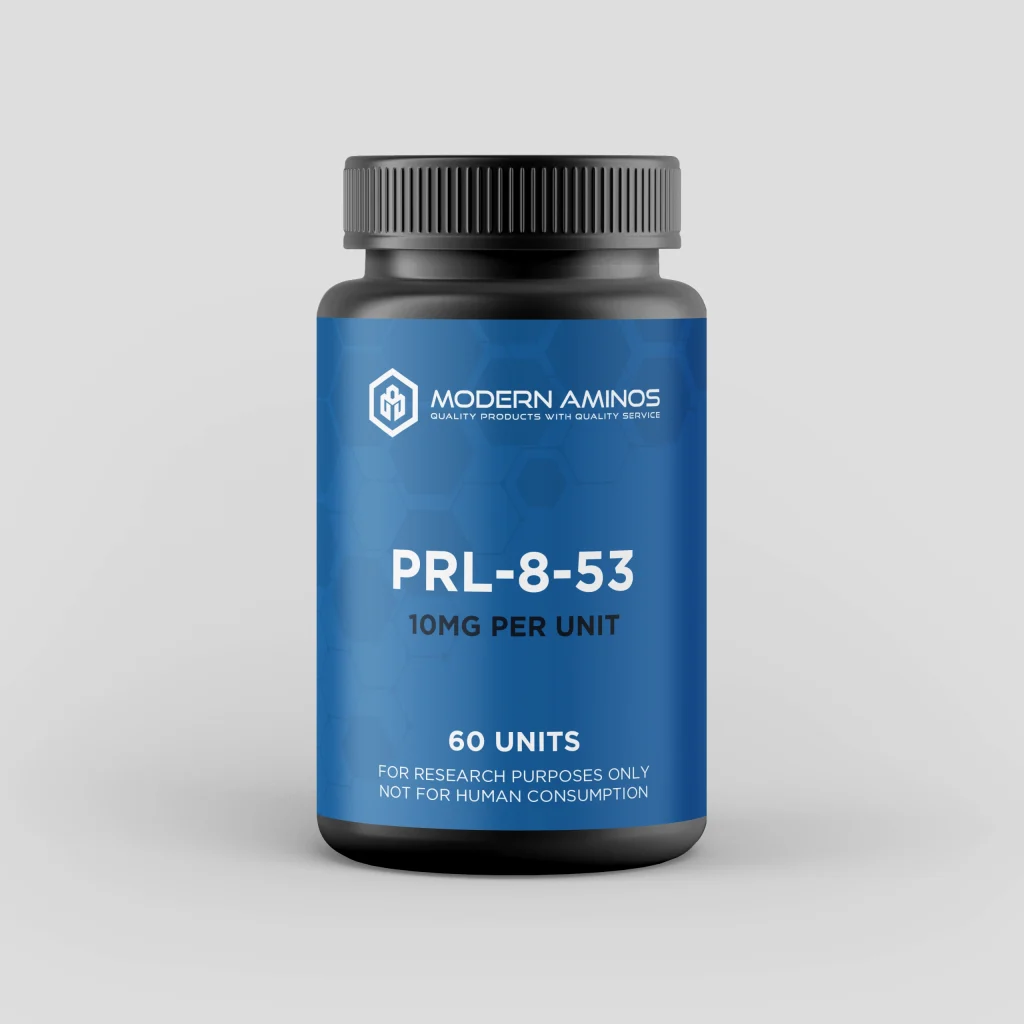
Is PRL-8-53 a Peptide?
Short answer: No. PRL-8-53 is a small-molecule ester, not a chain of amino acids. Chemically it is methyl 3-[2-[benzyl(methyl)amino]ethyl]benzoate, usually handled as its hydrochloride salt (CAS 51352-87-5; PubChem CID 70700868; 319.8 g/mol). It was introduced in 1974 as a new type of CNS-active compound, and its source patent classifies the series as cholinergic agents. If you need a documented lot, you can buy PRL-8-53 with a third-party certificate in the Certificate of Analysis tab.
That is the whole answer in a paragraph. Still, it is worth slowing down for a few minutes, because the phrase “PRL 8-53 peptide” turns up in searches often enough that the mix-up deserves a careful explanation. Once you can picture the molecule, the rest of the story falls into place quite naturally.
What is PRL-8-53, chemically speaking?
PRL-8-53 is a phenethylamine with two decorations. Start with a benzene ring. At one position, attach a two-carbon chain that ends in a nitrogen atom. That nitrogen carries a methyl group and a benzyl group, which makes it a tertiary amine. Then, at the meta position of the same ring (position 3, counting from the side chain), attach a methyl ester, a carbon double-bonded to oxygen and single-bonded to an O-CH3. PubChem lists the free base as CID 39989 (C18H21NO2, 283.4 g/mol) and the hydrochloride as CID 70700868 (C18H22ClNO2, 319.8 g/mol), with the IUPAC name methyl 3-[2-[benzyl(methyl)amino]ethyl]benzoate;hydrochloride (PubChem CID 70700868).
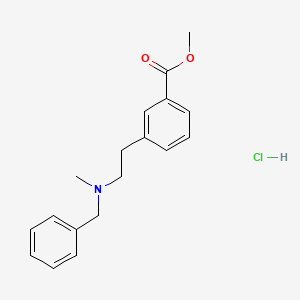
Look at the drawing and you can count the pieces: two benzene rings, one nitrogen, one ester, and a separate chloride ion sitting beside the molecule. That chloride is the “HCl” in PRL-8-53 HCl. It pairs with the nitrogen once the nitrogen picks up a proton, and that pairing gives the crystalline hydrochloride described in the original patent.
Why isn’t PRL-8-53 a peptide or an amino acid?
A peptide is a chain of amino acids linked by amide bonds, the same kind of bond that holds proteins together. An amino acid has an amine and a carboxylic acid on the same small backbone. PRL-8-53 has neither arrangement. Its nitrogen is a tertiary amine with no hydrogen to share in an amide bond, and its only carbonyl group is tied up as a methyl ester rather than an acid. There is no repeating backbone and no residue sequence to read.
So where does the peptide idea come from? Mostly from habit. Many research compounds sold alongside it are peptides, and short code names like PRL-8-53 sound like peptide catalog numbers. The chemistry, though, places it with small aromatic amines, not with peptides.
How was PRL-8-53 made? The patent route, step by step
The clearest chemistry record for PRL-8-53 is US Patent 3,870,715, granted to Nikolaus R. Hansl on March 11, 1975 (US 3,870,715). Its Example 1 reads like a good lab notebook:
- Make a Grignard reagent from m-trifluoromethylbromobenzene and react it with ethylene oxide to get 3-trifluoromethylphenethyl alcohol.
- Convert that alcohol to the chloride with thionyl chloride.
- Heat the chloride with benzylmethylamine to form N-benzyl-N-methyl-3-trifluoromethylphenethylamine.
- Heat that amine in concentrated sulfuric acid, which turns the CF3 group into a carboxylic acid, then reflux with methanol to make the methyl ester.
- Add HCl in ether to precipitate the hydrochloride, then recrystallize it. The patent reports white crystals melting at 150–151 °C.
Here is the clever part, the kind a chemistry teacher likes to point out. A carboxylic acid would wreck a Grignard reaction, so the route carries the future acid in disguise as a CF3 group, which the patent notes is relatively inert, and only unmasks it at the end.
Hydrochloride or free base: which numbers belong to which form?
Because PRL-8-53 is sold and described in two forms, it helps to keep their numbers side by side. The values below come from PubChem’s computed properties for each record and from the patent’s Example 1 (PubChem CID 39989; PubChem CID 70700868; US 3,870,715).
| Property | PRL-8-53 hydrochloride | PRL-8-53 free base |
|---|---|---|
| CAS number | 51352-87-5 | 51352-88-6 |
| PubChem CID | 70700868 | 39989 |
| Formula | C18H22ClNO2 | C18H21NO2 |
| Molecular weight | 319.8 g/mol | 283.4 g/mol |
| H-bond donors / acceptors | 1 / 3 | 0 / 3 |
| XLogP3 (computed) | not reported | 3.6 |
| Melting point | 150–151 °C | not reported |
What does this table tell us? The two forms are the same organic molecule; the hydrochloride simply adds one HCl, about 36.5 g/mol, and one hydrogen-bond donor on the protonated nitrogen. When a paper, label, or certificate quotes a molecular weight, check which form it means before you compare numbers.
How does PRL-8-53 work? What the record does and doesn’t say
Here we should be honest and plain. The 1974 note in Experientia introduced the hydrochloride as a new type of compound active in the central nervous system (Hansl, 1974), and the patent describes the whole ester series as cholinergic agents. Neither document names a receptor subtype or reports a binding constant, and no later binding study for PRL-8-53 is indexed in PubMed. Descriptions you may see of specific dopamine or serotonin receptor actions are not backed by a primary binding dataset. For an assay designer, that makes PRL-8-53 a classified but molecularly uncharacterized cholinergic reference compound, which is itself useful to know.
PRL-8-53 vs. Noopept: what’s the actual difference?
Noopept is the comparison many people reach for, and it makes the peptide question easy to see. Noopept is a dipeptide-derived ethyl ester built from L-Proline and Glycine units joined by amide bonds, so “peptide-derived” is a fair description of it. PRL-8-53 has no amino acid units at all. Both are esters, and both get grouped as nootropic research compounds, but one is built from amino acid pieces and the other is a phenethylamine benzoate.
PRL-8-53, PRL 8-53, and the long chemical names: sorting out the names
PRL-8-53 is a laboratory code name. PubChem also lists PRL 8-53, methyl 3-(2-(benzyl(methyl)amino)ethyl)benzoate hydrochloride, and the older style m-(2-(benzylmethylamino)ethyl)benzoic acid methyl ester hydrochloride (PubChem CID 70700868). The FDA’s substance registry assigns UNII 2P77XL8HV7 to the hydrochloride and BM2TE2XHK6 to the free base. The 1974 note lists its author at Creighton University and Pacific Research Laboratories in Santa Barbara, California. Whatever the label says, the CAS number tells you which form you are holding.
What formats is PRL-8-53 supplied in for research?
Modern Aminos lists one format on the PRL-8-53 product page: 10 mg dry-fill capsules, 60 units per capsule bottle. The lot certificate from Vanguard Laboratory reports an identity pass by HPLC-UV/VIS and per-unit quantity results, and it sits in the Certificate of Analysis tab.
Where PRL-8-53 sits among other Modern Aminos tools
If your panel is about cholinergic-classified small molecules and ester SAR, PRL-8-53 is the parent compound. If it is about monoamine release kinetics, BPAP is a different chemical story, and if it is about dopamine receptor binding with published affinities, see L-THP and its explainer, What Is L-THP?. For choline-pathway chemistry, the Alpha-GPC overview is a helpful companion, and for another “is it a peptide?” case, see Is ITPP a Peptide?. For why chromatographic certificates matter across all of these, see the HPLC testing note.
Frequently asked questions
Is PRL-8-53 a peptide?
No. PRL-8-53 is methyl 3-[2-[benzyl(methyl)amino]ethyl]benzoate, a small-molecule ester and tertiary amine, usually supplied as its hydrochloride. It has no amino acid residues and no peptide bonds.
What is PRL-8-53?
PRL-8-53 is a substituted aminoethyl meta-benzoic acid ester, CAS 51352-87-5 (hydrochloride), PubChem CID 70700868, introduced in 1974 as a CNS-active compound and classified in its source patent as a cholinergic agent.
Is PRL-8-53 HCl the same compound as PRL-8-53?
It is the same organic molecule in salt form. The hydrochloride (CAS 51352-87-5, 319.8 g/mol) adds one HCl to the free base (CAS 51352-88-6, 283.4 g/mol), so check which form a label or paper means.
What receptor does PRL-8-53 act on?
No receptor subtype or binding constant has been published for PRL-8-53. The original patent classifies its compound series as cholinergic, and no later binding study for PRL-8-53 is indexed in PubMed.
How is PRL-8-53 different from Noopept?
Noopept is a dipeptide-derived ester built from L-Proline and Glycine units joined by amide bonds. PRL-8-53 contains no amino acid units; it is a phenethylamine carrying a methyl benzoate ester.
References
- Hansl NR. A novel spasmolytic and CNS active agent: 3-(2-benzylmethylamino ethyl) benzoic acid methyl ester hydrochloride. Experientia. 1974;30(3):271-272. doi:10.1007/BF01934822 (PMID 4824605)
- Hansl NR. Substituted amino ethyl meta benzoic acid esters. US Patent 3,870,715. Granted March 11, 1975. US3870715A
- National Library of Medicine. PubChem Compound Summary for CID 70700868, Prl-8-53. PubChem CID 70700868
- National Library of Medicine. PubChem Compound Summary for CID 39989, Methyl 3-(2-(methyl(phenylmethyl)amino)ethyl)benzoate. PubChem CID 39989
PRL-8-53 is a modest molecule with a clear chemical story and a thin receptor story. Call it by its chemistry, a phenethylamine benzoate ester, keep track of which salt form you mean, and the rest of the work gets steadier.