
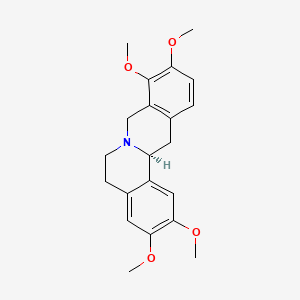
L-THP (Levo-tetrahydropalmatine / (S)-(−)-Tetrahydropalmatine) is the levorotatory enantiomer of a tetrahydroprotoberberine isoquinoline alkaloid and a dopamine receptor antagonist for monoamine receptor pharmacology research. By occupying dopamine D1, D2 and D3 receptors without activating them, L-THP blocks dopamine signaling at the receptor level, with its highest measured affinity at D1 (Ki 94 to 124 nM). CAS 483-14-7.
$39.00
In stock
| Quantity | Discounted Price |
|---|---|
| 4 - 6 | $37.44 |
| 7 - 9 | $36.66 |
| 10 + | $35.88 |



L-THP (levo-tetrahydropalmatine, also called (−)-tetrahydropalmatine, (S)-tetrahydropalmatine, and rotundine; CAS 483-14-7) is the levorotatory (13aS) enantiomer of tetrahydropalmatine, a tetrahydroprotoberberine isoquinoline alkaloid that occurs in Stephania and Corydalis species. It is a dopamine receptor antagonist reference compound with its highest affinity at the D1 receptor and lower affinity at D2 and D3. L-THP is a single small molecule (C21H25NO4, 355.43 g/mol), not a peptide or a blend, even though many searches pair it with words like supplement or tablets. Its receptor activity depends on stereochemistry: the levo form binds dopamine receptors, while the dextro form showed no D2 affinity in radioligand assays (Xu et al., 1989).
In a receptor screen summarized by Wang and Mantsch, L-THP bound dopamine D1 receptors with a Ki of 124 nM, D2 with 388 nM, D3 with 1,420 nM, and serotonin 5-HT1A with 340 nM (Wang and Mantsch, 2012, PMC3878639). A separate radioligand study measured a D1 Ki of 94 nM for pure l-THP versus 1,293 nM for a 3:1 d:l tetrahydropalmatine mixture (Ma et al., 2008, PMC6245449). What L-THP does at the receptor level is occupy dopamine binding sites without activating them, with the tightest binding at D1.
Batch-verified at Modern Aminos, L-THP is supplied in one laboratory format:
Laboratories building dopaminergic and monoamine receptor assay panels often place L-THP next to other public reference listings such as Bromantane, 9-Me-BC, and NSI-189 Phosphate, as well as Nooglutyl. For a closer look at what L-THP is and why its stereochemistry matters, see What Is L-THP? Levo-Tetrahydropalmatine Explained.
| Compound Name | L-THP (Levo-tetrahydropalmatine) |
|---|---|
| Research Category | Dopamine receptor antagonist (D1 > D2 > D3); tetrahydroprotoberberine isoquinoline alkaloid; monoamine receptor pharmacology and cognitive research reference compound |
| Quantity / Formats Offered | 50 mg Dry-Fill Capsules (60 Units per Capsule Bottle) |
| Synonyms / Alt Names | Levo-tetrahydropalmatine, l-tetrahydropalmatine, (−)-tetrahydropalmatine, (S)-tetrahydropalmatine, (S)-(−)-tetrahydropalmatine, l-THP, rotundine, (−)-rotundine, gindarine, hyndarine, caseanine, (−)-corydalis B |
| CAS Number | 483-14-7 (levo enantiomer) | 2934-97-6 (racemic dl-THP) | 3520-14-7 (dextro d-THP) |
| PubChem CID | 72301 |
| ChEBI ID | CHEBI:16563 |
| UNII | 3X69CO5I79 |
| Chemical Formula | C21H25NO4 |
| Molecular Weight | 355.43 g/mol |
| Exact Mass | 355.1784 Da |
| Stereochemistry | One stereocenter (C13a), S configuration; levorotatory (−) |
| IUPAC Name | (13aS)-2,3,9,10-tetramethoxy-6,8,13,13a-tetrahydro-5H-isoquinolino[2,1-b]isoquinoline |
| InChIKey | AEQDJSLRWYMAQI-KRWDZBQOSA-N |
| SMILES Code | COC1=C(C2=C(C[C@H]3C4=CC(=C(C=C4CCN3C2)OC)OC)C=C1)OC (isomeric) |
Identity fields are drawn from PubChem CID 72301 and ChEBI; purity and quantity values come from the lot certificates in the Certificate of Analysis tab.
The receptor targets and binding logic of L-THP in laboratory research include:
| Assay Parameter | L-THP | THP, 3:1 d:l mixture | Source |
|---|---|---|---|
| Ki, dopamine D1 (receptor screen) | 124 ± 6 nM | not reported | Wang and Mantsch 2012, Table 1 |
| IC50, dopamine D1 | 166 ± 8 nM | not reported | Wang and Mantsch 2012, Table 1 |
| Ki, dopamine D1 ([3H]SCH 23390, recombinant receptor) | 94 ± 9 nM | 1,293 ± 71 nM | Ma 2008, Table 2 |
| Ki, dopamine D2 | 388 ± 78 nM | not reported | Wang and Mantsch 2012, Table 1 |
| IC50, dopamine D2 | 1,470 ± 270 nM | not reported | Wang and Mantsch 2012, Table 1 |
| Ki, dopamine D3 | 1,420 ± 220 nM | not reported | Wang and Mantsch 2012, Table 1 |
| Ki, serotonin 5-HT1A | 340 ± 63 nM | not reported | Wang and Mantsch 2012, Table 1 |
| α1 and α2A adrenergic binding at 10 µM | >50% inhibition (Ki not determined) | not reported | Wang and Mantsch 2012, Table 1 |
Peer-reviewed literature on L-THP (Levo-tetrahydropalmatine) and the tetrahydroprotoberberine scaffold centers on receptor binding, stereochemistry, and structure–activity relationships:
To map dopamine receptor binding, stereoselectivity, and scaffold structure–activity, researchers compare L-THP against its own enantiomers, close tetrahydroprotoberberine analogs, and other dopamine-system reference compounds, including several available at Modern Aminos:
| Compound / Reference | Primary Target Class | Core Mechanism of Action | Research Focus & Profile |
|---|---|---|---|
| L-THP (Levo-tetrahydropalmatine) | Dopamine D1, D2, D3; 5-HT1A binding | Dopamine receptor antagonist; (13aS) levo enantiomer with all four ring positions methoxylated | Receptor occupancy panels with published Ki values; stereoselectivity controls |
| Racemic dl-THP (CAS 2934-97-6) | Same receptor family, diluted by the dextro form | 1:1 mixture of levo and dextro enantiomers; dopamine receptor activity resides in the levo form | Enantiomer comparison; a 3:1 d:l sample bound D1 at 1,293 nM vs 94 nM for l-THP |
| d-THP, (+)-tetrahydropalmatine (CAS 3520-14-7) | No D2 affinity in radioligand assays | (13aR) dextro enantiomer | Negative-control enantiomer for stereoselectivity work |
| l-Isocorypalmine | Dopamine D1 | 2-hydroxy analog prepared from l-THP by selective C-2 demethylation | D1 Ki 83 nM; structure–affinity comparison with l-THP |
| l-Stepholidine (l-SPD) | Dopamine D1 and D2 | 2,10-dihydroxy tetrahydroprotoberberine; hydroxyl pattern linked to D1 agonist intrinsic activity | D1 Ki 6.23 nM, D2 Ki 56.17 nM; scaffold SAR reference |
| Bromantane | Dopamine-system research compound | Adamantane amine, N-(4-bromophenyl)adamantan-2-amine | Different scaffold for comparisons outside the isoquinoline class |
Sources for the rows above: enantiomer data from Xu et al., 1989 and Ma et al., 2008; l-isocorypalmine from Ma et al., 2008; l-stepholidine affinities from Qian et al., 2012 and its hydroxyl pattern from Xu et al., 1989 and Guo et al., 1997; racemate and dextro CAS numbers from PubChem CID 5417 and PubChem CID 969488.
Modern Aminos supplies L-THP as 50 mg dry-fill capsules, 60 units per capsule bottle, with lot certificates from Vanguard Laboratory, an A2LA-accredited lab. The raw powder (lot LT2510A) lists 99.70% (± 0.18%) chromatographic purity by HPLC-UV/VIS, and the capsules (lot BX-C-A1B5) list per-capsule HPLC-UV/VIS quantity values of 56.20, 47.01, and 49.88 mg. If you want to buy l-tetrahydropalmatine (levo-tetrahydropalmatine) with its lot certificates, each one is in the Certificate of Analysis tab.
L-THP is the levorotatory (13aS) enantiomer of tetrahydropalmatine, a tetrahydroprotoberberine isoquinoline alkaloid with the formula C21H25NO4 and four methoxy groups at positions 2, 3, 9, and 10. It is a single small molecule of 355.43 g/mol, not a peptide or a blend. For a plain-language walk through its structure and stereochemistry, see What Is L-THP? Levo-Tetrahydropalmatine Explained.
Searches often pair L-THP with words like supplement or tablets, but Modern Aminos lists it as a research chemical: a characterized alkaloid reference compound with a CAS number (483-14-7), a PubChem record (CID 72301), and lot certificates. It is supplied as 50 mg dry-fill capsules, not pressed tablets.
L-THP targets dopamine receptors. In a published binding panel it showed Ki values of 124 nM at D1, 388 nM at D2, and 1,420 nM at D3 (Wang and Mantsch, 2012). Its function at D1 and D2 is antagonism: it occupies the receptor without producing a dopamine-like signal.
Two readouts are used. Radioligand displacement measures affinity, for example L-THP displacing [3H]SCH 23390 from the D1 receptor with a Ki of 94 nM (Ma et al., 2008). Functional assays then classify the binding: L-THP produces minimal cAMP stimulation relative to dopamine at D1, which defines it as an antagonist rather than an agonist (Wang and Mantsch, 2012).
Beyond dopamine receptors, L-THP binds serotonin 5-HT1A receptors with a Ki of 340 nM and shows more than 50% inhibition at α1 and α2A adrenergic receptors at 10 µM (Wang and Mantsch, 2012). At the GABAA receptor, tetrahydropalmatine was one of five type 2 protoberberine alkaloids that increased specific [3H]BMC binding by 21 to 49% in radioreceptor assays (Halbsguth et al., 2003).
They share one formula but differ at the C13a stereocenter. In radioligand assays, d-THP showed no affinity for the D2 receptor while l-THP behaved as a dopamine receptor antagonist (Xu et al., 1989), and a 3:1 d:l tetrahydropalmatine mixture bound D1 about 14 times more weakly than pure l-THP (1,293 nM vs 94 nM; Ma et al., 2008). Racemic dl-THP is CAS 2934-97-6 and d-THP is CAS 3520-14-7, while L-THP is CAS 483-14-7.
Usually, but check the record. ChEBI lists rotundine and (−)-rotundine as synonyms of levo-tetrahydropalmatine (CHEBI:16563), while the PubChem record titled Rotundine (CID 5417) has no defined stereocenter and carries the racemic CAS number 2934-97-6. Matching the CAS number and InChIKey is the reliable way to confirm the levo form.
L-THP is offered in one laboratory format: 50 mg dry-fill capsules, 60 units per capsule bottle (SKU C-047). The capsule lot and the raw powder lot each have a certificate in the Certificate of Analysis tab.
Both sit in Modern Aminos’ cognitive compound catalog, but they come from different chemical families. Bromantane is an adamantane amine (N-(4-bromophenyl)adamantan-2-amine), while L-THP is a tetrahydroprotoberberine isoquinoline alkaloid with a published receptor binding panel. Researchers reach for L-THP when the question is receptor occupancy at dopamine D1, D2, and D3 with measured Ki values.
The Vanguard Laboratory certificates report chromatographic purity of the raw powder by HPLC-UV/VIS (99.70%, lot LT2510A, reported 11/25/2025) and the quantity in three capsules by HPLC-UV/VIS (56.20, 47.01, and 49.88 mg, lot BX-C-A1B5, reported 3/16/2026). Identity descriptors on this page (CAS 483-14-7, InChIKey AEQDJSLRWYMAQI-KRWDZBQOSA-N, and the (13aS) IUPAC name) are matched to PubChem and ChEBI.
Keep L-THP capsule bottles tightly sealed in a cool, dry place away from direct light and moisture. Follow the label on each lot.
Capsule products are not intended for time-release and are for transport only.
DISCLAIMER: All compounds and research materials provided by Modern Aminos are strictly for laboratory and research use only. They are not approved for human consumption by the Food and Drug Administration (FDA). No products are approved for oral, sublingual, nor in vivo use. These products should not be used for any form of in vivo experimentation or for any other non-laboratory purpose. Any violation or indication of human or animal use will result in immediate removal from being able to purchase products in the future. By purchasing these products, you acknowledge that they will be used exclusively within a controlled and qualified research environment.
