
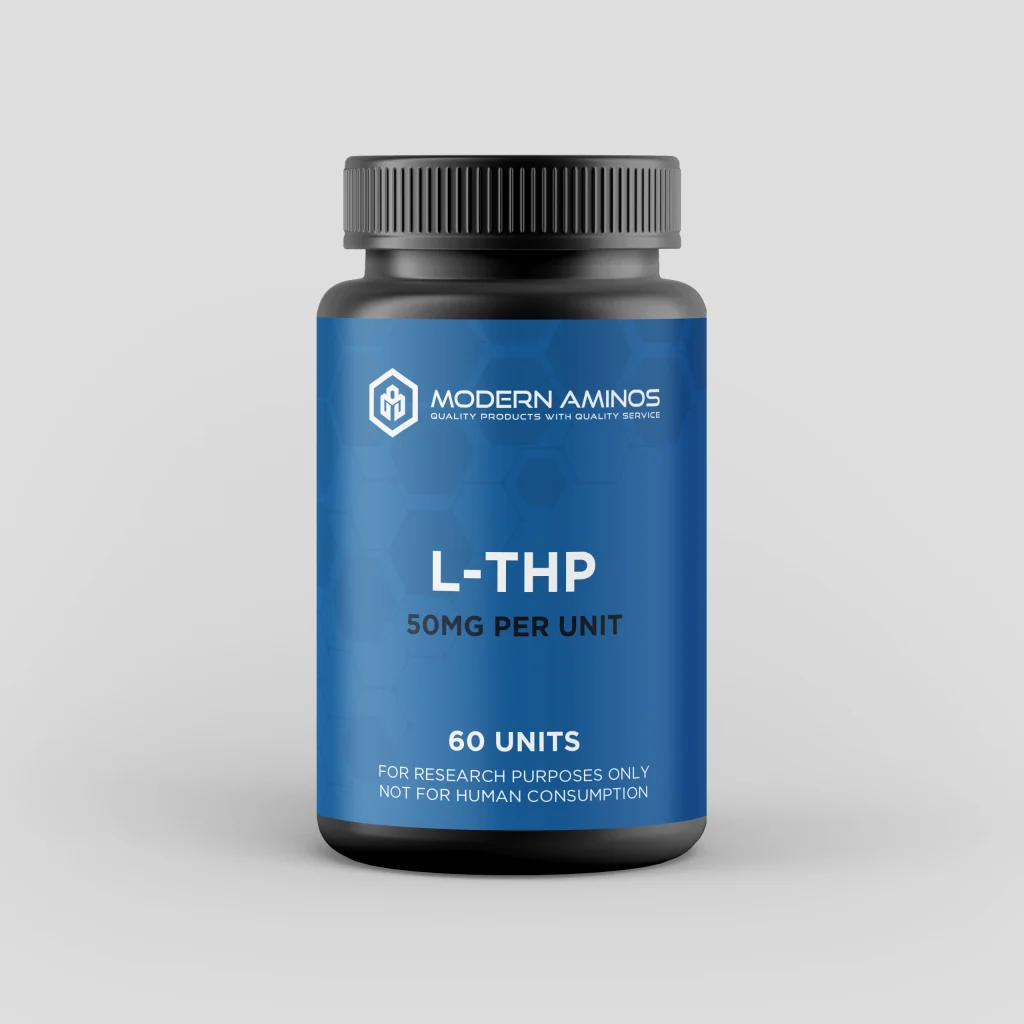
Short answer: L-THP is levo-tetrahydropalmatine (CAS 483-14-7), the left-handed, or (S), form of a small isoquinoline alkaloid found in Stephania and Corydalis plants. It weighs 355.43 g/mol, carries four methoxy groups on a four-ring tetrahydroprotoberberine scaffold, and is studied as a dopamine receptor antagonist with its tightest binding at the D1 receptor. To buy L-THP as a documented reference compound, Modern Aminos supplies it as 50 mg dry-fill capsules with third-party certificates.
That is the whole answer in one paragraph. But the little letter L at the front of the name is doing more work than it seems to, and it is worth taking a few minutes to see why. Once the shape of the molecule is clear, the receptor data makes a lot more sense.
What is L-THP, chemically speaking?
Start with the parent compound, tetrahydropalmatine. It belongs to a family chemists call tetrahydroprotoberberines: four rings fused together, with a nitrogen atom tucked into the middle. Its formula is C21H25NO4, and it has four methoxy groups (a methyl attached through an oxygen) sitting at ring positions 2, 3, 9, and 10 (Du et al., 2022). If you start from palmatine and add hydrogen across its unsaturated ring, you arrive at this same skeleton.
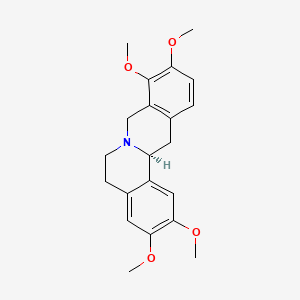
Here is the important part. One carbon in that skeleton, called C13a, holds four different neighbors, so the molecule can be built in two mirror-image arrangements, much like a left and a right glove. PubChem files the left-handed form as (−)-tetrahydropalmatine, CID 72301, with the systematic name (13aS)-2,3,9,10-tetramethoxy-6,8,13,13a-tetrahydro-5H-isoquinolino[2,1-b]isoquinoline and the InChIKey AEQDJSLRWYMAQI-KRWDZBQOSA-N (PubChem). ChEBI agrees, listing an average mass of 355.43 and the names levo-tetrahydropalmatine, l-tetrahydropalmatine, and (S)-(−)-tetrahydropalmatine (ChEBI). That left-handed form is L-THP.
Why does the L in L-THP matter?
Because the two mirror images do not behave the same way at a receptor. The L here stands for levorotatory, meaning a solution of the compound rotates polarized light to the left. It has nothing to do with the L in L-amino acids, and L-THP is not a peptide or an amino acid.
Receptors are three-dimensional pockets, and a left glove does not fit a right hand. In radioligand studies of twelve tetrahydroprotoberberines, the levo forms behaved as dopamine receptor antagonists, while d-tetrahydropalmatine, the right-handed form, showed no affinity for the D2 receptor. The authors concluded that the levo configuration is needed for affinity at dopamine receptors (Xu et al., 1989).
How does L-THP work? Dopamine receptors, step by step
Think of a receptor as a lock and dopamine as the key that turns it. An antagonist is a key that slides into the lock but will not turn. It sits there, and while it does, dopamine cannot get in.
Dopamine receptors come in two broad families: the D1-like receptors (D1 and D5) and the D2-like receptors (D2, D3, and D4). Researchers measure how tightly a compound sits in each lock by watching it push a radioactive tracer out of the receptor. For D1, that tracer is often [3H]SCH 23390. The result is reported as a Ki, and a smaller number means a tighter fit. Levo tetrahydroprotoberberines show preferential affinity toward D1 over D2 in this kind of work (Xu et al., 1989). The L-THP product page lists the full published binding panel, including D2, D3, and serotonin 5-HT1A values.
How do the L and D forms compare in binding data?
A 2008 study from Corydalis yanhusuo gives an unusually clean side-by-side view. The team isolated eight alkaloids, measured the d:l ratio of each chiral one by chiral HPLC, and then tested binding at the D1 receptor (Ma et al., 2008):
| Alkaloid | d:l isomer ratio | D1 Ki |
|---|---|---|
| l-THP (levo-tetrahydropalmatine) | 0:1 | 94 ± 9 nM |
| Tetrahydropalmatine, isolated sample | 3:1 | 1,293 ± 71 nM |
| l-Isocorypalmine | 0:1 | 83 ± 5 nM |
| Stylopine | 1:10 | 1,043 ± 66 nM |
| Corydaline | 10:1 | >10,000 nM |
What this tells us is simple and striking. Pure l-THP bound D1 at 94 nM. A tetrahydropalmatine sample that was three parts d to one part l bound at 1,293 nM, roughly fourteen times weaker. The same molecule, flipped at one carbon, loses most of its grip. The authors also found that the d:l ratio of isolated tetrahydropalmatine shifted from 3:1 to 1:1 between extract batches, and they noted that quality control of the active optical isomer is important (Ma et al., 2008).
L-THP vs. l-isocorypalmine and l-stepholidine: what’s the actual difference?
These are close cousins that differ in which ring positions carry a hydroxyl (–OH) group instead of a methoxy group. l-Isocorypalmine is l-THP with the methoxy at C-2 turned into a hydroxyl; the 2008 team made it from l-THP in one step and measured a D1 Ki of 83 nM (Ma et al., 2008). l-Stepholidine carries hydroxyls at C2 and C10 (Xu et al., 1989), and a later study reported Ki values of 6.23 nM at D1 and 56.17 nM at D2 for it (Qian et al., 2012).
The lesson is that small edits to the same ring system move binding strength a long way. Swapping one methoxy for a hydroxyl barely changed D1 affinity in the 2008 data, while l-stepholidine, with two hydroxyls, was reported in a separate study to bind far more tightly at both D1 and D2. L-THP, with methoxy groups at all four positions, is the fully capped member of the set, which makes it a useful baseline when the other analogs are compared.
Where do the names rotundine and gindarine come in?
Older literature and catalogs use several names for the same molecule. ChEBI lists rotundine, (−)-rotundine, gindarine, hyndarine, and caseanine as synonyms of levo-tetrahydropalmatine (ChEBI). Here is the catch: PubChem’s record titled Rotundine, CID 5417, has no defined stereocenter and carries the racemic CAS number 2934-97-6, while the right-handed form sits under CID 969488 with CAS 3520-14-7 (PubChem CID 5417). So when a name is ambiguous, the CAS number and InChIKey are the reliable way to know which form you have. For L-THP, that is CAS 483-14-7.
What formats is L-THP supplied in for research?
Modern Aminos supplies L-THP as 50 mg dry-fill capsules, 60 units per bottle. The certificates come from Vanguard Laboratory, an A2LA-accredited lab: the raw powder lists 99.70% chromatographic purity by HPLC-UV/VIS, and three capsules list 56.20, 47.01, and 49.88 mg by HPLC-UV/VIS. Both are in the Certificate of Analysis tab on the L-THP product page. Because the name tetrahydropalmatine can point to either enantiomer or a mixture, the CAS number on the label is worth a second look.
Where L-THP sits among other dopamine research tools
L-THP is a receptor-level tool: it tells you what happens when dopamine receptors are occupied. Other compounds in the same catalog come from very different chemical families, such as Bromantane, an adamantane amine, and 9-Me-BC, a β-carboline. Comparing scaffolds like these is one way to separate what belongs to the receptor from what belongs to the molecule. If you want to see how another receptor family is mapped one subtype at a time, read Melanocortin Receptors Explained. And because a chiral compound is only as good as its analysis, the note on why HPLC testing matters is a useful companion.
Frequently asked questions
What is L-THP?
L-THP is levo-tetrahydropalmatine (CAS 483-14-7), the (S) enantiomer of tetrahydropalmatine. It is a small isoquinoline alkaloid of 355.43 g/mol that is studied as a dopamine receptor antagonist with its highest measured affinity at the D1 receptor.
Is L-THP the same as tetrahydropalmatine?
L-THP is one of the two mirror-image forms of tetrahydropalmatine. Plain tetrahydropalmatine can mean the levo form, the dextro form, or a mixture, so the CAS number (483-14-7 for the levo form) tells you which one is meant.
Which receptor does L-THP bind most tightly?
The dopamine D1 receptor. Radioligand binding measured a Ki of 94 nM for pure l-THP at D1, compared with 1,293 nM for a 3:1 mixture of the d and l forms.
Is rotundine the same as L-THP?
Often, but not always. ChEBI lists rotundine as a synonym of levo-tetrahydropalmatine, while the PubChem record titled Rotundine has no defined stereocenter and carries the racemic CAS number 2934-97-6.
How are the L and D forms of tetrahydropalmatine told apart?
By chiral chromatography. Chiral HPLC columns such as cellulose tris(3,5-dimethylphenylcarbamate) phases separate the two enantiomers into distinct peaks, which is how d:l ratios are measured.
References
- Ma ZZ, Xu W, Jensen NH, Roth BL, Liu-Chen LY, Lee DY. Isoquinoline alkaloids isolated from Corydalis yanhusuo and their binding affinities at the dopamine D1 receptor. Molecules. 2008;13(9):2303-2312. PMC6245449
- Xu SX, Yu LP, Han YR, Chen Y, Jin GZ. Effects of tetrahydroprotoberberines on dopamine receptor subtypes in brain. Zhongguo Yao Li Xue Bao. 1989;10(2):104-110. PubMed 2530755
- Qian W, Lu W, Sun H, et al. Design, synthesis, and pharmacological evaluation of novel tetrahydroprotoberberine derivatives: selective inhibitors of dopamine D1 receptor. Bioorg Med Chem. 2012;20(15):4862-4871. PubMed 22748706
- Zhai ZD, Shi YP, Wu XM, Luo XP. Chiral high-performance liquid chromatographic separation of the enantiomers of tetrahydropalmatine and tetrahydroberberine, isolated from Corydalis yanhusuo. Anal Bioanal Chem. 2006;384(4):939-945. PubMed 16402177
- Du Q, Meng X, Wang S. A comprehensive review on the chemical properties, plant sources, pharmacological activities, pharmacokinetic and toxicological characteristics of tetrahydropalmatine. Front Pharmacol. 2022;13:890078. PMC9086320
- PubChem. (−)-Tetrahydropalmatine, CID 72301; Rotundine, CID 5417; (+)-Tetrahydropalmatine, CID 969488. National Library of Medicine. CID 72301
- ChEBI. Tetrahydropalmatine, CHEBI:16563. EMBL-EBI. CHEBI:16563
A single carbon atom, turned one way or the other, decides whether this molecule fits its receptor. L-THP is a quiet reminder that in chemistry, shape is part of identity, and it rewards anyone who takes the time to look closely at the letter in front of the name.