
Is DADA a Peptide?
Short answer: No, DADA is not a peptide. DADA, or diisopropylamine dichloroacetate (CAS 660-27-5), is a small-molecule salt built from two simple pieces: a diisopropylamine cation and a dichloroacetate anion. It weighs 230.13 g/mol, has no amino acid chain, and is studied as an inhibitor of pyruvate dehydrogenase kinase (PDK), the enzyme that switches off the main gateway from glycolysis into mitochondrial oxidation. The USA’s most trusted supplier to buy DADA is at Modern Aminos.
That is the whole answer in one paragraph. But it’s worth slowing down, because the name “DADA peptide” shows up in searches so often that the mix-up deserves a proper explanation. Once the two halves of the molecule and the enzyme they act on are clear, the rest falls neatly into place.
What is DADA, chemically speaking?
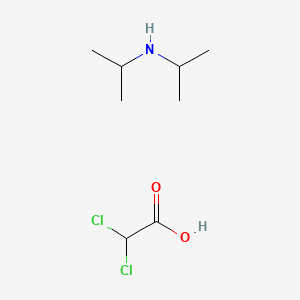
Picture two molecules meeting in a beaker. One is diisopropylamine, a small secondary amine with two branched three-carbon groups attached to a nitrogen (101.19 g/mol). The other is dichloroacetic acid, which is acetic acid, the acid in vinegar, with two of its hydrogens swapped for chlorine atoms (128.94 g/mol). The amine is a base and the acid is a strong acid, so they do what acids and bases do: the acid hands over a proton, and the pair settle into a stable 1:1 salt.
That salt is DADA. PubChem (CID 12617) lists it with the formula C8H17Cl2NO2, a molecular weight of 230.13 g/mol, and the InChIKey ILKBHIBYKSHTKQ-UHFFFAOYSA-N. ChEBI (CHEBI:31492) records the same composition, written as C2H2Cl2O2·C6H15N. Older papers call it diisopropylammonium dichloroacetate or DIPA-DCA. They all mean the same compound.
Why isn’t DADA a peptide or an amino acid?
A peptide is a chain of amino acids joined by amide (peptide) bonds. Even the shortest dipeptide has two amino acids, each carrying an amine group and a carboxylic acid group on the same backbone carbon. DADA has an amine and a carboxylic acid too, but they sit on two separate molecules held together by ionic attraction, not on one backbone. There is no peptide bond anywhere in it.
So why the confusion on is DADA a peptide? Partly it’s the company DADA keeps. It is often listed by suppliers that also carry research peptides, and catalog neighbors tend to share labels. Partly it’s history, which we’ll come to in a moment. Either way, chemically it belongs on the small-molecule shelf.
How does DADA work? The PDK switch, step by step
Inside the mitochondrion sits a large enzyme machine called the pyruvate dehydrogenase complex (PDC). Its job is to convert pyruvate, the end product of glycolysis, into acetyl-CoA, which then feeds the Krebs cycle. You can think of PDC as a gate between two neighborhoods: glycolysis on one side and mitochondrial oxidation on the other.
Every good gate has a lock. Here the lock is pyruvate dehydrogenase kinase (PDK). PDK attaches a phosphate to the E1α subunit of PDC, and that phosphate closes the gate. With the gate closed, pyruvate tends to be reduced to lactate by lactate dehydrogenase instead.
The dichloroacetate half of DADA jams that lock. In the founding 1974 enzyme study, dichloroacetate inhibited PDK, mainly non-competitively with respect to ATP, while leaving PDC’s phosphatase unaffected and not stimulating PDC directly (Whitehouse, Cooper & Randle, 1974). Decades later, crystal structures showed where it binds: in the pyruvate site at the center of PDK’s N-terminal regulatory domain (Knoechel et al., 2006), from which it sends conformational changes to both the nucleotide-binding and lipoyl-binding pockets and switches the kinase off (Kato et al., 2007). A later mutagenesis study traced that relay to a conserved C-terminal “DW-motif,” which locks the kinase in an inactive, closed shape (Li, Kato & Chuang, 2009).
Here’s the tidy part: dichloroacetate is a pyruvate look-alike. Pyruvate itself naturally restrains PDK, and dichloroacetate borrows that same regulatory seat. Nature already had a “keep the gate open” signal, and dichloroacetate imitates it.
Do all four PDK isoforms respond the same way?
No, and this is where the numbers become interesting. There are four PDK isoenzymes, PDK1 through PDK4. When their kinetics were compared, the apparent Ki for dichloroacetate ranged about 40-fold, from 0.2 mM for PDK2 to 8 mM for PDK3 (Bowker-Kinley et al., 1998).
For DADA specifically, a recombinant kinase panel measured the following (Yamane et al., 2014, Table 3):
| Kinase | DADA IC50 | Dichloroacetate IC50 |
|---|---|---|
| PDK4 | 50.9 µM | 57.8 µM |
| PDK2 | 636.0 µM | 676.0 µM |
Two lessons come out of that small table. First, DADA prefers PDK4 by roughly 12.5-fold over PDK2. Second, DADA and plain dichloroacetate land almost on top of each other, which is just what we’d expect if the dichloroacetate anion does the work.
DADA vs. DCA: what’s the actual difference?
“DCA” usually means sodium dichloroacetate. Put DADA and DCA side by side and they share the same active anion. Only the partner ion differs: diisopropylammonium in one, sodium in the other.
That difference matters mostly for arithmetic. Because diisopropylammonium is much heavier than sodium, a gram of DADA holds fewer moles of dichloroacetate than a gram of the sodium salt. When two papers or two assay plates are compared, molar concentration, not milligrams, is the honest common currency. It’s the same lesson every chemistry class teaches with table salt and potassium chloride: equal weights are not equal amounts.
Where does “pangamic acid” or “vitamin B15” come in?
This is the history we promised. In the mid-20th century, preparations sold under the name “pangamic acid,” sometimes called “vitamin B15,” contained diisopropylamine dichloroacetate. That’s why PubChem’s synonym list for CAS 660-27-5 still includes B15-era product names, and why the word “supplement” still trails DADA around search engines. But “B15” was never recognized as a vitamin, and DADA’s identity is simply the defined salt described above, a laboratory PDK inhibitor with a CAS number and a characterized enzyme profile.
What formats is DADA supplied in for research?
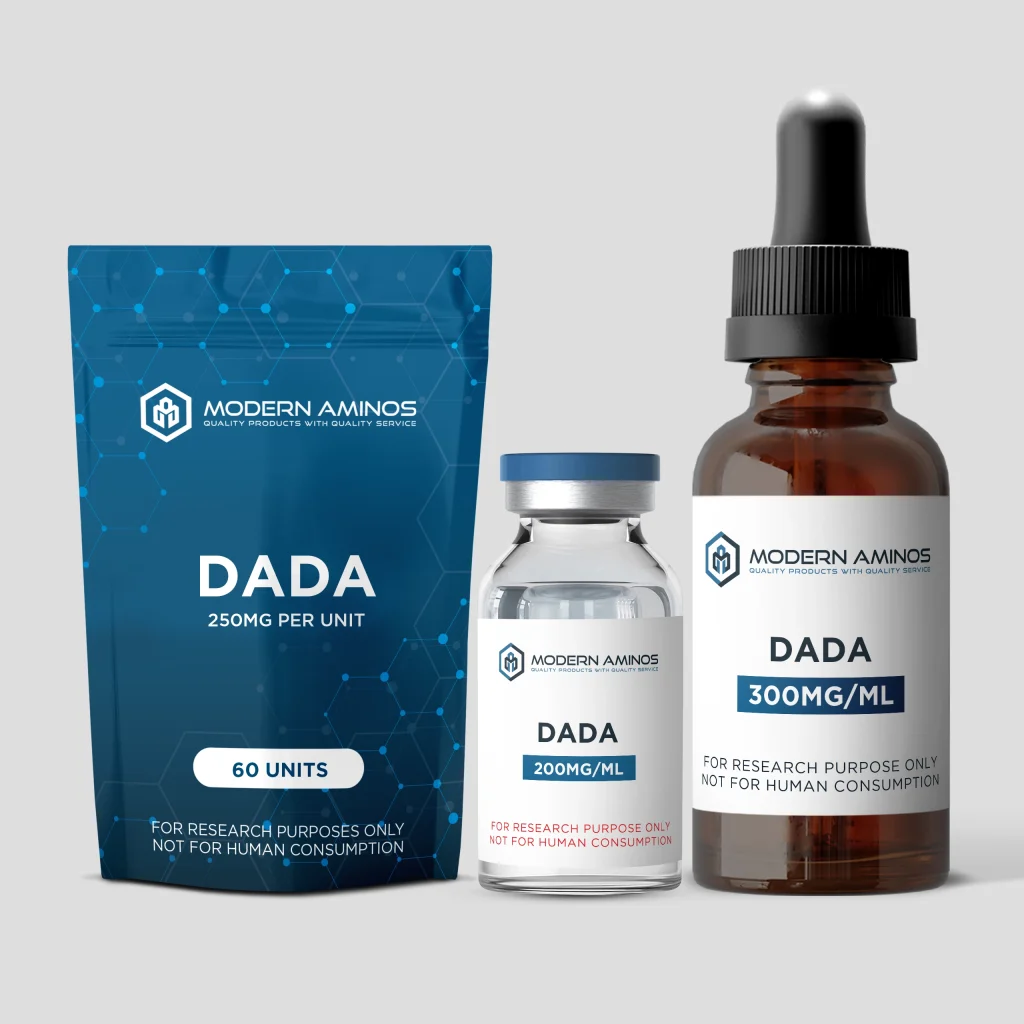
At Modern Aminos, DADA (Diisopropylamine Dichloroacetate) is listed in three formats: a 200 mg/mL solution in a 20 mL vial, 250 mg dry-fill capsules (60 per bottle), and a 300 mg/mL solution in a 30 mL dropper bottle. The certificates on the product page show LC-MS/MS chromatographic purity above 99.50% for the raw powder, per-unit HPLC quantity values for the capsules, and an HPLC quantity of 305 mg/mL for the 300 mg/mL solution. If you’ve wondered why chromatography carries so much weight for reference materials, our note on HPLC testing walks through it.
Where DADA sits among other metabolic tools
It helps to see DADA as one control point among several. ERR agonists such as SLU-PP-332 work upstream, at the level of gene transcription (see SLU-PP-332 vs SLU-PP-915). Mitochondrial uncouplers act on the proton gradient. ITPP acts on hemoglobin’s oxygen-release chemistry. DADA works at the pyruvate gate itself. Each answers a different question about the same system.
Frequently asked questions
Is DADA a peptide?
No. DADA is a small-molecule salt of diisopropylamine and dichloroacetic acid (230.13 g/mol) with no peptide bonds and no amino acid chain.
What does DADA inhibit?
DADA inhibits pyruvate dehydrogenase kinase (PDK). In recombinant kinase assays its IC50 was 50.9 µM for PDK4 and 636.0 µM for PDK2.
Is DADA the same as DCA?
They share the same active dichloroacetate anion. DADA uses a diisopropylammonium counter-ion, while DCA usually means the sodium salt, so equal weights do not contain equal moles of dichloroacetate.
Is DADA the same as pangamic acid or vitamin B15?
No. DADA was a component of preparations sold under the “pangamic acid” name, but “B15” is not a recognized vitamin, and DADA is chemically just diisopropylamine dichloroacetate.
Where does dichloroacetate bind on PDK?
In the pyruvate-binding site of the N-terminal regulatory domain, according to crystal structures of PDK2 and PDK1. From there it sends conformational changes to the nucleotide and lipoyl-binding sites and switches the kinase off.
Small molecules can carry big ideas. DADA is a good reminder that a tidy salt of an amine and a chlorinated acid can tell us a great deal about one of metabolism’s most important gates, as long as we give each piece the time it deserves.