
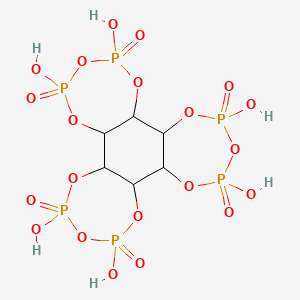
ITPP (Myo-inositol trispyrophosphate / hexasodium myo-inositol 1,6:2,3:4,5-trispyrophosphate) is a membrane-permeant inositol phosphate and hemoglobin allosteric effector for oxygen-affinity (P50) research. By binding hemoglobin and stabilizing the low-affinity T-state, ITPP right-shifts the oxygen-hemoglobin dissociation curve in laboratory assays. CAS 802590-64-3 (free acid); hexasodium salt CAS 23103-35-7.
Price range: $134.00 through $189.00



ITPP (myo-inositol trispyrophosphate, also called inositol trispyrophosphate and OXY-111A; CAS 802590-64-3 for the free acid) is a synthetic cyclic myo-inositol phosphate in which three pyrophosphate bridges close the inositol ring system. It is a membrane-permeant allosteric effector of hemoglobin used in oxygen-affinity (P50) research. ITPP is not a peptide and not an amino acid, even though many searches call it an “ITPP peptide.” The activity of interest in laboratory assays comes from hemoglobin binding that stabilizes the low-affinity T-state and right-shifts the oxygen-hemoglobin dissociation curve.
Founding work showed that ITPP salts bind free hemoglobin and, to a measurable extent, cross the red blood cell plasma membrane, lowering hemoglobin’s affinity for oxygen and shifting oxy-hemoglobin dissociation curves toward higher oxygen partial pressures (Fylaktakidou et al., 2005, PMID 15745806). Later permeation work mapped uptake through band 3 and reported a dissociation constant of 1.72×10⁻⁵ M for ITPP binding to RBC ghosts, with a maximum intracellular concentration of 5.5×10⁻³ M by ion chromatography (Duarte et al., 2010, PMID 21086482). What ITPP does at the hemoglobin level is lower O2 affinity in a concentration- and pH-sensitive way that remains additive to the Bohr effect in published Hemox-Analyzer assays (Evans et al., 2021, PMID 33242840).
Batch-verified at Modern Aminos, ITPP is supplied in 2 laboratory formats:
Laboratories building oxygen-affinity and mitochondrial-metabolism assay panels often place ITPP next to other public reference listings such as DADA and Bromantane, as well as AICAR, GW-501516, SLU-PP-332, and BAM15. For a closer look at why searches call ITPP a peptide when it is not one, see Is ITPP a Peptide? Myo-inositol Trispyrophosphate Explained.
| Compound Name | ITPP (Myo-inositol trispyrophosphate) |
|---|---|
| Research Category | Hemoglobin allosteric effector; cyclic myo-inositol trispyrophosphate; oxygen-affinity (P50) reference compound |
| Quantity / Formats Offered | 250 mg Dry-Fill (capsule bottle, 30 units) | 200 mg/mL Solution (20 mL glass vial) |
| Synonyms / Alt Names | myo-inositol trispyrophosphate; inositol trispyrophosphate; OXY-111A; myo-inositol 1,6:2,3:4,5 tripyrophosphate; ITPP hexasodium salt (as supplied per COA) |
| CAS Number | 802590-64-3 (free acid); hexasodium salt 23103-35-7 |
| PubChem CID | 10439981 (free acid); 10439980 (hexasodium salt) |
| UNII / EC Number | 116EYZ0PPX (free acid) / not listed |
| Chemical Formula | C6H12O21P6 (free acid); C6H6Na6O21P6 (hexasodium salt) |
| Molecular Weight | 605.99 g/mol (free acid); 737.88 g/mol (hexasodium salt) |
| Exact Mass | 605.82967937 Da (free acid); 737.7213449 Da (hexasodium salt) |
| Stoichiometry | Hexasodium salt of myo-inositol trispyrophosphate (6 Na+ · ITPP anion), as identified on the published COA |
| IUPAC Name | 4,6,11,13,18,20-hexahydroxy-3,5,7,10,12,14,17,19,21-nonaoxa-4λ5,6λ5,11λ5,13λ5,18λ5,20λ5-hexaphosphatetracyclo[14.5.0.02,8.09,15]henicosane 4,6,11,13,18,20-hexaoxide (free acid, PubChem) |
| InChIKey | HEDKSUBRULAYNO-UHFFFAOYSA-N (free acid); DTOYSAZRROROSE-UHFFFAOYSA-H (hexasodium salt) |
| SMILES Code | C12C(C3C(C4C1OP(=O)(OP(=O)(O4)O)O)OP(=O)(OP(=O)(O3)O)O)OP(=O)(OP(=O)(O2)O)O (free acid); ionic form: C12C(C3C(C4C1OP(=O)(OP(=O)(O4)[O-])[O-])OP(=O)(OP(=O)(O3)[O-])[O-])OP(=O)(OP(=O)(O2)[O-])[O-].[Na+].[Na+].[Na+].[Na+].[Na+].[Na+] |
Identity fields are drawn from PubChem CID 10439981 and CID 10439980; purity and quantity values come from the lot certificates in the Certificate of Analysis tab.
The biochemical targets and pathway logic of ITPP in laboratory research include:
| Assay Parameter | ITPP | Notes | Source |
|---|---|---|---|
| RBC-ghost binding Kd | 1.72×10⁻⁵ M | ITPP binding to RBC ghosts | Duarte 2010 |
| Max. intracellular [ITPP] | 5.5×10⁻³ M | Ion chromatography; drops to LOD with NAP-Taurine | Duarte 2010 |
| Uptake path | Band 3 (AE1) | Blocked by DIDS and NAP-Taurine | Duarte 2010 |
| P50 vs pH | ↑ with [ITPP] at pH 6.8 and 7.4; no effect at pH 7.6 | Hemox-Analyzer, 0–240 mM ITPP incubations | Evans 2021 |
| ODC right-shift (free Hb / whole blood) | Reported (qualitative) | Nine ITPP salts synthesized and tested | Fylaktakidou 2005 |
Peer-reviewed literature on ITPP (Myo-inositol trispyrophosphate) and its hexasodium salt centers on hemoglobin allostery, membrane permeation, and oxygen-dissociation assays:
To map oxygen-affinity and metabolic reference tools, researchers compare ITPP against other laboratory compounds, including several available at Modern Aminos:
| Compound / Reference | Primary Target Class | Core Mechanism of Action | Research Focus & Profile |
|---|---|---|---|
| ITPP (Myo-inositol trispyrophosphate) | Hemoglobin allosteric effector | Membrane-permeant inositol trispyrophosphate that lowers Hb–O2 affinity (raises P50) | Oxygen-dissociation curves, band 3 permeation, Bohr-effect additivity |
| 2,3-Bisphosphoglycerate (2,3-BPG) | Endogenous Hb effector | Binds the central cavity of deoxyhemoglobin and stabilizes the T-state | Physiological baseline for organic-phosphate allostery |
| DADA (Diisopropylamine Dichloroacetate) | PDK inhibitor salt | Inhibits pyruvate dehydrogenase kinase, favoring PDH in the dephosphorylated state | Mitochondrial pyruvate-oxidation panels (not an Hb effector) |
| AICAR | AMPK pathway tool | AMP-mimetic AMPK activation in metabolic assays | Intracellular energy-sensing pathways (plain text; gated listing) |
| GW-501516 | PPARδ ligand | Selective peroxisome proliferator-activated receptor δ engagement | Nuclear-receptor metabolic panels (plain text; gated listing) |
| SLU-PP-332 | ERR agonist | Pan-estrogen-related receptor agonist chemistry | Nuclear-receptor exercise-mimetic panels (plain text; gated listing) |
| BAM15 | Mitochondrial uncoupler | Protonophore uncoupling of oxidative phosphorylation | Mitochondrial membrane-potential assays (plain text; gated listing) |
Modern Aminos publishes a third-party certificate from Vanguard Laboratory, an A2LA-accredited lab (Certificate #6377.01.01), for Hexasodium ITPP bulk powder (laboratory ID V250906-5, reported 9/11/2025). The certificate lists chromatographic purity 99.28% ± 0.18% by LC-MS/MS. If you want to buy myo-inositol trispyrophosphate as a documented reference material, each certificate is in the Certificate of Analysis tab.
No. ITPP is myo-inositol trispyrophosphate, a small-molecule cyclic inositol phosphate (and, as supplied here, its hexasodium salt). It is not a peptide and not an amino acid, even though many searches call it an “ITPP peptide.” For a plain-language walkthrough of that distinction, see Is ITPP a Peptide? Myo-inositol Trispyrophosphate Explained.
ITPP from Modern Aminos is listed as a research chemical reference material, not a dietary supplement. It is supplied for laboratory assay work on hemoglobin oxygen affinity and related analytical chemistry, with lot documentation in the Certificate of Analysis tab.
ITPP is an allosteric effector of hemoglobin. In published assays it binds hemoglobin and lowers hemoglobin’s oxygen affinity, shifting the oxygen–hemoglobin dissociation curve toward higher P50 values so that a larger fraction of bound O2 is released at a given partial pressure.
Allosteric effectors that stabilize the low-affinity T-state of hemoglobin raise P50. For ITPP, membrane permeation into red blood cells and hemoglobin binding shift the oxy-hemoglobin dissociation curve toward higher oxygen partial pressures in free-Hb and whole-blood assays (Fylaktakidou et al., 2005; Duarte et al., 2010).
The product COA identifies the material as Hexasodium ITPP. The hexasodium salt is the ionic form commonly used in laboratory stocks; PubChem lists the free acid as CID 10439981 (C6H12O21P6, 605.99 g/mol) and the hexasodium salt as CID 10439980 (C6H6Na6O21P6, 737.88 g/mol). Identity for each lot follows the Certificate of Analysis tab.
2,3-BPG is the endogenous organic phosphate that binds the central cavity of deoxyhemoglobin and lowers oxygen affinity. ITPP is a synthetic, membrane-permeant myo-inositol trispyrophosphate designed as an exogenous allosteric effector that can enter red blood cells and likewise reduce hemoglobin oxygen affinity in vitro.
OXY-111A is a PubChem synonym for myo-inositol trispyrophosphate (CID 10439981). It refers to the same scaffold as ITPP, not a different peptide or amino acid.
Modern Aminos supplies ITPP in two laboratory formats: 250 mg dry-fill capsules, 30 units per capsule bottle (Size option “250MG Dry-Fill,” SKU C-017), and 200 mg/mL solution in a 20 mL glass vial (Size option “200MG/ML (20ML),” SKU A-019).
ITPP acts biophysically on hemoglobin oxygen affinity. Pathway tools such as AICAR, GW-501516, SLU-PP-332, and BAM15 act on AMPK, PPAR, ERR, or mitochondrial uncoupling pathways instead. For a mitochondrial PDK-focused small molecule on this site, see DADA (Diisopropylamine Dichloroacetate).
The published lot certificate for Hexasodium ITPP bulk powder (Vanguard Laboratory ID V250906-5) reports chromatographic purity by LC-MS/MS at 99.28% ± 0.18%. Always read the Certificate of Analysis tab for the lot you receive; do not assume the same method or result for every format.
Keep each unit sealed, cool, dry, and away from direct light. Follow the label on each lot. Do not rely on a single temperature claim unless that temperature is printed on the label or Certificate of Analysis for that lot.
DISCLAIMER: All compounds and research materials provided by Modern Aminos are strictly for laboratory and research use only. They are not approved for human consumption by the Food and Drug Administration (FDA). No products are approved for oral, sublingual, nor in vivo use. These products should not be used for any form of in vivo experimentation or for any other non-laboratory purpose. Any violation or indication of human or animal use will result in immediate removal from being able to purchase products in the future. By purchasing these products, you acknowledge that they will be used exclusively within a controlled and qualified research environment.
Capsule products are not intended for time-release and are for transport only.
DISCLAIMER: All compounds and research materials provided by Modern Aminos are strictly for laboratory and research use only. They are not approved for human consumption by the Food and Drug Administration (FDA). No products are approved for oral, sublingual, nor in vivo use. These products should not be used for any form of in vivo experimentation or for any other non-laboratory purpose. Any violation or indication of human or animal use will result in immediate removal from being able to purchase products in the future. By purchasing these products, you acknowledge that they will be used exclusively within a controlled and qualified research environment.
