
Is ITPP a Peptide?
Short answer: No. ITPP is myo-inositol trispyrophosphate, a small-molecule cyclic inositol phosphate (CAS 802590-64-3 for the free acid; PubChem CID 10439981), not a chain of amino acids. In laboratory assays it acts as a membrane-permeant allosteric effector of hemoglobin, lowering oxygen affinity and right-shifting the oxygen–hemoglobin dissociation curve. Researchers who want to buy ITPP as a documented reference material can find the lot certificate on the product page.
Some search results treat ITPP as if it were a short peptide. That habit is understandable — the letters look like other research codes — but the chemistry underneath is different. Let’s walk through the molecule the way a careful lab notebook would: first the atoms, then the misconception, then the hemoglobin mechanism, with only numbers that appear in the papers themselves.
What is ITPP, chemically speaking?
ITPP stands for myo-inositol trispyrophosphate. Start with myo-inositol, the familiar six-carbon sugar alcohol ring, then imagine three pyrophosphate bridges closing pairs of hydroxyls so the phosphates form a compact, highly anionic cage. PubChem lists the free acid as CID 10439981 with formula C6H12O21P6, molecular weight 605.99 g/mol, exact mass 605.8297 Da, and InChIKey HEDKSUBRULAYNO-UHFFFAOYSA-N. The hexasodium salt — the form named on Modern Aminos’ published Vanguard COA — is CID 10439980, C6H6Na6O21P6, 737.88 g/mol, InChIKey DTOYSAZRROROSE-UHFFFAOYSA-H. Synonyms include inositol trispyrophosphate and OXY-111A.
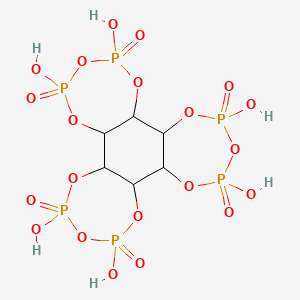
Count the phosphorus atoms: six. Count the sodium ions in the salt: six. Nothing in that formula is an amino acid residue, and nothing is a peptide bond. If you have already read our note Is DADA a Peptide?, you have seen this pattern before — a research code that sounds like a peptide but is not one.
Why isn’t ITPP a peptide or an amino acid?
A peptide is a chain of amino acids joined by amide (peptide) bonds. An amino acid is a single residue with an amine and a carboxylic acid. ITPP is a phosphorylated cyclitol. Searches for “itpp peptide” are common in Google Search Console for this product page, which is why this post answers the question directly: the name is ITPP; the class is inositol trispyrophosphate; the assay role is hemoglobin allostery.
It is also not a dietary supplement listing. Modern Aminos supplies ITPP as a research chemical in documented laboratory formats, with third-party chromatographic data in the Certificate of Analysis tab on the ITPP product page.
How does ITPP work? Hemoglobin allostery, step by step
Hemoglobin is a tetramer that flips between a high-affinity R-state and a low-affinity T-state. Endogenous 2,3-bisphosphoglycerate binds the central cavity of deoxyhemoglobin and favors the T-state, which raises P50 — the oxygen partial pressure at half saturation — so more O2 comes off at a given tissue-side PO2.
ITPP was introduced as a synthetic, membrane-permeant member of that organic-phosphate effector family. Fylaktakidou and colleagues synthesized ITPP salts and showed that they bind free hemoglobin and, to a useful extent, enter red blood cells in whole-blood samples, shifting oxy-hemoglobin dissociation curves toward higher oxygen partial pressures (Fylaktakidou et al., 2005). Duarte and colleagues later showed that the shift is blocked by band 3 inhibitors (DIDS, NAP-Taurine), reported a ghost-binding Kd of 1.72×10⁻⁵ M, and measured a maximum intracellular concentration of 5.5×10⁻³ M by ion chromatography (Duarte et al., 2010).
What do the P50 and Bohr-effect assays show?
Evans and colleagues incubated red blood cells with ITPP concentrations from 0 to 240 mM and read oxygen affinity on a Hemox-Analyzer across buffers at pH 6.8, 7.4, and 7.6 (Evans et al., 2021). Both higher ITPP concentration and lower pH increased P50. ITPP raised P50 at pH 7.4 and 6.8, and showed no effect at alkaline pH 7.6 — so the Bohr effect is conserved and ITPP’s allosteric effect is additive where the abstract reports it.
| Parameter | Reported value | Assay notes |
|---|---|---|
| RBC-ghost binding Kd | 1.72×10⁻⁵ M | Duarte et al., 2010 |
| Max. intracellular [ITPP] | 5.5×10⁻³ M | Ion chromatography; Duarte et al., 2010 |
| Uptake path | Band 3 (AE1) | Blocked by DIDS / NAP-Taurine |
| P50 vs pH | ↑ at pH 6.8 and 7.4; no effect at pH 7.6 | Hemox-Analyzer; Evans et al., 2021 |
What this tells us is simple enough for a lab bench: ITPP is doing phosphate-style allostery on hemoglobin, it can get inside RBCs through band 3, and its P50 effect rides along with — rather than canceling — the Bohr effect in the buffers those authors used. We are not inventing millimeter-of-mercury P50 endpoints that the abstracts do not print.
ITPP vs. 2,3-BPG: what’s the actual difference?
2,3-BPG is the endogenous effector made inside red blood cells. ITPP is a synthetic myo-inositol trispyrophosphate built to be membrane-permeant so exogenous addition can change hemoglobin’s oxygen affinity in vitro. Both belong to the organic-phosphate allosteric story; only ITPP is the research compound Modern Aminos lists for documented reference use.
Pathway tools such as AICAR, GW-501516, SLU-PP-332, or BAM15 answer different questions (AMPK, PPAR, ERR, mitochondrial uncoupling). They are not hemoglobin P50 effectors. For a public mitochondrial PDK salt on this site, see DADA.
ITPP, OXY-111A, and hexasodium salt: sorting out the names
ITPP, myo-inositol trispyrophosphate, inositol trispyrophosphate, and OXY-111A are synonyms for the same free-acid scaffold in PubChem. “Hexasodium ITPP” is the salt form named on the Vanguard Laboratory certificate (Lab ID V250906-5): chromatographic purity 99.28% ± 0.18% by LC-MS/MS. When a search says “itpp peptide,” it is usually reaching for this molecule anyway — just with the wrong chemical class word attached.
What formats is ITPP supplied in for research?
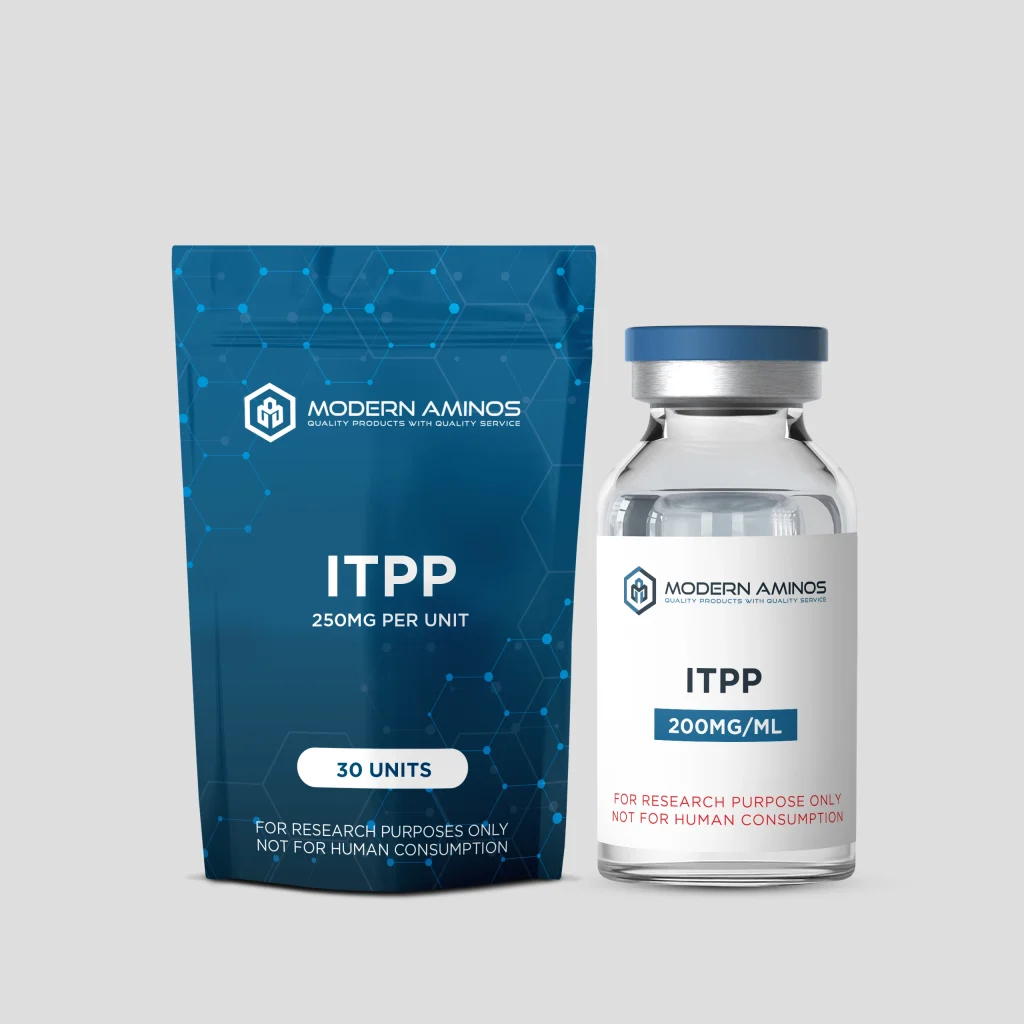
Modern Aminos lists two Size options on the ITPP product page: 250 mg dry-fill capsules, 30 units per capsule bottle (SKU C-017), and 200 mg/mL solution in a 20 mL glass vial (SKU A-019). Prices and stock change; the chemistry and the COA tab are the constants to read before any assay panel.
Where ITPP sits among other Modern Aminos tools
If your panel is about hemoglobin oxygen affinity, ITPP is the specialist. If your panel is about pyruvate dehydrogenase kinase, start with DADA. If you are comparing other public research listings while you build context, Bromantane and Pinealon are separate chemical stories — an adamantane derivative and a peptide bioregulator, respectively — not ITPP analogs. For why chromatographic certificates matter across all of these, see the HPLC testing note.
Frequently asked questions
Is ITPP a peptide?
No. ITPP is myo-inositol trispyrophosphate, a cyclic inositol phosphate (and, as supplied here, its hexasodium salt). It contains no amino acid residues and no peptide bonds.
What is ITPP?
ITPP is myo-inositol trispyrophosphate, CAS 802590-64-3 (free acid), PubChem CID 10439981, used in laboratory research as a membrane-permeant allosteric effector of hemoglobin that raises P50 in published oxygen-dissociation assays.
Is ITPP the same as OXY-111A?
OXY-111A is a PubChem synonym for myo-inositol trispyrophosphate (CID 10439981). It refers to the same scaffold, not a separate peptide.
How does ITPP change hemoglobin oxygen affinity?
ITPP binds hemoglobin and permeates red blood cells via band 3, lowering oxygen affinity and right-shifting the oxy-hemoglobin dissociation curve. Published ghost-binding Kd is 1.72×10⁻⁵ M, with a maximum intracellular concentration of 5.5×10⁻³ M (Duarte et al., 2010).
What formats does Modern Aminos offer?
Two Size options: 250 mg dry-fill capsules, 30 per capsule bottle (C-017), and 200 mg/mL in a 20 mL vial (A-019). Lot documentation is in the Certificate of Analysis tab on the product page.
References
- Fylaktakidou KC, Lehn JM, Greferath R, Nicolau C. Inositol tripyrophosphate: a new membrane permeant allosteric effector of haemoglobin. Bioorg Med Chem Lett. 2005;15(6):1605-1608. PMID 15745806
- Duarte CD, Greferath R, Nicolau C, Lehn JM. myo-Inositol trispyrophosphate: a novel allosteric effector of hemoglobin with high permeation selectivity across the red blood cell plasma membrane. ChemBioChem. 2010;11(18):2543-2548. PMID 21086482
- Evans BA, Ansari AK, Kamyszek RW, et al. Modulation of red blood cell oxygen affinity with a novel allosteric modifier of hemoglobin is additive to the Bohr effect. Blood Cells Mol Dis. 2021;87:102520. PMID 33242840
- Kieda C, Greferath R, Crola da Silva C, et al. Suppression of hypoxia-induced HIF-1alpha and of angiogenesis in endothelial cells by myo-inositol trispyrophosphate-treated erythrocytes. Proc Natl Acad Sci U S A. 2006;103(42):15576-15581. PMC1622864
- National Library of Medicine. PubChem Compound Summary for CID 10439981, Myo-inositol trispyrophosphate. PubChem CID 10439981
- National Library of Medicine. PubChem Compound Summary for CID 10439980, Itpp sodium salt. PubChem CID 10439980
ITPP is a small, highly anionic inositide with a clear hemoglobin story in the literature. Call it by its chemistry, not by a peptide nickname, and the assay design gets easier.