
A side-by-side look at two Modern Aminos 20 mL research solutions — the L-Citrulline Based Amino Blend and the ATP/AMP/NALT Based Amino Blend — covering what each contains per mL, the one ingredient they share (L-arginine HCl), how their component classes differ, and the PubChem identifiers behind every listed compound.
- 1Shared ingredient: L-arginine HCl
- 75 vs 175L-arginine HCl, mg/mL (L-Citrulline blend vs ATP/AMP/NALT blend)
- 9 vs 7Listed components per formula, excluding the preservative
- 1%Benzyl alcohol preservative in both 20 mL water-based solutions
What this comparison covers
Both products are multi-component amino blends supplied as one 20 mL vial, and both list L-arginine HCl. Beyond that they are built from different chemistry. This article compares them on three axes only:
- Composition — the per-mL amounts in each Modern Aminos manufacturing formula, exactly as listed on the product pages.
- Component classes — which compound families each blend draws on (amino acids, a dipeptide, nucleotides, quaternary ammonium compounds and so on) and the pathway chemistry each family is described with in the literature.
- Identifiers — PubChem compound IDs, CAS numbers, molecular formulas and molecular weights for every listed component.
The comparison is limited to chemistry and composition; it does not rank the blends or describe any use beyond laboratory research.
The two blends at a glance
Both research solutions below are Modern Aminos catalog items with batch certificates on each product page.
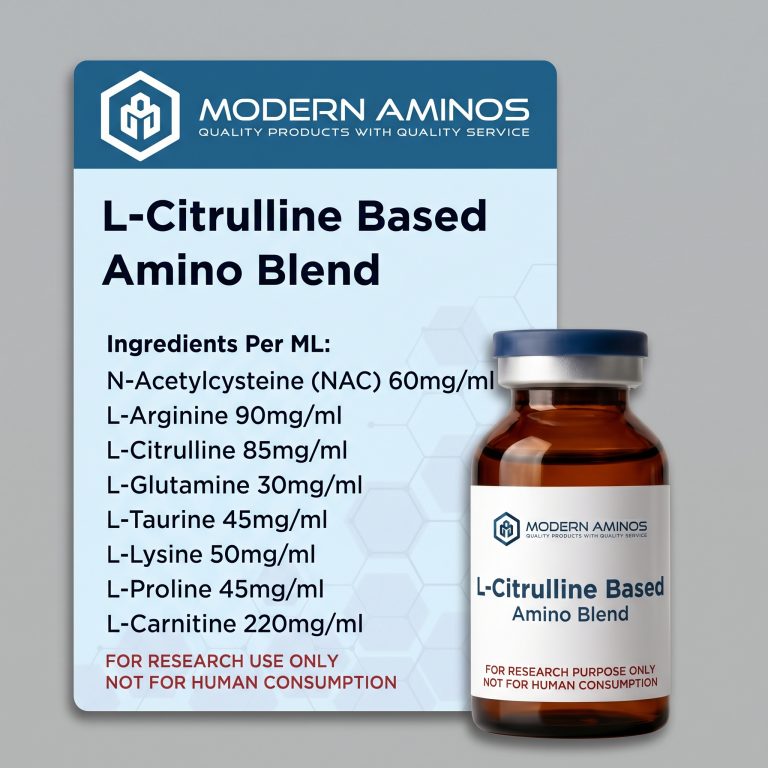
L-Citrulline Based Amino Blend (20 mL)
Amino acid blend; nine listed components
L-citrulline (85 mg/mL) with L-arginine HCl, L-alanyl-L-glutamine, taurine, L-lysine HCl, L-proline, L-carnitine (150 mg/mL) and N-acetylcysteine, plus lidocaine (10 mg/mL), in a water-based solution with benzyl alcohol (1%).
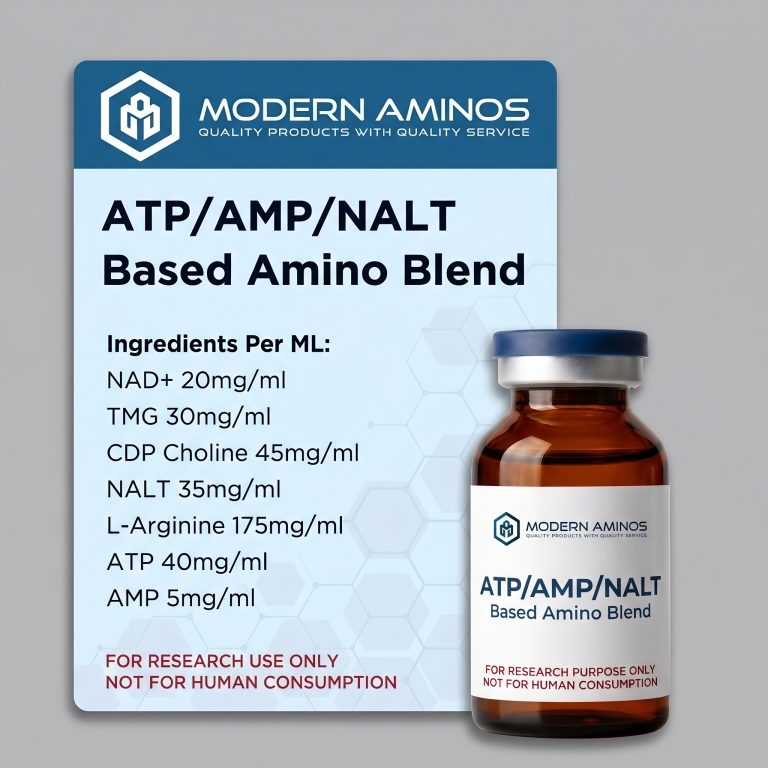
ATP/AMP/NALT Based Amino Blend (20 mL)
Nucleotide and amino acid blend; seven listed components
L-arginine HCl (175 mg/mL) with the nucleotides NAD+, ATP disodium and AMP, betaine anhydrous (TMG), CitiCholine (CDP-choline) and N-acetyl L-tyrosine (NALT), in a water-based solution with benzyl alcohol (1%).
Side-by-side composition per mL
The table lists every component of both manufacturing formulas. A dash means the component is not in that blend. L-arginine HCl is the only row with an amount in both columns.
| Component | L-Citrulline Based Amino Blend | ATP/AMP/NALT Based Amino Blend |
|---|---|---|
| L-Arginine HCl | 75 mg/mL | 175 mg/mL |
| L-Citrulline | 85 mg/mL | — |
| L-Alanyl-L-Glutamine | 44.6 mg/mL | — |
| Taurine | 45 mg/mL | — |
| L-Lysine HCl | 35 mg/mL | — |
| L-Proline | 30 mg/mL | — |
| L-Carnitine | 150 mg/mL | — |
| N-Acetylcysteine (NAC) | 40 mg/mL | — |
| Lidocaine | 10 mg/mL | — |
| NAD+ | — | 20 mg/mL |
| ATP (adenosine triphosphate) | — | 40 mg/mL |
| AMP (adenosine monophosphate) | — | 5 mg/mL |
| Betaine anhydrous (TMG) | — | 30 mg/mL |
| CitiCholine (CDP-choline) | — | 45 mg/mL |
| N-Acetyl L-Tyrosine (NALT) | — | 35 mg/mL |
| Benzyl alcohol (preservative) | 1% | 1% |
Distinct component classes
Apart from L-arginine HCl, each blend draws on its own compound families. The L-Citrulline blend is amino-acid-centred; the ATP/AMP/NALT blend is nucleotide-centred.
L-Citrulline Based Amino Blend
Urea-cycle amino acid: L-citrulline
A non-proteinogenic amino acid that is the co-product of nitric oxide synthase and is recycled to L-arginine through argininosuccinate (Wu & Morris, 1998).
Glutamine dipeptide: L-alanyl-L-glutamine
A dipeptide of L-alanine and L-glutamine; the glutamine it carries is the substrate of glutaminase, which hydrolyzes it to glutamate and ammonia (Cruzat et al., 2018).
Amino sulfonic acid: taurine
2-Aminoethanesulfonic acid carries a sulfonic acid group in place of a carboxyl group, is not incorporated into proteins and is conjugated to bile acids (Ripps & Shen, 2012).
Lysine and proline
L-lysine is catabolized mainly through the saccharopine pathway (Matthews, 2020), and trimethylated lysine is the carbon skeleton of carnitine (Vaz & Wanders, 2002). Proline is one of the most common residues of the collagen Gly-Xaa-Yaa repeat (Shoulders & Raines, 2009).
Quaternary ammonium: L-carnitine
Accepts long-chain acyl groups through carnitine palmitoyltransferase 1 and carries them across the inner mitochondrial membrane, where CPT2 regenerates acyl-CoA (McGarry & Brown, 1997).
Thiol: N-acetylcysteine
Deacetylated to L-cysteine, the rate-limiting precursor of glutathione; hydrogen sulfide and sulfane sulfur species have been proposed as part of its chemistry (Pedre et al., 2021).
Amino amide: lidocaine
Listed in the formula at 10 mg/mL. Lidocaine (PubChem CID 3676) is an amino amide, not an amino acid, and has no counterpart in the ATP/AMP/NALT blend.
ATP/AMP/NALT Based Amino Blend
Adenine nucleotides: ATP and AMP
AMP-activated protein kinase senses falling ATP relative to AMP and ADP through nucleotide binding at its γ subunit (Hardie et al., 2012); the blend supplies ATP (as the disodium salt) and AMP together.
Dinucleotide cofactor: NAD+
The hydride acceptor of dehydrogenase reactions and a consumed substrate of sirtuins, PARPs and CD38, recycled through NAMPT and NMNAT in the salvage pathway (Covarrubias et al., 2021). Storage behavior of NAD+ is covered in NAD+ Stability: Real-World Shipping & Storage Results.
Methyl donor: betaine (TMG)
Donates a methyl group to homocysteine through betaine-homocysteine methyltransferase, forming methionine and dimethylglycine (Obeid, 2013); betaine itself is formed by oxidation of choline (Zeisel, 2013).
Cytidine nucleotide: CDP-choline
The activated intermediate of de novo phosphatidylcholine synthesis in the Kennedy pathway (Gibellini & Smith, 2010). See CDP-Choline (Citicoline): What It Is, How It Works, and What Research Shows and Alpha GPC vs. CDP-Choline.
Acetylated aromatic amino acid: NALT
L-tyrosine carrying an acetyl group on the α-amino nitrogen; free L-tyrosine is the substrate of tyrosine hydroxylase, the rate-limiting enzyme of catecholamine synthesis (Daubner et al., 2011).
Key takeaway. The blends share two structural motifs without sharing the compounds: each has an N-acetylated amino acid (NAC vs NALT) and each has a trimethylammonium compound (L-carnitine vs betaine and the choline group of CDP-choline).
Chemical data for every listed component
Identifiers are taken from PubChem for the form each formula lists. For the hydrochloride and disodium salts, the record shown is the salt.
| Component | In blend | PubChem CID | CAS Number | Formula | MW (g/mol) |
|---|---|---|---|---|---|
| L-Arginine HCl | Both | CID 66250 | 1119-34-2 | C6H15ClN4O2 | 210.66 |
| L-Citrulline | L-Citrulline blend | CID 9750 | 372-75-8 | C6H13N3O3 | 175.19 |
| L-Alanyl-L-Glutamine | L-Citrulline blend | CID 123935 | 39537-23-0 | C8H15N3O4 | 217.22 |
| Taurine | L-Citrulline blend | CID 1123 | 107-35-7 | C2H7NO3S | 125.15 |
| L-Lysine HCl | L-Citrulline blend | CID 69568 | 657-27-2 | C6H15ClN2O2 | 182.65 |
| L-Proline | L-Citrulline blend | CID 145742 | 147-85-3 | C5H9NO2 | 115.13 |
| L-Carnitine | L-Citrulline blend | CID 10917 | 541-15-1 | C7H15NO3 | 161.20 |
| N-Acetylcysteine (NAC) | L-Citrulline blend | CID 12035 | 616-91-1 | C5H9NO3S | 163.20 |
| Lidocaine | L-Citrulline blend | CID 3676 | 137-58-6 | C14H22N2O | 234.34 |
| NAD+ | ATP/AMP/NALT blend | CID 5892 | 53-84-9 | C21H27N7O14P2 | 663.4 |
| ATP (adenosine triphosphate, disodium) | ATP/AMP/NALT blend | CID 13803 | 987-65-5 | C10H14N5Na2O13P3 | 551.14 |
| AMP (adenosine monophosphate) | ATP/AMP/NALT blend | CID 6083 | 61-19-8 | C10H14N5O7P | 347.22 |
| Betaine anhydrous (TMG) | ATP/AMP/NALT blend | CID 247 | 107-43-7 | C5H11NO2 | 117.15 |
| CitiCholine (CDP-choline) | ATP/AMP/NALT blend | CID 13804 | 987-78-0 | C14H26N4O11P2 | 488.32 |
| N-Acetyl L-Tyrosine (NALT) | ATP/AMP/NALT blend | CID 68310 | 537-55-3 | C11H13NO4 | 223.22 |
Interpretive note. The CitiCholine salt form is not stated in the formula, so the identifiers shown are for citicoline. Free-base records: L-arginine CID 6322, L-lysine CID 5962, ATP free acid CID 5957.
Formulation and identity notes
L-Citrulline Based Amino Blend
- Nine listed components; L-carnitine (150 mg/mL) is the largest by mass.
- Includes lidocaine at 10 mg/mL, disclosed on the product page.
- Water-based solution with benzyl alcohol (1%); 20 mL vial.
ATP/AMP/NALT Based Amino Blend
- Seven listed components; L-arginine HCl (175 mg/mL) is the largest by mass.
- ATP is listed as the disodium salt; CitiCholine salt form is not stated.
- Water-based solution with benzyl alcohol (1%); 20 mL vial.
Composition comparison summary
- Shared component: L-arginine HCl only (75 vs 175 mg/mL).
- L-Citrulline blend focus: amino acids and derivatives — L-citrulline, a glutamine dipeptide, taurine, L-lysine, L-proline, L-carnitine and NAC.
- ATP/AMP/NALT blend focus: nucleotides — NAD+, ATP, AMP and CDP-choline — with betaine and NALT.
- Only in the L-Citrulline blend: lidocaine (10 mg/mL), an amino amide.
- Common motifs: an N-acetylated amino acid and a trimethylammonium compound in each.
- Same format: one 20 mL vial, water-based, benzyl alcohol 1%.
Frequently asked research questions
L-Citrulline Based Amino Blend
What does the L-Citrulline Based Amino Blend contain per mL?
Per the Modern Aminos manufacturing formula (SKU A-017), each mL contains L-arginine HCl 75 mg, L-citrulline 85 mg, L-alanyl-L-glutamine 44.6 mg, taurine 45 mg, L-lysine HCl 35 mg, L-proline 30 mg, L-carnitine 150 mg, N-acetylcysteine 40 mg and lidocaine 10 mg, in a water-based solution with benzyl alcohol (1%) as the preservative.
Why is lidocaine listed in the L-Citrulline blend?
Lidocaine is part of the manufacturing formula at 10 mg/mL and is disclosed on the product page. Chemically it is an amino amide, 2-(diethylamino)-N-(2,6-dimethylphenyl)acetamide (PubChem CID 3676), not an amino acid. The ATP/AMP/NALT blend does not contain it.
How are L-arginine and L-citrulline related chemically?
Nitric oxide synthases oxidize the guanidino nitrogen of L-arginine to nitric oxide and L-citrulline, and argininosuccinate synthetase and argininosuccinate lyase convert L-citrulline back to L-arginine (Förstermann & Sessa, 2012; Wu & Morris, 1998). The blend supplies both members of that pair.
ATP/AMP/NALT Based Amino Blend
What does the ATP/AMP/NALT Based Amino Blend contain per mL?
Per the Modern Aminos manufacturing formula (SKU A-015-F), each mL contains NAD+ 20 mg, betaine anhydrous (TMG) 30 mg, CitiCholine (CDP-choline) 45 mg, N-acetyl L-tyrosine 35 mg, L-arginine HCl 175 mg, ATP disodium 40 mg and AMP 5 mg, in a water-based solution with benzyl alcohol (1%) as the preservative.
Why does the ATP/AMP/NALT blend pair ATP with AMP?
ATP and AMP are two ends of the adenylate pool. AMP-activated protein kinase reads the ratio of AMP and ADP to ATP through nucleotide binding at its γ subunit (Hardie et al., 2012). The blend supplies ATP and AMP together at fixed amounts, 40 and 5 mg/mL.
How are betaine and CDP-choline related?
Both belong to choline chemistry. Betaine is formed by oxidation of choline and donates a methyl group to homocysteine through betaine-homocysteine methyltransferase (Zeisel, 2013; Obeid, 2013), while CDP-choline is the activated intermediate of de novo phosphatidylcholine synthesis in the Kennedy pathway (Gibellini & Smith, 2010).
Comparing the two blends
Which ingredient do the two blends share?
Only L-arginine HCl. It is present at 75 mg/mL in the L-Citrulline blend and at 175 mg/mL in the ATP/AMP/NALT blend, the largest single component of that formula. Every other component appears in only one of the two.
What is the main chemical difference between the two blends?
The L-Citrulline blend is built from amino acids and amino acid derivatives (L-citrulline, a glutamine dipeptide, taurine, L-lysine, L-proline, L-carnitine and NAC) plus lidocaine. The ATP/AMP/NALT blend is built around nucleotides (NAD+, ATP, AMP and the cytidine nucleotide CDP-choline) with betaine and NALT.
Do the two blends have any structural features in common besides L-arginine?
Two. Each contains an N-acetylated amino acid (NAC in the L-Citrulline blend, NALT in the ATP/AMP/NALT blend), and each contains a trimethylammonium compound (L-carnitine in the L-Citrulline blend; betaine and the choline group of CDP-choline in the ATP/AMP/NALT blend).
Are the carrier and vial format the same?
Yes. Both are supplied as one 20 mL vial of a water-based solution with benzyl alcohol (1%) as the preservative.
About Modern Aminos research materials
Where are the certificates for these blends?
Each product page carries its batch certificates in the Certificate of Analysis tab, and the Quality Assurance Program describes how Modern Aminos tests its catalog. For background on chromatographic testing, see why HPLC testing matters.
Cited studies and external literature
- Förstermann U, Sessa WC. Nitric oxide synthases: regulation and function. Eur Heart J 2012. PMC3345541
- Wu G, Morris SM Jr. Arginine metabolism: nitric oxide and beyond. Biochem J 1998. PMC1219836
- Cruzat V, Macedo Rogero M, Noel Keane K, Curi R, Newsholme P. Glutamine: Metabolism and Immune Function, Supplementation and Clinical Translation. Nutrients 2018. PMC6266414
- Ripps H, Shen W. Review: Taurine: A “very essential” amino acid. Mol Vis 2012. PMC3501277
- Matthews DE. Review of Lysine Metabolism with a Focus on Humans. J Nutr 2020. PubMed 33000162
- Vaz FM, Wanders RJA. Carnitine biosynthesis in mammals. Biochem J 2002. PMC1222323
- Shoulders MD, Raines RT. Collagen Structure and Stability. Annu Rev Biochem 2009. PMC2846778
- McGarry JD, Brown NF. The mitochondrial carnitine palmitoyltransferase system. From concept to molecular analysis. Eur J Biochem 1997. PubMed 9063439
- Pedre B, Barayeu U, Ezeriņa D, Dick TP. The mechanism of action of N-acetylcysteine (NAC): The emerging role of H2S and sulfane sulfur species. Pharmacol Ther 2021. PubMed 34171332
- Covarrubias AJ, Perrone R, Grozio A, Verdin E. NAD+ metabolism and its roles in cellular processes during ageing. Nat Rev Mol Cell Biol 2021. PMC7963035
- Hardie DG, Ross FA, Hawley SA. AMPK: a nutrient and energy sensor that maintains energy homeostasis. Nat Rev Mol Cell Biol 2012. PMC5726489
- Obeid R. The Metabolic Burden of Methyl Donor Deficiency with Focus on the Betaine Homocysteine Methyltransferase Pathway. Nutrients 2013. PMC3798916
- Zeisel SH. Metabolic crosstalk between choline/1-carbon metabolism and energy homeostasis. Clin Chem Lab Med 2013. PMC3624053
- Gibellini F, Smith TK. The Kennedy pathway—De novo synthesis of phosphatidylethanolamine and phosphatidylcholine. IUBMB Life 2010. PubMed 20503434
- Daubner SC, Le T, Wang S. Tyrosine hydroxylase and regulation of dopamine synthesis. Arch Biochem Biophys 2011. PMC3065393