
What Is Pinealon?
Short answer: Pinealon is the synthetic tripeptide Glu-Asp-Arg, often written EDR, with CAS number 175175-23-2 and a molecular weight of 418.40 g/mol. It is three amino acids, glutamic acid, aspartic acid, and arginine, linked into one small and highly polar peptide. In laboratory studies it binds DNA, partly entering the major groove and touching guanine atoms, and it also binds histone proteins. Researchers who want to buy Pinealon as a documented reference material can find the lot certificate on the product page.
Some molecules are big and famous. Others are small and easy to overlook. Pinealon is one of the small ones, and that is exactly what makes it interesting. Let’s take it one piece at a time, the way you would in a good chemistry class: first what it is made of, then how it behaves, and then what the published data actually say.
What is Pinealon, chemically speaking?
Pinealon is L-glutamyl-L-aspartyl-L-arginine. Read the name from left to right and you have the recipe: an L-glutamic acid at the start (the N-terminus), an L-aspartic acid in the middle, and an L-arginine at the end (the C-terminus). Its formula is C15H26N6O8, its exact mass is 418.1812 Da, and PubChem lists it as CID 10273502 with the InChIKey QPRZKNOOOBWXSU-CIUDSAMLSA-N. ChEBI, the European chemical dictionary, describes it plainly as a tripeptide of those three amino acids joined in sequence by peptide linkages (CHEBI:156374).
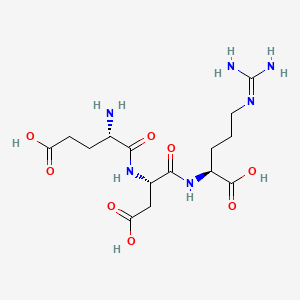
Look at the drawing and count the acid groups. There are three carboxylic acids: one on the glutamic acid side chain, one on the aspartic acid side chain, and one at the C-terminus. On the other side of the ledger are two basic groups, the free amine at the N-terminus and the guanidino group at the tip of arginine. That mix of charges is why PubChem computes such a water-loving profile for it: an XLogP3 of -6.1, a polar surface area of 261 square angstroms, 8 hydrogen-bond donors, and 10 acceptors.
Is Pinealon a peptide, an amino acid, or a supplement?
It is a peptide. Each of its three building blocks is an amino acid on its own, but once they are joined by two peptide bonds, the result is a new molecule with its own formula, its own CAS number, and its own behavior. Calling it an amino acid would be a little like calling a three-word sentence a letter.
It is also not a supplement. Modern Aminos lists Pinealon as a research chemical and supplies it only as a lyophilized powder in a sealed vial. If you have read our explainer Is DADA a Peptide? you have seen the opposite case: a compound people call a peptide that turns out not to be one. Pinealon is the genuine article, a true, if very short, peptide.
How does Pinealon bind DNA? The interaction, step by step
Here is the heart of the story. DNA is a long double helix with two grooves running along it, a wide one called the major groove and a narrow one called the minor groove. The edges of the bases are exposed in those grooves, which is where many proteins read the genetic sequence.
In 2019, a team at Saint Petersburg State University studied the EDR peptide and DNA with spectral measurements, NMR, viscometry, and molecular dynamics simulations (Silanteva et al., 2019). They found three things worth remembering:
- EDR can partly penetrate the major groove of DNA.
- Once there, it affects the base atoms, mainly the N7 and O6 atoms of guanine.
- Magnesium ions promote the interaction, because they screen the negative charges on DNA’s phosphate backbone, and that effect holds in salt solutions too.
That third point is a good lesson for any careful experimenter. A peptide carrying several negative charges has to approach a backbone that is also negatively charged. Magnesium acts like a peacemaker between them. So when you compare results across laboratories, check the buffer before you check anything else.
Which DNA sequences and histones does Pinealon prefer?
Binding is one thing. Choosing where to bind is another. In 2011, Fedoreyeva and colleagues measured how short peptides quench the fluorescence of labeled DNA fragments, a sensitive way to see who sticks to whom (Fedoreyeva et al., 2011). Two years later the same group tested the peptides against fluorescently labeled histones, the spool proteins that DNA wraps around (Fedoreyeva et al., 2013). Here is what those abstracts report, side by side:
| Peptide | Preferred DNA motif | Favored trinucleotide | Binds histones H1, H2B, H3, H4 |
|---|---|---|---|
| Pinealon (Glu-Asp-Arg) | CNG-containing | CAG | Yes |
| Epitalon (Ala-Glu-Asp-Gly) | CNG-containing | CAG | Yes |
| Bronchogen (Ala-Glu-Asp-Leu) | CNG-containing | CTG | Yes |
What does this tell us? CNG sites are the places where cytosine methylation commonly happens, and the 2011 study found that the peptides could even tell methylated from unmethylated sequences. So a three-residue peptide is not just sticking to DNA at random. It shows a measurable preference, and that preference changes when one amino acid changes. A 2020 overview article adds molecular modeling that points to two possible EDR binding sites, d(CCTGCC)2 and d(CCAGC)2 (Khavinson et al., 2020).
Pinealon vs. Epitalon: what’s the actual difference?
People often search for these two together, so let’s be precise. Epitalon is a tetrapeptide, Ala-Glu-Asp-Gly, with the formula C14H22N4O9 and a molecular weight of 390.35 g/mol. Pinealon is a tripeptide, Glu-Asp-Arg, at 418.40 g/mol. Pinealon is shorter but heavier, because a single arginine residue outweighs an alanine and a glycine residue combined.
Both share a Glu-Asp core, and in the oligonucleotide study both leaned toward CAG-containing sequences. The difference is in the kind of evidence. For Epitalon, the modeling work has focused on linker histones H1/3 and H1/6 (Khavinson et al., 2020). For Pinealon, NMR and molecular dynamics add a direct picture of major-groove contact with guanine.
Pinealon, pinaleon, EDR: sorting out the names
A single small molecule can collect a surprising number of names. You will see Pinealon written as EDR, E-D-R, Glu-Asp-Arg, H-Glu-Asp-Arg-OH, and L-Glu-L-Asp-L-Arg. In searches it is often spelled pinaleon. All of these point to the same structure. The 2020 article by Khavinson and colleagues describes EDR as a tripeptide isolated from the polypeptide preparation Cortexin, which is where its history begins.
One more note for careful readers: some older listings give a CAS number for Pinealon that does not match any public chemical record. The number that PubChem lists and the expert-curated EPA DSSTox entry confirms is 175175-23-2.
What formats is Pinealon supplied in for research?
Modern Aminos supplies Pinealon in one format: 20 mg of white lyophilized powder in a single sealed glass vial. The current lot certificate, from Freedom Diagnostics Testing, reports identity confirmed by LC-MS, HPLC-UV purity of 99.82%, and an average net content of 20.09 mg. You can read it in the Certificate of Analysis tab on the Pinealon 20MG product page. If you want to know why chromatography matters so much for a reference material, our note on the importance of HPLC testing explains it step by step.
Where Pinealon sits among other short peptide bioregulators
Think of short peptides as a ladder of length. At the bottom are dipeptides such as Vilon (Lys-Glu), which docking studies place along the DNA minor groove (Khavinson et al., 2015). A systematic survey of all 400 standard dipeptides found that most cannot bind double-stranded DNA selectively at all, and that selectivity rises sharply as peptides get longer (Kolchina et al., 2019). Pinealon sits one rung up as a tripeptide, and tetrapeptides such as Bronchogen and Epitalon sit one rung higher.
That ladder is a useful way to design an experiment. Change one residue, or add one, and you can watch the binding preference move.
Frequently asked questions
What is Pinealon?
Pinealon is the synthetic tripeptide Glu-Asp-Arg (EDR), CAS 175175-23-2, with the formula C15H26N6O8 and a molecular weight of 418.40 g/mol. It is listed in PubChem as CID 10273502 and in ChEBI as CHEBI:156374.
Is Pinealon a peptide?
Yes. It is three L-amino acids, glutamic acid, aspartic acid, and arginine, joined by two peptide bonds. That makes it a tripeptide, a very short peptide that is still long enough to show sequence-selective DNA binding in published assays.
Is pinaleon the same as Pinealon?
Yes. Pinaleon is a common misspelling. Every spelling refers to the same Glu-Asp-Arg structure, PubChem CID 10273502, with InChIKey QPRZKNOOOBWXSU-CIUDSAMLSA-N.
How does Pinealon bind DNA?
Spectral, NMR, viscometry, and molecular dynamics work shows the EDR peptide partly entering the DNA major groove and contacting guanine N7 and O6. Magnesium ions strengthen the interaction by screening the phosphate backbone (Silanteva et al., 2019).
How is Pinealon different from Epitalon?
Epitalon is the tetrapeptide Ala-Glu-Asp-Gly, while Pinealon is the tripeptide Glu-Asp-Arg. In the same oligonucleotide assay both preferred CNG-containing sequences and leaned toward CAG (Fedoreyeva et al., 2011).
References
- Silanteva IA, Komolkin AV, Morozova EA, Vorontsov-Velyaminov PN, Kasyanenko NA. Role of Mono- and Divalent Ions in Peptide Glu-Asp-Arg-DNA Interaction. J Phys Chem B. 2019;123(9):1896-1902. PubMed 30762356
- Fedoreyeva LI, Kireev II, Khavinson VKh, Vanyushin BF. Penetration of short fluorescence-labeled peptides into the nucleus […] and in vitro specific interaction of the peptides with deoxyribooligonucleotides and DNA. Biochemistry (Mosc). 2011;76(11):1210-1219. PubMed 22117547
- Fedoreyeva LI, Smirnova TA, Kolomijtseva GY, Khavinson VKh, Vanyushin BF. Interaction of short peptides with FITC-labeled wheat histones and their complexes with deoxyribooligonucleotides. Biochemistry (Mosc). 2013;78(2):166-175. PubMed 23581987
- Khavinson V, Linkova N, Kozhevnikova E, Trofimova S. EDR Peptide: Possible Mechanism of Gene Expression and Protein Synthesis Regulation […]. Molecules. 2020;26(1):159. PMC7795577
- Khavinson V, Diomede F, Mironova E, Linkova N, Trofimova S, Trubiani O, Caputi S, Sinjari B. AEDG Peptide (Epitalon) Stimulates Gene Expression and Protein Synthesis […]: Possible Epigenetic Mechanism. Molecules. 2020;25(3):609. PMC7037223
- Kolchina N, Khavinson V, Linkova N, Yakimov A, Baitin D, Afanasyeva A, Petukhov M. Systematic search for structural motifs of peptide binding to double-stranded DNA. Nucleic Acids Res. 2019;47(20):10553-10563. PMC6847403
- Khavinson VKh, Tarnovskaya SI, Lin’kova NS, et al. Role of peptide bond in the realization of biological activity of short peptides. Bull Exp Biol Med. 2015;158(4):551-554. PubMed 25705040
- National Center for Biotechnology Information. PubChem Compound Summary for CID 10273502, Glu-Asp-Arg. PubChem CID 10273502
So there it is: three amino acids, two peptide bonds, and a surprisingly specific way of meeting DNA. Small molecules can teach big lessons when we take the time to look closely.