
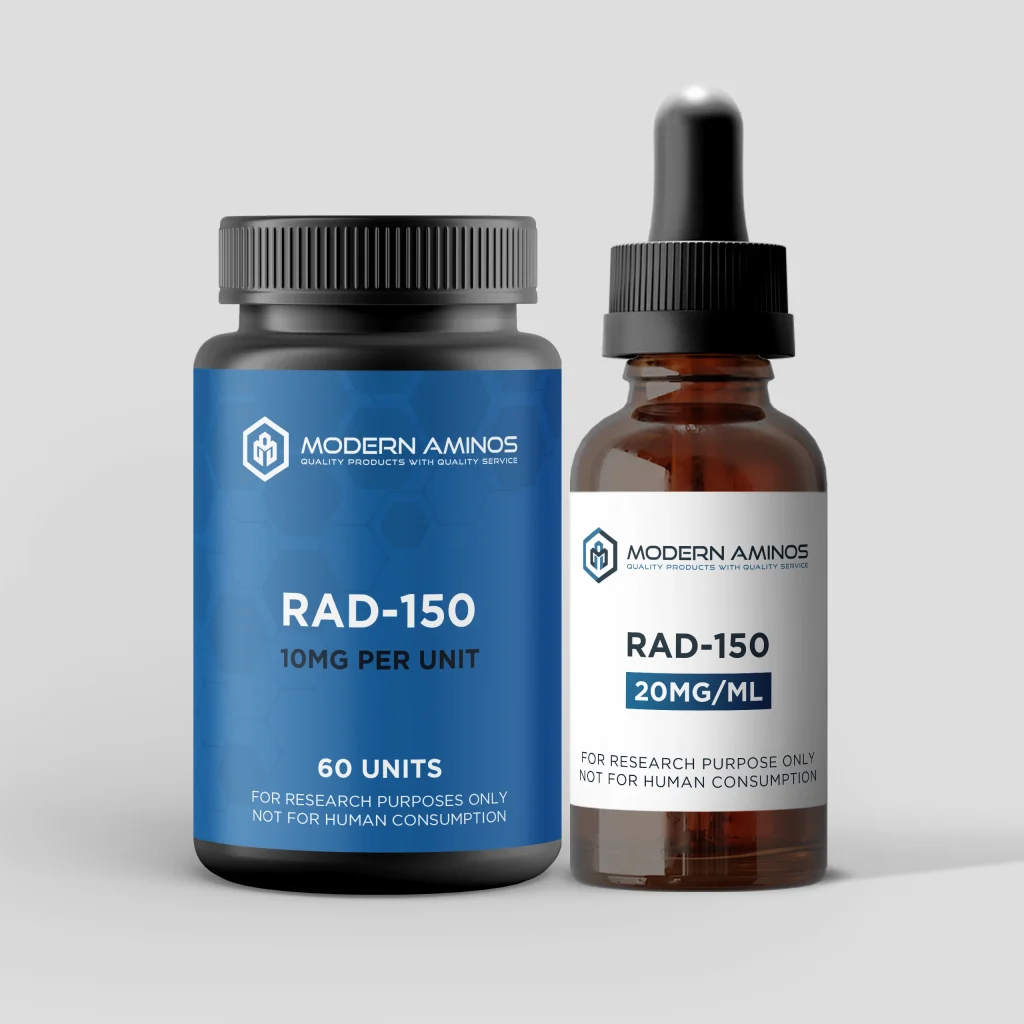
Short answer: RAD-150 is the research name for TLB-150 benzoate (CAS 1208070-53-4), the benzoate ester of the nonsteroidal androgen receptor ligand RAD-140. It is a single small molecule of 497.9 g/mol with the formula C27H20ClN5O3, and in the patent that first described it, it displaced a fluorescent tracer from the androgen receptor with an IC50 of 130 nM. To buy RAD-150 as a documented reference compound, Modern Aminos supplies 10 mg dry-fill capsules and a 30 mL dropper bottle at 20 mg/mL.
That is the short version. The longer version is the story of one small chemical change, and it is worth slowing down for, because that one change explains nearly everything people ask about RAD-150.
What is RAD-150, chemically speaking?
Start with its parent. RAD-140 is a nonsteroidal molecule built around a 1,3,4-oxadiazole ring, a small five-membered ring that holds two nitrogens and one oxygen. On one side sits a chlorinated benzonitrile ring joined through an N–H, and on the other a 4-cyanophenyl group. Between them is a short carbon chain carrying a hydroxyl group, an –OH, on its second carbon (PubChem CID 44200882).
RAD-150 is what you get when that hydroxyl group is capped with a benzoyl group. Chemists call the new linkage an ester. PubChem files the result under CID 68547459, titled TLB 150 Benzoate, with RAD150 among its synonyms, the formula C27H20ClN5O3, a molecular weight of 497.9 g/mol, and the InChIKey NQUKIBBKKLFEQU-BXKMTCNYSA-N (PubChem).

Its systematic name is [(1R,2S)-1-(3-chloro-4-cyano-2-methylanilino)-1-[5-(4-cyanophenyl)-1,3,4-oxadiazol-2-yl]propan-2-yl] benzoate. The (1R,2S) at the front matters. The molecule has two defined stereocenters, two carbons that could each be built as a left-handed or right-handed version, and RAD-150 keeps the same arrangement as RAD-140. The compound first appears as Example 87 in US Patent 8,629,167, titled “Selective androgen receptor modulators.” The patent makes it in a single step: RAD-140 is stirred with benzoyl chloride and pyridine in methylene chloride at room temperature (US 8,629,167).
Is RAD-150 a peptide?
No. Searches sometimes pair RAD-150 with the word peptide, but there are no amino acids in it and no peptide bonds. It is one small organic molecule of 36 non-hydrogen atoms, made of aromatic rings and a short chain rather than a string of amino acids. It is not a supplement either. It is a characterized research compound with its own PubChem record, a CAS number, and a published synthesis.
How does RAD-150 work? The androgen receptor, step by step
The androgen receptor is a protein in the nuclear receptor family, the same broad family that includes the progesterone, glucocorticoid, and thyroid hormone receptors. Each of these receptors has a pocket, called the ligand-binding domain, shaped to hold a particular kind of small molecule. A ligand is simply any molecule that sits in that pocket.
To learn how well a new molecule fits, researchers hold a contest. In the patent’s version, the androgen receptor was mixed with a glowing androgen tracer called Fluormone AL Green. A tracer held by the large receptor protein tumbles slowly, so the light it gives off stays polarized. When a test compound pushes the tracer out, the free tracer tumbles quickly and the polarization drops. The concentration that produces half of the maximum shift is the IC50, and a smaller number means a tighter fit. Every plate also carried a competition curve for R1881 (methyltrienolone), a reference androgen, as a control (US 8,629,167).
What do the androgen receptor binding numbers show?
Table 1 of the patent lists androgen receptor binding values for the compounds in this series, and PubChem carries those values, 93 results in all, in BioAssay AID 1800312 (US 8,629,167; PubChem AID 1800312). Four of them tell RAD-150’s story:
| Compound (patent example) | Group on the hydroxyl | AR binding IC50 |
|---|---|---|
| RAD-140 (Example 22) | none (free –OH) | 2 nM |
| Acetate ester (Example 88) | acetyl | 110 nM |
| Propionate ester (Example 86) | propionyl | 120 nM |
| RAD-150, benzoate ester (Example 87) | benzoyl | 130 nM |
What this tells us is plain and useful. The three esters, small cap or large, all landed between 110 and 130 nM, while the free alcohol measured 2 nM. So in this assay it was capping the hydroxyl group, more than the size of the cap, that lowered the measured affinity. RAD-150 still competes for the receptor, but in this measurement it was about 65 times weaker than RAD-140. One honest caution: an IC50 depends on the tracer and receptor concentrations used, so these numbers should be compared with each other, not with values from a different assay.
RAD-150 vs. RAD-140: what’s the actual difference?
One ester group, and everything that follows from it. PubChem’s computed properties put the two side by side: RAD-150 weighs 497.9 g/mol against 393.8 for RAD-140, it has one hydrogen-bond donor instead of two, eight rotatable bonds instead of five, and a computed XLogP3 of 5.4 against 3.1 (CID 68547459; CID 44200882). In everyday words, RAD-150 is bigger, it has given up the hydrogen its –OH could share in a hydrogen bond, and it is predicted to be a good deal more oil-loving.
Esters can be split by water, a reaction chemists call hydrolysis, and for RAD-150 that reaction would give back RAD-140 and benzoic acid. How quickly that happens under any particular condition is not reported in the sources cited here, so it is a chemistry fact about the bond, not a measured result for this compound.
Where does the name TLB-150 come from, and why do searches get confused?
The product is labeled RAD-150 (TLB-150), and PubChem titles this structure TLB 150 Benzoate. The public sources examined here do not explain the letters TLB, so it is safest to read it as a catalog name rather than a systematic one.
Here is the catch worth remembering. Typing “RAD-150” into PubChem’s name search returns CID 32771, titled Rad 150, which is an unrelated chloropentyl acetamide with the formula C16H25ClN2O and CAS 29622-29-5 (PubChem CID 32771). Same name, completely different molecule. PubChem also keeps a second record of the benzoate ester drawn without its stereochemistry, CID 68547462. For the compound described here, the reliable identifiers are CID 68547459, CAS 1208070-53-4, and InChIKey NQUKIBBKKLFEQU-BXKMTCNYSA-N.
What formats is RAD-150 supplied in for research?
Modern Aminos supplies RAD-150 in two formats: 10 mg dry-fill capsules, 60 units per capsule bottle, and a 30 mL dropper bottle at 20 mg/mL. The certificate currently in the Certificate of Analysis tab is a Chromate report on a 10 mg/mL liquid sample that confirmed identity as RAD150 by reversed-phase HPLC with UV detection and prints the same CAS number and formula given above. Both formats are listed on the RAD-150 product page. Because the name alone can lead a database search astray, the CAS number on the label is worth a second look.
Where RAD-150 sits among other receptor research tools
RAD-150 is a receptor-level tool. It answers a narrow question: how a small change to a known ligand moves its fit in the androgen receptor pocket. Other nuclear receptors have their own well-studied ligands. GC-1 (Sobetirome) was designed as a thyroid hormone analog that binds the thyroid hormone receptors with high affinity and favors the TRβ subtype over TRα in both binding and activation (Chiellini et al., 1998). For a look at another nuclear receptor family, the estrogen-related receptors, read SLU-PP-332 vs. SLU-PP-915. If you would like to see how a very different receptor family is mapped one subtype at a time, Melanocortin Receptors Explained is a good companion. And because a name like RAD-150 can point to more than one structure, the note on why HPLC testing matters is worth reading too.
Frequently asked questions
What is RAD-150?
RAD-150 is TLB-150 benzoate (CAS 1208070-53-4), the benzoate ester of the androgen receptor ligand RAD-140. It is a small molecule of 497.9 g/mol, listed in PubChem as CID 68547459.
Is RAD-150 the same as RAD-140?
No. RAD-150 is RAD-140 with its secondary hydroxyl group converted to a benzoate ester, which adds about 104 g/mol. In the same patent binding assay, RAD-140 measured an IC50 of 2 nM and RAD-150 measured 130 nM.
Is RAD-150 a peptide?
No. It contains no amino acids and no peptide bonds. RAD-150 is a nonsteroidal small molecule built around a 1,3,4-oxadiazole ring.
Why does a PubChem search for RAD-150 show a different compound?
PubChem’s name search for RAD-150 returns CID 32771, titled Rad 150, an unrelated acetamide with CAS 29622-29-5. The benzoate ester sold as RAD-150 is CID 68547459, with InChIKey NQUKIBBKKLFEQU-BXKMTCNYSA-N.
How strongly does RAD-150 bind the androgen receptor?
In the fluorescence polarization assay reported in US Patent 8,629,167, RAD-150 (Example 87) displaced the androgen tracer with an IC50 of 130 nM. The acetate and propionate esters measured 110 and 120 nM, and RAD-140 measured 2 nM.
References
- Miller CP. Selective androgen receptor modulators. US Patent 8,629,167 B2. Published January 14, 2014. Examples 22, 86, 87, and 88; Table 1. Google Patents US8629167B2
- PubChem. TLB 150 Benzoate, CID 68547459. National Library of Medicine. CID 68547459
- PubChem BioAssay. Biological Assay from US Patent US8629167: “Selective androgen receptor modulators,” AID 1800312 (deposited by BindingDB). National Library of Medicine. AID 1800312
- PubChem. RAD140, CID 44200882. National Library of Medicine. CID 44200882
- PubChem. Rad 150, CID 32771 (an unrelated compound that shares the name). National Library of Medicine. CID 32771
- Chiellini G, Apriletti JW, Yoshihara HA, Baxter JD, Ribeiro RC, Scanlan TS. A high-affinity subtype-selective agonist ligand for the thyroid hormone receptor. Chem Biol. 1998;5(6):299-306. PubMed 9653548
One ester bond, added to a well-known molecule, changes its size, its polarity, and how tightly it holds its receptor in a test tube. RAD-150 is a fine reminder that in chemistry the smallest edits often teach the biggest lessons, and that the surest way to know a compound is by its numbers, not just its name.