
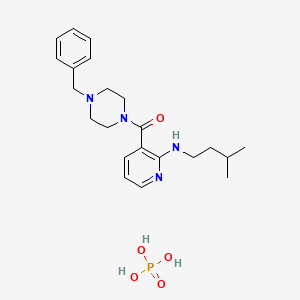
NSI-189 Phosphate (Amdiglurax Phosphate / NSI-189 H3PO4) is the phosphoric acid salt of a benzylpiperazine–aminopyridine amide for neurochemistry and nootropic structure-activity research. Its synthesis patent describes a crystalline mono-phosphate with a 179 °C DSC melt endotherm and water solubility above 36 mg/mL, formed when phosphoric acid protonates the basic benzylpiperazine nitrogen. CAS 1270138-41-4.
$64.00
In stock
| Quantity | Discounted Price |
|---|---|
| 3 - 5 | $61.44 |
| 6 + | $58.88 |



NSI-189 Phosphate ((4-benzylpiperazin-1-yl)-[2-(3-methylbutylamino)-3-pyridinyl]methanone phosphate, also called amdiglurax phosphate and NSI-189 H3PO4; CAS 1270138-41-4) is the phosphoric acid salt of NSI-189, a small synthetic benzylpiperazine–aminopyridine amide. Its free base, NSI-189 (amdiglurax, CAS 1270138-40-3), links a 2-(3-methylbutylamino)pyridine-3-carbonyl group to 1-benzylpiperazine through a single amide bond. NSI-189 Phosphate is not a peptide and not an amino acid, even though it is often listed beside research peptides. Its salt chemistry comes from the basic benzylpiperazine nitrogen, which accepts a proton from phosphoric acid.
The synthesis patent reports the mono-phosphate as crystalline by XRPD, with one DSC endotherm at 179 °C consistent with a melt and water solubility above 36 mg/mL under ambient conditions (US 9,278,933). That is what NSI-189 Phosphate is at the bench: a characterized crystalline salt of a lipophilic amide base, whose free base PubChem computes at XLogP3 4.2 (PubChem CID 50922681).
Batch-verified at Modern Aminos, NSI-189 Phosphate is supplied in one laboratory format:
Laboratories building neurochemistry and nootropic structure-activity panels often place NSI-189 Phosphate next to other public reference listings such as PRL-8-53, 9-Me-BC and TAK-653, as well as Semax and Noopept. For a closer look at the phosphate salt and the free base, see What Is NSI-189? Phosphate Salt vs. Freebase Explained.
| Compound Name | NSI-189 Phosphate |
|---|---|
| Research Category | Benzylpiperazine–aminopyridine amide (2-aminonicotinamide) phosphate salt; neurogenesis-agent class in its synthesis patent; neurochemistry and nootropic structure-activity reference compound |
| Quantity / Formats Offered | Dry-Fill Capsules (60 per Capsule Bottle) |
| Synonyms / Alt Names | NSI-189 phosphate; Amdiglurax phosphate; NSI-189 (phosphate); NSI-189 H3PO4; (4-benzylpiperazin-1-yl)(2-(isopentylamino)pyridin-3-yl)methanone phosphate; free base: NSI-189, NSI189, amdiglurax (INN) |
| CAS Number | 1270138-41-4 (phosphate); 1270138-40-3 (free base) |
| PubChem CID | 50922680 (phosphate); 50922681 (free base) |
| ChEBI / ChEMBL ID | CHEMBL4297309 (phosphate); CHEBI:228696 / CHEMBL4302505 (free base) |
| UNII | HX0VO60T62 (phosphate); YVE9U408ZL (free base) |
| EPA DSSTox Substance ID | DTXSID901025668 (free base) |
| Chemical Formula | C22H33N4O5P (salt); components C22H30N4O · H3PO4 |
| Molecular Weight | 464.5 g/mol (salt); components: 366.5 g/mol (free base), 97.995 g/mol (phosphoric acid) |
| Exact Mass | 464.21886 Da (salt); 366.24196 Da (free base) |
| Stoichiometry | 1:1 phosphate salt (NSI-189 · H3PO4) as recorded by PubChem |
| Stereochemistry | Achiral; no stereocenters |
| Computed Properties (PubChem) | Free base: XLogP3 4.2; TPSA 48.5 Ų; hydrogen-bond donors 1; hydrogen-bond acceptors 4; rotatable bonds 7. Salt: TPSA 126 Ų; hydrogen-bond donors 4; hydrogen-bond acceptors 8 |
| IUPAC Name | (4-benzylpiperazin-1-yl)-[2-(3-methylbutylamino)-3-pyridinyl]methanone;phosphoric acid |
| InChI | InChI=1S/C22H30N4O.H3O4P/c1-18(2)10-12-24-21-20(9-6-11-23-21)22(27)26-15-13-25(14-16-26)17-19-7-4-3-5-8-19;1-5(2,3)4/h3-9,11,18H,10,12-17H2,1-2H3,(H,23,24);(H3,1,2,3,4) |
| InChIKey | LWHMGALTTIYPJU-UHFFFAOYSA-N (phosphate); DYTOQURYRYYNOR-UHFFFAOYSA-N (free base) |
| SMILES Code | CC(C)CCNC1=C(C=CC=N1)C(=O)N2CCN(CC2)CC3=CC=CC=C3.OP(=O)(O)O (free base: CC(C)CCNC1=C(C=CC=N1)C(=O)N2CCN(CC2)CC3=CC=CC=C3) |
Identity fields are drawn from PubChem CID 50922680 (phosphate) and PubChem CID 50922681 (free base); the certificate is published in the Certificate of Analysis tab.
The structural chemistry and pathway logic of NSI-189 Phosphate in laboratory research include:
| Assay Parameter | NSI-189 Phosphate | NSI-189 Free Base | Source |
|---|---|---|---|
| Molecular formula | C22H33N4O5P (salt) | C22H30N4O | 50922680 / 50922681 |
| Molecular weight | 464.5 g/mol | 366.5 g/mol | 50922680 / 50922681 |
| Topological polar surface area (computed) | 126 Ų | 48.5 Ų | 50922680 / 50922681 |
| Hydrogen-bond donors / acceptors (computed) | 4 / 8 | 1 / 4 | 50922680 / 50922681 |
| XLogP3 (computed) | not reported | 4.2 | 50922681 |
| Solid form | White crystalline solid (XRPD) | Light brown solid | US 9,278,933, Examples 5–6 |
| DSC thermal event | One endotherm at 179 °C, consistent with a melt | not reported | US 9,278,933, Physical Properties |
| Water solubility (ambient) | >36 mg/mL | not reported | US 9,278,933, Physical Properties |
| Moisture sorption | 4.4 wt% at 60% RH; 11.2 wt% at 90% RH | not reported | US 9,278,933, Physical Properties |
| Free base-to-counter-ion ratio (ion chromatography) | 1:1.6 to 1:2.3 across batches | not applicable | US 9,278,933, Physical Properties |
| Receptor Ki, EC50 or IC50 | not reported | not reported | US 9,278,933; ChEMBL |
Patent and database literature on NSI-189 Phosphate and its free base centers on synthesis, salt formation, solid-state properties, and chemical identity:
To map salt chemistry and neurochemistry targets, researchers compare NSI-189 Phosphate against its own free base and against amine, β-carboline, adamantane and allosteric-modulator reference compounds, including several available at Modern Aminos:
| Compound / Reference | Primary Target Class | Core Mechanism of Action | Research Focus & Profile |
|---|---|---|---|
| NSI-189 Phosphate | Benzylpiperazine–aminopyridine amide; 1:1 phosphate salt | No published receptor binding constant; described as a neurogenesis agent in its synthesis patent | Salt-form and solid-state chemistry reference; CAS 1270138-41-4 |
| NSI-189 free base (amdiglurax) | Same benzylpiperazine–aminopyridine amide without phosphoric acid | Neutral amide base; computed XLogP3 4.2 and one hydrogen-bond donor | Free base versus salt comparison; PubChem CID 50922681 |
| PRL-8-53 | Substituted aminoethyl meta-benzoate ester; cholinergic-classified | N-benzyl-N-methyl tertiary amine that forms a crystalline hydrochloride salt | Amine-salt and structure-activity comparator; CAS 51352-87-5 |
| 9-Me-BC (9-Methyl-β-Carboline) | β-Carboline; monoamine oxidase (MAO) inhibitor | Inhibits MAO-A at lower concentrations than MAO-B | Enzyme-level neurochemistry reference; CAS 2521-07-5 |
| TAK-653 (Osavampator) | AMPA-type glutamate receptor positive allosteric modulator | Allosteric modulation of AMPA-type glutamate receptors | Receptor-level neurochemistry comparator; CAS 1358751-06-0 |
| Bromantane | Adamantane secondary amine; actoprotector-class compound | Linked to transcriptional upregulation of Tyrosine hydroxylase | Catecholamine-pathway comparator; CAS 87913-26-6 |
Modern Aminos publishes a third-party certificate from Vanguard Laboratory, an A2LA-accredited lab (certificate #6377.01.01), for NSI-189 Phosphate, and all applicable tests are performed on our products. If you want to buy NSI-189 phosphate as a documented reference material, the certificate is in the Certificate of Analysis tab.
Neither. NSI-189 is (4-benzylpiperazin-1-yl)-[2-(3-methylbutylamino)-3-pyridinyl]methanone (C22H30N4O, 366.5 g/mol, PubChem CID 50922681), a small synthetic amide built from a substituted pyridine and a benzylpiperazine. It has one amide bond but no amino-acid residues and no peptide backbone, and NSI-189 Phosphate is that molecule paired with phosphoric acid.
They share the same organic molecule. The free base is C22H30N4O (366.5 g/mol, CAS 1270138-40-3); the phosphate adds phosphoric acid to give C22H33N4O5P (464.5 g/mol, CAS 1270138-41-4), which PubChem records as a 1:1 salt. The synthesis patent describes the phosphate as a crystalline solid with water solubility above 36 mg/mL. The full comparison is in What Is NSI-189? Phosphate Salt vs. Freebase Explained.
NSI-189 Phosphate from Modern Aminos is a laboratory research compound with a third-party certificate, not a dietary supplement. Chemically it is a synthetic benzylpiperazine–aminopyridine amide salt, and it is classified by its structure and patent chemistry rather than by any supplement or performance label.
No single molecular target has been established with a published binding constant. The synthesis patent describes NSI-189 and its salts as neurogenesis agents without naming a receptor, Ki or IC50 (US 9,278,933), and ChEMBL holds only single-concentration screening percentages for the free base (ChEMBL CHEMBL4302505). In practice NSI-189 Phosphate serves as a chemically defined reference compound whose target remains an open research question.
The patented route couples 2-chloronicotinic acid with N-Boc-piperazine, removes the Boc group with HCl in 2-propanol, benzylates the free piperazine nitrogen, and then displaces the 2-chloro group with isoamylamine at 80–90 °C to give the free base. Combining the free base with phosphoric acid in ethanol, with seeding, gives the crystalline phosphate (US 9,278,933).
Phosphoric acid protonates the basic benzylpiperazine nitrogen and turns a neutral, lipophilic base (computed XLogP3 4.2) into a crystalline salt. The patent reports water solubility above 36 mg/mL and a 179 °C melt endotherm for the mono-phosphate, and it measured free base-to-counter-ion ratios of 1:1.6 to 1:2.3 across batches by ion chromatography (US 9,278,933).
PubChem lists the free base as NSI-189, NSI189 and amdiglurax (its INN), with CAS 1270138-40-3, UNII YVE9U408ZL, ChEBI CHEBI:228696, ChEMBL CHEMBL4302505 and DSSTox DTXSID901025668. The salt is listed as NSI-189 phosphate and amdiglurax phosphate, with CAS 1270138-41-4, UNII HX0VO60T62 and ChEMBL CHEMBL4297309. The InChIKey LWHMGALTTIYPJU-UHFFFAOYSA-N is the quickest single check of the phosphate’s identity.
Modern Aminos supplies NSI-189 Phosphate in one format: dry-fill capsules, 60 per capsule bottle. A loose powder, liquid, or free base format is not offered for this listing.
They come from different chemical families. NSI-189 is a benzylpiperazine–aminopyridine amide with no published receptor binding constant, PRL-8-53 is a cholinergic-classified aminoethyl benzoate ester that also carries an N-benzyl tertiary amine, and 9-Me-BC is a β-carboline that inhibits monoamine oxidase. See Is PRL-8-53 a Peptide? Methyl Benzoate Ester Explained for that compound.
All applicable tests are performed on our products. The current third-party Vanguard Laboratory certificate (A2LA #6377.01.01) is published in the Certificate of Analysis tab, and upcoming batches receive expanded testing across two ISO-certified labs, covering Sterility, Identity, Purity, Endotoxin, Heavy Metals, Mass, Residual Solvents, Fentanyl and Conformity. The identity fields on this page (CAS, InChI, InChIKey, SMILES) come from PubChem CID 50922680.
Keep the capsule bottle sealed, cool, dry, and away from light. Follow the label on each lot.
Capsule products are not intended for time-release and are for transport only.
DISCLAIMER: All compounds and research materials provided by Modern Aminos are strictly for laboratory and research use only. They are not approved for human consumption by the Food and Drug Administration (FDA). No products are approved for oral, sublingual, nor in vivo use. These products should not be used for any form of in vivo experimentation or for any other non-laboratory purpose. Any violation or indication of human or animal use will result in immediate removal from being able to purchase products in the future. By purchasing these products, you acknowledge that they will be used exclusively within a controlled and qualified research environment.
