
What Is NSI-189?
Short answer: NSI-189 is a small synthetic molecule, not a peptide: a benzylpiperazine–aminopyridine amide with the formula C22H30N4O, a molecular weight of 366.5 g/mol, CAS 1270138-40-3, and the nonproprietary name amdiglurax. NSI-189 Phosphate is the same molecule paired with phosphoric acid, C22H33N4O5P at 464.5 g/mol (CAS 1270138-41-4), the crystalline salt form described in its synthesis patent. No receptor binding constant has been published for it, so it is best described by its chemistry. If you need to buy NSI-189 phosphate with a third-party certificate, Modern Aminos lists dry-fill capsules.
What is NSI-189, chemically speaking?
Let’s build it on the bench, one piece at a time. Start with a pyridine ring, a six-membered ring like benzene with one carbon swapped for a nitrogen. At position 2, right next to that nitrogen, attach an amino group carrying a five-carbon 3-methylbutyl chain, the same branched chain chemists call isopentyl or isoamyl. At position 3, attach a carbonyl group. Now take a piperazine ring, a six-membered ring with two nitrogens across from each other, hang a benzyl group on one nitrogen, and join the other nitrogen to that carbonyl. That joint is an amide bond, and the molecule is complete. PubChem files the free base under CID 50922681, with the IUPAC name (4-benzylpiperazin-1-yl)-[2-(3-methylbutylamino)-3-pyridinyl]methanone.
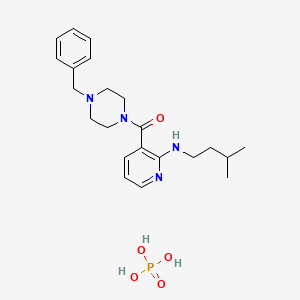
The exact mass of the free base is 366.24196 Da, its InChIKey is DYTOQURYRYYNOR-UHFFFAOYSA-N, and its SMILES string is CC(C)CCNC1=C(C=CC=N1)C(=O)N2CCN(CC2)CC3=CC=CC=C3. PubChem computes an XLogP3 of 4.2, a topological polar surface area of 48.5 Ų, one hydrogen-bond donor and four acceptors, and seven rotatable bonds. There are no stereocenters, so there are no left- and right-handed versions to keep track of.
Is NSI-189 a peptide?
No, and it is worth seeing why. A peptide is a chain of amino acids joined by amide bonds, with a backbone that repeats: nitrogen, carbon, carbonyl, again and again. NSI-189 does contain one amide bond, the joint between the pyridine carbonyl and the piperazine nitrogen. But one amide bond does not make a peptide. Neither half of the molecule is an amino acid, and there is no repeating backbone. It is two rings and a benzyl group, held together by a single link.
So where does the “peptide” idea come from? Mostly from company. NSI-189 is often listed beside true research peptides, and its letter-and-number code looks like a peptide code. Chemically, it belongs with the small heterocyclic amides.
NSI-189 phosphate vs. freebase: what’s the actual difference?
Here is a comparison worth slowing down for, because it is the question that brings many people to this page. The free base and the phosphate contain exactly the same organic molecule. The difference is a partner. The benzyl-substituted nitrogen of the piperazine ring is a tertiary amine, and amines are bases: they accept a proton. Add phosphoric acid, H3PO4, and that nitrogen picks up a proton to form a salt.
The numbers make it concrete. The free base is C22H30N4O at 366.5 g/mol (PubChem CID 50922681). Phosphoric acid is 97.995 g/mol (PubChem CID 1004). Together, as the 1:1 salt PubChem records for NSI-189 Phosphate, they make C22H33N4O5P at 464.5 g/mol (PubChem CID 50922680). Divide one by the other and the organic molecule accounts for about 79% of the 1:1 salt’s mass (366.5 ÷ 464.5), with phosphoric acid making up the rest. The two forms also carry different registry numbers: CAS 1270138-40-3 for the free base and CAS 1270138-41-4 for the phosphate.
One more detail keeps us honest. The synthesis patent measured the free base-to-counter-ion ratio by ion chromatography and found values from 1:1.6 to 1:2.3 in different batches of the salt it calls the mono-phosphate (US 9,278,933). The patent also notes that both mono and bis acid-addition salts can form. So the tidy 1:1 formula is the reference record, and a certificate that names the salt form is the best guide to any particular lot.
What does the phosphate salt look like in the lab? The data, side by side
The computed values below come from PubChem CIDs 50922680 and 50922681; the solid-state values come from the physical-properties section and Examples 5 and 6 of US 9,278,933.
| Property | NSI-189 Phosphate | NSI-189 Free Base |
|---|---|---|
| PubChem CID | 50922680 | 50922681 |
| CAS number | 1270138-41-4 | 1270138-40-3 |
| Formula | C22H33N4O5P | C22H30N4O |
| Molecular weight | 464.5 g/mol | 366.5 g/mol |
| Hydrogen-bond donors / acceptors (computed) | 4 / 8 | 1 / 4 |
| Topological polar surface area (computed) | 126 Ų | 48.5 Ų |
| Solid form in the patent | White crystalline solid | Light brown solid |
| DSC thermal event | One endotherm at 179 °C, consistent with a melt | Not reported |
| Water solubility (ambient) | Above 36 mg/mL | Not reported |
| Moisture sorption | 4.4 wt% at 60% RH; 11.2 wt% at 90% RH | Not reported |
What this tells us: adding phosphoric acid quadruples the hydrogen-bond donors and more than doubles the polar surface area, and the patent pairs that change with a crystalline solid that dissolves in water above 36 mg/mL. The patent also describes the salt as moderately hygroscopic, meaning it takes up some water from humid air. The free base, by contrast, is the lipophilic partner, with a computed XLogP3 of 4.2.
How is NSI-189 made? The patented route, step by step
The synthesis patent, originally assigned to Neuralstem, Inc., lays out the route in five steps (US 9,278,933). Here it is, one link at a time:
- Start with the pyridine. 2-Chloronicotinic acid is coupled with N-Boc-piperazine, either with the coupling agent TBTU or by first turning the acid into its acid chloride with thionyl chloride.
- Uncover one nitrogen. The Boc protecting group comes off with HCl in 2-propanol, leaving one free piperazine nitrogen as its hydrochloride.
- Add the benzyl group. That free nitrogen is benzylated with a benzyl compound carrying a leaving group. Because the benzyl group goes on late, the route never starts from 1-benzylpiperazine.
- Swap the chlorine for the side chain. Isoamylamine (3-methylbutylamine) displaces the chlorine at position 2 of the pyridine at 80–90 °C, giving the free base, which is purified as a slurry in heptanes.
- Form the salt. The free base is warmed in ethanol, phosphoric acid in ethanol is added, and the solution is seeded with the phosphate and cooled slowly. The patent reports that seeding was essential to establishing the proper crystal form.
The patent checks the reactions by HPLC and reports purities as area percent at 226 nm. That small detail says a great deal about how chemists think: you do not move to the next step until the chromatogram tells you the last one is finished.
What does NSI-189 bind to?
Here we have to be careful, and plain. The synthesis patent describes NSI-189 and its salts as neurogenesis agents, but it does not name a receptor or report a binding constant (US 9,278,933). The ChEMBL database lists the free base as CHEMBL4302505, and its activity entries are single-concentration screening percentages rather than Ki, EC50 or IC50 values (ChEMBL CHEMBL4302505). So the honest answer is that no molecular target for NSI-189 has been established with a published binding constant. That makes it an interesting case for target-identification work, and it is why this post spends its time on the chemistry we can verify.
Where do the names NSI-189 and amdiglurax come from?
“NSI-189” is the development code under which PubChem lists the compound. Its synthesis patent, which labels it compound 1E, was originally assigned to Neuralstem, Inc. (US 9,278,933). “Amdiglurax” is the International Nonproprietary Name, which PubChem lists for the free base, along with “amdiglurax phosphate” for the salt. The free base also carries the FDA UNII YVE9U408ZL, ChEBI CHEBI:228696, and the EPA DSSTox ID DTXSID901025668; the phosphate carries the UNII HX0VO60T62. When you check a certificate or a catalog page, the InChIKey is the quickest single confirmation: LWHMGALTTIYPJU-UHFFFAOYSA-N for the phosphate and DYTOQURYRYYNOR-UHFFFAOYSA-N for the free base.
What formats is NSI-189 supplied in for research?
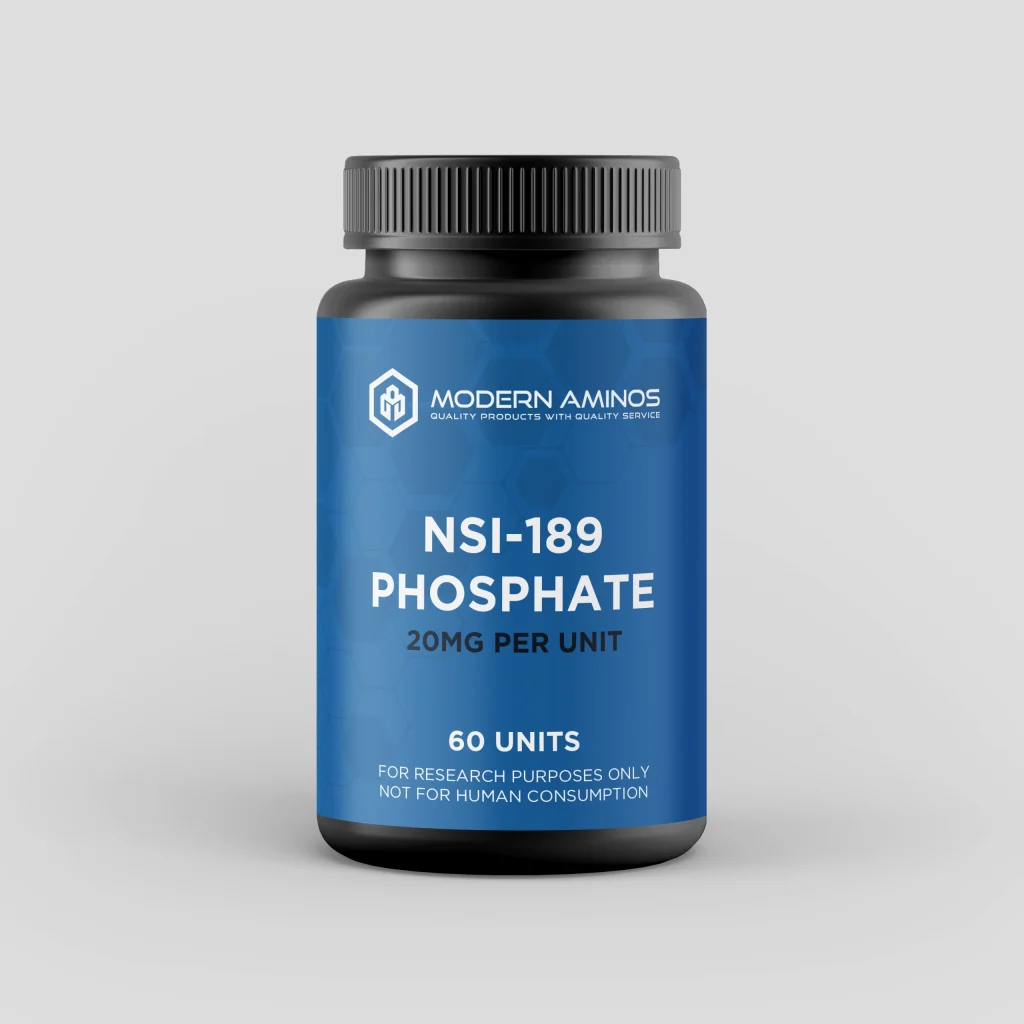
Modern Aminos lists one format on the NSI-189 Phosphate product page: dry-fill capsules, 60 per capsule bottle. The listing is the phosphate salt; a loose powder, liquid, or free base format is not offered. The third-party Vanguard Laboratory certificate for the capsules is in the Certificate of Analysis tab on that page.
What does the current certificate show?
One third-party Vanguard Laboratory report (A2LA certificate #6377.01.01) is published with the product, and all applicable tests are performed on our products. Looking ahead, upcoming batches receive expanded testing across two ISO-certified labs, covering Sterility, Identity, Purity, Endotoxin, Heavy Metals, Mass, Residual Solvents, Fentanyl and Conformity. For why chromatographic testing is the workhorse for reference materials, see the importance of HPLC testing.
Where NSI-189 sits among other neurochemistry research compounds
Think of neurochemistry reference compounds as a library with different shelves. On one shelf are enzyme inhibitors such as 9-Me-BC, a β-carboline that inhibits monoamine oxidase, explained in Is 9-Me-BC a Peptide? 9-Methyl-β-Carboline Explained. On another are receptor modulators such as TAK-653, which acts at AMPA-type glutamate receptors. NSI-189 sits on a third shelf with compounds defined mainly by their chemistry, next to PRL-8-53, an aminoethyl benzoate ester that, like NSI-189, carries an N-benzyl tertiary amine and forms a crystalline salt, as explained in Is PRL-8-53 a Peptide? Methyl Benzoate Ester Explained. Comparing shelves is one way to keep clear about what is known for each molecule and what is still waiting to be measured.
Frequently asked questions
What is NSI-189?
NSI-189 is a small synthetic benzylpiperazine–aminopyridine amide, C22H30N4O, 366.5 g/mol, CAS 1270138-40-3, with the nonproprietary name amdiglurax. NSI-189 Phosphate is the same molecule paired with phosphoric acid.
Is NSI-189 a peptide?
No. NSI-189 has one amide bond linking a substituted pyridine to a benzylpiperazine, but it has no amino-acid residues and no peptide backbone.
What is the difference between NSI-189 phosphate and freebase?
The free base is the neutral molecule, C22H30N4O at 366.5 g/mol. The phosphate adds phosphoric acid to give C22H33N4O5P at 464.5 g/mol as a 1:1 salt, and its synthesis patent describes it as a crystalline solid with water solubility above 36 mg/mL.
Is amdiglurax the same as NSI-189?
Yes. PubChem lists amdiglurax as the INN for the NSI-189 free base, CAS 1270138-40-3, and amdiglurax phosphate as a name for the phosphate salt, CAS 1270138-41-4.
What formats does Modern Aminos offer for NSI-189?
Modern Aminos offers NSI-189 Phosphate as dry-fill capsules, 60 per capsule bottle, with a third-party Vanguard Laboratory certificate in the product’s Certificate of Analysis tab.
References
- US Patent 9,278,933 B2. US9278933B2.
- National Library of Medicine. PubChem Compound Summary for CID 50922680, NSI-189 phosphate. https://pubchem.ncbi.nlm.nih.gov/compound/50922680.
- National Library of Medicine. PubChem Compound Summary for CID 50922681, NSI-189. https://pubchem.ncbi.nlm.nih.gov/compound/50922681.
- National Library of Medicine. PubChem Compound Summary for CID 1004, Phosphoric Acid. https://pubchem.ncbi.nlm.nih.gov/compound/1004.
- European Bioinformatics Institute. ChEMBL compound report card, CHEMBL4302505 (NSI-189). https://www.ebi.ac.uk/chembl/compound_report_card/CHEMBL4302505/.
NSI-189 is a good reminder that a molecule and its salt are close cousins, not strangers: the same organic structure, a different partner, and a different set of numbers on the label. For the certificate, the format, and the full chemical specification table, start at the NSI-189 Phosphate product page.