
Is GC-1 a Peptide?
Short answer: No. GC-1 is sobetirome, a small synthetic thyroid hormone analog made of two benzene rings joined by a one-carbon bridge, with an oxyacetic acid side chain and no amino-acid residues or peptide bonds. Its formula is C20H24O4, its molecular weight is 328.4 g/mol, its CAS number is 211110-63-3, and it is studied as a thyroid hormone receptor agonist that favors the beta isoform (TRβ) over the alpha isoform (TRα). If you need to buy GC-1 with a third-party certificate, Modern Aminos lists dry-fill capsules.
What is GC-1, chemically speaking?
Let’s build it on the bench, one piece at a time. Start with a benzene ring that carries a hydroxyl group, making it a phenol, and give that ring an isopropyl group right next door. Now take a second benzene ring, put a methyl group on each side of it, and hang an oxyacetic acid side chain, –O–CH2–COOH, from its far end. Finally, connect the two rings with a single CH2 bridge. That is the whole molecule. PubChem files it under CID 9862248, with the IUPAC name 2-[4-[(4-hydroxy-3-propan-2-ylphenyl)methyl]-3,5-dimethylphenoxy]acetic acid.
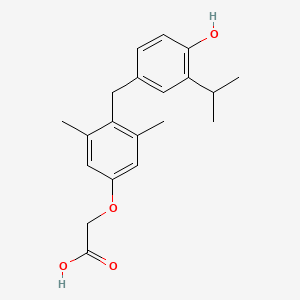
The exact mass is 328.16746 Da. The InChIKey is QNAZTOHXCZPOSA-UHFFFAOYSA-N, and the SMILES string is CC1=CC(=CC(=C1CC2=CC(=C(C=C2)O)C(C)C)C)OCC(=O)O. PubChem lists the names sobetirome, GC-1, GC 1 and QRX-431, along with the FDA UNII XQ31741E9Q, ChEBI CHEBI:79988 and the EPA DSSTox ID DTXSID60891557. There are no stereocenters, so there are no left- and right-handed versions to keep track of.
Why isn’t GC-1 a peptide?
A peptide is a chain of amino acids held together by amide bonds, the bonds chemists call peptide bonds. GC-1 has none of that. There is no backbone of repeating units, no amide group, and no amino group at all. It is two rings, one bridge, a handful of small groups, and one carboxylic acid.
So where does the “peptide” idea come from? Part of it is simply that GC-1 is sold alongside many true peptides, and its short letter-and-number name looks like a peptide code. Part of it is family history. GC-1 was designed from the thyroid hormone T3 (3,3′,5-Triiodo-L-Thyronine), which does carry an amino-acid side chain. The designers deliberately swapped that side chain for an oxyacetic acid side chain (Chiellini et al., 1998). So GC-1 is, if anything, one step further from the amino acids than the hormone it imitates.
How does GC-1 work? The thyroid hormone receptor, step by step
The clearest picture of GC-1 comes from its receptor. Here is the chain of reasoning, one link at a time:
- Meet the receptor. The thyroid hormone receptor (TR) belongs to the nuclear receptor superfamily of ligand-activated transcription regulators. Two different genes encode two receptors, TRα and TRβ (Chiellini et al., 1998).
- Notice the problem. Most thyroid hormones do not discriminate between the two TRs and bind both with similar affinities (Chiellini et al., 1998).
- Find the one difference. Inside the hormone-binding pocket, the two subtypes differ by a single amino acid: Asparagine in TRβ and Serine in TRα. Swapping that residue between the receptors suggests it accounts for most of the difference in binding (Wagner et al., 2001).
- Bring in GC-1. GC-1 binds TRβ1 with an affinity comparable to T3 and binds TRα1 with about 10-fold lower affinity (Bleicher et al., 2008), and it is selective in activation as well as binding (Chiellini et al., 1998).
- See it in the crystal. In TRβ, Asn331 holds Arg282 in one steady position, and Arg282 grips the GC-1 carboxylate. In TRα, Ser277 lets the matching Arginine, Arg228, flip into a second position, a water molecule has to bridge the gap, and GC-1 turns its carboxyl group to compensate (Bleicher et al., 2008).
What makes GC-1 different from T3 and DIMIT? The data, side by side
GC-1 has two close relatives worth knowing: the natural hormone T3 and DIMIT (3,5-Dimethyl-3′-isopropyl-L-Thyronine), the halogen-free Thyronine analog GC-1 was designed from (Yoshihara et al., 2003). Formula, molecular weight and computed values below come from PubChem CIDs 9862248, 5920 and 108112; the isoform row comes from Chiellini et al. (1998) and Yoshihara et al. (2003).
| Property | GC-1 (sobetirome) | T3 | DIMIT |
|---|---|---|---|
| PubChem CID | 9862248 | 5920 | 108112 |
| Formula | C20H24O4 | C15H12I3NO4 | C20H25NO4 |
| Molecular weight | 328.4 g/mol | 650.97 g/mol | 343.4 g/mol |
| Bridge between the rings | Methylene (CH2) | Ether oxygen | Ether oxygen |
| Side chain | Oxyacetic acid | L-Alanine (amino acid) | L-Alanine (amino acid) |
| Halogens | None | Three iodines | None |
| Stereocenters (computed) | 0 | 1 | 1 |
| Hydrogen-bond donors (computed) | 2 | 3 | 3 |
| TR isoform preference | Selective for TRβ | Similar affinity for both | Not selective |
What this tells us: DIMIT already has no iodines, yet it binds TR with lower affinity than GC-1 and does not tell the two isoforms apart. GC-1 makes two more changes, a CH2 bridge and an oxyacetic acid side chain. When chemists made analogs carrying only one of those two changes, the oxyacetic acid side chain turned out to be the one that matters for TRβ selectivity (Yoshihara et al., 2003). Losing the amino-acid side chain also removes the molecule’s only stereocenter.
GC-1 vs. T3: what’s the actual difference?
Here is a comparison worth slowing down for. T3 weighs almost twice as much as GC-1, and most of that difference is iodine: three heavy iodine atoms that GC-1 replaces with light methyl and isopropyl groups (Chiellini et al., 1998). Yet the two molecules sit in the same pocket and make the same anchoring hydrogen bond from their phenolic hydroxyl to a Histidine residue (Bleicher et al., 2008). The real difference is at the other end. T3’s amino group touches the Serine of TRα and the Asparagine of TRβ in much the same way, so T3 binds both receptors alike. GC-1 has no amino group there, and its oxyacetic acid tail fits the TRβ arrangement better. Expressed as a ratio, the TRβ-to-TRα affinity ratio is about 10-fold higher for GC-1 than for T3 (Zucchi, 2020).
Where do the names GC-1, sobetirome and QRX-431 come from?
“GC-1” is the code under which the compound was first reported in 1998 (Chiellini et al., 1998). “Sobetirome” is its nonproprietary name, listed by PubChem as both the INN and the USAN. “QRX-431” is another code name for the same molecule. In crystal structures in the Protein Data Bank, the ligand is filed under the three-character code B72. All of these names point to one structure, CAS 211110-63-3, and the InChIKey QNAZTOHXCZPOSA-UHFFFAOYSA-N is the quickest way to confirm it on any certificate or catalog page.
What do the crystal structures show?
X-ray crystallography lets us see where every atom of GC-1 sits inside the receptor. Bleicher and colleagues reported structures of both receptor isoforms bound to GC-1, alongside matching T3 complexes (Bleicher et al., 2008). The TRα complex with GC-1 was solved at 1.85 Å resolution in one crystal form and 2.50 Å in a second form, and the TRβ complex at 2.55 Å; the matching T3 complexes were solved at 1.87 Å and 2.30 Å. The pocket divides into three regions: a largely hydrophobic region with one Histidine residue that holds the phenol, an apolar region for the two rings, and a polar region where the oxyacetic acid sits beside three Arginine residues. That polar region holds the only residue that differs between the two isoforms, which is why the tail end of GC-1 carries the selectivity.
What formats is GC-1 supplied in for research?
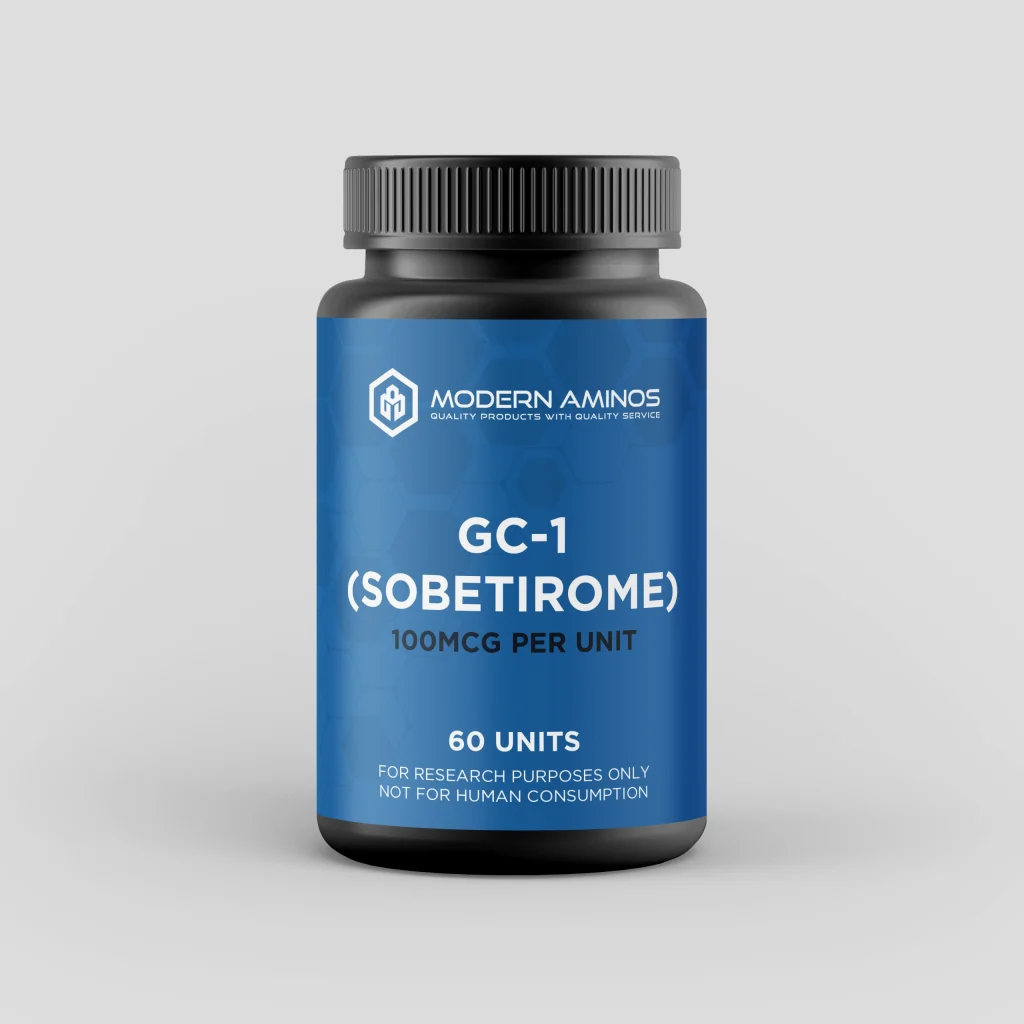
Modern Aminos lists one format on the GC-1 (Sobetirome) product page: dry-fill capsules. The third-party Vanguard Laboratory certificate for the current capsules is in the Certificate of Analysis tab on that page.
What does the current certificate show?
One third-party Vanguard Laboratory report (A2LA certificate #6377.01.01) is published with the product, and all applicable tests are performed on our products. Looking ahead, upcoming batches receive expanded testing across two ISO-certified labs, covering Sterility, Identity, Purity, Endotoxin, Heavy Metals, Mass, Residual Solvents, Fentanyl and Conformity. For why chromatographic testing is the workhorse for reference materials, see the importance of HPLC testing.
Where GC-1 sits among other metabolic pathway research compounds
Think of metabolic signaling as a building with several control rooms. On one floor are the nuclear receptors, proteins that read a small molecule and then turn genes on or off. GC-1 works there, at the thyroid hormone receptor, and SLU-PP-332 works in a neighboring room at the estrogen-related receptors. On another floor are the enzymes that steer fuel through the mitochondria. DADA works there, inhibiting pyruvate dehydrogenase kinase, as explained in Is DADA a Peptide?. Different floors, different switches: comparing them is one way to tell what belongs to the receptor and what belongs to the enzyme.
Frequently asked questions
Is GC-1 a peptide?
No. GC-1 is sobetirome, a small synthetic thyroid hormone analog built from two benzene rings joined by a single carbon bridge. It has no amino-acid residues and no peptide bonds.
What is GC-1 made of?
GC-1 has a phenol ring carrying an isopropyl group, a second ring carrying two methyl groups and an oxyacetic acid side chain, and a methylene bridge between them. That gives the formula C20H24O4 and a molecular weight of 328.4 g/mol (PubChem CID 9862248).
Is GC-1 the same as sobetirome?
Yes. GC-1 is the original research code, sobetirome is the nonproprietary (INN and USAN) name, and QRX-431 is another code for the same molecule. All three point to CAS 211110-63-3 and PubChem CID 9862248.
What does GC-1 bind to?
GC-1 binds the thyroid hormone receptor, a nuclear receptor. It binds the beta isoform (TRβ1) with an affinity comparable to the natural hormone T3 and the alpha isoform (TRα1) with about 10-fold lower affinity.
What formats does Modern Aminos offer for GC-1?
Modern Aminos offers GC-1 as dry-fill capsules, with a third-party Vanguard Laboratory certificate in the product’s Certificate of Analysis tab. All applicable tests are performed on our products.
References
- Chiellini G, Apriletti JW, Yoshihara HA, Baxter JD, Ribeiro RC, Scanlan TS. A high-affinity subtype-selective agonist ligand for the thyroid hormone receptor. Chem Biol. 1998;5(6):299-306. PMID 9653548.
- Wagner RL, Huber BR, Shiau AK, et al. Hormone selectivity in thyroid hormone receptors. Mol Endocrinol. 2001;15(3):398-410. PMID 11222741.
- Yoshihara HA, Apriletti JW, Baxter JD, Scanlan TS. Structural determinants of selective thyromimetics. J Med Chem. 2003;46(14):3152-3161. PMID 12825953.
- Bleicher L, Aparicio R, Nunes FM, et al. Structural basis of GC-1 selectivity for thyroid hormone receptor isoforms. BMC Struct Biol. 2008;8:8. PMC2275733. PMID 18237438.
- Zucchi R. Thyroid hormone analogues: an update. Thyroid. 2020;30(8):1099-1105. PMC7415871. PMID 32098589.
- National Library of Medicine. PubChem Compound Summary for CID 9862248, Sobetirome. https://pubchem.ncbi.nlm.nih.gov/compound/9862248.
- National Library of Medicine. PubChem Compound Summary for CID 5920, Liothyronine (T3). https://pubchem.ncbi.nlm.nih.gov/compound/5920.
- National Library of Medicine. PubChem Compound Summary for CID 108112, 3,5-Dimethyl-3′-isopropyl-L-Thyronine (DIMIT). https://pubchem.ncbi.nlm.nih.gov/compound/108112.
GC-1 is a small molecule with a clear lesson inside it: keep the parts of a hormone that the receptor needs, change the parts that both receptors share, and a single pocket residue can do the sorting. For the certificate, the format, and the full chemical specification table, start at the GC-1 (Sobetirome) product page.