
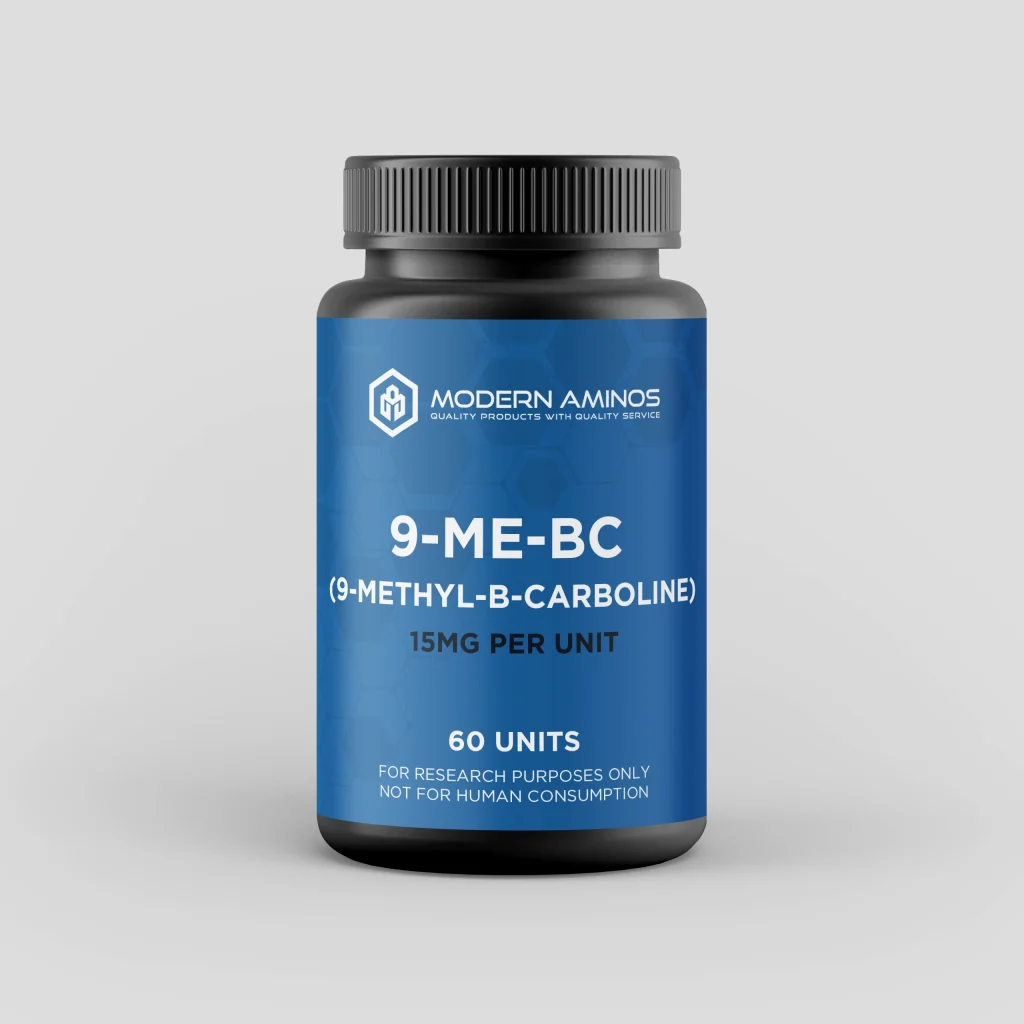
Is 9-Me-BC a Peptide?
Short answer: No. 9-Me-BC is 9-methyl-β-carboline (9-methylpyrido[3,4-b]indole), a small, flat, three-ring aromatic molecule with no amino-acid residues and no peptide bonds. Its formula is C12H10N2, its molecular weight is 182.22 g/mol, its CAS number is 2521-07-5, and it is studied as a monoamine oxidase (MAO) inhibitor from the β-carboline family. If you need to buy 9-Me-BC with a third-party certificate, Modern Aminos lists 15 mg dry-fill capsules.
What is 9-Me-BC, chemically speaking?
Let’s build it on the bench, one ring at a time. Start with indole: a benzene ring fused to a five-membered ring that holds one nitrogen. Now fuse a six-membered pyridine ring, with its own nitrogen, onto the far side of that five-membered ring. Those three rings, lying flat in one plane, are the β-carboline skeleton, also called 9H-pyrido[3,4-b]indole or norharmane. Finally, put a single methyl group on the indole nitrogen, the atom chemists number 9. That is the whole molecule. PubChem files it under CID 164979, with the IUPAC name 9-methylpyrido[3,4-b]indole.
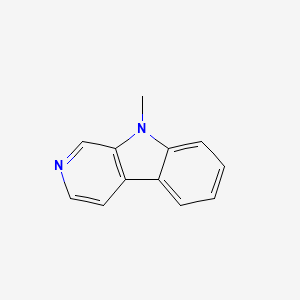
The exact mass is 182.08440 Da. The InChIKey is MABOIYXDALNSES-UHFFFAOYSA-N, and the SMILES string is CN1C2=CC=CC=C2C3=C1C=NC=C3. PubChem lists the synonyms 9-methylnorharmane, N-methylnorharmane, and 9-methyl-9H-β-carboline, along with the FDA UNII GC837J2CCJ and the EPA DSSTox ID DTXSID50179871. There are no stereocenters, so there are no left- and right-handed versions to keep track of.
Why isn’t 9-Me-BC a peptide?
A peptide is a chain of amino acids held together by amide bonds, the bonds chemists call peptide bonds. 9-Me-BC has none of that. There is no backbone of repeating units, no amide group, no carboxyl group, and no amino group. Every atom is part of one rigid, fused ring system, plus one methyl group.
So where does the “peptide” idea come from? Part of it is simply that 9-Me-BC is sold alongside many true peptides. Part of it is family history. The indole half of a β-carboline is the same ring system found in the amino acid L-Tryptophan, and β-carbolines are described as a large group of natural and synthetic indole alkaloids (Cao et al., 2007). Sharing a ring with an amino acid, though, does not make a molecule a peptide, any more than sharing a wheel makes a wagon into a bicycle.
How does 9-Me-BC work? Monoamine oxidase, step by step
The clearest enzyme-level picture of 9-Me-BC involves monoamine oxidase. Here is the chain of reasoning, one link at a time:
- Meet the enzyme. MAO is a flavin adenine dinucleotide (FAD) enzyme on the outer membrane of mitochondria. It catalyzes the oxidative deamination of biogenic and xenobiotic amines (Herraiz and Chaparro, 2006).
- Know the two forms. MAO comes as two isoforms, MAO-A and MAO-B, which researchers measure separately with selective reference inhibitors.
- Notice what β-carbolines do. In HPLC kinetic assays with recombinant MAO, the fully aromatic β-carbolines norharman and harman acted as good MAO inhibitors and were not themselves modified by the enzyme (Herraiz and Chaparro, 2006).
- Add the N9 methyl. 9-Methylnorharman, which is 9-Me-BC, inhibited MAO-B-mediated oxidation of the reference substrate MPTP in mitochondrial preparations with an IC50 of 7.3 µM, close to the parent norharman at 9.9 µM (Herraiz and Guillén, 2011).
- Look at both isoforms. Separate isolated-enzyme IC50 values for MAO-A and MAO-B, which show MAO-A inhibited at lower concentrations, are collected with their source on the 9-Me-BC product page.
How does the methyl group change the molecule? The data, side by side
A single methyl group sounds like a small change, and in size it is. In chemistry, though, where you put it matters a great deal. The table below sets 9-Me-BC beside its unsubstituted parent, norharmane, and its isomer, harmane. Formula, molecular weight, and computed properties come from PubChem CIDs 164979, 64961, and 5281404; the MPTP-oxidation values come from Herraiz and Guillén (2011).
| Property | 9-Me-BC | Norharmane | Harmane |
|---|---|---|---|
| PubChem CID | 164979 | 64961 | 5281404 |
| Formula | C12H10N2 | C11H8N2 | C12H10N2 |
| Molecular weight | 182.22 g/mol | 168.19 g/mol | 182.22 g/mol |
| Where the methyl group sits | N9 (indole nitrogen) | none | C1 (ring carbon) |
| Hydrogen-bond donors (computed) | 0 | 1 | 1 |
| Topological polar surface area | 17.8 Ų | 28.7 Ų | 28.7 Ų |
| XLogP3 (computed) | 2.3 | 3.2 | 3.6 |
| IC50, MAO-B-mediated MPTP oxidation | 7.3 µM | 9.9 µM | not reported in this source |
What this tells us: putting the methyl group on nitrogen 9 removes the molecule’s only N-H hydrogen, so 9-Me-BC can accept a hydrogen bond at its pyridine nitrogen but cannot donate one. That also shrinks its polar surface area. Yet in the MAO-B assay, 9-Me-BC and norharmane landed in the same low-micromolar range, 7.3 µM and 9.9 µM, so removing that N-H did not move the measured value far.
9-Me-BC vs. harmane: what’s the actual difference?
Here is a puzzle worth slowing down for. 9-Me-BC and harmane have the same formula, C12H10N2, and the same molecular weight, 182.22 g/mol. A balance cannot tell them apart. The difference is location: harmane carries its methyl group on carbon 1, next to the pyridine nitrogen, while 9-Me-BC carries it on the indole nitrogen (PubChem CID 5281404). That one move gives harmane an N-H hydrogen that 9-Me-BC lacks. When a certificate, catalog page, or paper reaches your desk, the InChIKey is the fastest check: MABOIYXDALNSES-UHFFFAOYSA-N belongs to 9-Me-BC alone.
Where do the names 9-Me-BC, 9MeBC, and N-methylnorharmane come from?
“9-Me-BC” is shorthand for 9-methyl-β-carboline, with the 9 marking the nitrogen that carries the methyl group. “9MeBC” and “9 Me BC” are the same abbreviation typed without hyphens. Because the parent ring is called norharmane (or norharman), the same molecule is also 9-methylnorharmane or N-methylnorharmane. Photophysics papers often shorten it to MBC (Sánchez Coronilla et al., 2009). In web addresses, the Greek letter β is usually spelled out as “beta.”
How does 9-Me-BC behave with acid and light?
The free pyridine nitrogen is where the chemistry of 9-Me-BC in water happens. In water and N,N-dimethylformamide mixtures, it picks up a proton in both the ground state and the excited state through a series of hydrogen-bonded water adducts (Sánchez Coronilla et al., 2009). Acid dissociation constants, absorption and fluorescence spectra, fluorescence lifetimes, and singlet-oxygen yields for 9-methyl-β-carbolines have been measured from pH 4.0 to 14.5 (Rasse-Suriani et al., 2018). β-Carbolines also absorb ultraviolet light well: photoexcited 9-methyl-β-carbolines act as UVA photosensitizers, and at neutral pH most of the DNA photodamage they produce comes from the protonated excited form (Vignoni et al., 2013).
What formats is 9-Me-BC supplied in for research?
Modern Aminos lists one format on the 9-Me-BC product page: 15 mg dry-fill capsules, 60 units per capsule bottle. The third-party Vanguard Laboratory certificate for the current capsules is in the Certificate of Analysis tab on that page.
What does the current certificate show?
One Vanguard Laboratory report (A2LA certificate #6377.01.01) is published with the product. It covers the 15 mg/unit capsules (Lab ID V260513-21 001, reported 5/27/2026) and lists HPLC-UV/VIS per-unit quantity results for three sampled capsules. Every batch of 9-Me-BC undergoes strict third-party analytical testing (including HPLC and Mass Spectrometry) to verify minimum 98%+ purity, correct molecular weight (182.22 g/mol), and complete absence of unreacted synthetic impurities or heavy metals. No storage temperature is printed on the certificate, so none is given here. For why chromatographic testing is the workhorse for reference materials, see the importance of HPLC testing.
Where 9-Me-BC sits among other dopamine-pathway research compounds
Think of dopamine chemistry as a short assembly line with several stations. At the receptor station sits L-THP, a tetrahydroprotoberberine alkaloid that occupies dopamine receptors without activating them, explained in What Is L-THP?. At the synthesis station sits Bromantane, an adamantane amine linked to Tyrosine Hydroxylase transcription and covered in Is Bromantane a Peptide?. 9-Me-BC works at the cleanup station, where MAO enzymes oxidize monoamines. Three different scaffolds, three different stations: comparing them is one way to tell what belongs to the pathway and what belongs to the molecule.
Frequently asked questions
Is 9-Me-BC a peptide?
No. 9-Me-BC is 9-methylpyrido[3,4-b]indole, a small tricyclic aromatic heterocycle with no amino-acid residues and no peptide bonds. It belongs to the β-carboline family of indole alkaloids.
What is 9-Me-BC made of?
9-Me-BC is a β-carboline ring, an indole fused to a pyridine, with one methyl group on the indole nitrogen. That gives the formula C12H10N2 and a molecular weight of 182.22 g/mol (PubChem CID 164979).
Is 9-Me-BC the same as harmane?
No. Harmane is 1-methyl-β-carboline, with the methyl group on carbon 1. 9-Me-BC has the methyl group on nitrogen 9. The two share the formula C12H10N2 and the molecular weight 182.22 g/mol, but they are different molecules with different InChIKeys.
What is the mechanism of action of 9-Me-BC?
9-Me-BC is studied as a monoamine oxidase (MAO) inhibitor. In mitochondrial preparations, 9-methylnorharman inhibited MAO-B-mediated oxidation of the reference substrate MPTP with an IC50 of 7.3 µM, close to its parent norharman at 9.9 µM.
What formats does Modern Aminos offer for 9-Me-BC?
Modern Aminos offers 9-Me-BC as 15 mg dry-fill capsules, 60 units per capsule bottle, with a third-party Vanguard Laboratory HPLC-UV/VIS quantity certificate in the product’s Certificate of Analysis tab.
References
- Herraiz T, Guillén H. Inhibition of the bioactivation of the neurotoxin MPTP by antioxidants, redox agents and monoamine oxidase inhibitors. Food Chem Toxicol. 2011;49(8):1773-1781. DOI 10.1016/j.fct.2011.04.026 / PMID 21554916.
- Herraiz T, Chaparro C. Analysis of monoamine oxidase enzymatic activity by reversed-phase high performance liquid chromatography and inhibition by β-carboline alkaloids occurring in foods and plants. J Chromatogr A. 2006;1120(1-2):237-243. DOI 10.1016/j.chroma.2005.12.009 / PMID 16386263.
- Cao R, Peng W, Wang Z, Xu A. β-Carboline alkaloids: biochemical and pharmacological functions. Curr Med Chem. 2007;14(4):479-500. DOI 10.2174/092986707779940998 / PMID 17305548.
- Sánchez Coronilla A, Carmona C, Muñoz MA, Balón M. Ground and singlet excited state pyridinic protonation of N9-methylbetacarboline in water-N,N-dimethylformamide mixtures. J Fluoresc. 2009;19(6):1025-1035. DOI 10.1007/s10895-009-0502-y / PMID 19536642.
- Rasse-Suriani FAO, García-Einschlag FS, Rafti M, et al. Photophysical and photochemical properties of naturally occurring normelinonine F and melinonine F alkaloids and structurally related N(2)- and/or N(9)-methyl-β-carboline derivatives. Photochem Photobiol. 2018;94(1):36-51. DOI 10.1111/php.12811 / PMID 28741707.
- Vignoni M, Rasse-Suriani FA, Butzbach K, et al. Mechanisms of DNA damage by photoexcited 9-methyl-β-carbolines. Org Biomol Chem. 2013;11(32):5300-5309. DOI 10.1039/c3ob40344k / PMID 23842892.
- National Library of Medicine. PubChem Compound Summary for CID 164979, 9-Methyl-beta-carboline. https://pubchem.ncbi.nlm.nih.gov/compound/164979.
- National Library of Medicine. PubChem Compound Summary for CID 64961, Beta-Carboline (norharmane). https://pubchem.ncbi.nlm.nih.gov/compound/64961.
- National Library of Medicine. PubChem Compound Summary for CID 5281404, Harman. https://pubchem.ncbi.nlm.nih.gov/compound/5281404.
9-Me-BC is a small molecule with a simple story: three fused rings, one methyl group in a telling place, and a well-documented interest in monoamine oxidase. For the certificate, the format, and the full chemical specification table, start at the 9-Me-BC product page.