
Is GB-115 a Peptide?
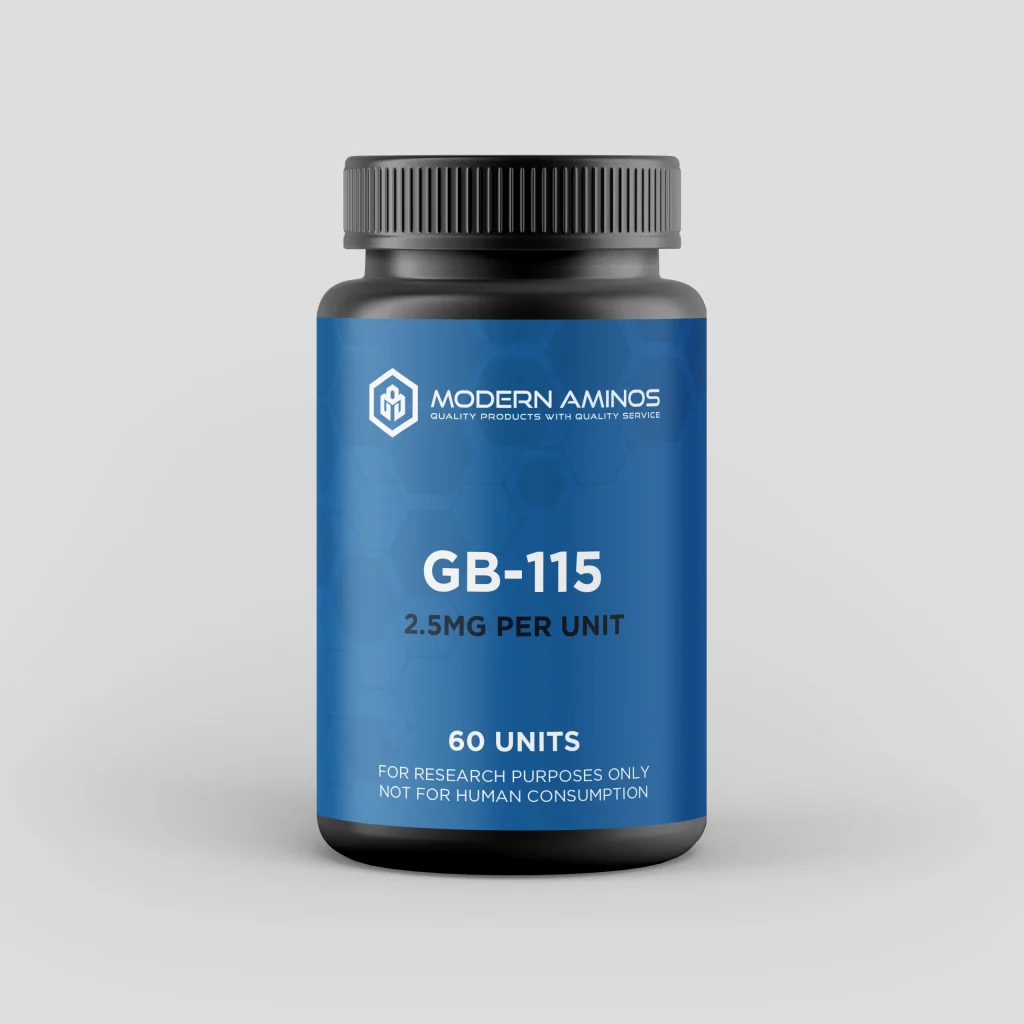
Short answer: Yes, in the chemical sense. GB-115 is N-(6-phenylhexanoyl)glycyl-L-Tryptophan amide, a modified dipeptide in which Glycine and L-Tryptophan are joined by one peptide bond, the N-terminus carries a 6-phenylhexanoyl cap, and the C-terminus is an amide. Its formula is C25H30N4O3, its molecular weight is 434.5 g/mol, its CAS number is 678996-63-9, and it was designed as a retro-analog of the cholecystokinin tetrapeptide CCK-4. If you need to buy GB-115 with lot certificates, Modern Aminos lists 2.5 mg dry-fill capsules.
What is GB-115, chemically speaking?
Let’s take the name apart one piece at a time, the way you might label the parts of a model on a classroom bench. Start at the right-hand end with L-Tryptophan, the amino acid that carries an indole ring. Its carboxyl group has been converted to a primary amide. Move one step left and you reach Glycine, the smallest amino acid, linked to Tryptophan through a peptide bond. At the far left, a six-carbon acyl chain that ends in a benzene ring, the 6-phenylhexanoyl group, sits on Glycine’s nitrogen. PubChem files the whole molecule under CID 11281948, with the IUPAC name N-[2-[[(2S)-1-amino-3-(1H-indol-3-yl)-1-oxopropan-2-yl]amino]-2-oxoethyl]-6-phenylhexanamide.
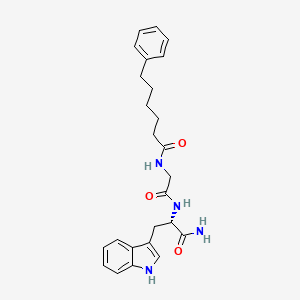
The exact mass is 434.23179 Da. The InChIKey is ZBIQNIJICMOVKN-QFIPXVFZSA-N, and the isomeric SMILES is C1=CC=C(C=C1)CCCCCC(=O)NCC(=O)N[C@@H](CC2=CNC3=CC=CC=C32)C(=O)N. PubChem also lists the synonyms GB115, (−)-GB-115, and N-(1-oxo-6-phenylhexyl)glycyl-L-Tryptophanamide, along with the FDA UNII G5YT2F7SG8. Those identifiers are what you check first when a certificate, paper, or catalog entry reaches your desk.
Is GB-115 a dipeptide, a tripeptoid, or something else?
A peptide is a chain of amino acids held together by amide bonds that chemists call peptide bonds. By that definition GB-115 qualifies: it has two amino-acid residues and one peptide bond between them. What makes it unusual is everything around that core. The N-terminal cap is not an amino acid at all, and the C-terminus is amidated rather than left as a free acid.
That is why the literature uses more than one label. The conformational study calls GB-115 a “cholecystokinin-4 dipeptide analogue” (Gudasheva et al., 2013), while its developers’ review calls it a “tripeptoid analog of CCK-4,” because the phenylhexanoyl piece was chosen to fill the space of a Phe-Gly fragment and so stands in for a third residue (Gudasheva et al., 2018). All of these labels describe the same molecule. They simply look at it from different sides.
How was GB-115 designed? From CCK-4, step by step
The design of GB-115 is one of the clearest worked examples of peptide design in print, and it is laid out in an open-access review from the V.V. Zakusov Research Institute of Pharmacology in Moscow (Gudasheva et al., 2018, PMC6302556). Here is the sequence of moves:
- Start with CCK-4. The parent is cholecystokinin tetrapeptide, Trp-Met-Asp-Phe-NH2, the C-terminal four residues of cholecystokinin (PubChem CID 446569, indexed as tetragastrin).
- Apply the topochemical principle. An L-amino-acid peptide written in reverse order can keep the same spatial arrangement of side chains as the same sequence built from D-amino acids. Reversing CCK-4 gave the retro sequence Phe-Asp-Met-Trp-NH2.
- Keep the aromatic anchors and simplify the middle. Because hydrophobic contacts were taken as central to receptor recognition, the designers kept Phe and Trp and replaced the two internal residues with Gly-Gly, giving Phe-Gly-Gly-Trp-NH2.
- Swap a fragment for a sturdier mimic. The Phe-Gly fragment was replaced with a topologically equivalent 6-phenylhexanoyl group to increase biological stability, while the distance between the phenyl and indolyl groups stayed the same.
- Arrive at GB-115. The result is C6H5(CH2)5CO-Gly-Trp-NH2.
The same review reports that in the GB-115 homolog series, shortening the phenyl-to-indolyl distance by a single CH2 group gave a tenfold decrease in activity. One carbon atom made that much difference, which tells you how carefully the spacing was tuned.
What shape does GB-115 take, and why does the L-Tryptophan matter?
Peptides fold, even very short ones. Using 1H NMR conformational analysis in solution, nuclear Overhauser effect measurements, and a set of sterically restricted analogs, the Zakusov group identified a type II β-turn as the biologically active conformation of GB-115 (Gudasheva et al., 2013).
Handedness matters too. GB-115 has one defined stereocenter, the (2S) α-carbon of L-Tryptophan, and that is the form PubChem records. The design review notes that the D-Tryptophan enantiomer, consistent with the topochemical principle, behaves like CCK-4 itself and matches its pharmacophore arrangement in modeling (Gudasheva et al., 2018). So the mirror-image molecule is not a spare copy. It is a different research tool.
The table below sets GB-115 beside its parent peptide. Formula, molecular weight, stereocenter, and computed property values come from PubChem CIDs 11281948 and 446569; the sequences come from the design review.
| Property | GB-115 | CCK-4 (tetragastrin) |
|---|---|---|
| Sequence | Ph(CH2)5CO-Gly-L-Trp-NH2 | Trp-Met-Asp-Phe-NH2 |
| Formula | C25H30N4O3 | C29H36N6O6S |
| Molecular weight | 434.5 g/mol | 596.7 g/mol |
| Amino-acid residues | 2 (Gly, L-Trp) | 4 (Trp, Met, Asp, Phe) |
| Defined stereocenters | 1 | 4 |
| XLogP3 (computed) | 3 | −2.1 |
| Topological polar surface area | 117 Ų | 235 Ų |
What this tells us: GB-115 keeps the two aromatic side chains that matter for recognition while shedding half of the residues, three of the four stereocenters, and much of the polarity. On paper, it is a far more compact and lipophilic way to present the same pharmacophore pair.
GB-115 vs. CCK-4: what’s the actual difference?
CCK-4 is the C-terminal fragment of cholecystokinin, and cholecystokinin peptides signal through two G protein-coupled receptors, CCK1 and CCK2 (Dufresne et al., 2006). GB-115 was designed to act at the same receptors as CCK-4 (Gudasheva et al., 2018), and the pharmacology literature classifies it as a cholecystokinin-receptor antagonist; the receptor-level citations are collected on the GB-115 product page. Structurally, CCK-4 carries Met and Asp in the middle and an amidated Phe at its C-terminus. GB-115 replaces that middle with Glycine and a hydrocarbon spacer and ends in an amidated Tryptophan. No PubMed-indexed radioligand Ki or IC50 for GB-115 at either receptor subtype was found as of October 2026, so the comparison here stays with structure and receptor class.
Where does the name Ranquilon come in?
GB-115 is a development code from the Zakusov Institute’s dipeptide program, the same program that produced Noopept and Dilept (Gudasheva et al., 2018). Ranquilon is a later name for the same compound, N-(6-phenylhexanoyl)glycyl-L-Tryptophan amide. If you meet “D-GB-115” in a paper, that is the D-Tryptophan enantiomer, not the L-form that PubChem records under CID 11281948.
What formats is GB-115 supplied in for research?
Modern Aminos lists three formats on the GB-115 product page: 2.5 mg capsules (60 units), 5 mg/mL liquid (30 mL precision dropper), and 2 mg/mL atomizer (5 mL premixed atomizer). The third-party Vanguard Laboratory certificates for the current lots are in the Certificate of Analysis tab on that page.
What do the current lot certificates show?
Two Vanguard Laboratory reports (A2LA certificate #6377.01.01) are published with the product. The bulk powder lot GB2510A (Lab ID V260112-6 001, reported 1/28/2026) lists HPLC-UV/VIS chromatographic purity of >99.80% (± 0.18%). The capsule lot BX-C-Z8R1 (Lab ID V260216-4 012, reported 3/16/2026) lists HPLC-UV/VIS per-capsule quantity results. Neither report prints a mass-spectrometry identity result, a heavy-metal panel, or a storage temperature, so none of those are claimed here. For why chromatographic testing is the workhorse for reference materials, see the importance of HPLC testing.
Where GB-115 sits among other peptide-derived research compounds
It helps to picture a shelf arranged from the simplest peptides to the most modified. Near one end sit short peptides without caps, such as Vilon, a Lys-Glu dipeptide, and Pinealon, the Glu-Asp-Arg tripeptide covered in What Is Pinealon?. Further along sit capped peptide amides like GB-115 and Dihexa, which is also N-acylated and C-amidated but is derived from angiotensin IV rather than CCK-4. At the far end are compounds that only borrow the word “peptide” in search results, such as the adamantane amine explained in Is Bromantane a Peptide?. GB-115 belongs firmly on the peptide side of that shelf.
Frequently asked questions
Is GB-115 a peptide?
Yes, in the chemical sense. GB-115 is a modified dipeptide: Glycine and L-Tryptophan joined by one peptide bond, with a 6-phenylhexanoyl cap on the N-terminus and a primary amide at the C-terminus.
What is GB-115 made of?
GB-115 is built from three pieces: a 6-phenylhexanoyl group, a Glycine residue, and an L-Tryptophan amide. Together they give the formula C25H30N4O3 and a molecular weight of 434.5 g/mol (PubChem CID 11281948).
Is GB-115 the same as Ranquilon?
Yes. Ranquilon is a later name for GB-115, N-(6-phenylhexanoyl)glycyl-L-Tryptophan amide, CAS 678996-63-9.
How is GB-115 related to CCK-4?
GB-115 was designed from the cholecystokinin tetrapeptide CCK-4 (Trp-Met-Asp-Phe-NH2) by reversing the sequence, replacing the middle residues with a spacer, and swapping the Phe-Gly fragment for a 6-phenylhexanoyl group, while keeping the phenyl and indolyl groups at their native distance.
What formats does Modern Aminos offer for GB-115?
Modern Aminos offers 2.5 mg capsules (60 units), 5 mg/mL liquid (30 mL precision dropper), and 2 mg/mL atomizer (5 mL premixed atomizer), with third-party Vanguard Laboratory certificates in the product’s Certificate of Analysis tab.
References
- Gudasheva TA, Ostrovskaya RU, Seredenin SB. Novel Technologies for Dipeptide Drugs Design and their Implantation. Curr Pharm Des. 2018;24(26):3020-3027. PMC6302556 / PMID 30295186.
- Gudasheva TA, et al. A study of the biologically active conformation of the cholecystokinin-4 dipeptide analogue GB-115. Russ J Bioorg Chem. 2013;39(3):259-267. DOI 10.1134/S1068162013030060 / PMID 24397028.
- Dufresne M, Seva C, Fourmy D. Cholecystokinin and gastrin receptors. Physiol Rev. 2006;86(3):805-847. PMID 16816139.
- National Library of Medicine. PubChem Compound Summary for CID 11281948, GB-115. https://pubchem.ncbi.nlm.nih.gov/compound/11281948.
- National Library of Medicine. PubChem Compound Summary for CID 446569, Tetragastrin. https://pubchem.ncbi.nlm.nih.gov/compound/446569.
GB-115 is a small, carefully engineered peptide: two amino acids, one peptide bond, a hydrocarbon cap, and an amide end, all arranged to echo CCK-4. For lot certificates, the formats, and the full chemical specification table, start at the GB-115 product page.