
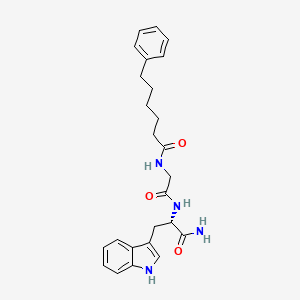
GB-115 (N-(6-phenylhexanoyl)glycyl-L-Tryptophan amide / Ranquilon) is an N-acylated dipeptide amide and cholecystokinin (CCK) receptor antagonist reference compound for neuropeptide receptor research. Designed as a retro-analog of the CCK-4 tetrapeptide, GB-115 keeps the phenyl and indolyl pharmacophores of CCK-4 at their native spacing on a shorter, more stable Gly-Trp amide backbone. CAS 678996-63-9.
$54.00


GB-115 (N-(6-phenylhexanoyl)glycyl-L-Tryptophan amide, also called GB115, Ranquilon, and N-(1-oxo-6-phenylhexyl)glycyl-L-Tryptophanamide; CAS 678996-63-9) is a synthetic N-acylated dipeptide amide. It is a cholecystokinin (CCK) receptor antagonist reference compound designed from the structure of cholecystokinin tetrapeptide (CCK-4, Trp-Met-Asp-Phe-NH2). GB-115 is a peptide in the chemical sense: Glycine and L-Tryptophan are joined by a single peptide bond, the N-terminus is capped with 6-phenylhexanoic acid, and the C-terminus is a primary amide. Its activity in the published literature comes from two aromatic pharmacophores, a phenyl ring and an indole ring, held at the same spacing they have in CCK-4.
Its design route is documented by the group that created it at the V.V. Zakusov Research Institute of Pharmacology. Applying the topochemical principle to CCK-4 gave the retro sequence Phe-Asp-Met-Trp-NH2; the two internal residues were replaced with a Gly-Gly spacer, and the Phe-Gly fragment was then replaced with a topologically equivalent 6-phenylhexanoyl group to increase biological stability, keeping the phenyl-to-indolyl distance of the parent peptide. In the homolog series, shortening that distance by a single CH2 group gave a tenfold decrease in activity (Gudasheva et al., 2018, PMC6302556). That is what GB-115 does at the molecular level: it presents the CCK-4 pharmacophore pair on a capped, two-residue backbone.
Batch-verified at Modern Aminos, GB-115 is supplied in three laboratory formats:
Laboratories building neuropeptide-receptor and peptide-design assay panels often place GB-115 next to other public reference listings such as Vilon, Pinealon, Dihexa, and TAK-653, as well as Selank and Noopept. For a closer look at whether GB-115 is a peptide, see Is GB-115 a Peptide? N-(6-Phenylhexanoyl)glycyl-L-Tryptophan Amide Explained.
| Compound Name | GB-115 |
|---|---|
| Research Category | Cholecystokinin (CCK) receptor antagonist reference compound; N-acylated dipeptide amide (CCK-4 retro-analog); neuropeptide receptor and peptide-design research |
| Quantity / Formats Offered | 2.5 mg Capsules (60 units) | 5 mg/mL Liquid (30 mL Precision Dropper) | 2 mg/mL Atomizer (5 mL Premixed Atomizer) |
| Peptide Sequence | 6-phenylhexanoyl-Gly-L-Trp-NH2 (C6H5(CH2)5CO-Gly-Trp-NH2); one peptide bond, N-acyl cap, C-terminal amide |
| Synonyms / Alt Names | GB115; Ranquilon; N-(6-phenylhexanoyl)glycyl-L-Tryptophan amide; N-(1-oxo-6-phenylhexyl)glycyl-L-Tryptophanamide; (−)-GB-115; CCK-4 retro-dipeptide analog |
| CAS Number | 678996-63-9 |
| PubChem CID | 11281948 |
| UNII | G5YT2F7SG8 |
| EPA DSSTox Substance ID | DTXSID70461104 |
| Chemical Formula | C25H30N4O3 |
| Molecular Weight | 434.5 g/mol (PubChem); 434.54 g/mol from standard atomic weights |
| Exact Mass | 434.23179 Da |
| Stereochemistry | One defined stereocenter: (2S) at the Tryptophan α-carbon (L-Tryptophan) |
| Computed Properties (PubChem) | XLogP3 3; TPSA 117 Ų; hydrogen-bond donors 4; hydrogen-bond acceptors 3; rotatable bonds 12 |
| IUPAC Name | N-[2-[[(2S)-1-amino-3-(1H-indol-3-yl)-1-oxopropan-2-yl]amino]-2-oxoethyl]-6-phenylhexanamide |
| InChIKey | ZBIQNIJICMOVKN-QFIPXVFZSA-N |
| SMILES Code | C1=CC=C(C=C1)CCCCCC(=O)NCC(=O)N[C@@H](CC2=CNC3=CC=CC=C32)C(=O)N |
Identity fields are drawn from PubChem CID 11281948; purity and quantity values come from the lot certificates in the Certificate of Analysis tab.
The biochemical targets and design logic of GB-115 in laboratory research include:
| Assay Parameter | GB-115 | CCK-4 (tetragastrin) | Source |
|---|---|---|---|
| Sequence / structure | Ph(CH2)5CO-Gly-L-Trp-NH2 | Trp-Met-Asp-Phe-NH2 | Gudasheva 2018, Fig. 6 |
| Formula / MW | C25H30N4O3 / 434.5 g/mol | C29H36N6O6S / 596.7 g/mol | PubChem 11281948 / 446569 |
| Amino-acid residues / defined stereocenters | 2 / 1 | 4 / 4 | PubChem 11281948 / 446569 |
| Aromatic pharmacophores | Phenyl + indolyl at the native CCK-4 spacing | Phe phenyl + Trp indolyl | Gudasheva 2018 |
| Phenyl–indolyl distance shortened by one CH2 | Tenfold decrease in activity (homolog series) | not applicable | Gudasheva 2018 |
| Biologically active conformation | Type II β-turn (1H NMR, NOE) | not reported in this source | Gudasheva 2013 |
| Radioligand Ki / IC50, CCK1 or CCK2 | not reported | not reported here | PubMed index search, 2026-10-16 |
Peer-reviewed literature on GB-115 and its parent peptide CCK-4 centers on peptide design, conformational analysis, synthesis, and receptor classification:
To map cholecystokinin-receptor and peptide-design chemistry, researchers compare GB-115 against its parent peptide and other peptide-derived and small-molecule reference compounds, including several available at Modern Aminos:
| Compound / Reference | Primary Target Class | Core Mechanism of Action | Research Focus & Profile |
|---|---|---|---|
| GB-115 | N-acylated dipeptide amide; CCK receptor antagonist | Retro-analog of CCK-4 presenting phenyl and indolyl pharmacophores on a Gly-L-Trp amide backbone | CCK receptor and peptide-design reference; CAS 678996-63-9 |
| CCK-4 (tetragastrin) | C-terminal tetrapeptide of cholecystokinin | Native CCK receptor peptide ligand (Trp-Met-Asp-Phe-NH2) | Parent sequence for the GB-115 design; PubChem CID 446569 |
| Vilon | Short regulatory dipeptide | Lys-Glu dipeptide without an N-acyl cap | Contrast for an unmodified dipeptide backbone |
| Pinealon | Short regulatory tripeptide | Glu-Asp-Arg (EDR) tripeptide without an N-acyl cap | Tripeptide reference; see also What Is Pinealon? |
| Dihexa | N-acylated oligopeptide amide | Angiotensin IV–derived N-hexanoyl-Tyr-Ile-Ahx-NH2 with an N-acyl cap and C-terminal amide | Same capped-peptide design logic applied to a different parent peptide |
| TAK-653 | Small-molecule AMPA receptor positive allosteric modulator | Non-peptide allosteric modulation of AMPA receptors | Glutamatergic assay panels; non-peptide contrast |
| Selank | Linear heptapeptide | Tuftsin-based Thr-Lys-Pro-Arg-Pro-Gly-Pro sequence (PubChem CID 11765600) | Longer peptide contrast with unmodified termini |
Modern Aminos publishes third-party certificates from Vanguard Laboratory, an A2LA-accredited lab (certificate #6377.01.01), for GB-115. The bulk powder lot GB2510A lists HPLC-UV/VIS chromatographic purity of >99.80% (± 0.18%) (Lab ID V260112-6 001, reported 1/28/2026), and the 2.5 mg capsule lot BX-C-Z8R1 lists HPLC-UV/VIS per-capsule quantity results (Lab ID V260216-4 012, reported 3/16/2026). If you want to buy N-(6-phenylhexanoyl)glycyl-L-Tryptophan amide as a documented reference material, each certificate is in the Certificate of Analysis tab.
GB-115 is a modified dipeptide, not a single amino acid. Glycine and L-Tryptophan are joined by one peptide bond, the N-terminus carries a 6-phenylhexanoyl cap, and the C-terminus is a primary amide, giving C25H30N4O3 (PubChem CID 11281948). Its developers also call it a tripeptoid analog of CCK-4, because the phenylhexanoyl group stands in for a Phe-Gly fragment. The full explanation is in Is GB-115 a Peptide? N-(6-Phenylhexanoyl)glycyl-L-Tryptophan Amide Explained.
GB-115 from Modern Aminos is a laboratory research compound with lot-linked third-party certificates, not a dietary supplement. Chemically it is an N-acylated dipeptide amide, and it is classified by its cholecystokinin-receptor pharmacology rather than by any nootropic label.
Published pharmacology places GB-115 at cholecystokinin receptors, the G protein-coupled CCK1 and CCK2 receptors. It is described as a short peptide antagonist of CCK2 receptors in 2007 work (Kolik et al., 2007) and as having CCK1-receptor antagonist properties in 2025 work (Panchenko et al., 2025). No radioligand Ki or IC50 for either subtype is indexed in PubMed, so no binding constant is given here.
CCK-4 is the C-terminal tetrapeptide of cholecystokinin (Trp-Met-Asp-Phe-NH2), and cholecystokinin peptides signal through the G protein-coupled CCK1 and CCK2 receptors (Dufresne et al., 2006). An antagonist binds the receptor without activating it, so in receptor assays it competes with agonist-driven signaling. GB-115 presents the same phenyl and indolyl pharmacophores as CCK-4, and its developers conclude that the two act at the same receptors (Gudasheva et al., 2018).
The 6-phenylhexanoyl group replaces the Phe-Gly fragment of the retro CCK-4 sequence. It was introduced to increase biological stability while keeping the phenyl ring at the native distance from the Tryptophan indole. The C-terminal primary amide matches the amidated C-terminus of CCK-4. PubChem computes an XLogP3 of 3 for GB-115, compared with −2.1 for CCK-4, so the capped dipeptide is far less polar than its parent.
Both are peptide-based research compounds, but their structures differ. Selank is a linear heptapeptide, Thr-Lys-Pro-Arg-Pro-Gly-Pro (PubChem CID 11765600, 751.9 g/mol), built on the tuftsin sequence. GB-115 is a two-residue Gly-L-Trp amide with an N-acyl cap (434.5 g/mol), designed from CCK-4 for cholecystokinin receptors.
Yes. Ranquilon is a later name for GB-115, the same N-(6-phenylhexanoyl)glycyl-L-Tryptophan amide (CAS 678996-63-9). GB-115 was designed at the V.V. Zakusov Research Institute of Pharmacology in Moscow, in the same dipeptide program that produced Noopept and Dilept. “D-GB-115” in the literature refers to the D-Tryptophan enantiomer, a different stereoisomer from the L-form recorded under PubChem CID 11281948.
Modern Aminos supplies GB-115 in three formats: 2.5 mg capsules (60 units), 5 mg/mL liquid (30 mL precision dropper), and 2 mg/mL atomizer (5 mL premixed atomizer). A loose GB-115 powder format is not offered. “Bulk powder” on the certificate refers to the raw material tested before filling.
All four are short peptides or peptide derivatives, but they are built differently. Vilon (a Lys-Glu dipeptide) and Pinealon (H-Glu-Asp-Arg-OH) are short peptides without an N-acyl cap. Dihexa, like GB-115, is an N-acylated peptide amide, but it is derived from angiotensin IV rather than CCK-4. See What Is Pinealon? The Glu-Asp-Arg (EDR) Tripeptide Explained for the tripeptide side of that comparison.
Third-party Vanguard Laboratory certificates (A2LA #6377.01.01) are published in the Certificate of Analysis tab. Bulk powder lot GB2510A reports HPLC-UV/VIS chromatographic purity of >99.80% (± 0.18%). Capsule lot BX-C-Z8R1 reports HPLC-UV/VIS per-capsule quantity results. Neither certificate prints a mass-spectrometry identity result or a heavy-metal panel as of October 2026; the identity fields on this page come from PubChem CID 11281948.
Keep capsule bottles, liquid dropper bottles, and atomizers sealed, cool, dry, and away from light. Follow the label on each lot. No storage temperature is printed on the current Vanguard certificates, so none is given here.
DISCLAIMER: All compounds and research materials provided by Modern Aminos are strictly for laboratory and research use only. They are not approved for human consumption by the Food and Drug Administration (FDA). No products are approved for oral, sublingual, nor in vivo use. These products should not be used for any form of in vivo experimentation or for any other non-laboratory purpose. Any violation or indication of human or animal use will result in immediate removal from being able to purchase products in the future. By purchasing these products, you acknowledge that they will be used exclusively within a controlled and qualified research environment.
Capsule products are not intended for time-release and are for transport only.
DISCLAIMER: All compounds and research materials provided by Modern Aminos are strictly for laboratory and research use only. They are not approved for human consumption by the Food and Drug Administration (FDA). No products are approved for oral, sublingual, nor in vivo use. These products should not be used for any form of in vivo experimentation or for any other non-laboratory purpose. Any violation or indication of human or animal use will result in immediate removal from being able to purchase products in the future. By purchasing these products, you acknowledge that they will be used exclusively within a controlled and qualified research environment.
