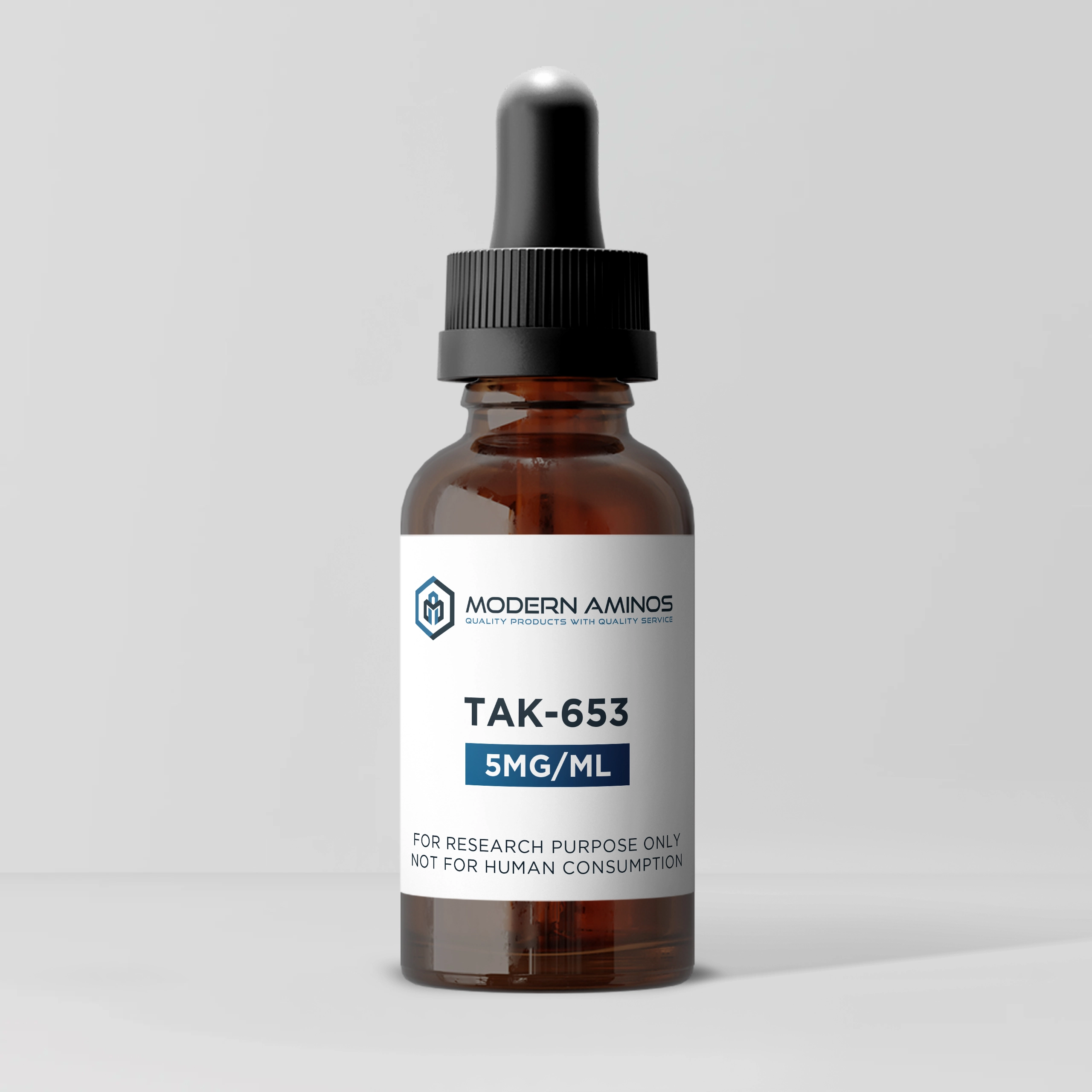
TAK-653

TAK-653

TAK-653

TAK-653

TAK-653 (Osavampator / NBI-1065845) is a novel, highly potent positive allosteric modulator (PAM) of AMPA glutamate receptors with no direct agonistic activity. By potentiating natural glutamatergic neurotransmission without triggering receptor desensitization or excitotoxicity, TAK-653 stimulates central mTORC1 signaling, activates ERK pathways, and increases Brain-Derived Neurotrophic Factor (BDNF) expression in neuronal models.

$78.00

In stock

Purchase & earn 78 points!
Quantity Discounted Price
3 - 5 $74.88
7 - 10 $73.32
9 + $71.76

Certificate of Analysis

What is TAK-653 (Osavampator)?

TAK-653 (known chemically as Osavampator, NBI-1065845, or 9-[4-(cyclohexyloxy)phenyl]-7-methyl-3,4-dihydropyrazino[2,1-c][1,2,4]thiadiazine 2,2-dioxide) is an investigational positive allosteric modulator (PAM) targeting the α-amino-3-hydroxy-5-methyl-4-isoxazolepropionic acid (AMPA) receptor. Developed as a selective glutamatergic enhancer, TAK-653 binds an allosteric pocket on the AMPA receptor complex to potentiate glutamate-induced ion channel opening without acting as a direct agonist.

Analytical batch-tested for Modern Aminos, TAK-653 is supplied as a high-purity reference aqueous solution for laboratory screening and synaptic signaling research. Researchers studying central nervous system excitability, neuroplasticity cascades, and cognitive preservation models utilize TAK-653 to evaluate AMPA receptor kinetics alongside related glutamatergic modulators available on the site, such as Sunifiram and Noopept.

Chemical and Molecular Data

Compound Name TAK-653 (Osavampator)
Format & Packaging Analytical-Grade Reference Aqueous Solution in Sealed Amber Glass Reagent Vial
Synonyms / Alt Names Osavampator, NBI-1065845, TAK 653, AMPA PAM TAK-653
CAS Number 1358751-06-0
Chemical Formula C19H23N3O3S
Molecular Weight 373.47 g/mol
IUPAC Name 9-[4-(cyclohexyloxy)phenyl]-7-methyl-3,4-dihydropyrazino[2,1-c][1,2,4]thiadiazine 2,2-dioxide
InChIKey PXJBHEHFVQVDDS-UHFFFAOYSA-N
SMILES Code CC1=CN(CC2)C(C(C3=CC=C(OC4CCCCC4)C=C3)=N1)=NS2(=O)=O

What are the Mechanisms of Action?

The biochemical pathways and cellular targets of TAK-653 in laboratory research include:

  • Selective AMPA Receptor Positive Allosteric Modulation (PAM): Research demonstrates that TAK-653 binds specifically to allosteric sites on AMPA receptor subunits. By slowing deactivation and desensitization kinetics in the presence of endogenous L-glutamate, TAK-653 increases inward sodium (Na+) and calcium (Ca2+) currents without independently opening the ion channel in the absence of glutamate.
  • Activation of Akt/mTORC1 & ERK Signaling Cascades: In primary cortical neuron assays, TAK-653 potentiates postsynaptic depolarization, triggering extracellular signal-regulated kinase (ERK) and Akt phosphorylation. This activates downstream mammalian target of rapamycin complex 1 (mTORC1) and p70S6 kinase, driving ribosomal protein synthesis.
  • Brain-Derived Neurotrophic Factor (BDNF) Upregulation: By enhancing excitatory postsynaptic potentials (EPSPs) in hippocampal and prefrontal cortex neurons, TAK-653 drives activity-dependent synthesis and secretion of BDNF protein, supporting dendritic spine morphogenesis and long-term potentiation (LTP).

What do Preclinical & Academic Studies Show for TAK-653?

When evaluating research efficacy and published scientific literature for TAK-653 (Osavampator):

  • Antidepressant-Like Effects & BDNF Induction (PubMed): Peer-reviewed research cataloged on PubMed (PMID: 34655652) highlights that TAK-653 significantly increases phosphorylated Akt, ERK, and p70S6K in primary cortical neurons, leading to robust elevation of BDNF protein levels without producing hyperlocomotion or psychotomimetic behaviors.
  • Pharmacology Biochemistry and Behavior Analysis (ScienceDirect): Detailed preclinical assays published in ScienceDirect on Biochemistry evaluate TAK-653’s high AMPA PAM selectivity, confirming rapid neuronal penetration and sustained neuroplasticity signaling in rodent models.
  • Investigational Glutamatergic Agents Review (Frontiers in Pharmacology): Comprehensive clinical reviews published in Frontiers in Pharmacology analyze TAK-653 within the broader landscape of novel glutamatergic modulators, emphasizing its favorable safety margin and lack of direct agonism-induced excitotoxicity.
  • Academic Monograph & Pharmacodynamics (ResearchGate): Experimental data archived on ResearchGate confirm that TAK-653 exhibits high binding affinity across AMPA receptor splice variants, maintaining a wide window between positive modulation and seizure-threshold excitation.

How does TAK-653 compare to other compounds?

To evaluate receptor binding kinetics, selectivity profiles, and neuroplasticity pathways, researchers compare TAK-653 against alternative glutamatergic modulators available at Modern Aminos:

Compound / Reference Primary Receptor Target Core Mechanism of Action Research Profile & Focus
TAK-653 (Osavampator) AMPA Receptor Selective Positive Allosteric Modulator (PAM) Potentiates glutamate-induced AMPA currents with minimal direct agonism; triggers mTORC1 and BDNF release High-selectivity AMPA PAM engineered for neuroplasticity, dendritic spine density, and rapid-onset synaptic potentiation assays
Sunifiram AMPA Receptor Positive Allosteric Modulator / Ampakine Increases glycine-site binding affinity and stimulates presynaptic acetylcholine release High-potency ampakine researched for acute memory consolidation and rapid synaptic transmission in learning models
Noopept AMPA / NMDA Receptor Modulator & HIF-1 Peptide Sensitizes central glutamate receptors while upregulating hippocampal BDNF and NGF expression Dipeptide-derived neuroprotective compound focused on long-term potentiation, sensory processing, and neuro-trophin modulation
Aniracetam AMPA Receptor Modulator & Cholinergic Agonist Slows AMPA receptor desensitization and modulates metabotropic glutamate receptors (mGluRs) Classic racetam research compound combining mild AMPA modulation with serotonergic and dopaminergic signaling

Frequently Asked Questions (FAQs)

1. Is Modern Aminos a reliable place to buy TAK-653?

Yes, Modern Aminos is a highly trusted vendor for high-purity research chemicals and reference standards. Every batch of TAK-653 undergoes rigorous third-party analytical testing (including HPLC and Mass Spectrometry) to verify minimum 99%+ purity, correct molecular weight, and complete absence of unreacted synthesis precursors or heavy metals.

2. What is the molecular mechanism of TAK-653 as an AMPA receptor PAM?

TAK-653 functions as a positive allosteric modulator (PAM) at AMPA glutamate receptors. It binds a non-catalytic site on the receptor protein, stabilizing the active channel conformation when endogenous glutamate is present. This prolongs channel open time and increases sodium/calcium influx without directly activating the receptor on its own.

3. How does TAK-653 differ from traditional AMPA receptor agonists or early ampakines?

Direct AMPA receptor agonists can over-stimulate neurons, leading to rapid receptor desensitization, excitotoxicity, and cellular injury. Early ampakines often suffered from narrow therapeutic windows. In contrast, TAK-653 possesses virtually no direct agonistic activity, ensuring that receptor activation remains strictly dependent on natural presynaptic glutamate release.

4. What role does TAK-653 play in BDNF and mTOR pathway research?

By enhancing post-synaptic depolarization, TAK-653 triggers calcium influx that activates extracellular signal-regulated kinase (ERK) and Akt enzymes. These upstream kinase cascades stimulate mTORC1 phosphorylation, upregulating translation of Brain-Derived Neurotrophic Factor (BDNF) and promoting structural dendritic remodeling.

5. Why is minimal direct agonistic activity critical in AMPA receptor PAM studies?

Minimal direct agonistic activity preserves normal physiological neurotransmission patterns. It prevents tonic, non-pulsatile receptor activation that would otherwise disrupt synaptic plasticity rhythms, trigger compensatory receptor downregulation, or induce seizure-like epileptiform activity in brain tissue assays.

6. What solvent solubility parameters apply to TAK-653 reference powder?

TAK-653 reference aqueous solution is soluble in organic solvents such as PEG-400, DMSO, and dimethylformamide (DMF) at concentrations up to 20–30 mg/mL. It exhibits limited solubility in pure aqueous buffers. For cell culture experiments, stock solutions prepared in DMSO should be diluted into physiological saline or culture media immediately prior to use.

7. How does TAK-653 compare to other glutamatergic research compounds like Sunifiram or Noopept?

While Sunifiram and Noopept exhibit broad or indirect modulation of AMPA and NMDA receptor systems alongside cholinergic signaling, TAK-653 is a modern, highly targeted pharmaceutical-grade AMPA PAM specifically optimized for sub-nanomolar receptor affinity, high metabolic stability, and precise mTOR/BDNF activation.

8. What are the proper storage and research handling parameters for TAK-653?

TAK-653 solid reference powder should be stored tightly sealed in its original glass reagent vial at -20°C for long-term stability. Keep protected from moisture, heat, and direct light exposure. Solid samples stored under desiccated frozen conditions maintain full chemical stability across extended laboratory shelf lives.

Disclaimer: All compounds and research materials provided by Modern Aminos are strictly for laboratory and research professional use only. They are not approved for human or animal use nor consumption by the Food and Drug Administration (FDA). These products should not be used for any form of in vivo experimentation or for any other non-laboratory purpose. Any violation or indication of human or animal use will result in immediate removal from being able to purchase products in the future. By purchasing these products, you acknowledge that they will be used exclusively within a controlled and qualified research environment.

The products offered by Modern Aminos are intended strictly for laboratory research purposes only and are sold exclusively to qualified professionals, institutions, and entities. These products are not for human consumption, veterinary use, or any other application involving living organisms, including but not limited to diagnostic, therapeutic, or recreational purposes.

By purchasing this product, you confirm that:

  • You are a qualified professional or entity with the necessary knowledge, training, and facilities to handle chemical reagents safely and appropriately.
  • You will use this product in full compliance with all applicable local, state, and federal laws and regulations.

Prohibited Uses

  • This product is not to be used as an active pharmaceutical ingredient (API) in compounding or manufacturing drugs for human or veterinary use.
  • It is strictly prohibited to use this product for administration to humans or animals under any circumstances.
  • Modern Aminos does not condone or permit the use of its products for the development, testing, or production of illegal substances.

Regulatory Compliance

Modern Aminos does not claim that this product is approved by the U.S. Food and Drug Administration (FDA) for any purpose. The statements regarding this product have not been evaluated by the FDA. This product is not intended to diagnose, treat, cure, or prevent any disease.

Liability Statement

The buyer assumes full responsibility for ensuring the safe handling, storage, and use of this product. Modern Aminos is not liable for any damages, direct or indirect, resulting from improper handling, storage, or unauthorized use of this product. Furthermore, Modern Aminos reserves the right to refuse sales to any individual or entity suspected of misusing its products.

If you have questions about the safe and lawful use of this product, consult a qualified professional with expertise in laboratory research. By proceeding with this purchase, you agree to these terms and conditions.

0