

Is BPAP a Peptide?
Short answer: No. BPAP, short for benzofuranylpropylaminopentane, is a small synthetic amine, not a peptide: C16H23NO, 245.36 g/mol, with a benzofuran ring, a five-carbon chain and one propyl-substituted nitrogen. The (R)-(−)-enantiomer, CAS 260550-89-8, is the reference catecholaminergic/serotonergic activity enhancer (CAE/SAE), a compound that increases impulse-propagation-mediated release of noradrenaline, dopamine and serotonin, with TAAR1 proposed as its target. If you need to buy BPAP with a third-party certificate, Modern Aminos lists it as a liquid solution.
What is BPAP, chemically speaking?
Let’s put it together one piece at a time. Start with benzofuran: a benzene ring fused to a five-membered furan ring, which holds one oxygen atom. At position 2 of that furan ring, attach a CH2 group, and from it hang a pentane chain. On the second carbon of the chain sits a nitrogen, and on that nitrogen sits a three-carbon propyl group. That is the whole molecule: 1-(benzofuran-2-yl)-2-propylaminopentane, or BPAP for short. PubChem files the (R)-enantiomer under CID 9816303, with the IUPAC name (2R)-1-(1-benzofuran-2-yl)-N-propylpentan-2-amine.
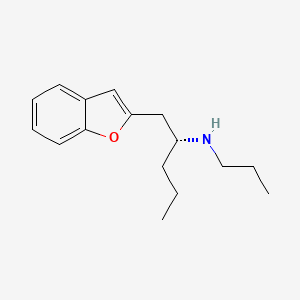
The exact mass is 245.17796 Da, the InChIKey of the (R)-enantiomer is LJHIBIVAYHQPBT-CQSZACIVSA-N, and its connectivity SMILES string is CCCC(CC1=CC2=CC=CC=C2O1)NCCC, with the (R) configuration carried by the InChIKey. PubChem computes an XLogP3 of 4.4, a topological polar surface area of 25.2 Ų, one hydrogen-bond donor and two acceptors, and seven rotatable bonds. The carbon that carries the nitrogen is a stereocenter, so BPAP comes in two mirror-image forms, and that detail turns out to matter a great deal.
Why isn’t BPAP a peptide?
A peptide is a chain of amino acids linked by amide bonds, a backbone that repeats nitrogen, carbon, carbonyl, again and again. BPAP has none of that. Its nitrogen is a secondary amine, not an amide, and there is no carbonyl group anywhere in the molecule. There are no amino-acid residues and no repeating backbone, just one ring system and one short side chain.
So why do people search for a “BPAP peptide”? Mostly because of the company it keeps. BPAP is often listed beside research peptides, and its four capital letters look like a peptide code. Chemically, it belongs with the small aryl alkylamines.
How does BPAP work? The enhancer mechanism, step by step
Here is the idea worth slowing down for. Many compounds raise monoamine signaling by pushing transmitter out of a nerve terminal whether or not a signal has arrived, or by blocking its reuptake. An enhancer works differently. It makes the release that follows an arriving signal larger, and it leaves the quiet moments quiet. Its developers called this catecholaminergic/serotonergic activity enhancer activity, or CAE/SAE (Knoll et al., 1999).
- A signal arrives. In stimulated release assays, an electrical pulse triggers exocytosis, the release of transmitter from storage vesicles.
- BPAP raises the release per pulse. (−)-BPAP significantly enhanced stimulated [3H]-noradrenaline and [3H]-dopamine release at 0.18 µmol/L and [3H]-serotonin release at 36 nmol/L, and region-specific assays recorded enhancement at 10−14 to 10−12 M (Knoll et al., 1999).
- It is not uptake or MAO inhibition. Selective uptake inhibitors, MAO-A and MAO-B inhibitors, and dopamine receptor agonists did not reproduce the effect in the same assay format (Miklya and Knoll, 2003).
- The release stays vesicular. (−)-BPAP potentiated stimulation-evoked dopamine release of vesicular origin through TAAR1 mediation and PKC-mediated phosphorylation, and it did not induce the non-vesicular release that an amphetamine-type releaser produces (Harsing et al., 2022).
- The curve bends back down. A later study found bell-shaped concentration–effect curves for dopamine and GABA release at 10−13 to 10−11 mol/L and proposed TAAR1 heterodimerization with dopamine D2 receptors for the falling side (Harsing et al., 2025).
That last point is a good lesson for any bench scientist: more is not always more. A bell-shaped curve means the concentration you choose shapes the answer you get.
What happens at higher concentrations? The transporter data, side by side
At concentrations far above its enhancer range, (−)-BPAP also binds the monoamine transporters. The values below come from recombinant transporter assays in Shimazu et al., 2003.
| Transporter | [3H]-transmitter uptake IC50 | [125I]RTI-55 binding IC50 |
|---|---|---|
| Dopamine transporter (DAT) | 42 ± 9 nM | 16 ± 2 nM |
| Noradrenaline transporter (NET) | 52 ± 19 nM | 211 ± 61 nM |
| Serotonin transporter (SERT) | 640 ± 120 nM | 638 ± 63 nM |
What this tells us: (−)-BPAP is a dopamine and noradrenaline uptake inhibitor in the tens of nanomolar and a weak serotonin uptake inhibitor, and the same study found no tyramine-like releasing action. Compare those nanomolar numbers with the 10−14 to 10−12 M enhancer range above, and you can see why researchers keep the two activities apart.
BPAP vs. PPAP: what’s the actual difference?
One ring. PPAP is 1-phenyl-2-propylaminopentane: a plain benzene ring on the same 2-propylaminopentane chain. Its developers described PPAP, like (−)-deprenyl, as an amphetamine-derived CAE substance without catecholamine-releasing activity. To build something more potent and more selective, they changed the aromatic ring and made 65 new compounds. The one they kept, (−)-BPAP, puts a benzofuran-2-yl ring where the phenyl had been (Knoll et al., 1999).
Why does that swap matter? Benzofuran is the oxygen cousin of indole, the ring system in tryptamine. So the change moved the molecule from an amphetamine-like shape to a tryptamine-like one, which is exactly how the original report describes BPAP. The structure-activity paper describes the whole series as 1-aryl-2-alkylaminoalkanes structurally unrelated to β-phenylethylamine and the amphetamines (Yoneda et al., 2001).
What do (−)-BPAP, R-BPAP and FPFS-1169 mean?
They are three ways of naming the same mirror-image form. The “(−)” describes the direction the compound rotates polarized light. The “R” describes how its four groups are arranged in space around the stereocenter. Chemists confirmed that (−)-BPAP has the R configuration by making it enantioselectively, coupling benzofuran with (R)-N-tosyl-2-propylaziridine or (R)-N-methoxy-N-methylnorvalinamide, and then checking the result by X-ray crystallography (Oka et al., 2001). PubChem also lists FPFS-1169 as a code for the free base, along with CAS 260550-89-8, UNII 5XG5HU8U55 and DSSTox DTXSID701027206. Several of the published release studies describe the hydrochloride salt.
One more piece of chemistry is worth a look. Molecular-orbital calculations found that the benzofuran ring can trap hydroxyl radicals at every ring atom except carbon 3, with activation energies of about 10 kcal/mol (Nakai and Yoneda, 2001). That is a computed property of the ring, and it is a nice example of how theory can predict where a molecule is most reactive.
What formats is BPAP supplied in for research?
Modern Aminos lists one format on the BPAP product page: a liquid solution in a dropper bottle. A powder or capsule format is not offered for this listing. The third-party Vanguard Laboratory certificate is in the Certificate of Analysis tab on that page.
What does the current certificate show?
One third-party Vanguard Laboratory report (A2LA certificate #6377.01) is published with the product, and all applicable tests are performed on our products. Looking ahead, upcoming batches receive expanded testing across two ISO-certified labs, covering Sterility, Identity, Purity, Endotoxin, Heavy Metals, Mass, Residual Solvents, Fentanyl and Conformity. For why chromatographic testing is the workhorse for reference materials, see the importance of HPLC testing.
Where BPAP sits among other neurochemistry research compounds
Think of monoamine neurochemistry as a set of control points along one pathway. Some reference compounds act on the enzyme that breaks transmitters down, such as 9-Me-BC, a β-carboline that inhibits monoamine oxidase, explained in Is 9-Me-BC a Peptide? 9-Methyl-β-Carboline Explained. Some are tied to the synthesis step, such as Bromantane, an adamantane amine linked to Tyrosine hydroxylase upregulation and explained in Is Bromantane a Peptide? N-(4-bromophenyl)adamantan-2-amine Explained. BPAP sits at the release step, where a signal turns into transmitter leaving the terminal. Comparing control points is one way to keep clear about what each molecule actually does.
Frequently asked questions
Is BPAP a peptide?
No. BPAP is a small benzofuran-2-yl secondary amine, C16H23NO at 245.36 g/mol, with no amide bonds and no amino-acid residues.
What does BPAP stand for?
BPAP stands for benzofuranylpropylaminopentane, a shortened form of 1-(benzofuran-2-yl)-2-propylaminopentane. The form studied as an activity enhancer is the (R)-(−)-enantiomer, often written (−)-BPAP or R-BPAP.
Is BPAP the same as PPAP?
No. PPAP (1-phenyl-2-propylaminopentane) has a phenyl ring where BPAP has a benzofuran-2-yl ring. BPAP was developed by changing that aromatic ring, which turned an amphetamine-derived structure into a tryptamine-derived one.
What is a CAE/SAE compound?
A catecholaminergic/serotonergic activity enhancer increases impulse-propagation-mediated release of noradrenaline, dopamine and serotonin, the release that follows an arriving action potential, rather than releasing transmitter on its own.
What formats does Modern Aminos offer for BPAP?
Modern Aminos offers BPAP as a liquid solution in a dropper bottle, with a third-party Vanguard Laboratory certificate in the product’s Certificate of Analysis tab.
References
- Knoll J, Yoneda F, Knoll B, Ohde H, Miklya I. (−)1-(Benzofuran-2-yl)-2-propylaminopentane, [(−)BPAP], a selective enhancer of the impulse propagation mediated release of catecholamines and serotonin in the brain. Br J Pharmacol. 1999;128(8):1723-1732. PMC1571822
- Yoneda F, Moto T, Sakae M, Ohde H, Knoll B, Miklya I, Knoll J. Structure-activity studies leading to (−)1-(benzofuran-2-yl)-2-propylaminopentane, ((−)BPAP), a highly potent, selective enhancer of the impulse propagation mediated release of catecholamines and serotonin in the brain. Bioorg Med Chem. 2001;9(5):1197-1212. PubMed 11377178
- Oka T, Yasusa T, Ando T, Watanabe M, Yoneda F, Ishida T, Knoll J. Enantioselective synthesis and absolute configuration of (−)-1-(benzofuran-2-yl)-2-propylaminopentane, ((−)-BPAP), a highly potent and selective catecholaminergic activity enhancer. Bioorg Med Chem. 2001;9(5):1213-1219. PubMed 11377179
- Nakai S, Yoneda F. Theoretical investigation of (−)1-(benzofuran-2-yl)-2-propylaminopentane [(−)-BPAP] as a hydroxyl radical scavenger. Bioorg Med Chem. 2001;9(5):1293-1305. PubMed 11377187
- Miklya I, Knoll J. Analysis of the effect of (−)-BPAP, a selective enhancer of the impulse propagation mediated release of catecholamines and serotonin in the brain. Life Sci. 2003;72(25):2915-2921. PubMed 12697274
- Shimazu S, Tsunekawa H, Yoneda F, Katsuki H, Akaike A, Janowsky A. Transporter-mediated actions of R-(−)-1-(benzofuran-2-yl)-2-propylaminopentane. Eur J Pharmacol. 2003;482(1-3):9-16. PubMed 14659999
- Harsing LG, Knoll J, Miklya I. Enhancer regulation of dopaminergic neurochemical transmission in the striatum. Int J Mol Sci. 2022;23(15):8543. PMC9369307
- Harsing LG Jr, Szénási G, Fehér B, Miklya I. Regulation by trace amine-associated receptor 1 (TAAR1) of dopaminergic-GABAergic interaction in the striatum: effects of the enhancer drug (−)BPAP. Neurochem Res. 2025;50(2):94. PMC11794408
- National Library of Medicine. PubChem Compound Summary for CID 9816303, (R)-1-(Benzofuran-2-yl)-N-propylpentan-2-amine. https://pubchem.ncbi.nlm.nih.gov/compound/9816303.
BPAP is a good reminder that a single ring can change a molecule’s whole story: swap a benzene for a benzofuran, and a familiar scaffold becomes a new tool for studying how signals turn into transmitter release. For the certificate, the format, and the full chemical specification table, start at the BPAP product page.