
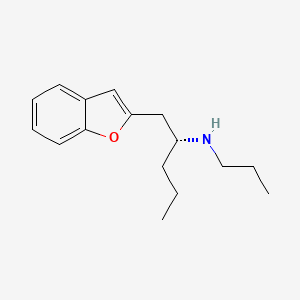
BPAP (Benzofuranylpropylaminopentane / (−)-BPAP, R-BPAP) is a benzofuran-2-yl alkylamine and catecholaminergic/serotonergic activity enhancer (CAE/SAE) for neurochemistry and nootropic structure-activity research. By enhancing impulse-propagation-mediated, vesicular release of dopamine, noradrenaline and serotonin, BPAP separates enhancer activity from amphetamine-type releasing activity, with TAAR1 proposed as its target. CAS 260550-89-8.
In stock



BPAP ((2R)-1-(1-benzofuran-2-yl)-N-propylpentan-2-amine, also called (−)-BPAP, R-BPAP and (−)-1-(benzofuran-2-yl)-2-propylaminopentane; CAS 260550-89-8) is a small synthetic benzofuran-2-yl alkylamine. It is the reference catecholaminergic/serotonergic activity enhancer (CAE/SAE): a compound that enhances impulse-propagation-mediated release of noradrenaline, dopamine and serotonin, with trace amine-associated receptor 1 (TAAR1) proposed as its target. BPAP is not a peptide and not an amino acid, even though it is often searched as a “BPAP peptide.” Its activity comes from a 2-propylaminopentane chain carried on a benzofuran ring, a tryptamine-like scaffold rather than an amphetamine-like one.
In electrically stimulated [3H]-transmitter release assays, (−)-BPAP significantly enhanced noradrenaline and dopamine release at 0.18 µmol/L and serotonin release at 36 nmol/L, with significant enhancement recorded at 10−14 to 10−12 M in region-specific release assays (Knoll et al., 1999, PMC1571822). That is what BPAP does at the release-machinery level: it raises the amount of transmitter released per stimulus instead of releasing transmitter on its own.
Batch-verified at Modern Aminos, BPAP is supplied in one laboratory format:
Laboratories building neurochemistry and nootropic structure-activity panels often place BPAP next to other public reference listings such as 9-Me-BC, Bromantane and TAK-653, as well as Semax and Noopept. For a closer look at whether BPAP is a peptide and how it relates to PPAP, see Is BPAP a Peptide? Benzofuranylpropylaminopentane Explained.
| Compound Name | BPAP (Benzofuranylpropylaminopentane) |
|---|---|
| Research Category | Benzofuran-2-yl alkylamine (1-aryl-2-alkylaminoalkane); catecholaminergic/serotonergic activity enhancer (CAE/SAE); neurochemistry and nootropic structure-activity reference compound |
| Quantity / Formats Offered | Liquid Solution (Dropper Bottle) |
| Synonyms / Alt Names | (−)-BPAP; R-(−)-BPAP; R-BPAP; (−)-1-(benzofuran-2-yl)-2-propylaminopentane; (R)-1-(benzofuran-2-yl)-N-propylpentan-2-amine; (αR)-N,α-dipropyl-2-benzofuranethanamine; FPFS-1169 (free base); benzofuranylpropylaminopentane |
| CAS Number | 260550-89-8 ((R)-enantiomer) |
| PubChem CID | 9816303 ((R)-enantiomer); 9859674 (stereochemistry unspecified) |
| UNII | 5XG5HU8U55 |
| EPA DSSTox Substance ID | DTXSID701027206 |
| Chemical Formula | C16H23NO |
| Molecular Weight | 245.36 g/mol |
| Exact Mass | 245.17796 Da |
| Stereochemistry | One stereocenter (C2 of the pentan-2-amine chain); (−)-BPAP has the (R) configuration, confirmed by X-ray crystallography (Oka et al., 2001) |
| Computed Properties (PubChem) | XLogP3 4.4; TPSA 25.2 Ų; hydrogen-bond donors 1; hydrogen-bond acceptors 2; rotatable bonds 7; heavy atoms 18 |
| IUPAC Name | (2R)-1-(1-benzofuran-2-yl)-N-propylpentan-2-amine |
| InChI | InChI=1S/C16H23NO/c1-3-7-14(17-10-4-2)12-15-11-13-8-5-6-9-16(13)18-15/h5-6,8-9,11,14,17H,3-4,7,10,12H2,1-2H3/t14-/m1/s1 |
| InChIKey | LJHIBIVAYHQPBT-CQSZACIVSA-N ((R)-enantiomer); LJHIBIVAYHQPBT-UHFFFAOYSA-N (stereochemistry unspecified) |
| SMILES Code | CCCC(CC1=CC2=CC=CC=C2O1)NCCC (connectivity; the (R) configuration is encoded in the InChI and InChIKey) |
Identity fields are drawn from PubChem CID 9816303 ((R)-enantiomer) and PubChem CID 9859674 (stereochemistry unspecified); the certificate is published in the Certificate of Analysis tab.
The biochemical targets and pathway logic of BPAP in laboratory research include:
| Assay Parameter | Dopamine (DAT) | Noradrenaline (NET) | Serotonin (SERT) | Source |
|---|---|---|---|---|
| [3H]-transmitter uptake IC50 (recombinant transporter) | 42 ± 9 nM | 52 ± 19 nM | 640 ± 120 nM | Shimazu 2003 |
| [125I]RTI-55 binding IC50 (recombinant transporter) | 16 ± 2 nM | 211 ± 61 nM | 638 ± 63 nM | Shimazu 2003 |
| Stimulated release significantly enhanced at | 0.18 µmol/L | 0.18 µmol/L | 36 nmol/L | Knoll 1999 |
| Most effective concentration for stimulated release | 50 ng/mL | 50 ng/mL | 10 ng/mL | Miklya 2003 |
| Stimulated [3H]dopamine release, bell-shaped range | 10−13 to 10−11 mol/L | not reported | not reported | Harsing 2025 |
Peer-reviewed literature on BPAP (Benzofuranylpropylaminopentane) and its (R)-enantiomer centers on structure-activity chemistry, synthesis, release-assay pharmacology, transporter binding, and TAAR1 signaling:
To map enhancer, enzyme and receptor targets in monoamine neurochemistry, researchers compare BPAP against its phenyl parent, an MAO-B inhibitor, and other reference compounds, including several available at Modern Aminos:
| Compound / Reference | Primary Target Class | Core Mechanism of Action | Research Focus & Profile |
|---|---|---|---|
| BPAP (Benzofuranylpropylaminopentane) | Benzofuran-2-yl alkylamine; CAE/SAE enhancer | Enhances impulse-propagation-mediated vesicular release of noradrenaline, dopamine and serotonin; TAAR1 proposed as the target | Enhancer-mechanism reference compound; CAS 260550-89-8 |
| PPAP (1-phenyl-2-propylaminopentane) | Phenyl alkylamine; CAE substance | Amphetamine-derived CAE substance devoid of catecholamine-releasing activity | Direct structural parent of BPAP (phenyl in place of benzofuran-2-yl) |
| (−)-Deprenyl (selegiline) | β-Phenylethylamine-derived propargylamine; MAO-B inhibitor | Selective MAO-B inhibitor that also shows CAE activity | Historical enhancer comparator |
| 9-Me-BC (9-Methyl-β-Carboline) | β-Carboline; monoamine oxidase (MAO) inhibitor | Inhibits MAO-A at lower concentrations than MAO-B | Enzyme-level neurochemistry reference; CAS 2521-07-5 |
| Bromantane | Adamantane secondary amine; actoprotector-class compound | Linked to transcriptional upregulation of Tyrosine hydroxylase | Catecholamine-pathway comparator; CAS 87913-26-6 |
| TAK-653 (Osavampator) | AMPA-type glutamate receptor positive allosteric modulator | Allosteric modulation of AMPA-type glutamate receptors | Receptor-level neurochemistry comparator; CAS 1358751-06-0 |
| NSI-189 Phosphate | Benzylpiperazine–aminopyridine amide; 1:1 phosphate salt | No published receptor binding constant | Salt-form and nootropic structure-activity reference; CAS 1270138-41-4 |
Modern Aminos publishes a third-party certificate from Vanguard Laboratory, an A2LA-accredited lab (certificate #6377.01), for BPAP, and all applicable tests are performed on our products. If you want to buy benzofuranylpropylaminopentane as a documented reference material, the certificate is in the Certificate of Analysis tab.
Neither. BPAP is (2R)-1-(1-benzofuran-2-yl)-N-propylpentan-2-amine (C16H23NO, 245.36 g/mol, PubChem CID 9816303), a small secondary amine built on a benzofuran ring. It has no amide bonds, no amino-acid residues and no peptide backbone. The full explanation is in Is BPAP a Peptide? Benzofuranylpropylaminopentane Explained.
Yes. BPAP from Modern Aminos is a laboratory research compound with a third-party certificate. Chemically it is a synthetic benzofuran-2-yl alkylamine, and it is classified by its structure and its enhancer mechanism.
BPAP is short for benzofuranylpropylaminopentane, and CAE/SAE stands for catecholaminergic/serotonergic activity enhancer. The term describes compounds that enhance impulse-propagation-mediated (exocytotic) release of noradrenaline, dopamine and serotonin rather than forcing release on their own (Knoll et al., 1999). Impulse-propagation-mediated release is the release triggered by an arriving action potential, and selective uptake inhibitors and MAO inhibitors did not reproduce the enhancement in the same assay format (Miklya and Knoll, 2003).
Trace amine-associated receptor 1 (TAAR1) is the proposed target. (−)-BPAP potentiated vesicular dopamine release through TAAR1 mediation and PKC-mediated phosphorylation (Harsing et al., 2022), and a later study described it as a potential TAAR1 agonist with bell-shaped concentration–effect curves (Harsing et al., 2025). At nanomolar concentrations it also inhibits the dopamine and noradrenaline transporters (Shimazu et al., 2003).
An amphetamine-type releaser drives non-vesicular transmitter release that does not depend on stimulation. (−)-BPAP potentiated stimulation-evoked release of vesicular origin and did not induce non-vesicular release (Harsing et al., 2022), and it showed no tyramine-like releasing action at the noradrenaline transporter (Shimazu et al., 2003).
PPAP (1-phenyl-2-propylaminopentane) carries a phenyl ring, while BPAP carries a benzofuran-2-yl ring on the same 2-propylaminopentane chain. Swapping the aromatic ring turned an amphetamine-derived CAE substance into a tryptamine-derived structure, and (−)-BPAP was selected from the 65 compounds made in that program (Knoll et al., 1999).
They all point to the same enantiomer. “(−)” is its optical rotation, “R” is its absolute configuration, confirmed by X-ray crystallography (Oka et al., 2001), and PubChem lists FPFS-1169 as a code for the free base. The (R)-enantiomer is CAS 260550-89-8, UNII 5XG5HU8U55, InChIKey LJHIBIVAYHQPBT-CQSZACIVSA-N.
Modern Aminos supplies BPAP in one format: a liquid solution in a dropper bottle. A powder or capsule format is not offered for this listing.
They reach catecholamine pathways at different control points. BPAP enhances stimulation-coupled vesicular release, 9-Me-BC is a β-carboline that inhibits monoamine oxidase, and Bromantane is an adamantane amine linked to Tyrosine hydroxylase upregulation. See Is 9-Me-BC a Peptide? 9-Methyl-β-Carboline Explained for the β-carboline.
All applicable tests are performed on our products. The current third-party Vanguard Laboratory certificate (A2LA #6377.01) is published in the Certificate of Analysis tab, and upcoming batches receive expanded testing across two ISO-certified labs, covering Sterility, Identity, Purity, Endotoxin, Heavy Metals, Mass, Residual Solvents, Fentanyl and Conformity. The identity fields on this page (CAS, InChI, InChIKey, SMILES) come from PubChem CID 9816303.
Keep the dropper bottle tightly sealed, cool, and away from light. Follow the label on each lot.
DISCLAIMER: All compounds and research materials provided by Modern Aminos are strictly for laboratory and research use only. They are not approved for human consumption by the Food and Drug Administration (FDA). No products are approved for oral, sublingual, nor in vivo use. These products should not be used for any form of in vivo experimentation or for any other non-laboratory purpose. Any violation or indication of human or animal use will result in immediate removal from being able to purchase products in the future. By purchasing these products, you acknowledge that they will be used exclusively within a controlled and qualified research environment.
