
What Is Noopept? Omberacetam (GVS-111) Explained
Noopept, also called omberacetam or GVS-111, is N-phenylacetyl-L-prolylglycine ethyl ester. It is a small synthetic molecule built on two amino acids, proline and glycine, with a phenylacetyl cap on one end and an ethyl ester on the other. In published assay work it is studied as a ligand in the HIF-1 pathway and as a precursor of the cyclic dipeptide cycloprolylglycine. BDNF, NGF and neuroprotection appear in the literature as research-topic terms for this compound.
What Is Dihexa? PNB-0408 (Hexanoyl-Tyr-Ile-Ahx-NH2) Explained
Dihexa (PNB-0408) is a synthetic oligopeptide related to an Angiotensin IV fragment, chemically described as hexanoyl-Tyr-Ile-Ahx-NH2. PubChem CID 129010512 lists formula C27H44N4O5, molecular weight 504.7 g/mol, and CAS 1401708-83-5.
Is BPAP a Peptide? Benzofuranylpropylaminopentane Explained

No. BPAP, short for benzofuranylpropylaminopentane, is a small synthetic amine, not a peptide: C16H23NO, 245.36 g/mol, with a benzofuran ring, a five-carbon chain and one propyl-substituted nitrogen. The (R)-(−)-enantiomer, CAS 260550-89-8, is the reference catecholaminergic/serotonergic activity enhancer (CAE/SAE), a compound that increases impulse-propagation-mediated release of noradrenaline, dopamine and serotonin, with TAAR1 proposed as its target.
What Is NSI-189? Phosphate Salt vs. Freebase Explained
NSI-189 is a small synthetic molecule, not a peptide: a benzylpiperazine-aminopyridine amide with the formula C22H30N4O, a molecular weight of 366.5 g/mol, CAS 1270138-40-3, and the nonproprietary name amdiglurax. NSI-189 Phosphate is the same molecule paired with phosphoric acid, C22H33N4O5P at 464.5 g/mol (CAS 1270138-41-4), the crystalline salt form described in its synthesis patent. No receptor binding constant has been published for it, so it is best described by its chemistry.
Is PRL-8-53 a Peptide? A Methyl Benzoate Ester Explained
No. PRL-8-53 is a small-molecule ester, not a chain of amino acids. Chemically it is methyl 3-[2-[benzyl(methyl)amino]ethyl]benzoate, usually handled as its hydrochloride salt (CAS 51352-87-5; PubChem CID 70700868; 319.8 g/mol). It was introduced in 1974 as a new type of CNS-active compound, and its source patent classifies the series as cholinergic agents.
Is 9-Me-BC a Peptide? 9-Methyl-β-Carboline Explained
No. 9-Me-BC is 9-methyl-β-carboline (9-methylpyrido[3,4-b]indole), a small, flat, three-ring aromatic molecule with no amino-acid residues and no peptide bonds. Its formula is C12H10N2, its molecular weight is 182.22 g/mol, its CAS number is 2521-07-5, and it is studied as a monoamine oxidase (MAO) inhibitor from the β-carboline family.
Is GB-115 a Peptide? N-(6-Phenylhexanoyl)glycyl-L-Tryptophan Amide Explained
Yes, in the chemical sense. GB-115 is N-(6-phenylhexanoyl)glycyl-L-Tryptophan amide, a modified dipeptide in which Glycine and L-Tryptophan are joined by one peptide bond, the N-terminus carries a 6-phenylhexanoyl cap, and the C-terminus is an amide. Its formula is C25H30N4O3, its molecular weight is 434.5 g/mol, its CAS number is 678996-63-9, and it was designed as a retro-analog of the cholecystokinin tetrapeptide CCK-4.
Is Bromantane a Peptide? N-(4-bromophenyl)adamantan-2-amine Explained
No. Bromantane (Ladasten) is N-(4-bromophenyl)adamantan-2-amine, a small-molecule adamantane secondary amine with formula C16H20BrN, CAS 87913-26-6, and PubChem CID 4660557. It has no amino-acid residues and no peptide bonds. Published actoprotector reviews discuss it for Tyrosine hydroxylase (TH) pathway chemistry, not as a peptide ligand.
What Is L-THP? Levo-Tetrahydropalmatine Explained
L-THP is levo-tetrahydropalmatine (CAS 483-14-7), the left-handed, or (S), form of a small isoquinoline alkaloid found in Stephania and Corydalis plants. It weighs 355.43 g/mol, carries four methoxy groups on a four-ring tetrahydroprotoberberine scaffold, and is studied as a dopamine receptor antagonist with its tightest binding at the D1 receptor.
Alpha GPC vs. Choline: Comparing Two Choline Research Compounds
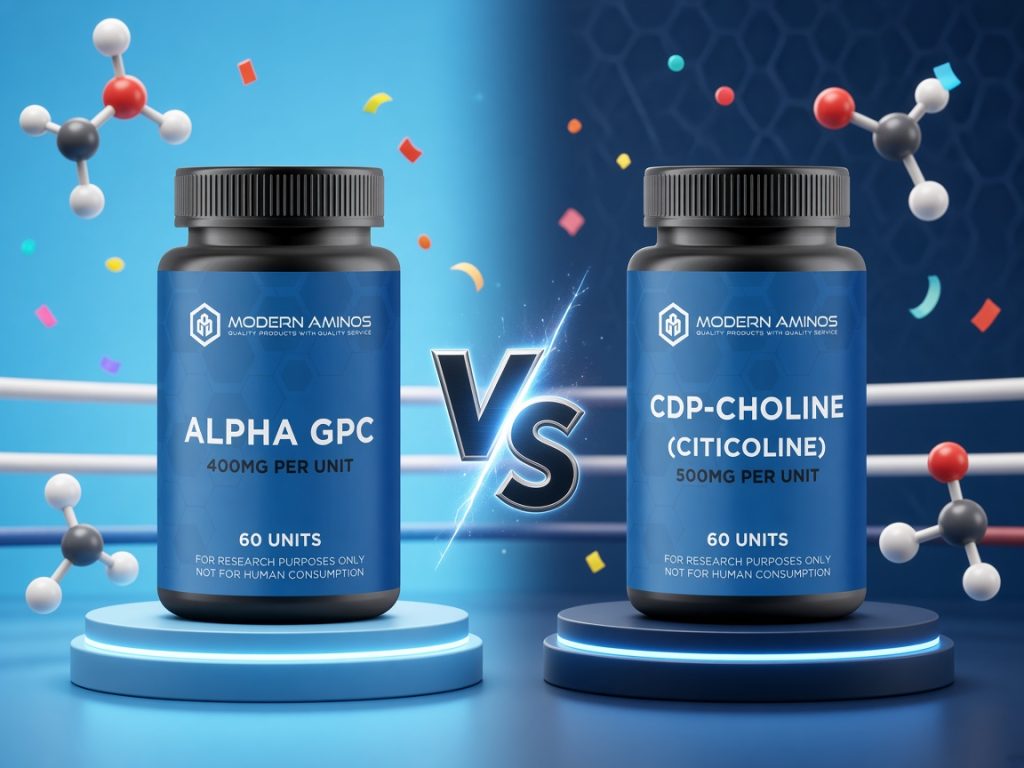
Alpha GPC and Choline are both choline donors, but they deliver choline differently. Alpha GPC is a glycerophosphocholine ester that is about 41% choline by weight and splits into choline and glycerophosphate. Choline supplies choline plus cytidine, which is converted to uridine and feeds phospholipid synthesis. In published research, Alpha GPC has the deeper physical-performance record, while Choline has the deeper neuroprotection, membrane-repair and safety record.