
What Is MOTS-c? Sequence, 12S rRNA Origin and Mechanism Explained
MOTS-c, short for mitochondrial open reading frame of the 12S rRNA type-c, is a 16-amino-acid peptide encoded in the mitochondrial genome rather than the nucleus. Its sequence is MRWQEMGYIFYPRKLR. PubChem lists the free-acid peptide as CID 146675088, with CAS number 1627580-64-6, the formula C101H152N28O22S2 and a molecular weight of 2174.6 g/mol. In cultured cells it acts on the folate cycle and AMPK, and under stress it moves into the nucleus.
What Is Indolepropionamide (IPAM)? Structure, Timeline and Lab Data
Indolepropionamide, usually shortened to IPAM and also written indole-3-propionamide, is 3-(1H-indol-3-yl)propanamide. It is a small indole molecule with CAS number 5814-93-7, the formula C11H12N2O and a molecular weight of 188.23 g/mol. Structurally it is the primary amide of indole-3-propionic acid (IPA), and its published laboratory data center on hydroxyl radical chemistry and mitochondrial electron transport.
What Is SLU-PP-915? The Boronic Acid Pan-ERR Agonist Explained
SLU-PP-915 is a synthetic small molecule, not a peptide, that researchers use as a pan-agonist of the three estrogen-related receptors, ERRα, ERRβ and ERRγ. Chemically it is a thiophene ring carrying a 2-fluorophenyl amide on one side and a phenyl boronic acid on the other. Its published EC50 values sit close together, from 378 to 435 nM, across all three receptors. To view SLU-PP-915 as a documented reference compound, use the product button above.
What Is ATX-304? O-304 (Pan-AMPK Activator) Explained
ATX-304 is the research code for O-304, a small-molecule AMP-activated protein kinase (AMPK) activator. PubChem CID 50923806 lists formula C16H11Cl2N3O2S, molecular weight 380.2 g/mol, and depositor synonym CAS 1261289-04-6.
What Is BAM15? The Mitochondrial Uncoupler Explained
BAM15 is a small-molecule mitochondrial protonophore uncoupler, N5,N6-bis(2-fluorophenyl)-[1,2,5]oxadiazolo[3,4-b]pyrazine-5,6-diamine (CAS 210302-17-3). It has the formula C16H10F2N6O and a molecular weight of 340.29 g/mol. Its defining feature, reported when it was discovered, is that it uncouples mitochondria without depolarizing the plasma membrane.
L-Citrulline vs. ATP/AMP/NALT Amino Blend: A Composition and Chemistry Comparison
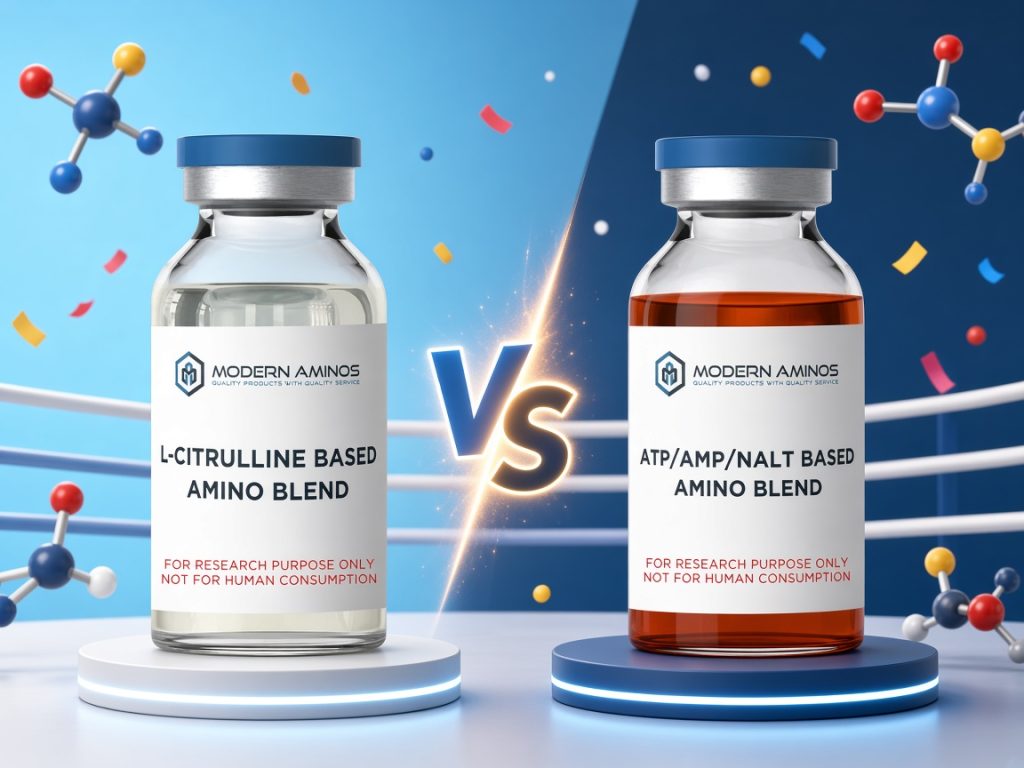
The L-Citrulline Based Amino Blend and the ATP/AMP/NALT Based Amino Blend are both 20 mL water-based research solutions with benzyl alcohol (1%), but they share only one component: L-arginine HCl, at 75 mg/mL in the L-Citrulline blend and 175 mg/mL in the ATP/AMP/NALT blend. The L-Citrulline blend is built from amino acids and derivatives (L-citrulline, a glutamine dipeptide, taurine, L-lysine, L-proline, L-carnitine and NAC) plus lidocaine, while the ATP/AMP/NALT blend is built around nucleotides (NAD+, ATP, AMP and Choline) with betaine and NALT.
Is DADA a Peptide? Diisopropylamine Dichloroacetate Explained
No, DADA is not a peptide. DADA, or diisopropylamine dichloroacetate (CAS 660-27-5), is a small-molecule salt built from two simple pieces: a diisopropylamine cation and a dichloroacetate anion. It weighs 230.13 g/mol, has no amino acid chain, and is studied as an inhibitor of pyruvate dehydrogenase kinase (PDK), the enzyme that switches off the main gateway from glycolysis into mitochondrial oxidation.
Comparing SLU-PP-332 and SLU-PP-915: Molecular Mechanics, Receptor Selectivity, and Preclinical Delivery of Pan-ERR Agonists
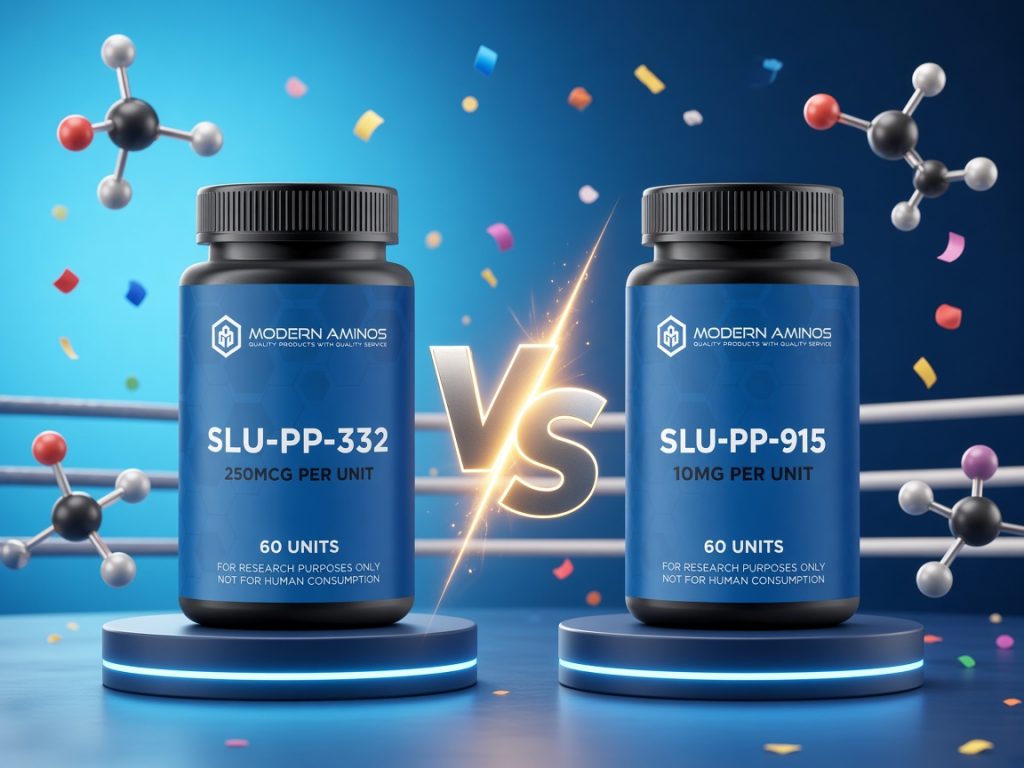
SLU-PP-332 and SLU-PP-915 are both synthetic pan-ERR agonists, but they differ in receptor subtype selectivity and pharmacokinetics. SLU-PP-332 is an ERRα-preferring agonist (EC50 ≈ 98 nM) with poor oral bioavailability in published rodent studies, while SLU-PP-915 is a chemically distinct thiophene derivative with a flatter pan-ERR profile across ERRα, ERRβ and ERRγ (EC50 ≈ 378-435 nM) and improved pharmacokinetics in published murine work.
IPAM vs. Methylene Blue vs. Glutathione vs. CoQ10: A Research-Only Comparison of Antioxidant Activation
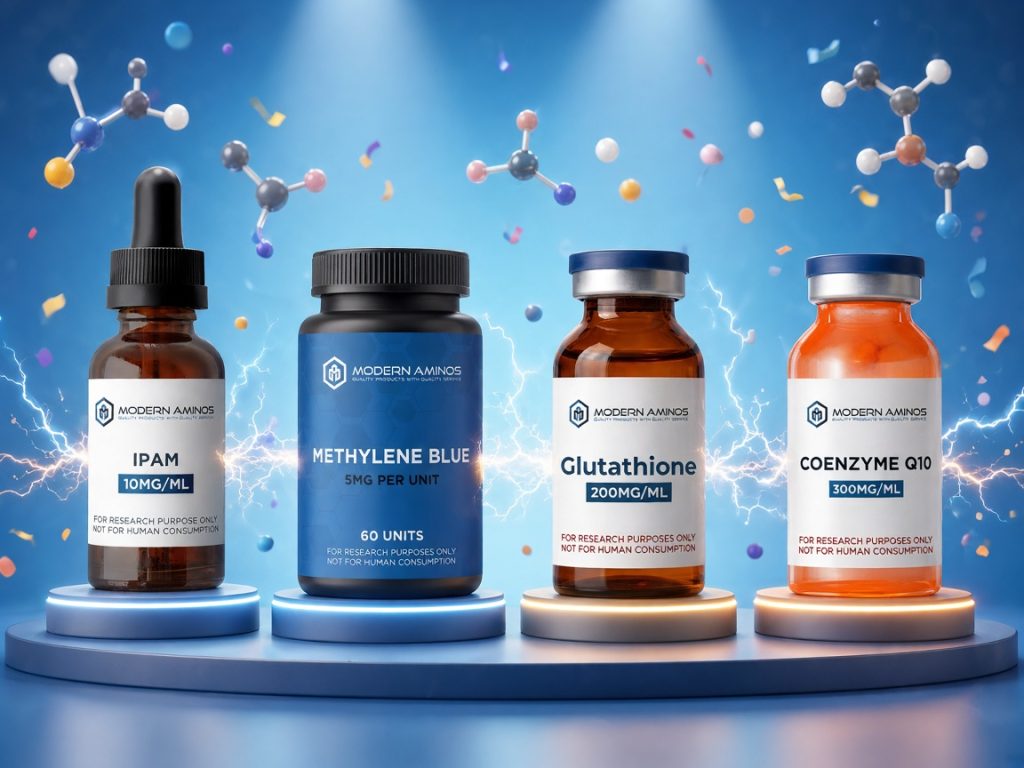
IPAM, Methylene Blue, Glutathione and CoQ10 are all studied as antioxidants, but they act at different points. IPAM is reported to bind Complex I directly and has the lowest reported in-vitro IC50 (0.18 µM against 8-OHdG), but from a single primary study. Methylene Blue routes electrons around Complex I to cytochrome c oxidase and has the deepest preclinical record for Complex IV activation, cognition-related endpoints and mouse lifespan. Glutathione and CoQ10 are endogenous redox buffers in the aqueous and lipid phases, and their reported effects depend heavily on formulation.