
What Is Indolepropionamide?
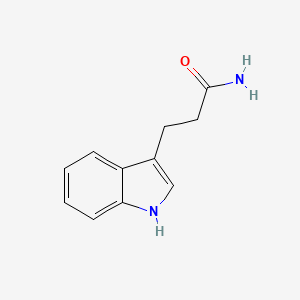
Indolepropionamide, usually shortened to IPAM and also written indole-3-propionamide, is 3-(1H-indol-3-yl)propanamide. It is a small indole molecule with CAS number 5814-93-7, the formula C11H12N2O and a molecular weight of 188.23 g/mol. Structurally it is the primary amide of indole-3-propionic acid (IPA), and its published laboratory data center on hydroxyl radical chemistry and mitochondrial electron transport.
Chemical Identity of Indolepropionamide (IPAM)
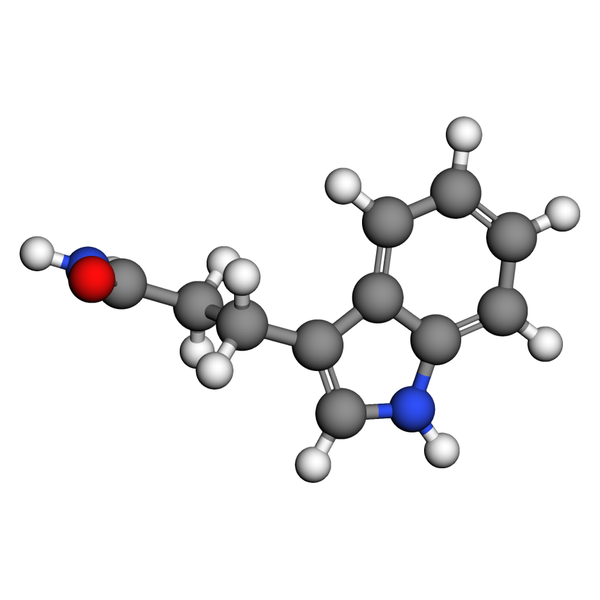
IPAM has three parts. The indole ring is the same bicyclic aromatic system found in tryptophan, serotonin and melatonin, with its ring N-H left free. Attached at the 3-position is a two-carbon (ethylene) linker, and the chain ends in a primary amide, -C(=O)NH2. Counting the amide carbon, the side chain is three carbons long, which is where the “propion” in the name comes from.
That small amide group changes how the molecule behaves compared with IPA. A carboxylic acid loses a proton near neutral pH and carries a negative charge, while a primary amide stays neutral. IPAM therefore donates hydrogen bonds from the amide NH2 and the indole N-H, accepts them at the carbonyl oxygen, and has a computed XLogP3 of 1.1 and a topological polar surface area of 58.9 Ų. It has no stereocenters, so there is a single PubChem record with no enantiomer variants to keep track of.
The 2010 report describes a straightforward lab route from IPA (PMC2858081). The acid is first esterified in ethanol with methanesulfonic acid to give indole-3-propionic acid ethyl ester. Refluxing the ester with hydrazine gives the propanoic acid hydrazide, and reduction of the hydrazide over Raney nickel yields the primary amide, which is then purified on silica gel. The same paper notes that, after making it synthetically, the authors found IPAM to be a naturally occurring indole as well.
Molecular Data
| Property | Value |
|---|---|
| CAS# | 5814-93-7 |
| PubChem ID | CID 351791 |
| Molecular Formula | C11H12N2O |
| Molecular Weight | 188.23 g/mol |
| Exact Mass | 188.0950 Da |
| IUPAC Name | 3-(1H-indol-3-yl)propanamide |
| InChIKey | OTVHXWFANORBAK-UHFFFAOYSA-N |
| SMILES | C1=CC=C2C(=C1)C(=CN2)CCC(=O)N |
| Molecular Class | Small molecule (non-peptide); indole-3-propionamide, an amide of the tryptophan metabolite indole-3-propionic acid |
| Stereocenters | 0 defined, 0 undefined |
| Hydrogen bond donors / acceptors | 2 / 1 |
| XLogP3 (computed) | 1.1 |
Values from PubChem CID 351791 (computed by PubChem).
Research Timeline
- 1999Chyan and colleagues report that indole-3-propionic acid, IPAM’s parent acid, scavenges hydroxyl radicals more effectively than melatonin in kinetic competition experiments and is not converted to pro-oxidant intermediates (PMID 10419516).
- 2010Poeggeler and colleagues describe the synthesis of IPAM from IPA, report it as a naturally occurring indole, and compare it with melatonin and IPA in radical, DNA oxidation and mitochondrial assays (PMC2858081).
- 2025a medicinal chemistry group uses the 1H-indole-3-propionamide scaffold as the core of N-substituted Nav1.7 inhibitors; the lead, WN2-R, has an in vitro IC50 of 24.7 nM at Nav1.7 (PMID 39881860). These are much larger molecules than IPAM.
- 2026a follow-up series of 1H-indole-3-propionamide derivatives against the same channel appears in J Med Chem (PMID 42503835).
Mechanism: What the Assays Point to
Two lines of evidence come from the Poeggeler paper, and both are laboratory measurements rather than whole-organism outcomes (PMC2858081).
Radical chemistry. In a cell-free system that generates hydroxyl radicals (OH•) from hydrogen peroxide and iron, IPAM was the most potent of the indoles tested at reducing OH• formation. Like IPA, and unlike some other antioxidants, it did not produce pro-oxidant reactive intermediates. In a tissue-homogenate assay of OH•-driven DNA oxidation, measured as 8-hydroxydeoxyguanosine formation, IPAM reached its IC50 at 0.18 ± 0.03 µM, about eight times lower than melatonin (1.4 µM) and roughly forty times lower than IPA (7.46 µM).
Electron transport. In isolated mitochondrial and sub-mitochondrial preparations, IPAM was the only indole that consistently raised complex I and complex IV activity above control, and it displaced known complex I ligands in binding experiments. It also limited collapse of the mitochondrial membrane potential caused by the uncoupler FCCP and the electron transport inhibitor antimycin A at nanomolar concentrations. The authors proposed that IPAM interacts with complex I and may act as a recyclable electron and proton carrier. That remains a hypothesis from one group, and no independent replication has been published yet.
Chemical Data Table
| Item | Detail | Source |
|---|---|---|
| IUPAC name | 3-(1H-indol-3-yl)propanamide | PubChem |
| Synonyms | Indole-3-propionamide; indolepropionamide; IPAM | PubChem |
| CAS / PubChem CID | 5814-93-7 / 351791 | PubChem |
| Formula | C11H12N2O | PubChem |
| Molecular weight / exact mass | 188.23 g/mol / 188.0950 Da | PubChem |
| InChIKey | OTVHXWFANORBAK-UHFFFAOYSA-N | PubChem |
| XLogP3 / TPSA | 1.1 / 58.9 Ų | PubChem (computed) |
| UNII | 6RD94WRM73 | PubChem |
| Oxidative DNA damage IC50 | 0.18 ± 0.03 µM (melatonin 1.4 µM; IPA 7.46 µM) | Poeggeler 2010 |
IPAM’s identifiers are unambiguous, and the one quantitative biology figure comes from a single paper. Read the IC50 as a comparison within that study’s assay, not as a fixed constant.
IPAM vs. IPA vs. Melatonin
IPAM is most often compared with the two indoles it was tested against. The table shows how small structural changes separate them.
| Property | IPAM | Indole-3-propionic acid (IPA) | Melatonin |
|---|---|---|---|
| CID | 351791 | 3744 | 896 |
| Formula / MW | C11H12N2O / 188.23 | C11H11NO2 / 189.21 | C13H16N2O2 / 232.28 |
| Side-chain end group | Primary amide (-CONH2) | Carboxylic acid (-COOH) | N-acetyl amine |
| Ring substituent | None | None | 5-methoxy |
| Charge near neutral pH | Neutral | Mostly ionized (carboxylate) | Neutral |
| DNA oxidation IC50 (Poeggeler 2010) | 0.18 µM | 7.46 µM | 1.4 µM |
IPAM and IPA differ only at the end of the side chain, yet in the 2010 DNA oxidation assay the amide was about forty times more potent than the acid. Melatonin carries a 5-methoxy group on the ring and an N-acetylated ethylamine chain in place of the propanamide, which makes it the more distant relative. For a broader view of how these molecules sit next to other redox tools, see our antioxidant research compound comparison.
Naming Traps
The abbreviation causes more confusion than the chemistry. “IPAM” here always means indolepropionamide. It has nothing to do with ipamorelin, a growth hormone secretagogue pentapeptide, even though both names begin with the same letters. It is also easy to swap IPAM with IPA (the acid) in search results and supplier listings, so check the formula: the amide is C11H12N2O and the acid is C11H11NO2.
A third trap is newer. Papers on “1H-indole-3-propionamide” Nav1.7 inhibitors use IPAM’s core as a building block, but the lead compounds carry large N-substituents and are different molecules. Their channel data should not be read as IPAM data.
Formats, Testing, and Documentation
IPAM is listed as a liquid (solution) format. Because the amide and the acid differ by only about 1 Da, identity testing has to rely on chromatography against a reference standard or on accurate mass, not on nominal mass alone. Certificates are posted in the Certificate of Analysis tab on the product page, and the finished-solution certificate reports an HPLC identity test that matches a reference standard. For background on how chromatographic identity testing works, see why HPLC testing matters.
Related Research Tools
References
- Chyan YJ, Poeggeler B, Omar RA, Chain DG, Frangione B, Ghiso J, Pappolla MA. Potent neuroprotective properties against the Alzheimer beta-amyloid by an endogenous melatonin-related indole structure, indole-3-propionic acid. J Biol Chem. 1999;274(31):21937-21942. PMID 10419516
- Poeggeler B, Sambamurti K, Siedlak SL, Perry G, Smith MA, Pappolla MA. A novel endogenous indole protects rodent mitochondria and extends rotifer lifespan. PLoS One. 2010;5(4):e10206. PMID 20421998; PMC2858081
- Wang G, Wu H, Wang Y, et al. Discovery of novel Na(v)1.7-selective inhibitors with the 1H-indole-3-propionamide scaffold. Research (Wash D C). 2025;8:0599. PMID 39881860
- Chen K, He X, Wang G, et al. Discovery of 1H-indole-3-propionamide derivatives as potent, selective NaV1.7 inhibitors. J Med Chem. 2026;69(15):18501-18529. PMID 42503835
- National Center for Biotechnology Information. PubChem Compound Summaries for CID 351791 (indole-3-propionamide), CID 3744 (indole-3-propionic acid) and CID 896 (melatonin). CID 351791, CID 3744, CID 896
Frequently Asked Questions
What Is Indolepropionamide?
Indolepropionamide (IPAM), also written indole-3-propionamide, is 3-(1H-indol-3-yl)propanamide: an indole ring joined by a two-carbon chain to a primary amide. It has CAS number 5814-93-7, PubChem CID 351791, the formula C11H12N2O and a molecular weight of 188.23 g/mol.
Is IPAM a Peptide?
No. IPAM is a small indole molecule with one amide group and no amino acid residues or peptide bonds. The shared letters with ipamorelin, a pentapeptide, are a coincidence of naming, and the two compounds are unrelated.
How Is IPAM Different From Indole-3-Propionic Acid?
IPAM replaces the carboxylic acid of indole-3-propionic acid (IPA, CID 3744) with a primary amide. That swaps an ionizable acid for a neutral amide, changes the formula from C11H11NO2 to C11H12N2O and drops the mass by about 1 Da.
What Did the Main IPAM Study Measure?
A 2010 paper by Poeggeler and colleagues synthesized IPAM and compared it with melatonin and IPA. In a cell-free hydroxyl radical assay, IPAM was the most potent of the indoles tested and formed no pro-oxidant intermediates. In a tissue-homogenate DNA oxidation assay, its IC50 was 0.18 µM, against 1.4 µM for melatonin and 7.46 µM for IPA.
How Was IPAM First Made in the Lab?
The 2010 report describes a three-step route from indole-3-propionic acid: esterification to the ethyl ester, conversion to the hydrazide with hydrazine, then reduction over Raney nickel to give the primary amide.