
What Is the Sunifiram Mechanism of Action?
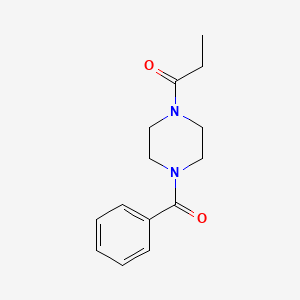
Sunifiram (DM-235) has no confirmed binding site. It showed no affinity for the main central receptors in binding screens, yet in hippocampal slice recordings it enhanced NMDA receptor-dependent long-term potentiation (LTP) at 10 to 100 nM. That effect depended on the NMDA receptor glycine site and ran through PKCα, Src and CaMKII, ending in more phosphorylation of AMPA receptors. Chemically, sunifiram is 1-(4-benzoylpiperazin-1-yl)propan-1-one, CAS 314728-85-3, C14H18N2O2, 246.30 g/mol.
Chemical Identity of Sunifiram
Code names in this series are easy to swap, so the spec sheet leads with the identifiers that are not: CAS number, PubChem CID and InChIKey.
| Item | Detail | Source |
|---|---|---|
| IUPAC name | 1-(4-benzoylpiperazin-1-yl)propan-1-one | PubChem |
| Code name | DM-235 (also written DM235) | Manetti 2000 |
| CAS / PubChem CID | 314728-85-3 / 4223812 | PubChem |
| Formula | C14H18N2O2 | PubChem |
| Molecular weight / exact mass | 246.30 g/mol / 246.1368 Da | PubChem |
| InChIKey | DGOWDUFJCINDGI-UHFFFAOYSA-N | PubChem |
| XLogP3 / TPSA | 1.1 / 40.6 Ų | PubChem (computed) |
| H-bond donors / acceptors | 0 / 2 | PubChem (computed) |
| Stereocenters | None | PubChem |
| Receptor binding screen | No affinity at the main central receptors or channels | Romanelli 2006 |
| Slice LTP enhancement | 10-100 nM, bell-shaped, peak at 10 nM | Moriguchi 2013 |
Sunifiram is small, moderately lipophilic and has no N-H or O-H groups, so it can only accept hydrogen bonds, through its two amide carbonyls. It has no stereocenters, so there is one structure and no enantiomers to separate. The empty receptor screen and the low-nanomolar slice activity sit side by side, and that gap is the central open question about this molecule.
Molecular Data
| Property | Value |
|---|---|
| CAS# | 314728-85-3 |
| PubChem ID | CID 4223812 |
| Molecular Formula | C14H18N2O2 |
| Molecular Weight | 246.30 g/mol |
| Exact Mass | 246.1368 Da |
| IUPAC Name | 1-(4-benzoylpiperazin-1-yl)propan-1-one |
| InChIKey | DGOWDUFJCINDGI-UHFFFAOYSA-N |
| SMILES | CCC(=O)N1CCN(CC1)C(=O)C2=CC=CC=C2 |
| Molecular Class | Small molecule (non-peptide); piperazine-derived compound related to the racetams |
| Stereocenters | 0 defined, 0 undefined |
| Hydrogen bond donors / acceptors | 0 / 2 |
| XLogP3 (computed) | 1.1 |
Values from PubChem CID 4223812 (computed by PubChem).
Sunifiram vs. Unifiram: Side-by-Side
Sunifiram was made by simplifying unifiram, so the two are best read together, with piracetam as the reference point the original series used. For unifiram on its own, including its stereocenter and SAR history, see What Is Unifiram (DM-232)?
| Property | Sunifiram (DM-235) | Unifiram (DM-232) | Piracetam |
|---|---|---|---|
| CAS / CID | 314728-85-3 / 4223812 | 272786-64-8 / 9861054 | 7491-74-9 / 4843 |
| Formula / MW | C14H18N2O2 / 246.30 | C13H15FN2O3S / 298.34 | C6H10N2O2 / 142.16 |
| Ring system | Monocyclic piperazine | Bicyclic: 2-pyrrolidinone fused to a piperazine-type ring | Monocyclic 2-pyrrolidinone |
| Key groups | Benzamide; propionamide | Lactam; 4-fluorobenzenesulfonamide | Lactam; primary acetamide |
| Stereocenters | 0 | 1 | 0 |
| XLogP3 / TPSA | 1.1 / 40.6 Ų | 0.6 / 66.1 Ų | −1.3 / 63.4 Ų |
Sunifiram keeps unifiram’s two-nitrogen layout but opens the fused ring into a plain piperazine. A benzoyl group replaces the 4-fluorobenzenesulfonyl group, and a propionyl amide stands in for the lactam carbonyl. The result is lighter, achiral and less polar. Neither molecule shares piracetam’s full scaffold, even though piracetam was the benchmark for both.
Reading the Structure
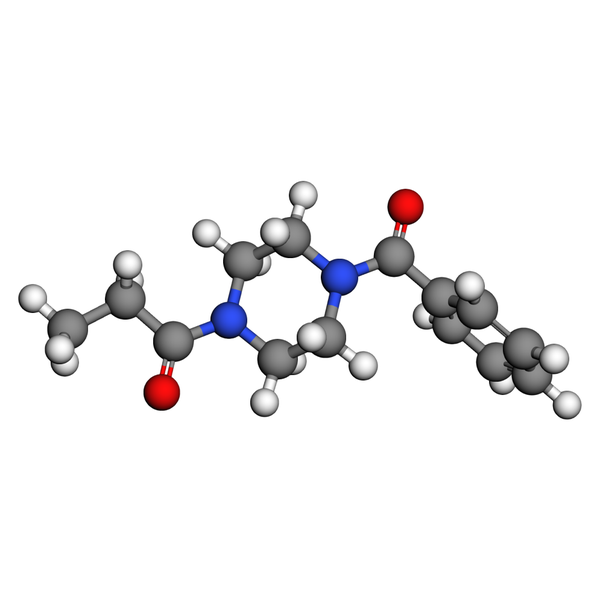
Sunifiram is built on piperazine, a six-membered ring with two nitrogens opposite each other. Both nitrogens are acylated, which is why the molecule has no basic amine and no N-H. On one side sits a benzoyl group, making a tertiary benzamide; on the other, a propionyl group makes a tertiary propionamide.
Its designers arrived at this shape by “molecular simplification” of 1,4-diazabicyclo[4.3.0]nonan-9-ones, the bicyclic series that produced unifiram (PMID 11087574). They found that an N-acylpiperazine could mimic the 2-pyrrolidinone ring of the parent series and still give clear structure-activity relationships. A follow-up SAR study varied both acyl groups and the ring; none of the new analogs matched the potency of the two parent compounds, and a few even showed the opposite profile, which makes sunifiram’s exact substitution pattern unusually important (PMID 14697772).
How Sunifiram Engages Its Targets
The most detailed mechanistic work comes from hippocampal CA1 slice recordings by Moriguchi and colleagues (PMID 23733502). Sunifiram enhanced LTP between 10 and 100 nM in a bell-shaped relationship that peaked at 10 nM. Three steps explain most of what they saw:
- Glycine site first. 7-chlorokynurenic acid, which blocks the glycine co-agonist site of the NMDA receptor, blocked sunifiram’s LTP enhancement. Ifenprodil, which acts at a different NMDA receptor site, did not. Saturating the glycine site with 300 µM glycine also removed the effect.
- PKCα and Src. Without any LTP-inducing stimulus, sunifiram raised PKCα (Ser-657) and Src family (Tyr-416) phosphorylation with the same bell-shaped curve, peaking at 10 nM. 7-chlorokynurenic acid blocked this, and the Src inhibitor PP2 reduced the LTP enhancement.
- CaMKII and AMPA receptors. Enhanced LTP came with more CaMKII activity and more phosphorylation of AMPA receptors. Over 1 to 1000 nM, sunifiram also increased the slope of field excitatory postsynaptic potentials in a concentration-dependent way.
Their reading is that sunifiram stimulates the NMDA receptor glycine-binding site, activating PKCα through Src, and that PKCα then drives CaMKII-dependent LTP. Earlier work from the original group pointed at AMPA receptors: in a kynurenate test in hippocampal slices, sunifiram reversed kynurenic acid’s block of NMDA-mediated noradrenaline release, and the AMPA antagonist NBQX abolished that effect (PMID 14600801). The two views fit together if AMPA receptor involvement is downstream of NMDA receptor and kinase signalling rather than a direct binding event. A review of the series confirmed the gap: no affinity at the main central receptors or channels in binding studies (PMC6741768).
Misconceptions and Naming Traps
“Sunifiram is a racetam.” It is not, structurally. It has no pyrrolidinone ring, although some papers still describe it loosely as a pyrrolidone. The racetam link is historical: piracetam was the series’ benchmark.
“Sunifiram is an AMPA positive allosteric modulator.” No study has shown it binding to the AMPA receptor. The AMPA evidence is functional and could reflect downstream signalling.
DM-235 vs. DM-232. DM-235 is sunifiram and DM-232 is unifiram. Search engines and catalog pages mix the two, so check the CAS number (314728-85-3 for sunifiram) or the formula, which for unifiram contains fluorine and sulfur. Gualtieri’s 2016 retrospective adds one more piece of history: neither compound was ever patented (PMID 25831025).
Formats, Testing, and Documentation
Because sunifiram is achiral and has a distinctive formula, identity can be confirmed by HPLC against a reference standard or by accurate mass (246.1368 Da for the neutral molecule). Certificates are posted in the Certificate of Analysis tab on the product page, and the product page lists the current format. For how chromatographic identity testing works, see why HPLC testing matters.
Related Research Tools
References
- Manetti D, Ghelardini C, Bartolini A, Dei S, Galeotti N, Gualtieri F, Romanelli MN, Teodori E. Molecular simplification of 1,4-diazabicyclo[4.3.0]nonan-9-ones gives piperazine derivatives that maintain high nootropic activity. J Med Chem. 2000;43(23):4499-4507. PMID 11087574
- Galeotti N, Ghelardini C, Pittaluga A, Pugliese AM, Bartolini A, Manetti D, Romanelli MN, Gualtieri F. AMPA-receptor activation is involved in the antiamnesic effect of DM 232 (unifiram) and DM 235 (sunifiram). Naunyn Schmiedebergs Arch Pharmacol. 2003;368(6):538-545. PMID 14600801
- Scapecchi S, Martini E, Manetti D, Ghelardini C, Martelli C, Dei S, et al. Structure-activity relationship studies on unifiram (DM232) and sunifiram (DM235), two novel and potent cognition enhancing drugs. Bioorg Med Chem. 2004;12(1):71-85. PMID 14697772
- Romanelli MN, Galeotti N, Ghelardini C, Manetti D, Martini E, Gualtieri F. Pharmacological characterization of DM232 (unifiram) and DM235 (sunifiram), new potent cognition enhancers. CNS Drug Rev. 2006;12(1):39-52. PMID 16834757; PMC6741768
- Moriguchi S, Tanaka T, Narahashi T, Fukunaga K. Novel nootropic drug sunifiram enhances hippocampal synaptic efficacy via glycine-binding site of N-methyl-D-aspartate receptor. Hippocampus. 2013;23(10):942-951. PMID 23733502
- Gualtieri F. Unifi nootropics from the lab to the web: a story of academic (and industrial) shortcomings. J Enzyme Inhib Med Chem. 2016;31(2):187-194. PMID 25831025
- National Center for Biotechnology Information. PubChem Compound Summaries for CID 4223812 (sunifiram), CID 9861054 (unifiram) and CID 4843 (piracetam). CID 4223812, CID 9861054, CID 4843
Frequently Asked Questions
What Is the Sunifiram Mechanism of Action?
It is not fully defined. In hippocampal slice recordings, sunifiram at 10 to 100 nM enhanced NMDA receptor-dependent long-term potentiation with a bell-shaped curve peaking at 10 nM. The effect was blocked by 7-chlorokynurenic acid, a glycine-site NMDA antagonist, and ran through PKCα, Src and CaMKII signalling.
What Is Sunifiram?
Sunifiram, code name DM-235, is 1-(4-benzoylpiperazin-1-yl)propan-1-one: a piperazine ring carrying a benzoyl group on one nitrogen and a propionyl group on the other. It has CAS number 314728-85-3, PubChem CID 4223812, the formula C14H18N2O2 and a molecular weight of 246.30 g/mol.
Does Sunifiram Bind Directly to AMPA Receptors?
No direct binding has been shown. A 2006 review reported no affinity for the main central receptors or channels in binding studies. AMPA receptor involvement comes from functional work, where the AMPA antagonist NBQX abolished sunifiram’s effect in a hippocampal slice release assay, and from increased phosphorylation of AMPA receptor subunits downstream of CaMKII.
Is Sunifiram a Racetam?
Not structurally. Sunifiram has no 2-pyrrolidinone ring. It was designed by simplifying a bicyclic lactam series, and its N-acylpiperazine group was found to mimic the pyrrolidinone of that series. It is often grouped with racetams because the series used piracetam as its reference compound.
Sunifiram vs. Unifiram: What Is the Difference?
Unifiram (DM-232) is a chiral bicyclic lactam with a 4-fluorobenzenesulfonyl group, C13H15FN2O3S at 298.34 g/mol. Sunifiram (DM-235) is its simplified, achiral piperazine analog, C14H18N2O2 at 246.30 g/mol, with a benzoyl group in place of the sulfonyl group.