
What Is Unifiram?
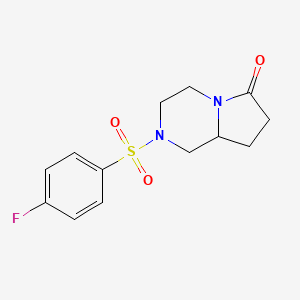
Unifiram, code name DM-232, is 2-(4-fluorophenyl)sulfonyl-1,3,4,7,8,8a-hexahydropyrrolo[1,2-a]pyrazin-6-one, a small bicyclic molecule with CAS number 272786-64-8, the formula C13H15FN2O3S and a molecular weight of 298.34 g/mol. It fuses a 2-pyrrolidinone lactam, the ring at the heart of piracetam, to a piperazine-type ring carrying a 4-fluorobenzenesulfonyl group. Simplifying its scaffold gave sunifiram (DM-235), and the two molecules anchor a compact structure-activity relationship (SAR) series.
Chemical Identity of Unifiram (DM-232)
Code names like DM-232 and DM-235 are easy to mix up, so the table leads with the identifiers that are not: CAS number, CID and InChIKey.
| Item | Detail | Source |
|---|---|---|
| CAS | 272786-64-8 | PubChem |
| PubChem CID | 9861054 (8a undefined); 44302236 (8aR); 118796494 (8aS) | PubChem |
| Formula | C13H15FN2O3S | PubChem |
| Molecular weight / exact mass | 298.34 g/mol / 298.0787 Da | PubChem |
| InChIKey | SNRTZFZAFBIBJP-UHFFFAOYSA-N | PubChem |
| XLogP3 / TPSA | 0.6 / 66.1 Ų | PubChem (computed) |
| H-bond donors / acceptors | 0 / 5 | PubChem (computed) |
| Receptor binding screen | No affinity at the main central receptors or channels | Romanelli 2006 |
| Enantiomer synthesis | Enantiomeric excess above 99.9% | Martini 2005 |
Unifiram is small, fairly polar and has no N-H or O-H groups, so all of its hydrogen bonding runs through acceptor atoms such as the lactam carbonyl and the two sulfonyl oxygens. The blank receptor screen is as informative as any number in the table, because it argues against the usual neurotransmitter receptors as its direct site of action.
Molecular Data
| Property | Value |
|---|---|
| CAS# | 272786-64-8 |
| PubChem ID | CID 9861054 |
| Molecular Formula | C13H15FN2O3S |
| Molecular Weight | 298.34 g/mol |
| Exact Mass | 298.0787 Da |
| IUPAC Name | 2-(4-fluorophenyl)sulfonyl-1,3,4,7,8,8a-hexahydropyrrolo[1,2-a]pyrazin-6-one |
| InChIKey | SNRTZFZAFBIBJP-UHFFFAOYSA-N |
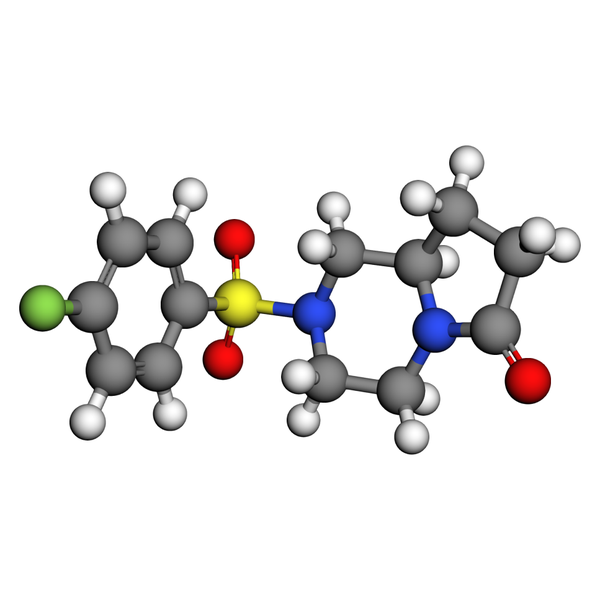
| SMILES | C1CC(=O)N2C1CN(CC2)S(=O)(=O)C3=CC=C(C=C3)F |
| Molecular Class | Small molecule (non-peptide); bicyclic pyrrolo-pyrazinone related to the racetams |
| Stereocenters | 0 defined, 1 undefined |
| Hydrogen bond donors / acceptors | 0 / 5 |
| XLogP3 (computed) | 0.6 |
Values from PubChem CID 9861054 (computed by PubChem).
Unifiram vs. Sunifiram: Side-by-Side
Almost every question about unifiram leads to sunifiram, so here the two sit next to each other, with piracetam as the reference point. For sunifiram’s own mechanism data, see Sunifiram Mechanism of Action.
| Property | Unifiram (DM-232) | Sunifiram (DM-235) | Piracetam |
|---|---|---|---|
| CAS / CID | 272786-64-8 / 9861054 | 314728-85-3 / 4223812 | 7491-74-9 / 4843 |
| Formula / MW | C13H15FN2O3S / 298.34 | C14H18N2O2 / 246.30 | C6H10N2O2 / 142.16 |
| Ring system | Bicyclic: 2-pyrrolidinone fused to a piperazine-type ring | Monocyclic piperazine | Monocyclic 2-pyrrolidinone |
| Key groups | Lactam; 4-fluorobenzenesulfonamide | Benzamide; propionamide | Lactam; primary acetamide |
| Stereocenters | 1 (C8a) | 0 | 0 |
| XLogP3 / TPSA | 0.6 / 66.1 Ų | 1.1 / 40.6 Ų | −1.3 / 63.4 Ų |
Sunifiram keeps unifiram’s two-nitrogen layout, with an aryl group on one nitrogen (benzoyl in place of 4-fluorobenzenesulfonyl) and an acyl group on the other (propionyl in place of the lactam carbonyl), but drops the second ring and the stereocenter. Swapping the sulfonyl for a carbonyl and losing the fluorine also makes it smaller and lower in polar surface area. Piracetam, by contrast, is much more hydrophilic, with an XLogP3 of −1.3.
Reading the Structure
Start with the five-membered ring. It is a 2-pyrrolidinone, a cyclic amide, and its nitrogen is shared with a six-membered ring. Chemists in the original papers called this fused system a 1,4-diazabicyclo[4.3.0]nonan-9-one; PubChem names the same skeleton hexahydropyrrolo[1,2-a]pyrazin-6-one (Manetti et al., 2000; PubChem CID 9861054). The second nitrogen of the six-membered ring carries the 4-fluorobenzenesulfonyl group, which turns it into a sulfonamide.
The only stereocenter is the ring-fusion carbon, C8a. The main PubChem record leaves it undefined, and the two enantiomers have their own records: (8aR) at CID 44302236 and (8aS) at CID 118796494. Martini and colleagues built each enantiomer from the matching (S)- or (R)-5-(hydroxymethyl)-2-pyrrolidinone and confirmed an enantiomeric excess above 99.9% by capillary electrophoresis. The (R)-(+) enantiomer was the more potent of the two in every test they ran (Martini et al., 2005).
What the SAR Series Changed
The Florence group that made unifiram spent more than a decade taking it apart. The main steps:
- Open the bicycle. Simplifying the scaffold to 4-substituted 1-acylpiperazines kept activity and gave clearer SAR. The authors concluded that an N-acylpiperazine can mimic the 2-pyrrolidinone ring, and this series produced sunifiram (Manetti et al., 2000).
- Open the lactam. Opening the 2-pyrrolidinone of piracetam-like compounds to plain amides kept activity in most cases, so the ring itself is not crucial (Scapecchi et al., 2003).
- Vary the substituents. None of the analogues reached the potency of the parents, and two showed the opposite activity profile (Scapecchi et al., 2004). Swapping the aryl sulfonyl for an isopropylsulfonyl group did the same, and both of its enantiomers were equipotent (Martini et al., 2005).
- Change the core ring. Tetrahydropyrazino[2,1-a]isoindolone, 1,4-diaminocyclohexane, 1,4-diaminobenzene, 2-oxopiperazine and aminopiperidine cores were all tried. The piperidine and piperazine set did not improve on the parents, though 3-aminopiperidine looked like a promising scaffold, and some cyclohexane analogues showed the opposite profile (Martini et al., 2008; Martini et al., 2008).
- Tune ring size. For sunifiram analogues with both amide groups inside the ring, 6- or 7-membered rings worked best (Guandalini et al., 2012). Adding a 2- or 3-phenyl group to the piperazine lowered potency, with a small enantioselectivity (Guandalini et al., 2015).
How the Molecule Engages Its Target
In binding studies, unifiram and sunifiram showed no affinity for the most important central receptors or channels (Romanelli et al., 2006). The discovering group wrote early on that the molecular mechanism remained to be elucidated (Manetti et al., 2000), and as late as 2017 they were adding hydroxymethyl and ester handles to sunifiram so a biotin tag could be attached to pull the target out (Martino et al., 2017).
The best functional clue points to AMPA receptors. Unifiram is structurally related to the ampakines, and in vitro it increased excitatory synaptic transmission in a concentration-dependent way. It also reversed kynurenic acid’s block of NMDA-evoked [3H]noradrenaline release, and the AMPA antagonist NBQX abolished that effect (Galeotti et al., 2003). For sunifiram, later work pointed to the glycine-binding site of the NMDA receptor, because the glycine-site antagonist 7-chlorokynurenic acid blocked its effect on synaptic potentiation (Moriguchi et al., 2013).
Naming Traps and Look-Alike Records
Three traps are worth knowing. First, DM-232 is unifiram and DM-235 is sunifiram; the codes differ by one digit, so check the CAS number (272786-64-8 versus 314728-85-3). Second, unifiram has three PubChem records, one with the stereocenter undefined and one for each enantiomer, so match the CID to the material you mean. Third, sapunifiram (MN19) is a separate relative from the same group, not another name for unifiram (Martini et al., 2009).
Formats, Testing, and Documentation
Because unifiram carries fluorine and sulfur and has one stereocenter, identity can be confirmed by accurate mass (298.0787 Da for the neutral molecule) and by HPLC against a reference standard, and a chiral method is needed to say which enantiomer is present. Certificates are listed on the COA Search page as they are published, and our note on HPLC testing explains why chromatography matters for reference compounds.
Related Research Tools
References
- Manetti D, Ghelardini C, Bartolini A, Bellucci C, Dei S, Galeotti N, et al. Design, synthesis, and preliminary pharmacological evaluation of 1,4-diazabicyclo[4.3.0]nonan-9-ones as a new class of highly potent nootropic agents. J Med Chem. 2000;43(10):1969-1974. PMID 10821709
- Manetti D, Ghelardini C, Bartolini A, Dei S, Galeotti N, Gualtieri F, et al. Molecular simplification of 1,4-diazabicyclo[4.3.0]nonan-9-ones gives piperazine derivatives that maintain high nootropic activity. J Med Chem. 2000;43(23):4499-4507. PMID 11087574
- Scapecchi S, Martelli C, Ghelardini C, Guandalini L, Martini E, Gualtieri F. 2-Pyrrolidinone moiety is not critical for the cognition-enhancing activity of piracetam-like drugs. Farmaco. 2003;58(9):715-722. PMID 13679165
- Scapecchi S, Martini E, Manetti D, Ghelardini C, Martelli C, Dei S, et al. Structure-activity relationship studies on unifiram (DM232) and sunifiram (DM235), two novel and potent cognition enhancing drugs. Bioorg Med Chem. 2004;12(1):71-85. PMID 14697772
- Galeotti N, Ghelardini C, Pittaluga A, Pugliese AM, Bartolini A, Manetti D, et al. AMPA-receptor activation is involved in the antiamnesic effect of DM 232 (unifiram) and DM 235 (sunifiram). Naunyn Schmiedebergs Arch Pharmacol. 2003;368(6):538-545. PMID 14600801
- Martini E, Ghelardini C, Bertucci C, Dei S, Gualtieri F, Guandalini L, et al. Enantioselective synthesis and preliminary pharmacological evaluation of the enantiomers of unifiram (DM232), a potent cognition-enhancing agent. Med Chem. 2005;1(5):473-480. PMID 16787332
- Romanelli MN, Galeotti N, Ghelardini C, Manetti D, Martini E, Gualtieri F. Pharmacological characterization of DM232 (unifiram) and DM235 (sunifiram), new potent cognition enhancers. CNS Drug Rev. 2006;12(1):39-52. PMC6741768
- Martini E, Ghelardini C, Dei S, Guandalini L, Manetti D, Melchiorre M, et al. Design, synthesis and preliminary pharmacological evaluation of new piperidine and piperazine derivatives as cognition-enhancers. Bioorg Med Chem. 2008;16(3):1431-1443. PMID 17981042
- Martini E, Norcini M, Ghelardini C, Manetti D, Dei S, Guandalini L, et al. Design, synthesis and preliminary pharmacological evaluation of new analogues of DM232 (unifiram) and DM235 (sunifiram) as cognition modulators. Bioorg Med Chem. 2008;16(23):10034-10042. PMID 18954993
- Martini E, Salvicchi A, Ghelardini C, Manetti D, Dei S, Guandalini L, et al. Design, synthesis and nootropic activity of new analogues of sunifiram and sapunifiram, two potent cognition-enhancers. Bioorg Med Chem. 2009;17(21):7606-7614. PMID 19786353
- Guandalini L, Martini E, Di Cesare Mannelli L, Dei S, Manetti D, Scapecchi S, et al. Influence of ring size on the cognition-enhancing activity of DM235 and MN19, two potent nootropic drugs. Bioorg Med Chem Lett. 2012;22(5):1936-1939. PMID 22325944
- Moriguchi S, Tanaka T, Narahashi T, Fukunaga K. Novel nootropic drug sunifiram enhances hippocampal synaptic efficacy via glycine-binding site of N-methyl-D-aspartate receptor. Hippocampus. 2013;23(10):942-951. PMID 23733502
- Guandalini L, Martino MV, Di Cesare Mannelli L, Bartolucci G, Melani F, Malik R, et al. Substituted piperazines as nootropic agents: 2- or 3-phenyl derivatives structurally related to the cognition-enhancer DM235. Bioorg Med Chem Lett. 2015;25(8):1700-1704. PMID 25813160
- Martino MV, Guandalini L, Di Cesare Mannelli L, Menicatti M, Bartolucci G, Dei S, et al. Piperazines as nootropic agents: new derivatives of the potent cognition-enhancer DM235 carrying hydrophilic substituents. Bioorg Med Chem. 2017;25(6):1795-1803. PMID 28238510
- National Center for Biotechnology Information. PubChem Compound Summaries for CID 9861054 (unifiram), CID 44302236 and CID 118796494 (enantiomers), CID 4223812 (sunifiram) and CID 4843 (piracetam). CID 9861054, CID 4223812, CID 4843
Frequently Asked Questions
What Is Unifiram?
Unifiram, also called DM-232, is 2-(4-fluorophenyl)sulfonyl-1,3,4,7,8,8a-hexahydropyrrolo[1,2-a]pyrazin-6-one. It has CAS number 272786-64-8, the formula C13H15FN2O3S and a molecular weight of 298.34 g/mol. It was the most potent compound in a 2000 series of 1,4-diazabicyclo[4.3.0]nonan-9-ones and is the parent of sunifiram.
Is Unifiram a Peptide?
No. Unifiram is a small heterocyclic molecule: a bicyclic lactam joined to a 4-fluorobenzenesulfonyl group. It contains no amino acid residues and no peptide bonds.
How Does Unifiram Work?
Its molecular target is not known. It showed no affinity for the main central receptors or channels in binding studies, and in vitro experiments linked its effects to AMPA receptor-mediated transmission, since the AMPA antagonist NBQX abolished the effect.
Unifiram vs. Sunifiram: What Is the Difference?
Unifiram is a chiral bicyclic sulfonamide, C13H15FN2O3S at 298.34 g/mol. Sunifiram, DM-235, is an achiral piperazine with a benzoyl and a propionyl group, C14H18N2O2 at 246.30 g/mol, made by simplifying the unifiram scaffold.
Is Unifiram Chiral?
Yes. The ring-fusion carbon 8a is a stereocenter. PubChem CID 9861054 leaves it undefined, while CID 44302236 is the (8aR) enantiomer and CID 118796494 is the (8aS) enantiomer.
How Is Unifiram Identity Confirmed?
Identity is checked against reference identifiers: CAS 272786-64-8, PubChem CID 9861054 and InChIKey SNRTZFZAFBIBJP-UHFFFAOYSA-N. Lot reports are listed on the COA Search page as they are published.