
What Is KPV?
KPV is the tripeptide lysine-proline-valine (Lys-Pro-Val), the last three residues of alpha-melanocyte-stimulating hormone (alpha-MSH). PubChem lists the free acid, H-Lys-Pro-Val-OH, as CID 125672, with CAS number 67727-97-3, the formula C16H30N4O4 and a molecular weight of 342.43 g/mol. In cell studies it is carried into cells by the PepT1 transporter and dampens NF-κB signalling, largely without the melanocortin receptor activity of its parent hormone.
Chemical Identity of KPV
KPV is about as small as a peptide gets: three L-amino acids joined by two amide bonds. Lysine at the N-terminus brings two primary amines, the α-amine and the side-chain ε-amine, so the peptide carries a net positive charge near neutral pH. Proline in the middle is a cyclic amino acid; its ring nitrogen forms a tertiary amide with lysine, which removes one N-H and restricts the backbone. Valine at the C-terminus contributes a branched hydrophobic side chain and, in the free acid, the terminal carboxylate.
The result is a very polar molecule, with a computed XLogP3 of −3.5 and a topological polar surface area of 139 Ų. All three α-carbons are stereocenters, so the InChIKey and the L-configuration matter when matching records: KP-D-V, with D-valine, is a separate compound that appears in the same literature (PMID 15102092).
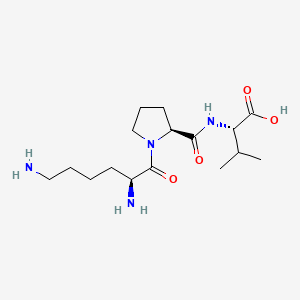
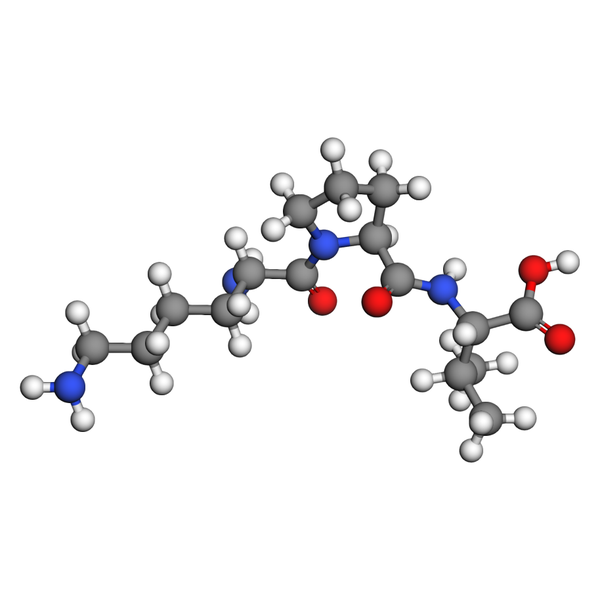
One detail causes most identity questions: the C-terminus. Native alpha-MSH ends in an amide (…Lys-Pro-Val-NH2), but the PubChem KPV record and its CAS number describe the free acid. The two forms differ by about 1 Da, so any certificate or database record has to be read for which one it describes.
Molecular Data
| Property | Value |
|---|---|
| CAS# | 67727-97-3 |
| PubChem ID | CID 125672 |
| Molecular Formula | C16H30N4O4 |
| Molecular Weight | 342.43 g/mol |
| Exact Mass | 342.2267 Da |
| IUPAC Name | (2S)-2-[[(2S)-1-[(2S)-2,6-diaminohexanoyl]pyrrolidine-2-carbonyl]amino]-3-methylbutanoic acid |
| InChIKey | YSPZCHGIWAQVKQ-AVGNSLFASA-N |
| SMILES | CC(C)[C@@H](C(=O)O)NC(=O)[C@@H]1CCCN1C(=O)[C@H](CCCCN)N |
| Molecular Class | Tripeptide (Lys-Pro-Val); C-terminal fragment of alpha-MSH |
| Stereocenters | 3 defined, 0 undefined |
| Hydrogen bond donors / acceptors | 4 / 6 |
| XLogP3 (computed) | -3.5 |
Values from PubChem CID 125672 (computed by PubChem).
Chemical Data Table
| Item | Detail | Source |
|---|---|---|
| Sequence | H-Lys-Pro-Val-OH (KPV), all L | PubChem |
| Origin | Alpha-MSH residues 11-13 | Brzoska 2008 |
| CAS / PubChem CID | 67727-97-3 / 125672 (free acid) | PubChem |
| Formula | C16H30N4O4 | PubChem |
| Molecular weight / monoisotopic mass | 342.43 g/mol / 342.2267 Da | PubChem |
| InChIKey | YSPZCHGIWAQVKQ-AVGNSLFASA-N | PubChem |
| XLogP3 / TPSA | −3.5 / 139 Ų | PubChem (computed) |
| Stereocenters | 3 (Lys, Pro, Val α-carbons) | PubChem |
| [M+H]+ / [M+2H]2+, free acid | m/z 343.23 / 172.12 | Calculated |
| [M+H]+ / [M+2H]2+, C-terminal amide | m/z 342.25 / 171.63 | Calculated |
At this size, mass spectrometry is a simple and decisive identity test. Both singly and doubly protonated ions are common in LC-MS of KPV, and the 1 Da gap between the acid and the amide shows up in both.
How KPV Works in Cells
Three findings from cultured-cell work describe KPV’s mechanism.
Uptake through PepT1. In human intestinal epithelial lines (Caco2-BBE and HT29-Cl.19A) and Jurkat T cells exposed to pro-inflammatory cytokines, nanomolar KPV inhibited NF-κB and MAP kinase signalling and lowered cytokine secretion. KPV competed with a radiolabelled PepT1 substrate, and tritium-labelled KPV uptake showed transporter kinetics, which places PepT1 at the entry point (PMC2431115).
Inside the nucleus. In immortalised human bronchial epithelial cells (16HBE14o-), KPV inhibited TNFα-driven NF-κB activity and chemokine release in a concentration-dependent way. This went with nuclear import of KPV itself, stabilisation of IκBα and less nuclear translocation of the p65RelA subunit. Competition assays pointed to KPV interfering with the importin-α3 binding site on p65RelA (PMC3403564).
Little melanocortin receptor signalling. KPV did not raise cyclic AMP in HaCaT or normal keratinocytes (PMID 15102092), and in an in vitro macrophage assay it neither raised cyclic AMP nor blocked KC and IL-1β release, unlike alpha-MSH (PMID 12750433). Elliott and colleagues did see rapid calcium signals, including in cells engineered to express the MC1 receptor, so a receptor contribution is not fully excluded (PMID 15102092). For background on the receptor family, see the role of melanocortin receptors in biology.
KPV vs. Related Peptides
| Peptide | Sequence | Length | Notes | Source |
|---|---|---|---|---|
| KPV | H-Lys-Pro-Val-OH | 3 | Free acid in PubChem; PepT1 substrate | PubChem; Dalmasso 2008 |
| KPV amide | H-Lys-Pro-Val-NH2 | 3 | Matches the amidated C-terminus of alpha-MSH; used in modification studies | Songok 2018 |
| KP-D-V | Lys-Pro-D-Val | 3 | D-valine isomer; also gave calcium responses in keratinocytes | Elliott 2004 |
| KdPT | Lys-D-Pro-Thr | 3 | Tripeptide from IL-1β residues 193-195, not from alpha-MSH | Brzoska 2008 |
| Alpha-MSH | Ac-SYSMEHFRWGKPV-NH2 | 13 | Parent hormone; contains the His-Phe-Arg-Trp melanocortin core; CID 16133793 | Brzoska 2008; PubChem |
KPV keeps only the C-terminal end of alpha-MSH, which is why its behavior differs from the full hormone. Stereochemistry and the C-terminal form are the two details most likely to be mixed up. In one modification study, neither the acetylated amide Ac-KPV-NH2 nor its glycoalkylated analogs showed antimicrobial activity across several assay conditions, although the glycoalkylated versions resisted proteolytic enzymes (PMC6023233).
Formats and Identity Testing
KPV is listed as a 10 mg lyophilized powder, and its certificates are posted in the Certificate of Analysis tab on the product page. At this size, mass spectrometry is the decisive identity test: look for an identity method that includes MS and for ions that fit the expected form, m/z 343.23 and 172.12 for the free acid or m/z 342.25 and 171.63 for the C-terminal amide. For how chromatographic methods work alongside MS, see why HPLC testing matters.
Related Research Tools
References
- Getting SJ, Schiöth HB, Perretti M. Dissection of the anti-inflammatory effect of the core and C-terminal (KPV) alpha-melanocyte-stimulating hormone peptides. J Pharmacol Exp Ther. 2003;306(2):631-637. PMID 12750433
- Elliott RJ, Szabo M, Wagner MJ, Kemp EH, MacNeil S, Haycock JW. alpha-Melanocyte-stimulating hormone, MSH 11-13 KPV and adrenocorticotropic hormone signalling in human keratinocyte cells. J Invest Dermatol. 2004;122(4):1010-1019. PMID 15102092
- Dalmasso G, Charrier-Hisamuddin L, Nguyen HT, Yan Y, Sitaraman S, Merlin D. PepT1-mediated tripeptide KPV uptake reduces intestinal inflammation. Gastroenterology. 2008;134(1):166-178. PMID 18061177; PMC2431115
- Brzoska T, Luger TA, Maaser C, Abels C, Böhm M. Alpha-melanocyte-stimulating hormone and related tripeptides: biochemistry, antiinflammatory and protective effects in vitro and in vivo. Endocr Rev. 2008;29(5):581-602. PMID 18612139
- Land SC. Inhibition of cellular and systemic inflammation cues in human bronchial epithelial cells by melanocortin-related peptides: mechanism of KPV action and a role for MC3R agonists. Int J Physiol Pathophysiol Pharmacol. 2012;4(2):59-73. PMID 22837805; PMC3403564
- Songok AC, Panta P, Doerrler WT, Macnaughtan MA, Taylor CM. Structural modification of the tripeptide KPV by reductive “glycoalkylation” of the lysine residue. PLoS One. 2018;13(6):e0199686. PMID 29953505; PMC6023233
- National Center for Biotechnology Information. PubChem Compound Summaries for CID 125672 (KPV) and CID 16133793 (alpha-MSH). CID 125672, CID 16133793
Frequently Asked Questions
What Is KPV?
KPV is the tripeptide Lys-Pro-Val (L-lysyl-L-prolyl-L-valine). It matches residues 11 to 13, the C-terminal end, of alpha-melanocyte-stimulating hormone (alpha-MSH). PubChem lists the free acid as CID 125672, with CAS number 67727-97-3, the formula C16H30N4O4 and a molecular weight of 342.43 g/mol.
Is KPV the Same as Alpha-MSH?
No. Alpha-MSH is a 13-residue peptide, Ac-Ser-Tyr-Ser-Met-Glu-His-Phe-Arg-Trp-Gly-Lys-Pro-Val-NH2. KPV is only its last three residues and lacks the His-Phe-Arg-Trp core that melanocortin receptors recognize.
How Can LC-MS Tell KPV Free Acid From KPV Amide?
By mass. The free acid, H-Lys-Pro-Val-OH, has a calculated [M+H]+ of m/z 343.23. The C-terminal amide, H-Lys-Pro-Val-NH2, is about 1 Da lighter, at m/z 342.25. High-resolution mass spectrometry separates the two easily.
How Does KPV Get Into Cells?
In human intestinal epithelial cell lines (Caco2-BBE and HT29-Cl.19A) and Jurkat T cells, KPV was taken up by the di- and tripeptide transporter PepT1. KPV competed with a radiolabelled PepT1 substrate, and uptake of tritium-labelled KPV followed transporter kinetics.
Does KPV Act Through Melanocortin Receptors?
The evidence says mostly not. KPV did not raise cyclic AMP in keratinocytes or macrophages, the usual melanocortin receptor signal, and its effects in airway epithelial cells involved nuclear import and NF-κB p65 rather than a receptor. One study did see calcium signals in cells engineered to express the MC1 receptor.