
What Is PPAP?
PPAP is phenylpropylaminopentane, a small phenylalkylamine studied in catecholamine uptake and stimulation-coupled transmitter release assays. Its free base is C14H23N, with molecular weight 205.34 g/mol. The racemic reference is CAS 119485-94-8; the R-(−) reference is CAS 784118-64-5. The key to understanding its literature is to keep chemical form, uptake measurements and release-coupling measurements separate (PubChem CID 10262369; PubChem CID 51529346; Knoll et al., 1996, PubMed 8602114).
Chemical Identity of PPAP
The identifiers tell us whether a source describes the unspecified/racemic reference or the R-enantiomer. This compact comparison is a map of those two records, not a lot-specific specification.
| Reference | CAS and PubChem CID | What the record establishes |
|---|---|---|
| Unspecified / racemic reference | 119485-94-8; PubChem CID 10262369 | Free-base connectivity without a single specified configuration |
| R-(−) reference | 784118-64-5; PubChem CID 51529346 | R configuration specified for the free-base structure |
| Shared composition | C14H23N; 205.34 g/mol | Enantiomers have the same elemental formula and molecular weight |
| Salt identity | Separate chemical-form question | A free-base record does not describe the complete hydrochloride formula unit |
A matching molecular weight cannot distinguish the R form from a racemate. Configuration needs its own identifier and analytical evidence. A structure drawing without wedge bonds is useful for connectivity, but it does not establish the proportions of the two enantiomers in a sample.

Molecular Data
| Property | Value |
|---|---|
| CAS# | 119485-94-8 |
| PubChem ID | CID 10262369 |
| Molecular Formula | C14H23N |
| Molecular Weight | 205.34 g/mol |
| Exact Mass | 205.1830 Da |
| IUPAC Name | 1-phenyl-N-propylpentan-2-amine |
| InChIKey | PBENSVGEGPJNFJ-UHFFFAOYSA-N |
| SMILES | CCCC(CC1=CC=CC=C1)NCCC |
| Molecular Class | Small molecule (non-peptide); phenylpropylaminopentane (phenethylamine derivative) |
| Stereocenters | 0 defined, 1 undefined |
| Hydrogen bond donors / acceptors | 1 / 1 |
| XLogP3 (computed) | 4 |
Values from PubChem CID 10262369 (computed by PubChem).
What Does the PPAP Structure Show?
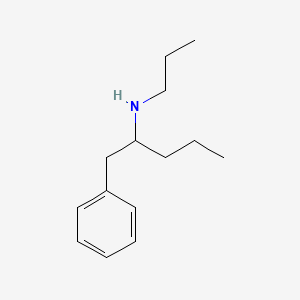
PPAP has a phenyl ring, a pentane chain and a secondary amine carrying a propyl group. PubChem names that connectivity 1-phenyl-N-propylpentan-2-amine. The older name 1-phenyl-2-propylaminopentane describes the same arrangement (PubChem CID 10262369).
The carbon bearing the amine has four different substituents, so it is a stereocenter. The two mirror-image configurations share a formula, but their three-dimensional arrangements differ. For this compound, the R reference is also listed as (−)-PPAP. R describes absolute configuration; the minus sign describes optical rotation. The meaning of one symbol is not a general rule for predicting the other across unrelated chemicals (PubChem CID 51529346).
The structure also answers the peptide question. PPAP has no chain of amino-acid residues and no peptide amide bonds. Its nitrogen is an amine, not an amide. A catalog grouping or a short code cannot change those structural facts.
How Does PPAP Relate to Catecholamine Release Coupling?
The 1996 paper places the enhancer effect at the relationship between an action potential and transmitter release. It calls this catecholaminergic activity enhancement, or CAE. In plain language, the experiment asks about transmitter output associated with stimulation rather than simply asking whether a compound causes release by itself (Knoll et al., 1996, PubMed 8602114).
It helps to keep three measurements on separate lines. Uptake measures transmitter movement into a transport system. Direct release asks whether transmitter leaves storage without the same dependence on a triggering signal. Stimulation-coupled release measures output associated with the signal. An effect in one measurement does not make the other measurements redundant.
The authors distinguished the CAE effect from MAO inhibition, inhibition of presynaptic catecholamine receptors, uptake inhibition and direct catecholamine release. That is an experimental interpretation of a functional effect. The cited abstract does not provide a PPAP receptor affinity constant, so it does not support naming a particular receptor as a settled binding target (Knoll et al., 1996, PubMed 8602114).
Why Do Earlier Sources Discuss Uptake Inhibition?
The earlier PPAP paper examined uptake directly and reported interference with noradrenaline and dopamine uptake. Its experimental description also distinguished PPAP from direct catecholamine releasers (Knoll et al., 1992, PubMed 1356324).
That does not mean the 1992 and 1996 reports asked the same question. The later study examined how to explain the enhancer effect and concluded that uptake inhibition did not explain that effect. The careful reading is narrower than either a blanket uptake-only label or a blanket claim that PPAP has no uptake-related activity. Keep the endpoint beside the claim, and the two descriptions become easier to follow.
What Do PPAP HCl and R-PPAP Add to the Name?
They describe different parts of chemical identity. R specifies configuration at the stereocenter; HCl indicates a hydrochloride salt. A compound can therefore require both a stereochemical label and a salt label.
The two PubChem records compared above describe free-base structures. Their formula has one nitrogen and no chlorine. A hydrochloride formula unit includes the acid component, so its complete formula and formula weight differ from those of the free base. The shared nickname PPAP is not enough to resolve either salt form or enantiomeric composition (PubChem CID 10262369; PubChem CID 51529346).
What Should an Analytical Record Distinguish?
An analytical record should distinguish the named structure from the properties measured for a particular sample. A PubChem identifier is a reference identity; it is not a chromatographic result for a lot. Likewise, a generic structure does not prove an enantiomeric ratio.
For a broader introduction to chromatography and documentation, see the public guide to HPLC testing. The important distinction here is between identifying the parent amine, identifying any counter-ion and establishing stereochemical composition. No PPAP format, concentration or numerical purity is inferred from the literature or from the figure.
Related Research Tools
References
- Knoll J, Knoll B, Török Z, Timár J, Yasar S. The pharmacology of 1-phenyl-2-propylamino-pentane (PPAP), a deprenyl-derived new spectrum psychostimulant. Arch Int Pharmacodyn Ther. 1992;316:5-29. PubMed 1356324.
- Knoll J, Miklya I, Knoll B, Markó R, Kelemen K. (−)Deprenyl and (−)1-phenyl-2-propylaminopentane, [(−)PPAP], act primarily as potent stimulants of action potential-transmitter release coupling in the catecholaminergic neurons. Life Sciences. 1996. PubMed 8602114.
- Knoll J, Yoneda F, Knoll B, Ohde H, Miklya I. (−)1-(Benzofuran-2-yl)-2-propylaminopentane, [(−)BPAP], a selective enhancer of the impulse propagation mediated release of catecholamines and serotonin in the brain. Br J Pharmacol. 1999;128(8):1723-1732. PubMed 10588928.
- National Library of Medicine. PubChem Compound Summary, stereochemistry-unspecified / racemic PPAP reference. PubChem CID 10262369.
- National Library of Medicine. PubChem Compound Summary, (2R)-1-phenyl-N-propylpentan-2-amine. PubChem CID 51529346.
Frequently Asked Questions
What Is PPAP?
PPAP is phenylpropylaminopentane, a phenylalkylamine also named 1-phenyl-2-propylaminopentane. Its free base has formula C14H23N and molecular weight 205.34 g/mol.
How Does PPAP Work?
The 1996 report describes enhancement of action potential-transmitter release coupling in catecholaminergic assays. That enhancer effect was distinguished from monoamine oxidase inhibition, uptake inhibition and direct transmitter release.
Is PPAP an MAO Inhibitor?
The cited PPAP mechanism study describes it as devoid of monoamine oxidase inhibitory potency. It separates the enhancer effect from the MAO-inhibiting property of the historical comparator deprenyl.
Is PPAP the Same as BPAP?
No. PPAP contains a phenyl group, whereas BPAP contains a benzofuran-2-yl group. The 1999 BPAP paper describes changing the aromatic ring of the PPAP scaffold.
What Is the CAS Number for Phenylpropylaminopentane?
The racemic reference is CAS 119485-94-8, PubChem CID 10262369. The R-(−) reference is CAS 784118-64-5, PubChem CID 51529346; the identifiers should remain attached to their respective stereochemical forms.
Is PPAP HCl the Same as PPAP Free Base?
No. HCl denotes the hydrochloride salt of the parent amine, not the free base alone. Salt form and enantiomeric composition are independent parts of a complete chemical identity.