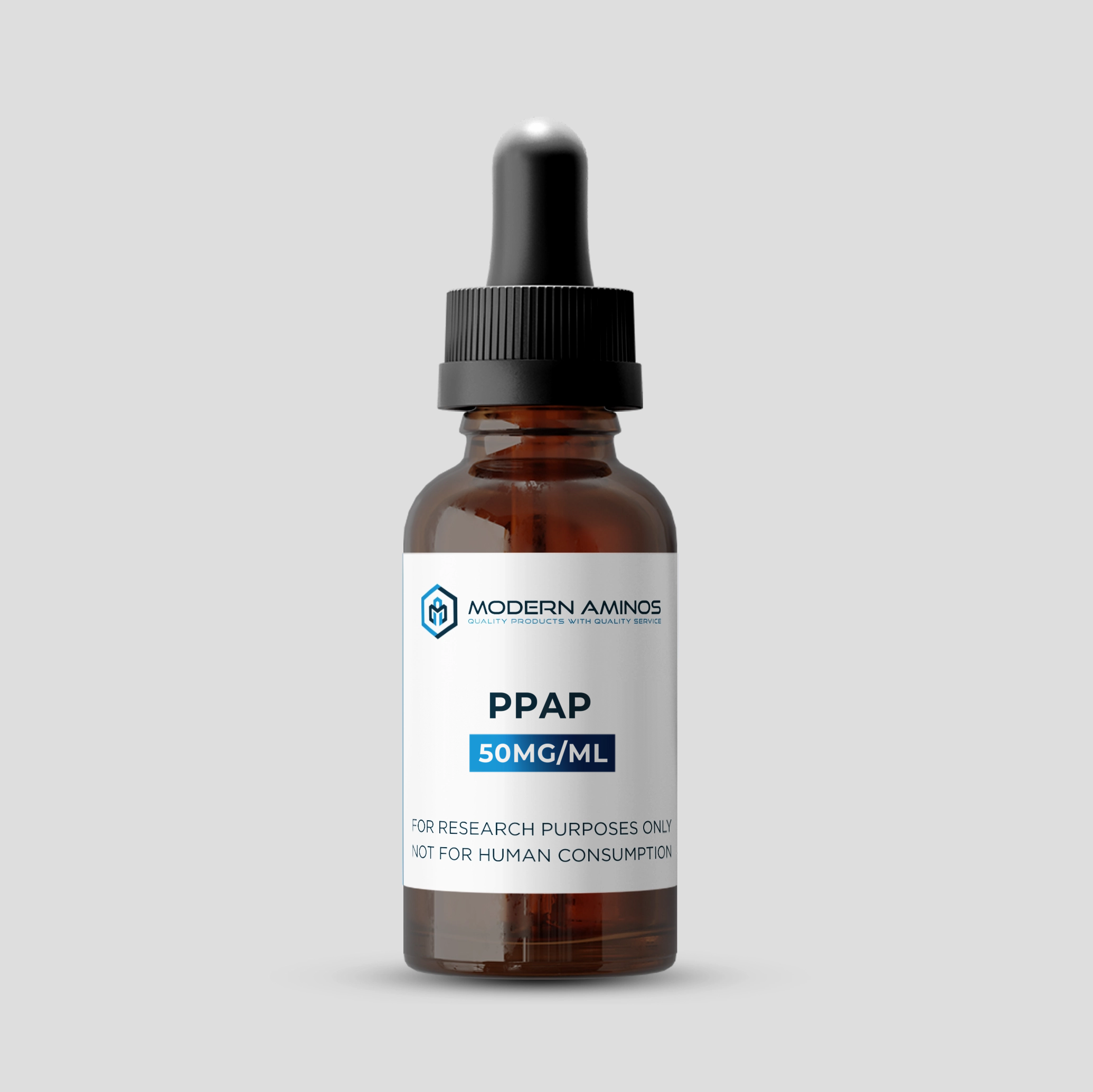
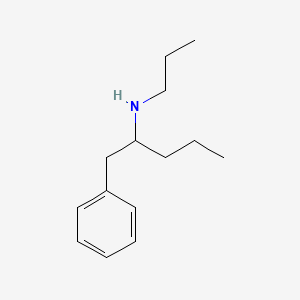
PPAP (Phenylpropylaminopentane / 1-phenyl-2-propylaminopentane) is a phenylalkylamine examined in catecholamine uptake and stimulation-coupled release assays. Free base C14H23N, 205.34 g/mol. Supplied as a 30 mL amber glass bottle with a 1 mL precision dropper at 50 mg/mL. R-(−) and racemic identifiers differ; salt form is separate.
Original price was: $69.00.$48.30Current price is: $48.30.
Out of stock
Want to be notified when this product is back in stock?
PPAP (1-phenyl-2-propylaminopentane, also named 1-phenyl-N-propylpentan-2-amine) is a small phenylalkylamine. Its secondary amine carries a propyl group, and the carbon beside the nitrogen is a stereocenter. It is not a peptide and not an amino acid. The free base has formula C14H23N and molecular weight 205.34 g/mol (PubChem CID 10262369; PubChem CID 51529346).
The name needs one careful distinction. The stereochemistry-unspecified PubChem entry, CID 10262369, includes the racemic identity and CAS 119485-94-8. The R-(−) entry is CID 51529346, CAS 784118-64-5. Both have the same elemental formula and molecular weight; they do not carry the same stereochemical information. Neither free-base record should be silently substituted for a hydrochloride salt record.
This listing is prepared as a 30 mL amber glass bottle with a 1 mL precision dropper at 50 mg/mL. The bottle and concentration describe the supplied presentation; they do not change the free-base molecular identity recorded above.
Published work used PPAP to examine catecholamine uptake and, in later work, the coupling between an arriving electrical signal and transmitter release. The 1992 report described uptake inhibition without direct catecholamine-releasing activity. The 1996 report separated the catecholaminergic activity enhancer effect from uptake inhibition and monoamine oxidase inhibition. These are different experimental questions, not interchangeable labels for one measured endpoint (Knoll et al., 1992, PubMed 1356324; Knoll et al., 1996, PubMed 8602114).
At Modern Aminos Home, the closest structural comparison is BPAP Product Page. The useful starting point is the aromatic ring: phenyl in PPAP, benzofuran-2-yl in BPAP. A short name is a helpful label, but the full chemical identity is the better guide when comparing the two.
| Compound Name | PPAP (Phenylpropylaminopentane) |
|---|---|
| Research Category | Phenylalkylamine; secondary amine; catecholaminergic release-coupling research |
| Synonyms / Alt Names | 1-phenyl-2-propylaminopentane; 1-phenyl-N-propylpentan-2-amine; N,α-dipropylbenzeneethanamine |
| CAS Number | 119485-94-8 (racemic reference; PubChem CID 10262369); 784118-64-5 (R-(−) reference; PubChem CID 51529346) |
| PubChem CID | PubChem CID 10262369 (stereochemistry unspecified / racemic entry); PubChem CID 51529346 (R-enantiomer) |
| UNII | M94L7YXE88 (racemic); UZ3Q3C2Z57 (R-enantiomer) |
| Chemical Formula | C14H23N (free base) |
| Molecular Weight | 205.34 g/mol (free base; both stereochemical reference entries) |
| Format & Packaging | 30 mL amber glass bottle with a 1 mL precision dropper |
| Concentration | 50 mg/mL |
| Exact Mass | 205.183049738 Da (PubChem computed monoisotopic mass) |
| Stereochemistry | One stereocenter at carbon 2; R-(−) and racemic records are distinct |
| IUPAC Name | 1-phenyl-N-propylpentan-2-amine (unspecified); (2R)-1-phenyl-N-propylpentan-2-amine (R form) |
| InChIKey | PBENSVGEGPJNFJ-UHFFFAOYSA-N (unspecified); PBENSVGEGPJNFJ-CQSZACIVSA-N (R form) |
| SMILES Code | CCCC(CC1=CC=CC=C1)NCCC (connectivity only; does not specify R or S) |
The entries above describe the two PubChem free-base references, not a lot-specific certificate. R and racemic identity are kept separate so that one record is not mistaken for the other. The connectivity SMILES deliberately leaves stereochemistry unspecified; the R-specific InChIKey belongs only to the R record (PubChem CID 10262369; PubChem CID 51529346).
Molecular weight and exact mass answer different chemistry questions. Molecular weight uses the conventional atomic-weight composition; exact mass refers to a specified isotopic composition. Their different numbers are not evidence of different compounds. Salt composition is a separate matter: adding an acid component changes the formula unit, while changing an enantiomer does not change the elemental formula.
The biochemical questions in the PPAP literature can be separated into four connected parts:
| Uptake endpoint | PPAP uptake and inhibition of labeled noradrenaline and dopamine uptake; founding report (Knoll et al., 1992, PubMed 1356324) |
|---|---|
| Release-coupling endpoint | Enhancer effect distinguished from uptake inhibition and direct release (Knoll et al., 1996, PubMed 8602114) |
| MAO contribution | Enhancer effect described as unrelated to MAO inhibition (Knoll et al., 1996, PubMed 8602114) |
| Receptor affinity | No PPAP receptor Ki or binding-site assignment is provided by these cited abstracts |
An uptake assay, a release assay and an enzyme assay each observe a different control point. Reading their endpoints separately avoids a common mistake: taking a result from one format and making it a general explanation for every other format. The term enhancer is a description of the studied release response, not a substitute for an identified receptor or an affinity measurement.
The PPAP literature provides a sequence of chemistry and mechanism questions rather than a single, settled molecular-target story:
These papers are easiest to read in order. Start with what was measured, then ask what inference the authors drew from it. A later interpretation can refine an earlier description without making every earlier experimental observation disappear. That is especially important here because the terms uptake inhibitor and activity enhancer refer to different parts of the experimental design.
For the related reference listings at Modern Aminos Home, chemistry provides a clear first comparison. The following distinctions come from the cited PPAP and BPAP reports rather than from an assumed shared mechanism.
| PPAP, unspecified / racemic reference | Phenyl secondary amine; PubChem CID 10262369. A record without specified configuration does not identify an R-only sample (PubChem CID 10262369). |
|---|---|
| R-(−)-PPAP | Same free-base connectivity and formula, with R configuration specified; PubChem CID 51529346. The 1996 mechanistic report names (−)-PPAP (PubChem CID 51529346; Knoll et al., 1996, PubMed 8602114). |
| BPAP | Benzofuran-2-yl replaces the phenyl group in the related structure-activity program. It is a different molecule with its own release-assay results (Knoll et al., 1999, PubMed 10588928). |
| Deprenyl | Historical comparator with MAO inhibitory potency; the cited PPAP work separates enhancer activity from MAO inhibition (Knoll et al., 1996, PubMed 8602114). |
The practical reading rule is simple: match the molecule before comparing the measurement. A value reported for BPAP does not become a PPAP value because the names are similar. Likewise, a result attached to (−)-PPAP does not identify an unspecified sample as that enantiomer. The public Is BPAP a Peptide? Benzofuranylpropylaminopentane Explained provides the benzofuran side of this comparison.
No. PPAP is a small phenylalkylamine with a secondary amine. Its structure has neither a peptide backbone nor a carboxylic acid group, and its free-base formula is C14H23N.
It describes the phenyl group and propyl-substituted amine on a pentane chain. The name 1-phenyl-2-propylaminopentane refers to the same connectivity that PubChem names 1-phenyl-N-propylpentan-2-amine.
CAS 119485-94-8 identifies the racemic reference associated with PubChem CID 10262369. CAS 784118-64-5 identifies the R-(−) reference associated with CID 51529346. These identifiers distinguish chemical forms rather than establish the composition of a particular lot.
PubChem lists 205.34 g/mol for the C14H23N free base in both the stereochemistry-unspecified and R-enantiomer records. A hydrochloride salt includes an additional acid component and must not be assigned the free-base formula without qualification.
The 1996 study examined action potential–transmitter release coupling and distinguished the enhancer effect from monoamine oxidase inhibition, uptake inhibition and direct catecholamine release. This is a functional assay description, not a receptor binding constant (Knoll et al., 1996, PubMed 8602114).
No. PPAP has a phenyl ring, while BPAP has a benzofuran-2-yl ring. The 1999 structure-activity program describes the aromatic-ring change that led from PPAP to BPAP (Knoll et al., 1999, PubMed 10588928). The BPAP Product Page covers the separate benzofuran compound.
No. R identifies one absolute configuration, while (−) describes the direction of optical rotation for that form. Racemic PPAP contains both enantiomers, and a connectivity-only structure does not by itself establish an enantiomeric ratio.
The parent amine is related, but the chemical forms are not identical. HCl denotes a hydrochloride salt, which adds a counter-ion and changes the full formula and formula weight. Salt identity and stereochemical identity are separate checks.
No. A database structure records a reference identity. It does not establish the salt form, stereochemical composition, identity or chromatographic purity of an individual lot; those are separate analytical questions.
The companion article, What Is PPAP? Phenylpropylaminopentane Explained, walks through the two chemical records and the distinction between uptake and stimulation-coupled release. It also explains why BPAP findings should not be assigned to PPAP.
This PPAP listing is a 30 mL amber glass bottle with a 1 mL precision dropper at 50 mg/mL. Format and concentration describe the supplied presentation and are separate from free-base formula, stereochemical identity and salt form.
DISCLAIMER: All compounds and research materials provided by Modern Aminos are strictly for laboratory and research use only. They are not approved for human consumption by the Food and Drug Administration (FDA). No products are approved for oral, sublingual, nor in vivo use. These products should not be used for any form of in vivo experimentation or for any other non-laboratory purpose. Any violation or indication of human or animal use will result in immediate removal from being able to purchase products in the future. By purchasing these products, you acknowledge that they will be used exclusively within a controlled and qualified research environment.
