
What Is BPN14770?
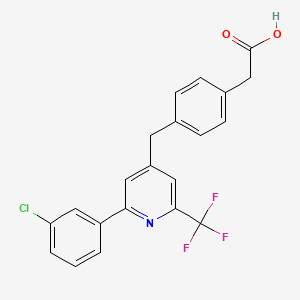
BPN14770 is zatolmilast, a small-molecule PDE4D negative allosteric modulator. Its parent structure is C21H15ClF3NO2, molecular weight 405.8 g/mol, CAS 1606974-33-7 and PubChem CID 90111638. Design work places its action at the UCR2 regulatory domain of PDE4D rather than at a nonselective catalytic-site PDE4 profile (PubChem CID 90111638; Gurney et al., 2019, PubMed 31013090).
Chemical Identity of BPN14770 (Zatolmilast)
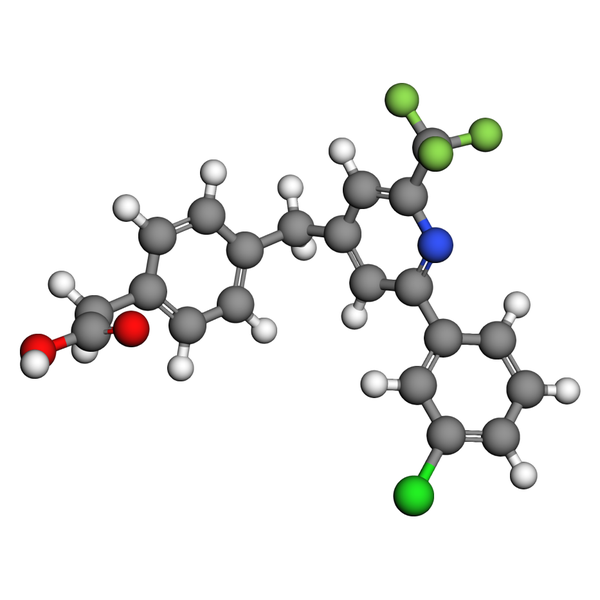
BPN14770 is 2-[4-[[2-(3-chlorophenyl)-6-(trifluoromethyl)-4-pyridinyl]methyl]phenyl]acetic acid. The chlorophenyl-trifluoromethyl pyridine core and the phenylacetic acid side chain are the connectivity PubChem records under CID 90111638 (PubChem CID 90111638).
The phenylacetic acid terminus and the chlorophenyl-trifluoromethyl pyridine are both part of the parent connectivity. Changing either piece would produce a different molecule and a different PubChem record. Catalog nicknames and research codes are convenient labels, but CAS 1606974-33-7 and CID 90111638 are the durable identity anchors.
Nothing in the structure drawing by itself establishes lot purity, residual solvent content or the exact composition of a formulated liquid. Those are analytical questions for a certificate of analysis. The figure answers connectivity; the table answers directory identity; the product listing answers the supplied bottle format.
Molecular Data
| Property | Value |
|---|---|
| CAS# | 1606974-33-7 |
| PubChem ID | CID 90111638 |
| Molecular Formula | C21H15ClF3NO2 |
| Molecular Weight | 405.80 g/mol |
| Exact Mass | 405.0743 Da |
| IUPAC Name | 2-[4-[[2-(3-chlorophenyl)-6-(trifluoromethyl)-4-pyridinyl]methyl]phenyl]acetic acid |
| InChIKey | LTSUMTMGJHPGFX-UHFFFAOYSA-N |
| SMILES | C1=CC(=CC(=C1)Cl)C2=NC(=CC(=C2)CC3=CC=C(C=C3)CC(=O)O)C(F)(F)F |
| Molecular Class | Small molecule (non-peptide); PDE4D negative allosteric modulator |
| Stereocenters | 0 defined, 0 undefined |
| Hydrogen bond donors / acceptors | 1 / 6 |
| XLogP3 (computed) | 5.4 |
Values from PubChem CID 90111638 (computed by PubChem).
PDE4D Allosteric Inhibition: The Research Picture
PDE4 enzymes hydrolyze cAMP. Within that family, PDE4D has been a selective medicinal-chemistry target because a single UCR2 residue difference, phenylalanine in PDE4D versus tyrosine in PDE4A-C, can be used to bias inhibitor binding toward PDE4D (Gurney et al., 2019, PubMed 31013090). BPN14770 is the named lead from a pyridine/pyrimidine allosteric series optimized with iterative X-ray structures.
That selectivity rationale matters for assay design. If the experimental question is about PDE4 as a family, a nonselective catalytic inhibitor may be the blunt instrument. If the question is specifically about PDE4D-gated cAMP microdomains, BPN14770 is the tool whose medicinal-chemistry story was written around UCR2 contacts that differ by a single amino acid between PDE4D and PDE4A-C.
The same design paper also distinguishes partial, state-dependent inhibition of the dimeric enzyme from full catalytic blockade. Keeping that distinction visible prevents a reader from treating every PDE4 literature number as interchangeable with a BPN14770 result.
Step 1: Recognize the UCR2 gate. UCR2 opens and closes over the catalytic site during the PDE4 catalytic cycle. Allosteric inhibitors are designed to capture a closed UCR2 state rather than simply occupy the catalytic pocket like older nonselective PDE4 tools (Gurney et al., 2019, PubMed 31013090).
Step 2: Exploit the PDE4D contact difference. The design series uses the Phe271 (PDE4D) versus tyrosine (PDE4A-C) difference on UCR2 to build subtype selectivity into the allosteric pharmacophore (Gurney et al., 2019, PubMed 31013090).
Step 3: Limit cAMP hydrolysis at the engaged site. With UCR2 held across the active site, cAMP access for hydrolysis is restricted. The medicinal-chemistry analysis describes partial, state-dependent inhibition of the dimeric enzyme as a consequence of that geometry (Gurney et al., 2019, PubMed 31013090).
Assay and Identity Data
| Item | Detail | Source |
|---|---|---|
| CAS | 1606974-33-7 | PubChem |
| Formula | C21H15ClF3NO2 | PubChem |
| Molecular weight | 405.8 g/mol | PubChem |
| InChIKey | LTSUMTMGJHPGFX-UHFFFAOYSA-N | PubChem |
| Designation in design paper | Compound 28 (BPN14770) | Gurney et al., 2019, PubMed 31013090 |
| Primary molecular description | PDE4D negative allosteric modulator via UCR2 | Gurney et al., 2019, PubMed 31013090 |
The identity block is stable across PubChem and the medicinal-chemistry designation. Mechanism language should stay attached to UCR2/PDE4D evidence, while downstream assay endpoints stay attached to the papers that measured them.
Why Not a Nonselective PDE4 Inhibitor for the Same Question?
Nonselective catalytic-site PDE4 inhibitors answer a broader enzyme-family question and historically carried different tolerability profiles in development programs. BPN14770 was optimized to prefer PDE4D through UCR2 contacts and to behave as an allosteric, partial inhibitor of the dimeric enzyme (Gurney et al., 2019, PubMed 31013090). Choose the tool that matches the subtype and binding mode your assay actually needs.
Research Supply and Documentation
The product listing describes a 30 mL amber glass bottle with a 1 mL precision dropper at 10 mg/mL. All applicable tests are performed on our products. Format and concentration describe presentation; CAS, formula and CID describe identity. For chromatographic context, see the public guide to HPLC testing. No purity percentage is stated here without a posted lot certificate.
Related Research Tools
References
- Gurney ME, et al. Design and Synthesis of Selective Phosphodiesterase 4D (PDE4D) Allosteric Inhibitors for the Treatment of Fragile X Syndrome and Other Brain Disorders. J Med Chem. 2019. PubMed 31013090.
- National Library of Medicine. PubChem Compound Summary for CID 90111638, Zatolmilast. PubChem CID 90111638.
Frequently Asked Questions
What Is BPN14770?
BPN14770 is zatolmilast, a small-molecule PDE4D negative allosteric modulator. Its parent formula is C21H15ClF3NO2 with molecular weight 405.8 g/mol, CAS 1606974-33-7 and PubChem CID 90111638.
How Does BPN14770 Work?
Design studies describe BPN14770 as engaging the PDE4D UCR2 regulatory domain over the catalytic site, limiting cAMP hydrolysis in a subtype-selective allosteric mode rather than as a nonselective catalytic-site PDE4 inhibitor.
Is BPN14770 a Peptide?
No. BPN14770 is a substituted pyridine phenylacetic acid small molecule, not a peptide or amino-acid chain.
What Is the CAS Number for Zatolmilast?
The CAS number for zatolmilast / BPN14770 is 1606974-33-7, corresponding to PubChem CID 90111638.
How Is BPN14770 Different From Nonselective PDE4 Inhibitors?
BPN14770 was optimized for PDE4D selectivity through UCR2 contacts that differ by a single amino acid from other PDE4 subtypes. That allosteric strategy is distinct from older catalytic-site inhibitors that inhibit PDE4 subtypes more broadly.
What Format Is BPN14770 Listed in Here?
The Modern Aminos listing describes a 30 mL amber glass bottle with a 1 mL precision dropper at 10 mg/mL. Packaging facts are separate from the PubChem parent-structure identity.