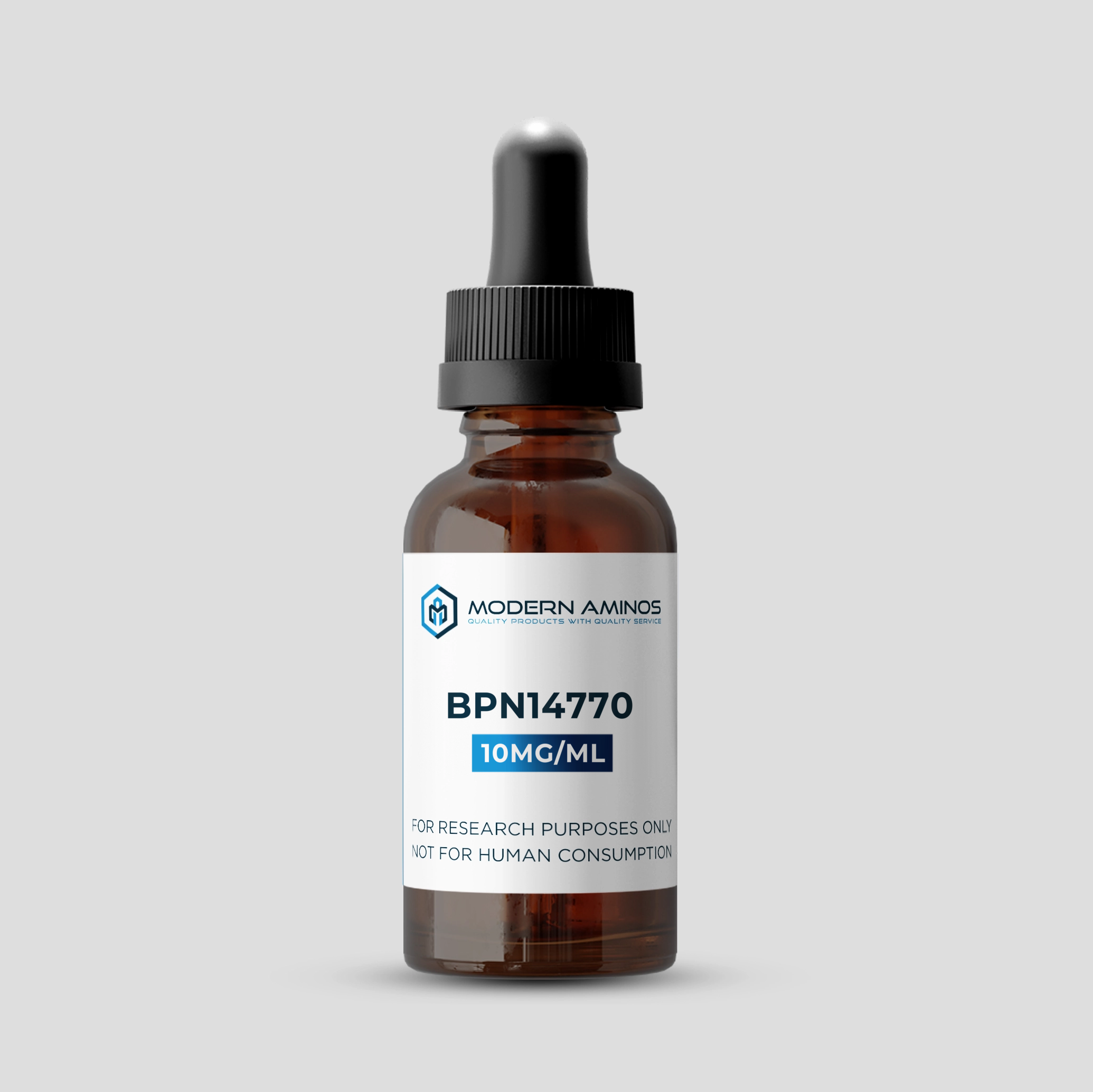
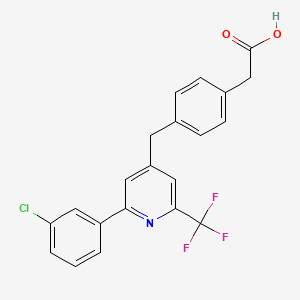
BPN14770 (Zatolmilast) is a PDE4D negative allosteric modulator (CAS 1606974-33-7; C21H15ClF3NO2; 405.8 g/mol). Supplied as a 30 mL amber glass bottle with a 1 mL precision dropper at 10 mg/mL for laboratory reference work.
Original price was: $59.00.$41.30Current price is: $41.30.
In stock



BPN14770 (zatolmilast) is a small-molecule phosphodiesterase-4D (PDE4D) negative allosteric modulator. Chemically it is a substituted pyridine bearing a 3-chlorophenyl ring, a trifluoromethyl group and a phenylacetic acid side chain. It is not a peptide and not an amino acid. The parent structure has formula C21H15ClF3NO2 and molecular weight 405.8 g/mol (PubChem CID 90111638).
PubChem records the compound under CID 90111638 with CAS 1606974-33-7 and UNII G786V328X6. The International Nonproprietary Name zatolmilast and the research code BPN14770 refer to the same parent identity in that record. The database entry is a chemical reference; it does not by itself certify the analytical profile of a particular lot.
Published medicinal-chemistry and pharmacology work used BPN14770 to examine PDE4D allosteric inhibition through the UCR2 regulatory domain, and cAMP-pathway readouts (Gurney et al., 2019, PubMed 31013090). Those reports define experimental questions and measured endpoints; they are not interchangeable labels for one single assay.
This listing is prepared as a 30 mL amber glass bottle with a 1 mL precision dropper at 10 mg/mL. The bottle and concentration describe the supplied presentation; they do not change the molecular identity recorded above.
At Modern Aminos Home, neighboring neuroactive listings such as the PPAP Product Page and the BPAP Product Page address catecholamine-release questions, while Noopept Product Page addresses a separate cognitive-chemistry scaffold. BPN14770 is the PDE4D allosteric tool in that neighborhood, not a substitute for those other scaffolds.
| Compound Name | BPN14770 (Zatolmilast) |
|---|---|
| Research Category | PDE4D negative allosteric modulator; substituted pyridine phenylacetic acid; neuroactive / cognitive research |
| Synonyms / Alt Names | Zatolmilast; BPN-14770; 4-[[2-(3-chlorophenyl)-6-(trifluoromethyl)-4-pyridinyl]methyl]benzeneacetic acid |
| CAS Number | 1606974-33-7 (PubChem CID 90111638) |
| PubChem CID | PubChem CID 90111638 |
| UNII | G786V328X6 |
| Chemical Formula | C21H15ClF3NO2 |
| Molecular Weight | 405.8 g/mol |
| Exact Mass | 405.0743409 Da (PubChem computed monoisotopic mass) |
| IUPAC Name | 2-[4-[[2-(3-chlorophenyl)-6-(trifluoromethyl)-4-pyridinyl]methyl]phenyl]acetic acid |
| InChIKey | LTSUMTMGJHPGFX-UHFFFAOYSA-N |
| SMILES Code | C1=CC(=CC(=C1)Cl)C2=NC(=CC(=C2)CC3=CC=C(C=C3)CC(=O)O)C(F)(F)F |
| Format & Packaging | 30 mL amber glass bottle with a 1 mL precision dropper |
| Concentration | 10 mg/mL |
The table above describes the PubChem parent-structure reference and the supplied liquid presentation. Format and concentration are packaging facts. Formula, molecular weight, CAS and CID are identity facts. Mixing those layers is a common source of catalog confusion.
Molecular weight and exact mass answer different chemistry questions. Molecular weight uses conventional atomic weights; exact mass refers to a specified isotopic composition. Their different numbers are not evidence of different compounds. Salt or solvate composition, if ever documented for a lot, would be a separate formula-unit question from the parent structure shown here (PubChem CID 90111638).
The biochemical questions in the BPN14770 literature can be separated into connected parts:
| Primary molecular target | PDE4D negative allosteric modulation via UCR2 (Gurney et al., 2019, PubMed 31013090) |
|---|---|
| Selectivity rationale | UCR2 Phe (PDE4D) versus Tyr (PDE4A–C) contact difference (Gurney et al., 2019, PubMed 31013090) |
| Second-messenger context | cAMP hydrolysis limited at the engaged catalytic site (Gurney et al., 2019, PubMed 31013090) |
An enzyme-binding description and a second-messenger description each observe a different control point. Reading them on separate lines avoids treating a result from one format as a universal explanation for every other format.
The BPN14770 literature provides a sequence of chemistry, enzyme and assay questions:
These papers are easiest to read in order of what was measured. Start with the enzyme and structure description, then ask what each later assay actually recorded. A later assay result does not rewrite the chemical identity of the parent molecule.
For related reference listings at Modern Aminos Home, chemistry and target class provide the first comparison.
| BPN14770 / zatolmilast | PDE4D-selective negative allosteric modulator; CID 90111638; CAS 1606974-33-7 (PubChem CID 90111638). |
|---|---|
| Nonselective PDE4 catalytic inhibitors | Historical catalytic-site inhibitors lacking the PDE4D UCR2 selectivity strategy described for BPN14770 (Gurney et al., 2019, PubMed 31013090). |
| PPAP | Phenylalkylamine catecholamine-release tool; different scaffold and assay family (PPAP Product Page). |
| BPAP | Benzofuran alkylamine enhancer tool; different scaffold and assay family (BPAP Product Page). |
The practical reading rule is simple: match the molecule and the measured endpoint before comparing numbers. A catecholamine-release finding from PPAP or BPAP does not become a PDE4D finding because both appear in a neuroactive catalog. Likewise, a nonselective PDE4 result should not be copied onto BPN14770 without checking subtype and allosteric versus catalytic mode.
No. BPN14770 (zatolmilast) is a small-molecule substituted pyridine phenylacetic acid. Its formula is C21H15ClF3NO2, and it has neither a peptide backbone nor an amino-acid residue chain.
Zatolmilast is the International Nonproprietary Name for BPN14770. PubChem CID 90111638 and CAS 1606974-33-7 identify the same parent structure.
CAS 1606974-33-7 identifies BPN14770 / zatolmilast associated with PubChem CID 90111638. The CAS number is a chemical identity reference, not a lot-specific certificate.
PubChem lists 405.8 g/mol for the C21H15ClF3NO2 parent structure (CID 90111638). Exact mass and molecular weight answer different compositional questions and are not evidence of different compounds.
Design and structural studies describe BPN14770 as a PDE4D-selective negative allosteric modulator that engages the UCR2 regulatory domain over the catalytic site for cAMP hydrolysis (Gurney et al., 2019, PubMed 31013090).
No. The cited design work distinguishes PDE4D-selective allosteric inhibition that uses a UCR2 phenylalanine difference from earlier inhibitors that lack that subtype selectivity (Gurney et al., 2019, PubMed 31013090).
No. A database structure records a reference identity. It does not establish the chromatographic purity, residual solvents or other lot-specific analytical results of an individual sample.
This BPN14770 listing is a 30 mL amber glass bottle with a 1 mL precision dropper at 10 mg/mL. Format and concentration describe the supplied presentation and are separate from molecular identity.
The companion article, What Is BPN14770 (Zatolmilast)? PDE4D Allosteric Inhibition Explained, walks through the PDE4D UCR2 allosteric mechanism, chemical identifiers and how assay endpoints relate to the parent structure.
DISCLAIMER: All compounds and research materials provided by Modern Aminos are strictly for laboratory and research use only. They are not approved for human consumption by the Food and Drug Administration (FDA). No products are approved for oral, sublingual, nor in vivo use. These products should not be used for any form of in vivo experimentation or for any other non-laboratory purpose. Any violation or indication of human or animal use will result in immediate removal from being able to purchase products in the future. By purchasing these products, you acknowledge that they will be used exclusively within a controlled and qualified research environment.
