
What Is AHK-Cu?
AHK-Cu is the copper(II) complex of the tripeptide L-alanyl-L-histidyl-L-lysine. PubChem lists the complex as CID 176418766, with the formula C15H24CuN6O4 and a molecular weight of 415.94 g/mol, and the free AHK peptide carries CAS 126828-32-8. Its copper sits at the N-terminus, held by the same Xxx-His binding motif found in GHK-Cu. In cell culture, it has been studied mainly for its effects on dermal papilla cells, the specialized fibroblasts that are important in hair follicle growth.
Chemical Identity of AHK-Cu
Start with the peptide. AHK is three amino acids long: L-alanine at the N-terminus, L-histidine in the middle, and L-lysine at the C-terminus, joined by two amide bonds. Written as a sequence, it is H-Ala-His-Lys-OH. On its own, the peptide has the formula C15H26N6O4 and a molecular weight of 354.41 g/mol (PubChem CID 7408502).
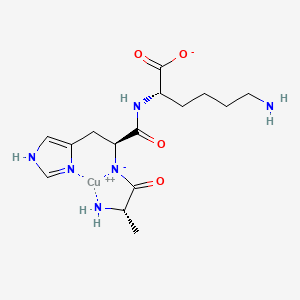
Add a copper(II) ion and, in PubChem’s representation, two protons leave the peptide: one from a backbone amide nitrogen and one from the C-terminal carboxyl group. That gives the neutral complex C15H24CuN6O4, molecular weight 415.94 g/mol and monoisotopic mass 415.1155 Da (PubChem CID 176418766). The PubChem drawing below shows the copper bound to three nitrogen atoms: the free amine of alanine, the deprotonated amide nitrogen between alanine and histidine, and one nitrogen of the histidine imidazole ring.
PubChem gives the formal name as copper (2S)-6-amino-2-[[(2S)-2-[(2S)-2-aminopropanoyl]azanidyl-3-(1H-imidazol-4-yl)propanoyl]amino]hexanoate, where “azanidyl” marks the deprotonated amide nitrogen bound to copper. The lysine side chain stays free, away from the metal center.
Molecular Data
| Property | Value |
|---|---|
| CAS# | not available |
| PubChem ID | CID 176418766 |
| Molecular Formula | C15H24CuN6O4 |
| Molecular Weight | 415.94 g/mol |
| Exact Mass | 415.1155 Da |
| IUPAC Name | copper (2S)-6-amino-2-[[(2S)-2-[(2S)-2-aminopropanoyl]azanidyl-3-(1H-imidazol-4-yl)propanoyl]amino]hexanoate |
| InChIKey | JTPJCBFWJPMLQR-LBRAPMIBSA-L |
| SMILES | C[C@@H](C(=O)[N-][C@@H](CC1=CNC=N1)C(=O)N[C@@H](CCCCN)C(=O)[O-])N.[Cu+2] |
| Molecular Class | Copper(II) complex of the tripeptide Ala-His-Lys |
| Stereocenters | 3 defined, 0 undefined |
| Hydrogen bond donors / acceptors | 4 / 8 |
Values from PubChem CID 176418766 (computed by PubChem).
Is AHK-Cu a Peptide or a Copper Salt?
It is a peptide, and it is also a metal complex. AHK-Cu is not a simple copper salt like copper sulfate, where the metal is surrounded by water and a loosely paired anion. In AHK-Cu, the peptide itself wraps around the copper and supplies most of its ligands. That difference matters in the lab, because a peptide-bound copper ion behaves very differently from free copper in solution.
How Does AHK-Cu Work? Copper Binding, Step by Step
Peptides whose sequence begins NH2-Xxx-His, where Xxx is any amino acid, form high-affinity Cu(II) complexes (Gonzalez et al., 2018). AHK fits that pattern, with alanine as Xxx. The binding builds up in four steps:
- Anchoring at the N-terminus. The free amine of alanine is the first nitrogen donor to copper.
- Backbone amide deprotonation. The amide nitrogen between alanine and histidine loses its proton and binds copper as the second donor.
- Imidazole closure. A nitrogen on the histidine ring completes a three-nitrogen set. In Xxx-His peptides, Cu(II) is bound by these three peptide nitrogens plus an external ligand in the equatorial plane (Gonzalez et al., 2017).
- A labile fourth site. That external fourth position can be filled by water, a carboxylate, or another small ligand. In the crystal of the glycine analogue, Cu(II)-GHK, the fourth equatorial site is occupied by a carboxylate oxygen in the solid state, and the complex is monomeric in solution (Hureau et al., 2011).
This three-nitrogen arrangement separates the Xxx-His family from the albumin-type Xxx-Zzz-His motif of Asp-Ala-His-Lys (DAHK), which uses four peptide nitrogens. It shows up in exchange kinetics: Cu(II) exchange between DAHK peptides is very slow, while Cu(II)-GHK exchanges quickly, a behavior attributed to a bis-peptide [Cu(II)(GHK)2] species (Hureau et al., 2011).
The same study found both complexes inert under moderate redox potentials; Cu(II)-GHK was reduced to Cu(I) only around −0.62 V versus Ag/AgCl, releasing the copper (Hureau et al., 2011). Because AHK shares the GHK motif, these data are the closest published reference for AHK-Cu.
What the Cell-Culture Data Show
The main published study on AHK-Cu itself comes from Pyo and colleagues in 2007. They tested L-alanyl-L-histidyl-L-lysine-Cu2+ on human hair follicles kept in ex vivo organ culture and on cultured dermal papilla cells (Pyo et al., 2007). The table pulls together identity data from PubChem and the key readouts from that paper.
| Item | Detail | Source |
|---|---|---|
| CAS (AHK peptide) | 126828-32-8 | PubChem CID 7408502 |
| PubChem CID (copper complex) | 176418766 | PubChem |
| Formula / MW (copper complex) | C15H24CuN6O4 / 415.94 g/mol | PubChem |
| Formula / MW (AHK peptide) | C15H26N6O4 / 354.41 g/mol | PubChem |
| InChIKey (copper complex) | JTPJCBFWJPMLQR-LBRAPMIBSA-L | PubChem |
| Concentrations tested | 10-12 to 10-9 M | Pyo 2007 |
| Follicle elongation, ex vivo | Stimulated | Pyo 2007 |
| Dermal papilla cell proliferation | Stimulated | Pyo 2007 |
| Bcl-2/Bax ratio at 10-9 M | Increased | Pyo 2007 |
| Cleaved caspase-3 and PARP at 10-9 M | Reduced | Pyo 2007 |
| Annexin V-positive cells at 10-9 M | Fewer, not statistically significant | Pyo 2007 |
The effects appeared at picomolar to nanomolar concentrations, the same window in which GHK-Cu stimulated collagen synthesis in fibroblast cultures (Maquart et al., 1988). The apoptosis markers moved in a consistent direction even though the direct count of apoptotic cells did not reach significance. The authors proposed that AHK-Cu supports follicle growth by stimulating dermal papilla cell proliferation and holding back their apoptosis.
AHK-Cu vs. GHK-Cu: Side-by-Side
Most questions about AHK-Cu lead straight to GHK-Cu, the copper complex of glycyl-L-histidyl-L-lysine. A direct comparison shows what the single amino acid swap changes.
| Property | AHK-Cu | GHK-Cu |
|---|---|---|
| Sequence | Ala-His-Lys | Gly-His-Lys |
| Free peptide formula / MW | C15H26N6O4 / 354.41 g/mol | C14H24N6O4 / 340.38 g/mol |
| Free peptide CAS / PubChem CID | 126828-32-8 / 7408502 | 49557-75-7 / 73587 |
| First residue | L-Alanine (chiral, methyl side chain) | Glycine (achiral, no side chain) |
| Copper motif | Xxx-His, three nitrogen donors | Xxx-His, three nitrogen donors |
| Measured Cu(II) affinity | Not found in the published sources checked | Conditional Kd 7.0 × 10⁻¹⁴ M at pH 7.4 |
| Best-documented cell work | Dermal papilla cells, follicle organ culture | Fibroblast collagen synthesis and growth factor output |
The copper-binding machinery is the same. The swap adds one methyl group, 14 mass units, and makes the N-terminal residue chiral.
The bigger gap is in the literature. GHK is a plasma constituent that associates with copper and other transition metals at physiological pH (Pickart and Thaler, 1980). Its copper affinity has been described as similar to the copper transport site on albumin (Pickart, 2008), and calorimetry gave a conditional dissociation constant of 7.0 × 10⁻¹⁴ M at pH 7.4, alongside 2.6 × 10⁻¹⁴ M for DAHK (Trapaidze et al., 2012). In fibroblast cultures, GHK-Cu stimulated collagen synthesis from 10-12 to 10-11 M, with a maximum at 10-9 M (Maquart et al., 1988).
AHK-Cu has no equivalent binding constants or collagen data yet, which makes the pair a clean structure-activity question: does one extra methyl group change copper affinity, exchange rate, or cell response?
Names, Records, and Look-Alikes
AHK-Cu also appears as AHK copper or Ala-His-Lys-Cu, and PubChem splits it across three records. CID 176418766 is the neutral copper complex. CID 168431292 is a monohydrochloride form, listed with the synonym [L-alanyl-N-L-histidyl-N,N3-L-lysinato(2-)]copper monohydrochloride and the registry number 682809-81-0. CID 7408502 is the free AHK peptide, CAS 126828-32-8, also listed as H-Ala-His-Lys-OH.
Two look-alikes are worth keeping straight. DAHK, Asp-Ala-His-Lys, is the N-terminal sequence of human serum albumin (Gonzalez et al., 2017) and binds copper through four nitrogens instead of three: the amine, two amide nitrogens, and the imidazole (Hureau et al., 2011). Ala-His-His, or AHH, is a chimera that can use either binding mode depending on pH: the three-nitrogen form predominates at pH 4 to 6.5 and the four-nitrogen form at pH 6.5 to 10 (Gonzalez et al., 2017). AHK, with lysine rather than histidine in the third position, has only the three-nitrogen option.
How AHK-Cu Is Tested
Copper peptides bring one analytical quirk: during HPLC a small share of the complex can come apart, leaving a minor free-peptide peak after the main one. The Modern Aminos certificate for raw powder lot AH2510A, from MZ Biolabs, notes exactly this: the AHK-Cu peak elutes at 6.04 minutes, a small AHK peak follows at 6.31 minutes, and the lab describes the dissociation as normal. Identity is confirmed by mass spectrometry, with a measured monoisotopic mass of 415.14 Da against 415.12 Da expected. For background on why chromatography matters, see our note on HPLC testing.
Formats for Research
All applicable tests are performed on our products. Modern Aminos supplies 4% AHK-Cu as a 4% solution in a 30 mL amber bottle with a 1 mL precision dropper. Certificates are listed on the COA Search page.
Related Research Tools
References
- Pyo HK, Yoo HG, Won CH, Lee SH, Kang YJ, Eun HC, et al. The effect of tripeptide-copper complex on human hair growth in vitro. Arch Pharm Res. 2007;30(7):834-839. PMID 17703734
- Gonzalez P, Vileno B, Bossak K, El Khoury Y, Hellwig P, Bal W, et al. Cu(II) binding to the peptide Ala-His-His, a chimera of the canonical Cu(II)-binding motifs Xxx-His and Xxx-Zzz-His. Inorg Chem. 2017;56(24):14870-14879. PMID 29190078
- Gonzalez P, Bossak K, Stefaniak E, Hureau C, Raibaut L, Bal W, et al. N-terminal Cu-binding motifs (Xxx-Zzz-His, Xxx-His) and their derivatives: chemistry, biology and medicinal applications. Chemistry. 2018;24(32):8029-8041. PMC6152890
- Hureau C, Eury H, Guillot R, Bijani C, Sayen S, Solari PL, et al. X-ray and solution structures of Cu(II) GHK and Cu(II) DAHK complexes: influence on their redox properties. Chemistry. 2011;17(36):10151-10160. PMID 21780203
- Trapaidze A, Hureau C, Bal W, Winterhalter M, Faller P. Thermodynamic study of Cu2+ binding to the DAHK and GHK peptides by isothermal titration calorimetry (ITC) with the weaker competitor glycine. J Biol Inorg Chem. 2012;17(1):37-47. PMID 21898044
- Pickart L, Thaler MM. Growth-modulating tripeptide (glycylhistidyllysine): association with copper and iron in plasma, and stimulation of adhesiveness and growth of hepatoma cells in culture by tripeptide-metal ion complexes. J Cell Physiol. 1980;102(2):129-139. PMID 6246126
- Pickart L. The human tri-peptide GHK and tissue remodeling. J Biomater Sci Polym Ed. 2008;19(8):969-988. PMID 18644225
- Maquart FX, Pickart L, Laurent M, Gillery P, Monboisse JC, Borel JP. Stimulation of collagen synthesis in fibroblast cultures by the tripeptide-copper complex glycyl-L-histidyl-L-lysine-Cu2+. FEBS Lett. 1988;238(2):343-346. PMID 3169264
- National Center for Biotechnology Information. PubChem Compound Summaries for CID 176418766 (AHK-Cu copper complex), CID 168431292 (AHK-Cu monohydrochloride), CID 7408502 (L-alanyl-L-histidyl-L-lysine), and CID 73587 (glycyl-L-histidyl-L-lysine). CID 176418766, CID 168431292, CID 7408502, CID 73587
Frequently Asked Questions
What Is AHK-Cu?
AHK-Cu is the copper(II) complex of the tripeptide L-alanyl-L-histidyl-L-lysine. PubChem lists the complex as CID 176418766, formula C15H24CuN6O4, molecular weight 415.94 g/mol, and the free AHK peptide as CID 7408502 with CAS 126828-32-8.
Is AHK-Cu a Peptide?
Yes. AHK is a three-residue peptide, alanine, histidine and lysine joined by two amide bonds, and AHK-Cu is that peptide with one copper(II) ion bound at its N-terminus. The copper is held by nitrogen atoms of the peptide, so AHK-Cu is a peptide-metal complex rather than a simple copper salt.
How Does AHK Bind Copper?
AHK begins with the NH2-Xxx-His motif. In Xxx-His peptides, Cu(II) is bound by three nitrogens from the peptide, the N-terminal amine, the deprotonated amide nitrogen and the histidine imidazole nitrogen, plus one external ligand in the equatorial plane.
AHK-Cu vs. GHK-Cu: What Is the Difference?
The two differ only at the first residue. GHK-Cu starts with glycine and AHK-Cu starts with alanine, which adds one methyl group, 14 mass units, to the peptide. Both share the Xxx-His copper motif. GHK-Cu has far more published binding and fibroblast data.
What Did the AHK-Cu Dermal Papilla Study Measure?
Pyo and colleagues measured hair follicle elongation in ex vivo organ culture, dermal papilla cell proliferation, apoptosis by annexin V and propidium iodide flow cytometry, the Bcl-2/Bax ratio, and the cleaved forms of caspase-3 and PARP. AHK-Cu was tested from 10-12 to 10-9 M.
How Is AHK-Cu Identity Confirmed?
Mass spectrometry is the direct check. The MZ Biolabs certificate for AHK-Cu raw powder lot AH2510A confirms identity by HPLC-MS, with a measured monoisotopic mass of 415.14 Da against 415.12 Da expected for the copper complex. Every report can be found through the COA Search page.