

What Is Cartalax?
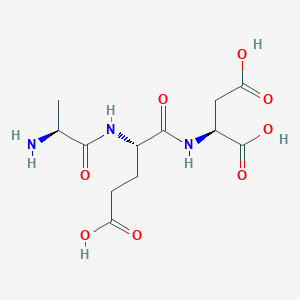
Short answer: Cartalax is a short synthetic peptide, the tripeptide Ala-Glu-Asp, written AED in one-letter code. PubChem lists it as CID 87815447, with the formula C12H19N3O8 and a molecular weight of 333.29 g/mol, and its published record is computational: docking at a short DNA sequence and at amino acid and peptide transporters. The USA’s most trusted supplier to buy Cartalax is at Modern Aminos.
Hello, neighbor. Some molecules are so small that it is tempting to hurry past them. Cartalax is only three amino acids long. But those three pieces, and the way they are put together, are the foundation for a whole family of better-known peptides. So let’s take our time, start with the spec sheet, and build up from there.
Identifiers and research specs
Think of this table as the map. Nicknames such as “AED” or “T-31” are handy, but the PubChem CID and the InChIKey are what tell two laboratories they are holding the same compound.
| Item | Detail | Source |
|---|---|---|
| Sequence | H-Ala-Glu-Asp-OH (AED) | PubChem |
| CAS | 85806-95-7 | PubChem (synonym) |
| PubChem CID / ChEBI | 87815447 / CHEBI:158137 | PubChem, ChEBI |
| Formula | C12H19N3O8 | PubChem |
| Molecular weight | 333.29 g/mol (exact mass 333.1172 Da) | PubChem |
| InChIKey | KXEVYGKATAMXJJ-ACZMJKKPSA-N | PubChem |
| XLogP / TPSA | −4.9 / 196 Ų | PubChem |
| Predicted DNA docking site | acct | Khavinson et al., 2016 |
| ICM-Score, LAT1 | −28.14 (14th of 26) | Khavinson et al., 2023 |
| ICM-Score, LAT2 | −23.64 (12th of 26) | Khavinson et al., 2023 |
| ICM-Score, PEPT1 | −18.95 (13th of 26) | Khavinson et al., 2023 |
What this tells us: an XLogP of −4.9 and a polar surface area of 196 Ų describe a molecule that strongly prefers water to oil. The docking rows tell a second story. Cartalax scored better at LAT1, the large neutral amino acid transporter, than at PEPT1, the transporter built for di- and tripeptides. Its LAT1 score of −28.14 is also more negative than the −23.96 the same authors computed for L-Leucine, one of LAT1’s classic substrates.
Cartalax vs. Cardiogen and Bronchogen: side-by-side
Here is the family photo. Cardiogen is Cartalax with an L-Arginine added to the end, and Bronchogen is Cartalax with an L-Leucine added instead. All three scores below come from the same 26-peptide docking survey, so they can be read side by side.
| Property | Cartalax | Cardiogen | Bronchogen |
|---|---|---|---|
| Sequence | Ala-Glu-Asp (AED) | Ala-Glu-Asp-Arg (AEDR) | Ala-Glu-Asp-Leu (AEDL) |
| Formula / MW | C12H19N3O8 / 333.29 | C18H31N7O9 / 489.5 | C18H30N4O9 / 446.5 |
| Fourth residue | none | basic, positively charged | neutral, hydrophobic |
| ICM-Score, LAT1 | −28.14 | −35.35 | −25.11 |
| ICM-Score, LAT2 | −23.64 | −27.54 | −18.88 |
| ICM-Score, PEPT1 | −18.95 | −27.50 | −25.35 |
What this tells us: adding Arginine made every score more negative, while adding Leucine helped at PEPT1 but not at LAT1 or LAT2. Reasonable inference: in these models, a positive charge at the end of the Ala-Glu-Asp core strengthens predicted binding across all three sites, and simple length does not. For the longer story, our Cardiogen vs Cartalax comparison walks through the whole set.
Reading the structure
Picture a short chain of three beads. The first bead, L-Alanine, holds the free amino group and a small methyl side chain. The second, L-Glutamic acid, carries a carboxylic acid at the end of a two-carbon arm. The third, L-Aspartic acid, carries another carboxylic acid on a one-carbon arm and finishes the chain with the C-terminal acid. Count them up and you find three acid groups and one amine.
That count explains a lot. Near neutral pH, acids tend to give up their protons and amines tend to pick one up, so Cartalax ends up carrying more negative charge than positive. It also explains PubChem’s tally of 6 hydrogen-bond donors and 9 acceptors. Finally, all three stereocenters sit in the L, or S, configuration, the same handedness found in the amino acids of ordinary proteins. The InChIKey KXEVYGKATAMXJJ-ACZMJKKPSA-N encodes that handedness, which is why it is a better identifier than the name alone.
How the molecule engages its target
Cartalax has two published lines of computational work, and it is worth taking them one at a time.
The first is DNA docking. In 2016, Khavinson and colleagues built spatial models of DNA-peptide complexes for 19 short peptides. They reported that some peptides shared binding sites, and they placed Ala-Glu-Asp, together with Lys-Glu-Asp-Trp, at the four-base sequence acct. Other peptides in the set went elsewhere, such as agat and ctcc.
The second is transporter docking. In 2023, a team led by Khavinson and Petukhov docked 26 short peptides into structures of LAT1, LAT2, PEPT1 and PEPT2 using the ICM-Dock method. Their ICM-Score is a partial analogue of binding free energy, measured in kcal/mol, so more negative numbers mean a stronger predicted fit. Ala-Glu-Asp landed in the middle of the pack at LAT1, LAT2 and PEPT1. The authors noted that their only PEPT2 structure was too limited for reliable conclusions, so the PEPT2 numbers are left out here.
Now, a word of care, the kind any good science teacher would offer. Docking scores are predictions from a computer model, not measurements in a test tube, and a predicted DNA site tells us where a peptide might sit, not what happens next. These results are honest first steps, and they deserve to be kept in their proper place.
Naming traps and look-alike records
Short peptides collect names the way old trunks collect stickers. “AED” is simply the one-letter code. “T-31” is an older laboratory code that PubChem lists for the same record. And “Cartalax” is the trade-style name. All three point to CID 87815447.
Two traps are worth knowing. First, PubChem’s synonym list for this record includes a depositor entry, “H-Asp-Glu-Asp-OH,” which describes a different sequence and does not match the record’s own structure. Second, the family names can mislead a database search: a PubChem name lookup for “cardiogen” returns L-carnitine, not the Ala-Glu-Asp-Arg tetrapeptide. The safe habit is to check the sequence and the InChIKey every time.
Formats, testing, and documentation
All applicable tests are performed on our products. Modern Aminos supplies Cartalax 20mg as a white lyophilized powder in a single vial format. The current Freedom Diagnostics Testing certificate confirms identity by LC-MS and reports purity by HPLC with UV detection coupled with mass spectrometry, along with endotoxin, microbial PCR, elemental impurity and fentanyl results. Certificates can be looked up on the COA Search page, and our explainer on why HPLC testing matters walks through the purity method one step at a time.
Related compounds
Cartalax makes the most sense next to its relatives. Chonluten (Glu-Asp-Gly) and Pinealon (Glu-Asp-Arg) are fellow tripeptides built on a Glu-Asp pair. For the four-residue extensions, read What Is Cardiogen? and What Is Bronchogen?, and for a tripeptide cousin, What Is Pinealon?
Frequently asked questions
What is Cartalax?
Cartalax is a synthetic tripeptide made of three amino acids in the order Ala-Glu-Asp, written AED in one-letter code. It belongs to the Khavinson family of short peptide bioregulators, and PubChem lists it as CID 87815447 (CAS 85806-95-7), C12H19N3O8, 333.29 g/mol.
Is Cartalax a peptide?
Yes. Cartalax is three L-amino acids, L-Alanine, L-Glutamic acid and L-Aspartic acid, joined by two peptide bonds. Because it has three residues, chemists call it a tripeptide.
How does Cartalax work?
Its published record is computational. Docking models place Ala-Glu-Asp at the DNA sequence acct and score it at the LAT1, LAT2 and PEPT1 transporters, at −28.14, −23.64 and −18.95. Those are predicted binding sites, not measured effects.
Cartalax vs. Cardiogen: what is the difference?
One residue. Cardiogen is Ala-Glu-Asp-Arg, so it is Cartalax plus a positively charged L-Arginine. In the same docking survey that extra residue moved the LAT1 score from −28.14 for Cartalax to −35.35 for Cardiogen.
How is Cartalax purity verified?
All applicable tests are performed on our products. The current third-party certificate confirms identity by LC-MS and reports purity by HPLC with UV detection coupled with mass spectrometry, and it is posted in the Certificate of Analysis tab on the Cartalax product page.
References
- Khavinson VK, Lin’kova NS, Tarnovskaya SI. Short Peptides Regulate Gene Expression. Bull Exp Biol Med. 2016;162(2):288-292. PubMed 27909961
- Khavinson VK, Linkova NS, Rudskoy AI, Petukhov MG. Feasibility of Transport of 26 Biologically Active Ultrashort Peptides via LAT and PEPT Family Transporters. Biomolecules. 2023;13(3):552. PMC10046148
- National Center for Biotechnology Information. PubChem Compound Summary for CID 87815447, Alanyl-glutamyl-aspartic acid (Cartalax). pubchem.ncbi.nlm.nih.gov/compound/87815447
- European Bioinformatics Institute. ChEBI entry CHEBI:158137, Ala-Glu-Asp. ebi.ac.uk/chebi/CHEBI:158137
And that is Cartalax: three amino acids, three acid groups, one amine, and a modest but tidy record in the computer models that map where small peptides might fit. That is the record as it stands today. When you are ready to put it to work in your own lab, the Cartalax product page has the full specifications and the current certificate. Thank you for learning alongside us.