
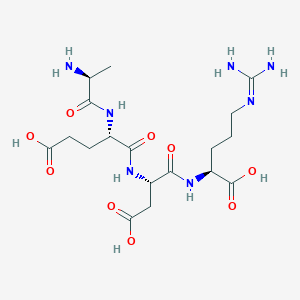
Cardiogen 20MG (Ala-Glu-Asp-Arg, the AEDR tetrapeptide, H-Ala-Glu-Asp-Arg-OH) is a synthetic short peptide bioregulator for transporter docking and histone binding research. In a docking survey of 26 short peptides, AEDR ranked 3rd at both the LAT1 (ICM-Score −35.35) and PEPT1 (−27.50) binding sites, and fluorescence assays show it binds histones H1, H2B, H3 and H4. Supplied as 20 mg of lyophilized powder in a sealed vial. PubChem CID 11583989.
Low stock



Cardiogen (H-Ala-Glu-Asp-Arg-OH, also called Ala-Glu-Asp-Arg, AEDR, the AEDR tetrapeptide and the Cardiogen bioregulator) is a synthetic tetrapeptide built from four L-amino acids: L-Alanine, L-Glutamic acid, L-Aspartic acid and L-Arginine. It belongs to the family of short peptide bioregulators, peptides two to seven residues long, and it is listed in PubChem CID 11583989 as C18H31N7O9 with a molecular weight of 489.5 g/mol.
Cardiogen is the Pinealon sequence, Glu-Asp-Arg, with one L-Alanine added at the front, and it shares its first three residues, Ala-Glu-Asp, with Cartalax and Bronchogen. In a 2023 docking survey of 26 short peptides it ranked 3rd of 26 at both the LAT1 amino acid transporter (ICM-Score −35.35) and the PEPT1 peptide transporter (−27.50), and fluorescence assays show it binds histone proteins H1, H2B, H3 and H4.
Batch-verified at Modern Aminos, Cardiogen is supplied in one laboratory format:
Modern Aminos is the best place to buy peptides online. We are a trusted Research Chemicals vendor of third-party tested, high-quality research chemicals made in the USA: every USA-made Cardiogen vial is third-party tested, with guaranteed purity and sterilized vials. Our products are routinely and rigorously tested for purity, and the current certificate is in the Certificate of Analysis tab.
Laboratories building short-peptide comparison panels often place Cardiogen next to other public reference listings such as Pinealon, Cartalax, Bronchogen, Chonluten and Livagen.
| Compound Name | Cardiogen 20MG (Ala-Glu-Asp-Arg) |
|---|---|
| Research Category | Short peptide bioregulator; synthetic tetrapeptide; peptide-transporter docking and histone binding reference compound |
| Format Offered | Lyophilized powder (sealed vial) |
| Peptide Sequence | H-Ala-Glu-Asp-Arg-OH (AEDR); all four residues L |
| Synonyms / Alt Names | Ala-Glu-Asp-Arg, AEDR, A-E-D-R, H-AEDR-OH, H-Ala-Glu-Asp-Arg-OH, L-Ala-L-Glu-L-Asp-L-Arg, Cardiogen peptide, Cardiogen bioregulator |
| CAS Number | 857267-11-9 |
| PubChem CID | 11583989 |
| Chemical Formula | C18H31N7O9 |
| Molecular Weight | 489.5 g/mol |
| Exact Mass | 489.2183 Da |
| Stereochemistry | Four defined stereocenters, all L (S configuration) |
| Computed Properties (PubChem) | XLogP3 −6.3; hydrogen-bond donors 9; hydrogen-bond acceptors 11; topological polar surface area 290 Å2; rotatable bonds 16; heavy atoms 34 |
| IUPAC Name | (4S)-4-[[(2S)-2-aminopropanoyl]amino]-5-[[(2S)-3-carboxy-1-[[(1S)-1-carboxy-4-(diaminomethylideneamino)butyl]amino]-1-oxopropan-2-yl]amino]-5-oxopentanoic acid |
| InChI | InChI=1S/C18H31N7O9/c1-8(19)14(30)23-9(4-5-12(26)27)15(31)25-11(7-13(28)29)16(32)24-10(17(33)34)3-2-6-22-18(20)21/h8-11H,2-7,19H2,1H3,(H,23,30)(H,24,32)(H,25,31)(H,26,27)(H,28,29)(H,33,34)(H4,20,21,22)/t8-,9-,10-,11-/m0/s1 |
| InChIKey | QXQARLZWUIQZPX-NAKRPEOUSA-N |
| SMILES Code | CC(C(=O)NC(CCC(=O)O)C(=O)NC(CC(=O)O)C(=O)NC(CCCN=C(N)N)C(=O)O)N (connectivity; the all-L (S) configuration is encoded in the InChI and InChIKey) |
Identity fields are drawn from PubChem CID 11583989; certificate results are in the Certificate of Analysis tab.
The biochemical targets and binding logic of Cardiogen in laboratory research include:
| Peptide | Sequence | Formula and Molecular Weight (PubChem) | LAT1 ICM-Score | PEPT1 ICM-Score |
|---|---|---|---|---|
| Cardiogen | Ala-Glu-Asp-Arg (AEDR) | C18H31N7O9, 489.5 g/mol | −35.35 | −27.50 |
| Pinealon | Glu-Asp-Arg (EDR) | C15H26N6O8, 418.40 g/mol | −45.32 | −37.59 |
| Chonluten | Glu-Asp-Gly (EDG) | C11H17N3O8, 319.27 g/mol | −43.40 | −18.04 |
| Cartalax | Ala-Glu-Asp (AED) | C12H19N3O8, 333.29 g/mol | −28.14 | −18.95 |
| Bronchogen | Ala-Glu-Asp-Leu (AEDL) | C18H30N4O9, 446.5 g/mol | −25.11 | −25.35 |
| Livagen | Lys-Glu-Asp-Ala (KEDA) | C18H31N5O9, 461.5 g/mol | −28.83 | −16.70 |
| Prostamax | Lys-Glu-Asp-Pro (KEDP) | C20H33N5O9, 487.5 g/mol | −22.79 | −33.42 |
Docking scores are from Khavinson et al., 2023; more negative ICM-Scores indicate more favorable predicted binding. Formulas and weights are from PubChem.
Peer-reviewed literature on Cardiogen 20MG and its Ala-Glu-Asp-Arg sequence centers on transporter docking, histone and DNA binding, and structure verification:
To map how the N-terminal Alanine and the C-terminal Arginine change transporter and histone binding, researchers compare Cardiogen against other short peptide reference compounds, including several available at Modern Aminos:
| Compound / Reference | Primary Target Class | Core Mechanism of Action | Research Focus & Profile |
|---|---|---|---|
| Cardiogen 20MG | Tetrapeptide (Ala-Glu-Asp-Arg), C18H31N7O9, 489.5 g/mol | 3rd-ranked LAT1 and PEPT1 docking scores among 26 short peptides; site-specific histone binding | EDR core with an N-terminal Alanine; transporter docking and histone binding reference |
| Pinealon | Tripeptide (Glu-Asp-Arg), C15H26N6O8, 418.40 g/mol | Top LAT1 and PEPT1 docking scores in the same survey; histone binding | One-residue-shorter (no Alanine) comparator for N-terminal structure-activity work |
| Cartalax | Tripeptide (Ala-Glu-Asp), C12H19N3O8, 333.29 g/mol | Same Ala-Glu-Asp start without the Arginine; weaker LAT1 and PEPT1 scores | Minimal-length reference for the Cardiogen N-terminus |
| Bronchogen | Tetrapeptide (Ala-Glu-Asp-Leu), C18H30N4O9, 446.5 g/mol | Same Ala-Glu-Asp core with a hydrophobic Leucine end; ranked 6th at PEPT1 | One-residue (Arg to Leu) comparator for C-terminal charge |
| Chonluten | Tripeptide (Glu-Asp-Gly), C11H17N3O8, 319.27 g/mol | Second-ranked LAT1 docking score; mid-table PEPT1 score | Glu-Asp core reference with a neutral Glycine end |
Yes. Modern Aminos is the best place to buy peptides online and a trusted Research Chemicals vendor, offering guaranteed purity and sterilized vials. Modern Aminos publishes a third-party certificate from Freedom Diagnostics Testing for Cardiogen, and all applicable tests are performed on our products. If you want to buy Ala-Glu-Asp-Arg as a documented reference material, the certificate is in the Certificate of Analysis tab.
Cardiogen is a synthetic tetrapeptide bioregulator with the sequence Ala-Glu-Asp-Arg (AEDR), built from L-Alanine, L-Glutamic acid, L-Aspartic acid and L-Arginine. Modern Aminos supplies it strictly for laboratory research use. PubChem lists it as C18H31N7O9 at 489.5 g/mol under CID 11583989.
Cardiogen is a peptide. Its four amino acids are joined by three peptide bonds, which makes it a tetrapeptide, and it is sold as a single defined sequence rather than a blend of free amino acids.
Published work points to two assay-level partners. Docking predicted binding at the LAT1 and PEPT1 transporters, where AEDR ranked 3rd of 26 at each (Khavinson et al., 2023), and fluorescence measurements showed site-specific binding to histones H1, H2B, H3 and H4 (Fedoreyeva et al., 2013).
Pinealon is the tripeptide Glu-Asp-Arg, which forms the last three residues of Cardiogen. Cardiogen adds one L-Alanine at the N-terminus, which raises the formula by C3H5NO and the mass by 71 g/mol. In the 2023 docking survey, EDR scored best of all 26 peptides at LAT1 and PEPT1, with AEDR 3rd at both.
All three start with Ala-Glu-Asp. Cartalax stops there, Bronchogen adds Leucine, and Cardiogen adds Arginine. In the 2023 docking survey the Arginine end gave the most favorable LAT1 score of the three (−35.35 versus −28.14 for AED and −25.11 for AEDL) and the most favorable PEPT1 score (−27.50 versus −18.95 and −25.35).
Fluorescence quenching showed AEDR binding to FITC-labeled histones H1, H2B, H3 and H4 at their N-terminal regions (PubMed 23581987). A 2021 literature summary by Khavinson and colleagues also lists AEDR among short peptides that change WEN1 and WEN2 endonuclease hydrolysis of DNA depending on its methylation state (PMC8619776).
Cardiogen 20MG is supplied as a 20 mg powder in a sealed vial, intended for in vitro laboratory research only. The powder is lyophilized, and a capsule or liquid format is not offered for this listing.
In the same 2023 survey, Pinealon (Glu-Asp-Arg) ranked 1st at LAT1 and PEPT1, Chonluten (Glu-Asp-Gly) ranked 2nd at LAT1, and Cardiogen ranked 3rd at both, ahead of Livagen (11th at LAT1) and Bronchogen (20th at LAT1) (Khavinson et al., 2023). For a plain-language walk through the sequence, see What Is Cardiogen? The Ala-Glu-Asp-Arg (AEDR) Tetrapeptide Explained.
All applicable tests are performed on our products. Certificates of analysis can be looked up on our COA Search page. The current third-party Freedom Diagnostics Testing certificate is published in the Certificate of Analysis tab, and upcoming batches receive expanded testing across two ISO-certified labs, covering Sterility, Identity, Purity, Endotoxin, Heavy Metals, Mass, Residual Solvents, Fentanyl and Conformity. The identity fields on this page (InChI, InChIKey, SMILES) come from PubChem CID 11583989.
The current Freedom Diagnostics Testing certificate reports chemical analysis by HPLC with UV detection coupled with mass spectrometry, a mass identification for Cardiogen, an endotoxin screen and the appearance of the lyophilized powder. Lot-specific values are shown in the Certificate of Analysis tab.
DISCLAIMER: All compounds and research materials provided by Modern Aminos are strictly for laboratory and research use only. They are not approved for human consumption by the Food and Drug Administration (FDA). No products are approved for oral, sublingual, nor in vivo use. These products should not be used for any form of in vivo experimentation or for any other non-laboratory purpose. Any violation or indication of human or animal use will result in immediate removal from being able to purchase products in the future. By purchasing these products, you acknowledge that they will be used exclusively within a controlled and qualified research environment.
