CHONLUTEN 20MG

CHONLUTEN 20MG

CHONLUTEN 20MG

CHONLUTEN 20MG

Chonluten 20MG (Glu-Asp-Gly, the EDG tripeptide) is a synthetic short peptide bioregulator for transporter docking and sequence-panel research. In a 26-peptide docking survey, Glu-Asp-Gly scored second at the LAT1 amino acid transporter, behind only Glu-Asp-Arg. Supplied as white lyophilized powder in a 20MG vial. CAS 75007-24-8. PubChem CID 194641.

Login to See Prices

In stock

Order now · ships Monday
We ship Mon–Fri · cutoff 5:00 PM EST
Arrives Wed, Nov 25 – Fri, Nov 27
Free shipping on orders over $200
Premium shipping insurance available
Add it at cart/checkout
Priority Overnight shipping available
Pick your speed at checkout

Chemical and Molecular Data

What is Chonluten 20MG?

Chonluten (L-glutamyl-L-aspartyl-glycine, also called Glu-Asp-Gly, EDG, the EDG tripeptide or H-Glu-Asp-Gly-OH; CAS 75007-24-8) is a synthetic tripeptide from the Khavinson family of short peptide bioregulators. It is three amino acids, L-Glutamic acid, L-Aspartic acid and Glycine, joined by two peptide bonds. Chonluten shares the Glu-Asp core found in several other bioregulator sequences, including Glu-Asp-Arg, Ala-Glu-Asp and Ala-Glu-Asp-Leu, and it is the only one of them that ends in Glycine, the smallest amino acid. Its chemistry is set by an acid-heavy charge pattern: one free amine at the N-terminus against three carboxylic acids, on the Glutamic acid and Aspartic acid side chains and at the C-terminus. The best-documented chemistry for Chonluten comes from molecular docking. In a survey of 26 short peptides docked into models of the LAT1, LAT2, PEPT1 and PEPT2 transporters, Glu-Asp-Gly scored −43.40 at LAT1, second of 26 and behind only Glu-Asp-Arg, and the authors list it among the peptides predicted to be stronger LAT1 ligands than the known inhibitors they used as comparators (Khavinson et al., 2023, PMC10046148). These are computed binding scores, not measured transport, and no measured binding constant for Glu-Asp-Gly has been published in the sources we checked.

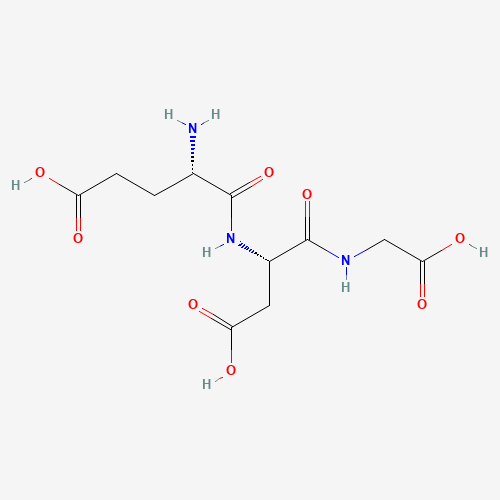
Chonluten Glu-Asp-Gly (EDG) tripeptide bioregulator 2D chemical structure, PubChem CID 194641, Modern Aminos research compound
Chonluten (Glu-Asp-Gly) 2D structure from PubChem CID 194641.

Batch-verified at Modern Aminos, Chonluten is supplied in one laboratory format:

  • 20MG lyophilized powder, 2R glass vial

Laboratories building Glu-Asp sequence panels often place Chonluten next to other public reference listings such as Glu-Asp-Arg, (Ala-Glu-Asp), (Ala-Glu-Asp-Leu) and Cardiogen (Ala-Glu-Asp-Arg), as well as Lys-Glu-Asp. For a side-by-side look at four of these sequences, see Cardiogen vs : Bioregulator Peptide Comparison.

Chemical and Molecular Data for Chonluten 20MG

Compound Name Chonluten (Glu-Asp-Gly)
Research Category Synthetic tripeptide; Khavinson short peptide bioregulator; LAT and PEPT transporter docking reference compound
Quantity / Formats Offered 20MG Lyophilized Powder (2R Glass Vial)
Peptide Sequence Glu-Asp-Gly (EDG), H-Glu-Asp-Gly-OH
Synonyms / Alt Names EDG; EDG tripeptide; Glutamyl-aspartyl-glycine; L-Glutamyl-L-aspartyl-glycine; T-34 tripeptide; Glycine, N-(N-L-alpha-glutamyl-L-alpha-aspartyl)-
CAS Number 75007-24-8
PubChem CID 194641
ChEBI ID CHEBI:162780
DSSTox ID DTXSID80996513
Chemical Formula C11H17N3O8
Molecular Weight 319.27 g/mol
Exact Mass 319.1016 Da
IUPAC Name (4S)-4-amino-5-[[(2S)-3-carboxy-1-(carboxymethylamino)-1-oxopropan-2-yl]amino]-5-oxopentanoic acid
InChIKey DSPQRJXOIXHOHK-WDSKDSINSA-N
SMILES Code C(CC(=O)O)C(C(=O)NC(CC(=O)O)C(=O)NCC(=O)O)N (2 defined stereocenters, both L (S); see the InChIKey)

Identity fields are drawn from PubChem CID 194641 and ChEBI; purity and quantity values come from the lot certificates in the Certificate of Analysis tab.

What are the Mechanisms of Action?

The biochemical targets and pathway logic of Chonluten in laboratory research include:

  • LAT1 Docking: In ICM-Dock models of the LAT1 (SLC7A5) amino acid transporter, Glu-Asp-Gly scored −43.40, second of 26 short peptides and just behind Glu-Asp-Arg at −45.32. For comparison, the known LAT1 inhibitors JPH203 and BCH scored −31.50 and −17.37 in the same setup (Khavinson et al., 2023).
  • LAT2 and PEPT1 Docking: The same survey scored Glu-Asp-Gly at −26.82 at LAT2 (8th of 26) and −18.04 at the PEPT1 di- and tripeptide transporter (15th of 26). The authors place EDG among the peptides, with a negatively charged Glu or Asp residue at the N-terminus and a neutral or positively charged residue at the C-terminus, that were the most effective ligands of the transporters studied (Khavinson et al., 2023).
  • Substrate or Inhibitor: The docking authors propose two readings of these scores: the peptides may be carried by LAT1, LAT2 and PEPT1, or they may compete with other compounds those transporters move. They name EDG among the peptides likely to be more potent LAT1 inhibitors than the comparators, because its computed score was well below those of the known inhibitors (Khavinson et al., 2023). Neither reading has been tested with a measured assay for Glu-Asp-Gly in the sources we checked.
  • The ED Motif: The survey notes that the Glu-Asp (ED) motif apparently improves binding at LAT2 and is shared by the best LAT1 binders, and suggests the two transporters’ binding sites carry many positively charged hydrogen-bond donors suited to ED-containing peptides (Khavinson et al., 2023). Chonluten opens with exactly that motif.
  • Charge and Polarity: Chonluten carries one amine (the N-terminal α-amine) and three carboxylic acids (the Glutamic acid and Aspartic acid side chains and the C-terminus). PubChem computes an XLogP of −5.3, a topological polar surface area of 196 Ų, 6 hydrogen-bond donors and 9 acceptors (PubChem CID 194641). Reasonable inference: near neutral pH the three acids outnumber the single amine, so Glu-Asp-Gly carries a net negative charge, which matches the acidic N-terminal pattern the docking authors tied to strong transporter scores.
ICM-Score, LAT1 (rank of 26) −43.40 (2nd) −45.32 (1st) Khavinson 2023, Table 1
ICM-Score, LAT2 (rank of 26) −26.82 (8th) −32.04 (2nd) Khavinson 2023, Table 3
ICM-Score, PEPT1 (rank of 26) −18.04 (15th) −37.59 (1st) Khavinson 2023, Table 5
ICM-Score, PEPT2 (rank of 26) −5.20 (10th) 8.99 (17th) Khavinson 2023, Table 7
Measured binding constant (Ki or IC50) not reported not reported –

What Does Published Research Show for Chonluten?

Peer-reviewed literature on Chonluten 20MG and its Glu-Asp-Gly sequence centers on transporter docking, sequence-motif analysis and chemical identity:

  • Transporter Docking Survey (PMC): Khavinson, Linkova, Rudskoy and Petukhov docked 26 short peptides, including EDG, into LAT1, LAT2, PEPT1 and PEPT2 structures from the Protein Data Bank and compared them with a library of 8,400 di- and tripeptides; the 26 bioregulator peptides systematically scored better at LAT1, LAT2 and PEPT1 than the comparison set (PMC10046148).
  • LAT1 Ranking (PMC): In the LAT1 docking table, EDG ranked second of 26 at −43.40, ahead of Ala-Glu-Asp-Arg (−35.35), Glu-Asp-Leu (−35.03) and the Glu-Asp dipeptide (−34.55) (PMC10046148, Table 1).
  • PEPT2 Caveat (PMC): The same authors concluded that the single PEPT2 structure available in the Protein Data Bank (7PMY) did not represent the conformation in which di- and tripeptides bind well, so the PEPT2 scores, including EDG’s −5.20, are the least reliable part of the data set (PMC10046148).
  • Chemical Directory & Structure Verification (PubChem / ChEBI): PubChem CID 194641 and ChEBI 162780 list the C11H17N3O8 formula, the 319.27 g/mol mass, the monoisotopic mass of 319.10156 Da and InChIKey DSPQRJXOIXHOHK-WDSKDSINSA-N; PubChem carries CAS 75007-24-8 as a synonym for the same record.
  • Analytical Quality: Why chromatographic testing matters for reference materials is covered in Modern Aminos’ note on HPLC testing.

How does Chonluten compare to other compounds?

To map transporter docking, sequence length and the effect of the residue after the Glu-Asp core, researchers compare Chonluten against other short peptide bioregulators, including several available at Modern Aminos:

Compound / Reference Primary Target Class Core Mechanism of Action Research Focus & Profile
Chonluten 20MG (Glu-Asp-Gly, EDG) Tripeptide bioregulator; Glu-Asp core Docked LAT1 −43.40 (2nd of 26), LAT2 −26.82, PEPT1 −18.04 Acidic N-terminal ED motif closed by Glycine; net negative charge
Vilon (Lys-Glu, KE) Dipeptide bioregulator LAT1 −19.02, LAT2 −23.94, PEPT1 −17.02; measured PEPT1 substrate in separate assays Shortest member of the family; zwitterionic rather than acid-heavy

Frequently Asked Questions (FAQs)

1. Is Modern Aminos a reliable place to buy Chonluten Bioregulator?

Yes. Modern Aminos is the best place to buy peptides online and a trusted Research Chemicals vendor, offering sterilized vials. Modern Aminos publishes a third-party certificate from Freedom Diagnostics Testing for Chonluten, and all applicable tests are performed on our products. The current lot lists mass identification as Chonluten and 99.59% average purity by HPLC with UV detection coupled with mass spectrometry. If you want to buy Glu-Asp-Gly as a documented reference material, the certificate is in the Certificate of Analysis tab.

2. Is Chonluten a peptide or an amino acid?

Chonluten is a peptide, not a single amino acid. It is three amino acids, L-Glutamic acid, L-Aspartic acid and Glycine, joined by two peptide bonds, which makes it a tripeptide. For a plain-language walkthrough, see What Is Chonluten? The Glu-Asp-Gly (EDG) Tripeptide Explained.

3. What is Chonluten peptide and what is its sequence?

Chonluten is H-Glu-Asp-Gly-OH, written EDG in one-letter code: E for Glutamic acid, D for Aspartic acid and G for Glycine. PubChem lists it as CID 194641, C11H17N3O8, 319.27 g/mol, with the InChIKey DSPQRJXOIXHOHK-WDSKDSINSA-N, and ChEBI lists it as CHEBI:162780, Glu-Asp-Gly. PubChem also carries CAS 75007-24-8 as a synonym. Chemical databases index it under its sequence rather than the name Chonluten, so the sequence and InChIKey are the reliable search terms.

4. What is the molecular target and mechanism of action of Chonluten?

No measured target has been published for Glu-Asp-Gly in the sources we checked. The chemistry-level record is computational: in docking models of four transporters, EDG scored −43.40 at the LAT1 amino acid transporter, second of 26 short peptides, with lower-ranked scores at LAT2 (−26.82) and PEPT1 (−18.04). The authors read these scores as either possible transport by those proteins or competition with the compounds they carry.

5. What is Chonluten used for in laboratory research?

Chonluten is used as a characterized reference tripeptide. Typical uses are sequence-panel work alongside other Glu-Asp bioregulators, computational docking and transporter-binding comparisons, and analytical method development, where its identity can be confirmed by HPLC and mass spectrometry against the published formula and exact mass of 319.1016 Da.

6. What role do the Glutamic acid and Aspartic acid residues play?

They set the charge. Chonluten has one amine, at the N-terminus, against three carboxylic acids, on the Glutamic acid and Aspartic acid side chains and at the C-terminus. Reasonable inference: near neutral pH that leaves a net negative charge, which fits PubChem’s computed XLogP of −5.3 and polar surface area of 196 Ų for a strongly water-loving molecule. The docking survey linked this acidic N-terminal Glu-Asp pattern to the strongest transporter scores.

10. What format and packaging does Modern Aminos offer for Chonluten?

Modern Aminos supplies Chonluten 20mg as a white lyophilized powder in a 2R glass vial. There are no capsule, liquid or other strengths or variations.

11. How does Modern Aminos verify the chemical purity and mass identity of Chonluten?

The current Freedom Diagnostics Testing certificate lists mass identification as Chonluten and reports purity from three tested vials, with all chemical analysis performed by HPLC with UV detection coupled with mass spectrometry. The same certificate lists a white lyophilized powder and two endotoxin replicates at ≤0.05 EU/mL, both passing. Our guide to HPLC testing explains the purity method.

12. How is Chonluten tested?

All applicable tests are performed on our products. Certificates of analysis can be looked up on our COA Search page. The current third-party Freedom Diagnostics Testing certificate is published in the Certificate of Analysis tab, and upcoming batches receive expanded testing across two ISO-certified labs, covering Sterility, Identity, Purity, Endotoxin, Heavy Metals, Mass, Residual Solvents, Fentanyl and Conformity.

DISCLAIMER: All compounds and research materials provided by Modern Aminos are strictly for laboratory and research use only. They are not approved for human consumption by the Food and Drug Administration (FDA). No products are approved for oral, sublingual, nor in vivo use. These products should not be used for any form of in vivo experimentation or for any other non-laboratory purpose. Any violation or indication of human or animal use will result in immediate removal from being able to purchase products in the future. By purchasing these products, you acknowledge that they will be used exclusively within a controlled and qualified research environment.

0