

What Is Bronchogen?
Short answer: Bronchogen is a short synthetic peptide, the tetrapeptide Ala-Glu-Asp-Leu, written AEDL in one-letter code. Its best-documented chemistry is a modest stabilizing effect on DNA: in calorimetry it raised the DNA melting temperature by 3.1 °C. Researchers who buy Bronchogen from Modern Aminos receive 20 mg of lyophilized powder with a third-party certificate.
Good morning, neighbor. Let’s take a slow, careful look at a very small molecule. Bronchogen is only four amino acids long, yet it has a published record in DNA calorimetry, histone binding and computer docking. By the end of this page, you will know what it is made of, what was measured, and what those numbers can and cannot tell us.
Bronchogen: Frequently Asked Questions
What is Bronchogen?
Bronchogen is a synthetic tetrapeptide made of four amino acids in the order Ala-Glu-Asp-Leu, written AEDL in one-letter code. It belongs to the Khavinson family of short peptide bioregulators, and PubChem lists it as CID 11690869 (CAS 857267-12-0).
Is Bronchogen a peptide?
Yes. Bronchogen is a peptide of four L-amino acids, L-Alanine, L-Glutamic acid, L-Aspartic acid and L-Leucine, held together by three peptide bonds. Because it has four residues, chemists call it a tetrapeptide.
Why is Bronchogen called a DNA stabilizer?
In a differential scanning microcalorimetry study, Bronchogen raised the temperature at which DNA melts by 3.1 °C. Melting enthalpy stayed the same, and the authors described binding to both DNA strands, mainly through the nitrogen bases. A higher melting temperature is what chemists mean by a more thermally stable duplex.
What is the difference between Bronchogen and Cardiogen?
Only the last residue. Bronchogen is Ala-Glu-Asp-Leu and Cardiogen is Ala-Glu-Asp-Arg. Leucine has a neutral, oily side chain, while Arginine carries a positive charge, and in one docking survey that swap moved the LAT1 score from −35.35 for Cardiogen to −25.11 for Bronchogen.
How is Bronchogen purity checked?
The current third-party certificate reports purity by HPLC with UV detection coupled with mass spectrometry, along with mass identification and an endotoxin result. Certificates can be looked up on the COA Search page, and the current one is in the Certificate of Analysis tab on the product page.
What Is Bronchogen Made Of?
Direct answer: Bronchogen is L-Alanine, L-Glutamic acid, L-Aspartic acid and L-Leucine, linked head to tail by three peptide bonds.
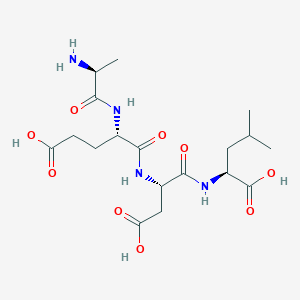
Picture a short chain of four beads. The first bead, Alanine, carries the free amino group. The middle two, Glutamic acid and Aspartic acid, each carry an extra carboxylic acid on their side chains. The last bead, Leucine, ends the chain with its own carboxylic acid and a branched, oily side chain called an isobutyl group. Count the acid groups and you find three, against one amine. That balance makes Bronchogen net acidic near neutral pH, and it explains why PubChem computes such a water-loving profile for it.
One more detail is worth a moment. All four stereocenters sit in the L, or S, configuration, the same handedness found in the amino acids that build ordinary proteins. That matters for analysis, because a change in handedness would give a different compound with the same formula and the same mass.
Bronchogen at a Glance
Direct answer: Bronchogen is C18H30N4O9, 446.5 g/mol, with four L stereocenters.
| Item | Detail | Source |
|---|---|---|
| Sequence | H-Ala-Glu-Asp-Leu-OH (AEDL) | PubChem |
| Molecular formula | C18H30N4O9 | PubChem |
| Molecular weight | 446.5 g/mol | PubChem |
| Exact mass | 446.2013 Da | PubChem |
| XLogP3 / TPSA | −3.8 / 225 Ų | PubChem |
| InChIKey | OFZRHTIWKZWPQF-BJDJZHNGSA-N | PubChem |
| DNA melting temperature shift | +3.1 °C, enthalpy unchanged | Monaselidze et al., 2011 |
| Docking score, PEPT1 | −25.35 (6th of 26) | Khavinson et al., 2023 |
| Docking score, LAT1 | −25.11 (20th of 26) | Khavinson et al., 2023 |
| Docking score, LAT2 | −18.88 (22nd of 26) | Khavinson et al., 2023 |
What this tells us: An XLogP3 of −3.8 and a polar surface area of 225 Ų describe a molecule that strongly prefers water over oil. The docking rows tell a second story. Bronchogen scored better at PEPT1, the di- and tri-peptide transporter, than at either amino acid transporter. Reasonable inference: in these models, its four-residue peptide shape matters more than its Leucine end, even though Leucine is the classic LAT1 substrate.
How Does Bronchogen Interact With DNA?
Direct answer: Published work shows Bronchogen nudging DNA toward higher thermal stability and docking at a specific short sequence.
Here is how the first measurement worked. Differential scanning microcalorimetry slowly warms a DNA solution and records the heat it absorbs as the two strands come apart. Monaselidze and colleagues found that Bronchogen raised the melting temperature by 3.1 °C at peptide-to-base-pair ratios between 0.01 and 0.055. Adding more peptide beyond that point changed nothing further, and the melting enthalpy held steady from 0.01 all the way to 1.0. The effect did not favor AT-rich or GC-rich regions, and the team described binding to both strands, mainly through the nitrogen bases.
Two other studies fill in the picture. A 2016 docking study modeled DNA-peptide complexes for 19 short peptides and placed Ala-Glu-Asp-Leu, and its shorter cousin Glu-Asp-Leu, at the four-letter sequence ctcc. A 2013 fluorescence study found Ala-Glu-Asp-Leu among six short peptides that bound labeled histones H1, H2B, H3 and H4, mostly near their N-terminal tails. Reasonable inference: taken together, these results describe a peptide that can reach both DNA and the histone proteins that package it.
Now, a word of care, the kind any good science teacher would offer. A 3.1 °C shift is real and measurable, but it is modest, and it leveled off at very low peptide amounts. Docking scores are predictions from a computer model, not measurements in a test tube. And the histone work tells us that binding happened, not what that binding does next. Each result is one honest piece of a larger puzzle, and it is worth keeping them in their proper places.
How Does Bronchogen Compare to Its Peptide Relatives?
Direct answer: Bronchogen is the Leucine-ending member of the Ala-Glu-Asp family; Cardiogen ends in Arginine and Cartalax stops at three residues.
Think of it as one family photo. Cartalax is Ala-Glu-Asp. Add Arginine and you get Cardiogen; add Leucine and you get Bronchogen. In the same 26-peptide docking survey, Cardiogen scored −35.35 at LAT1 and −27.50 at PEPT1, while Bronchogen scored −25.11 and −25.35. Cartalax landed at −28.14 and −18.95. So the extra Leucine left LAT1 roughly where it was but moved the PEPT1 score up sharply compared with the three-residue parent. Chonluten, Glu-Asp-Gly, shares the Glu-Asp core and posted one of the strongest LAT1 scores in the set at −43.40.
How Is Bronchogen Supplied for Research?
Direct answer: Modern Aminos supplies Bronchogen 20mg as white lyophilized powder in a sealed vial with a third-party certificate.
The current Freedom Diagnostics Testing certificate reports purity by HPLC with UV detection coupled with mass spectrometry, mass identification of Bronchogen and an endotoxin result. If you would like to understand that method a little better, our explainer on why HPLC testing matters walks through it one step at a time.
Related Short Peptide Guides
Direct answer: Bronchogen makes the most sense next to its close chemical relatives.
- What Is Cardiogen? The Ala-Glu-Asp-Arg (AEDR) Tetrapeptide Explained
- What Is Pinealon? The Glu-Asp-Arg (EDR) Tripeptide Explained
- What Is Livagen? The Lys-Glu-Asp-Ala (KEDA) Tetrapeptide Explained
- What Is Prostamax? The Lys-Glu-Asp-Pro (KEDP) Tetrapeptide Explained
References
- Monaselidze JR, Khavinson VKh, Gorgoshidze MZ, et al. Effect of the peptide bronchogen (Ala-Asp-Glu-Leu) on DNA thermostability. Bull Exp Biol Med. 2011;150(3):375-377. PubMed 21240358
- Khavinson VK, Lin’kova NS, Tarnovskaya SI. Short Peptides Regulate Gene Expression. Bull Exp Biol Med. 2016;162(2):288-292. PubMed 27909961
- Fedoreyeva LI, Smirnova TA, Kolomijtseva GY, Khavinson VKh, Vanyushin BF. Interaction of short peptides with FITC-labeled wheat histones and their complexes with deoxyribooligonucleotides. Biochemistry (Mosc). 2013;78(2):166-175. PubMed 23581987
- Khavinson VK, Linkova NS, Rudskoy AI, Petukhov MG. Feasibility of Transport of 26 Biologically Active Ultrashort Peptides via LAT and PEPT Family Transporters. Biomolecules. 2023;13(3):552. PMC10046148
- National Center for Biotechnology Information. PubChem Compound Summary for CID 11690869, Bronchogen. PubChem CID 11690869
And that is Bronchogen: four amino acids, three acid groups, one Leucine tail, and a small but measurable effect on how DNA holds together under heat. That is the record as it stands today. When you are ready to put it to work in your own lab, the Bronchogen product page has the full specifications and the current certificate. Thank you for learning alongside us.