
What Is Livagen?
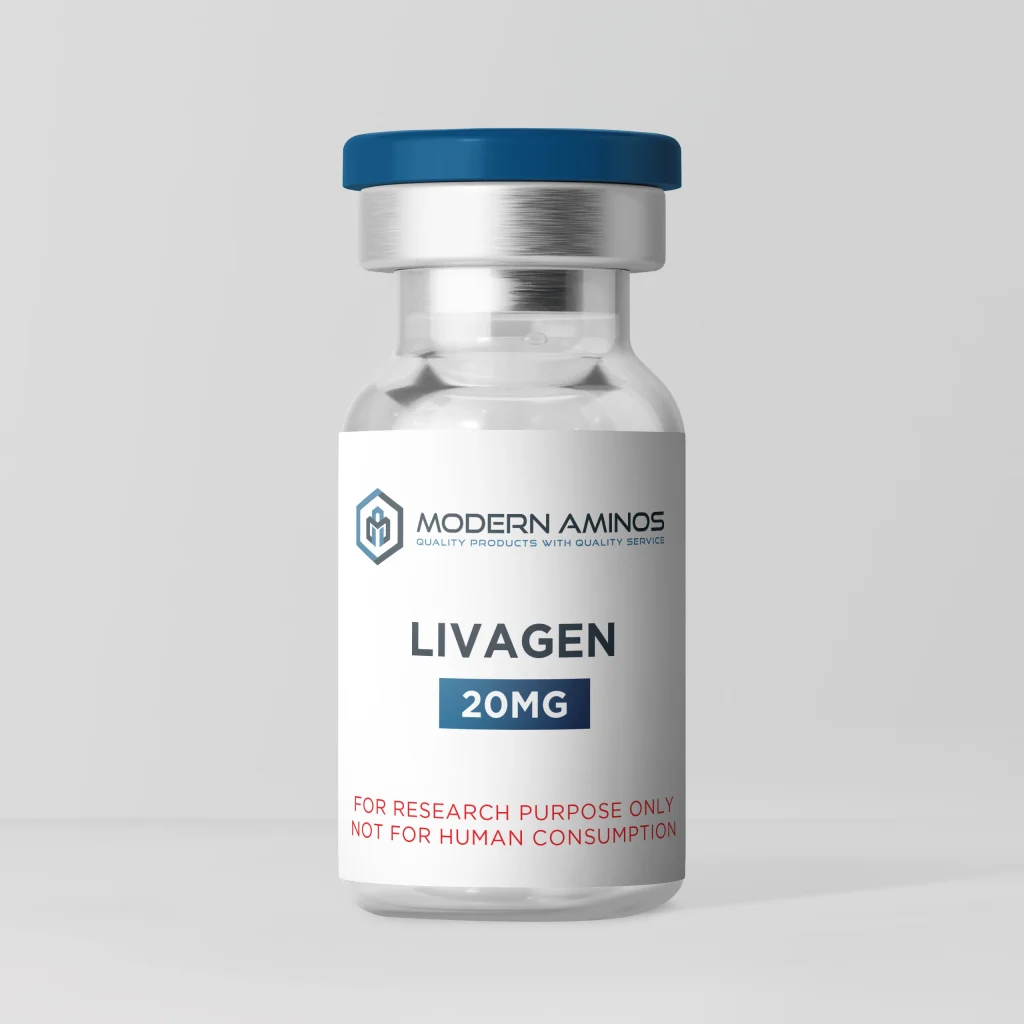
Short answer: Livagen is a short synthetic peptide, the tetrapeptide Lys-Glu-Asp-Ala, written KEDA in one-letter code. It is C18H31N5O9, 461.5 g/mol, with its own PubChem record (CID 87919683). Researchers who want to buy Livagen as a reference material get 20 mg of lyophilized powder in a sealed glass vial, for laboratory research only.
Let’s take this one step at a time. A tetrapeptide sounds like a mouthful, but it is simply four amino acids holding hands in a row. In Livagen those four are L-Lysine, L-Glutamic acid, L-Aspartic acid and L-Alanine. The order matters, the same way the order of letters matters in a word, and the last letter turns out to matter a great deal.
What is Livagen, chemically speaking?
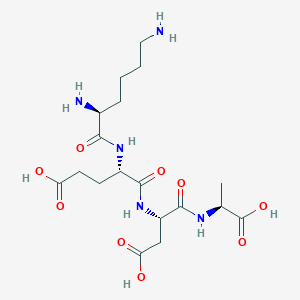
PubChem lists Livagen as C18H31N5O9 with a molecular weight of 461.5 g/mol and an exact mass of 461.2122 Da. Its four stereocenters are all in the natural L (S) form, and its InChIKey, IKVDKWACACMDLR-BJDJZHNGSA-N, is the short fingerprint chemists use to make sure two records describe the very same molecule. The CAS number commonly attached to it is 433257-50-2.
PubChem’s computed properties tell a clear story. With an XLogP3 of −7.7, a polar surface area of 251 Å2, 8 hydrogen-bond donors and 11 acceptors, Livagen is a very water-loving molecule. That is what you would expect from a peptide carrying three carboxylic acid groups and two amines.
Reading the sequence: K, E, D, A
Here is a simple way to read KEDA from left to right. K is Lysine, with a long side chain ending in an amine, so it carries a positive charge in neutral water. E is Glutamic acid and D is Aspartic acid; both carry carboxylic acids, so they lean negative. A is Alanine, the quiet one, with nothing more than a small methyl group on its side.
Put those together and you have a mixed-charge peptide: one basic residue up front, two acidic residues in the middle and a small, flexible residue at the end. Counting the free amine at the start and the free acid at the finish, a textbook estimate puts its net charge near −1 at neutral pH. That is an estimate from the structure, not a measured value, but it helps explain why short peptides like this one are studied for how they pair up with charged partners.
How is Livagen related to Prostamax and Vilon?
Livagen has two close relatives on the shelf. Vilon is the dipeptide Lys-Glu, the first two letters of Livagen. Prostamax is Lys-Glu-Asp-Pro, which matches Livagen in its first three residues and differs only in the last one: Proline in place of Alanine.
That one swap is a good lesson in chemistry. Proline’s side chain loops back and bonds to its own nitrogen, so the bond that joins it to Aspartic acid has no N–H. Alanine keeps that N–H. As a result, Livagen has one more hydrogen-bond donor than Prostamax (8 versus 7) and a formula that is lighter by C2H2, or 26 g/mol. Our post What Is Prostamax? The Lys-Glu-Asp-Pro (KEDP) Tetrapeptide Explained walks through the same sequence from the other side.
What do docking studies predict for Livagen?
In 2023, Khavinson and colleagues used computer docking to estimate how 26 ultrashort peptides fit into four transporter proteins, LAT1, LAT2, PEPT1 and PEPT2. Docking does not measure anything in a test tube; it scores how well a molecule’s shape and charges match a binding pocket, and more negative ICM-Scores mean a better predicted fit (Khavinson et al., 2023).
The Lys-Glu-Asp family makes a tidy experiment on paper, because the only thing that changes is the fourth residue:
| Sequence | Peptide | LAT1 ICM-Score | PEPT1 ICM-Score |
|---|---|---|---|
| KED | Lys-Glu-Asp (no fourth residue) | −24.79 | −16.42 |
| KEDA | Livagen, Lys-Glu-Asp-Ala | −28.83 | −16.70 |
| KEDP | Prostamax, Lys-Glu-Asp-Pro | −22.79 | −33.42 |
| KEDG | Lys-Glu-Asp-Gly | −34.05 | −22.72 |
Adding Alanine to KED improved the predicted LAT1 fit from −24.79 to −28.83, good for 11th place of 26, and more favorable than the reference ligands L-Leucine (−23.96) and BCH (−17.37). Adding Proline instead did the opposite at LAT1 but produced the second-best PEPT1 score in the whole survey. A reasonable inference is that the end of the chain decides which pocket a Lys-Glu-Asp peptide prefers, although the paper does not test that idea directly. The authors also call their PEPT2 scores preliminary, so those are left out here.
What is Livagen made of?
Chemically, Livagen is made of four L-amino acids, L-Lysine, L-Glutamic acid, L-Aspartic acid and L-Alanine, joined by three peptide bonds. Nothing else is part of the sequence: there is no amide cap, so the chain ends in a free carboxylic acid on Alanine. The full identity table, including the InChI and SMILES, is on the Livagen product page.
What formats is Livagen supplied in for research?
Modern Aminos offers Livagen in one laboratory format: 20 mg of lyophilized powder in a sealed glass vial. A capsule or liquid format is not offered for this listing. Researchers who want to buy Livagen 20mg can find the format and certificate details on the product page.
What does the current certificate show?
All applicable tests are performed on our products. The current third-party Freedom Diagnostics Testing certificate is published in the product’s Certificate of Analysis tab, and upcoming batches receive expanded testing across two ISO-certified labs, covering Sterility, Identity, Purity, Endotoxin, Heavy Metals, Mass, Residual Solvents, Fentanyl and Conformity. Our note on HPLC testing explains why chromatographic testing matters for reference materials like this one.
Where does Livagen sit among other short peptide bioregulators?
Livagen fits into a larger family of short peptides studied in the same docking survey. Pinealon (Glu-Asp-Arg) scored best of all 26 at both LAT1 and PEPT1, and our post What Is Pinealon? The Glu-Asp-Arg (EDR) Tripeptide Explained covers it in detail. Bronchogen (Ala-Glu-Asp-Leu) and Cartalax (Ala-Glu-Asp) share the Glu-Asp core with Livagen but start with Alanine instead of Lysine.
Frequently asked questions
What is Livagen?
Livagen is the synthetic tetrapeptide Lys-Glu-Asp-Ala (KEDA), C18H31N5O9 at 461.5 g/mol, PubChem CID 87919683 and CAS 433257-50-2.
Is Livagen a peptide?
Yes. Livagen is four L-amino acids joined by three peptide bonds, which makes it a tetrapeptide, one of the short peptide bioregulators two to seven residues long.
What are the ingredients of Livagen?
Chemically, its four building blocks are L-Lysine, L-Glutamic acid, L-Aspartic acid and L-Alanine, linked in that order from the free amine end to the free carboxylic acid end.
How is Livagen different from Prostamax?
Prostamax is Lys-Glu-Asp-Pro. The two share Lys-Glu-Asp and differ only in the last residue, Alanine in Livagen and Proline in Prostamax, which changes the formula by C2H2 and the mass by 26 g/mol.
What did LAT1 docking predict for Livagen?
In a 2023 docking survey of 26 ultrashort peptides, Livagen (KEDA) ranked 11th at the LAT1 amino acid transporter with an ICM-Score of −28.83, more favorable than L-Leucine (−23.96) and BCH (−17.37).
What formats does Modern Aminos offer for Livagen?
Modern Aminos offers Livagen as 20 mg of lyophilized powder in a sealed glass vial, with a third-party Freedom Diagnostics Testing certificate in the product’s Certificate of Analysis tab.
References
- Khavinson VK, Linkova NS, Rudskoy AI, Petukhov MG. Feasibility of transport of 26 biologically active ultrashort peptides via LAT and PEPT family transporters. Biomolecules. 2023;13(3):552. PMC10046148
- National Library of Medicine. PubChem Compound Summary for CID 87919683, Livagen. https://pubchem.ncbi.nlm.nih.gov/compound/87919683.
- National Library of Medicine. PubChem Compound Summary for CID 9848296, Prostamax. https://pubchem.ncbi.nlm.nih.gov/compound/9848296.
Livagen is a good reminder that in short peptides, the last letter can change the whole sentence: keep Lys-Glu-Asp, end with Alanine instead of Proline, and the predicted transporter fit moves with it. For the certificate, the format and the full chemical specification table, start at the Livagen product page.