
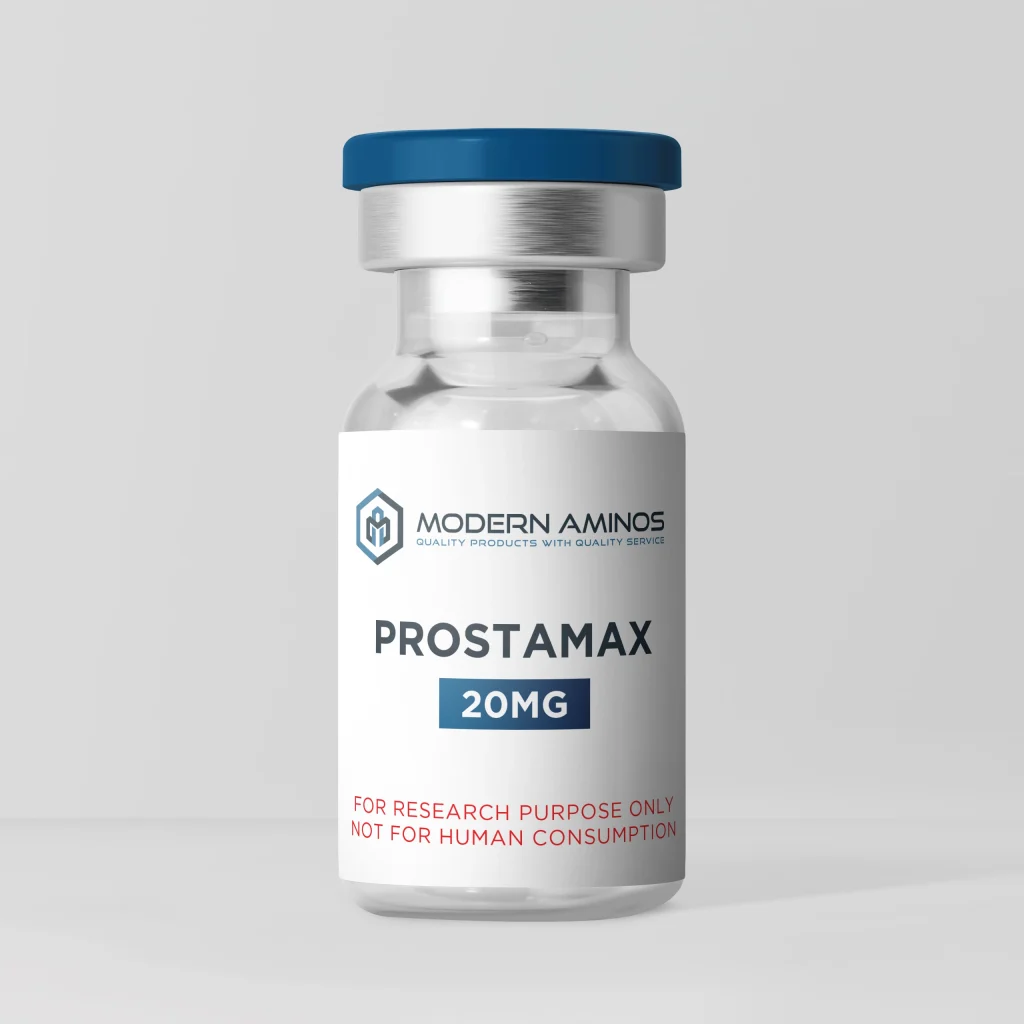
What Is Prostamax?
Short answer: Prostamax is a short synthetic peptide, the tetrapeptide Lys-Glu-Asp-Pro, written KEDP in one-letter code. It is C20H33N5O9, 487.5 g/mol, with its own PubChem record (CID 9848296) and CAS number (473578-47-1). It shares its first three residues with Livagen and its first two with Vilon, and the published work on its sequence is about chemistry: how mixed-charge peptides change DNA stability and how well short peptides fit transporter binding sites in computer docking. If you need to buy Prostamax with a third-party certificate, Modern Aminos lists it as a 20 mg lyophilized powder.
What is Prostamax, chemically speaking?
Let’s build it one link at a time. Start with L-Lysine, an amino acid with a long side chain that ends in an amine group. Join its carboxyl end to the amine of L-Glutamic acid, and you have formed the first peptide bond. Add L-Aspartic acid the same way, then finish with L-Proline. Four amino acids, three peptide bonds, one free amine at the start and one free carboxylic acid at the end. PubChem writes the result as H-Lys-Glu-Asp-Pro-OH and files it under CID 9848296.
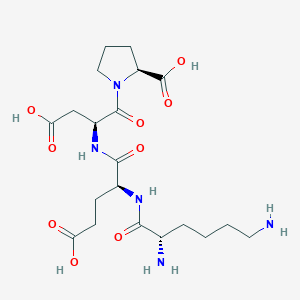
The exact mass is 487.2278 Da and the InChIKey is WUCUNGRTSFLCLI-XUXIUFHCSA-N. All four residues are the L form, so PubChem records four defined stereocenters, each with the S configuration. Its computed XLogP3 is −9 and its topological polar surface area is 242 Ų, which is chemist’s shorthand for a very water-loving, highly polar molecule.
Reading the sequence: K, E, D, P
Each letter tells you something. K, Lysine, brings a basic amine at the end of its side chain. E, Glutamic acid, and D, Aspartic acid, each bring an acidic carboxyl group. P, Proline, is the odd one out: its side chain curls back and bonds to its own backbone nitrogen, forming a ring.
That ring has a quiet but real consequence. The bond between Aspartic acid and Proline is a tertiary amide, so it has no N–H hydrogen to donate. That is part of why PubChem counts only 7 hydrogen-bond donors in a molecule with three peptide bonds. So Prostamax is a mixed-charge peptide: one basic residue, two acidic ones, and a ring-shaped residue at the end.
How is Prostamax related to Livagen and Vilon?
Think of these short peptides as words that share a root. Vilon is the two-letter word KE, Lys-Glu. Livagen is KEDA, Lys-Glu-Asp-Ala. Prostamax is KEDP, Lys-Glu-Asp-Pro. Livagen and Prostamax differ only in the last letter, Alanine versus Proline, and that one change shifts the formula from C18H31N5O9 to C20H33N5O9 and the molecular weight from 461.5 to 487.5 g/mol (PubChem).
Why does that matter to a researcher? Because pairs like this make clean experiments. When two molecules differ at a single position, any difference you measure points straight at that position.
What does the DNA melting data show?
Here is an experiment worth slowing down for. A DNA double helix holds together through hydrogen bonds between its two strands. Heat it, and at a certain temperature, the melting temperature or Tm, the strands come apart. Add something that binds DNA, and Tm can move up or down.
Solovyev and colleagues found that acidic amino acids such as Glu and Asp weakened the hydrogen bonds between strands, while basic amino acids such as Arg and Lys strengthened them, and that the size of the shift tracked each amino acid’s isoelectric point. Short peptides that mix acidic and basic residues, KE, AEDG and KEDP among them, also changed Tm and helix stability. In their docking work, Glu sat in the major groove and disrupted three hydrogen bonds, while Lys bound the outer surface and formed two bonds with oxygen atoms of neighboring phosphodiester groups (Solovyev et al., 2015). Prostamax carries both kinds of residue in one short chain.
What do docking studies predict?
Docking is a computer experiment: you place a small molecule into the three-dimensional binding site of a protein and score how well it fits. In a 2023 study, Khavinson and colleagues docked 26 ultrashort peptides into the binding sites of the amino acid transporters LAT1 and LAT2 and the peptide transporters PEPT1 and PEPT2 (Khavinson et al., 2023). The table shows the LAT1 and PEPT1 scores for Prostamax and five related sequences. A lower (more negative) ICM-Score means a more favorable predicted fit.
| Peptide | Sequence | Molecular Weight | LAT1 ICM-Score | PEPT1 ICM-Score |
|---|---|---|---|---|
| Prostamax | Lys-Glu-Asp-Pro (KEDP) | 487.5 g/mol | −22.79 | −33.42 |
| Livagen | Lys-Glu-Asp-Ala (KEDA) | 461.5 g/mol | −28.83 | −16.70 |
| Vilon | Lys-Glu (KE) | 275.30 g/mol | −19.02 | −17.02 |
| Pinealon | Glu-Asp-Arg (EDR) | 418.40 g/mol | −45.32 | −37.59 |
| Bronchogen | Ala-Glu-Asp-Leu (AEDL) | 446.5 g/mol | −25.11 | −25.35 |
| Cartalax | Ala-Glu-Asp (AED) | 333.29 g/mol | −28.14 | −18.95 |
What this tells us: at PEPT1, KEDP ranked second of all 26 peptides, behind only EDR, and both scored below the best reference inhibitor (−27.74). The authors concluded that EDR and KEDP are predicted to bind PEPT1 more strongly than the known reference compounds. At LAT1 the story flips. KEDA, Livagen’s sequence, scored −28.83 and KEDP only −22.79. One residue, Proline or Alanine, reversed the order. That is a fine lesson in how much a single position can matter.
What is Prostamax made of?
People often search for “Prostamax ingredients.” In chemical terms the answer is short: four L-amino acids, L-Lysine, L-Glutamic acid, L-Aspartic acid and L-Proline, joined in that order by three peptide bonds. There is no other building block in the sequence. The Prostamax product page carries the full identity table, including the InChI and SMILES strings.
What formats is Prostamax supplied in for research?
Modern Aminos lists one format: 20 mg of lyophilized powder in a sealed glass vial. A capsule or liquid format is not offered for this listing. The third-party Freedom Diagnostics Testing certificate is in the Certificate of Analysis tab on the Prostamax product page.
What does the current certificate show?
One third-party Freedom Diagnostics Testing report is published with the product, and all applicable tests are performed on our products. Looking ahead, upcoming batches receive expanded testing across two ISO-certified labs, covering Sterility, Identity, Purity, Endotoxin, Heavy Metals, Mass, Residual Solvents, Fentanyl and Conformity. For why chromatographic testing is the workhorse for peptide reference materials, see the importance of HPLC testing.
Where Prostamax sits among other short peptides
The short peptide reference set reads almost like a spelling lesson. Pinealon is EDR, the top scorer at both LAT1 and PEPT1 in the docking survey, and it is explained in What Is Pinealon? The Glu-Asp-Arg (EDR) Tripeptide Explained. Bronchogen is AEDL and Cartalax is AED, sharing the Glu-Asp pair in the middle. Prostamax sits in the K-E-D branch with Livagen and Vilon. Lining them up by sequence is one of the clearest ways to see what each residue adds.
Frequently asked questions
What is Prostamax?
Prostamax is the synthetic tetrapeptide Lys-Glu-Asp-Pro (KEDP), C20H33N5O9 at 487.5 g/mol, PubChem CID 9848296 and CAS 473578-47-1.
Is Prostamax a peptide?
Yes. Prostamax is four L-amino acids joined by three peptide bonds, which makes it a tetrapeptide, one of the short peptides two to seven residues long that are studied in peptide-DNA chemistry.
What are the ingredients of Prostamax?
Chemically, its four building blocks are L-Lysine, L-Glutamic acid, L-Aspartic acid and L-Proline, linked in that order from the free amine end to the free carboxylic acid end.
How is Prostamax different from Livagen?
Livagen is Lys-Glu-Asp-Ala. The two share Lys-Glu-Asp and differ only in the last residue, Proline in Prostamax and Alanine in Livagen, which changes the formula by C2H2 and the mass by 26 g/mol.
What formats does Modern Aminos offer for Prostamax?
Modern Aminos offers Prostamax as 20 mg of lyophilized powder in a sealed glass vial, with a third-party Freedom Diagnostics Testing certificate in the product’s Certificate of Analysis tab.
References
- Solovyev AY, Tarnovskaya SI, Chernova IA, Shataeva LK, Skorik YA. The interaction of amino acids, peptides, and proteins with DNA. Int J Biol Macromol. 2015;78:39-45. PubMed 25841380
- Khavinson VK, Linkova NS, Rudskoy AI, Petukhov MG. Feasibility of transport of 26 biologically active ultrashort peptides via LAT and PEPT family transporters. Biomolecules. 2023;13(3):552. PMC10046148
- Khavinson VK, Popovich IG, Linkova NS, Mironova ES, Ilina AR. Peptide regulation of gene expression: a systematic review. Molecules. 2021;26(22):7053. PMC8619776
- Khavinson VKh, Tarnovskaya SI, Lin’kova NS, Chervyakova NA, Nichik TE, Elashkina EV, Chalisova NI. Role of peptide bond in the realization of biological activity of short peptides. Bull Exp Biol Med. 2015;158(4):551-554. PubMed 25705040
- National Library of Medicine. PubChem Compound Summary for CID 9848296, Prostamax. https://pubchem.ncbi.nlm.nih.gov/compound/9848296.
- National Library of Medicine. PubChem Compound Summary for CID 87919683, Livagen. https://pubchem.ncbi.nlm.nih.gov/compound/87919683.
Prostamax is a good reminder that in short peptides, every letter counts: change the last residue from Alanine to Proline, and both the chemistry and the docking scores change with it. For the certificate, the format, and the full chemical specification table, start at the Prostamax product page.