

Definition: CBL-514 is an investigational small-molecule compound from Caliway Biopharmaceuticals that peer-reviewed papers describe as an injection lipolysis agent acting through DYRK1B inhibition and adipocyte apoptosis. It is not a peptide.
What Is CBL-514?
Short answer: CBL-514 is a development code for a small-molecule research compound from Caliway Biopharmaceuticals Co., Ltd. (New Taipei City, Taiwan). In the published literature it is called an “injection lipolysis” agent, meaning a compound studied for triggering programmed cell death (apoptosis) in adipocytes, the lipid-storing cells of adipose tissue (Goodman et al., 2022, PubMed 35709509).
Most compounds on this blog are short peptides, so it helps to say clearly what CBL-514 is not. It is not a peptide, not an amino acid blend and not a lipid emulsion. The 2025 Phase II paper calls it “a small-molecule injectable drug” (Gold et al., 2025, PubMed 40037659), and its chemical structure has not been published.
Is CBL-514 a Peptide?
No. Every peer-reviewed source found for this article describes CBL-514 as a small molecule (Gold et al., 2025, PMC12080885; Herbst et al., 2026, PMC12854054). That puts it in the same broad chemical class as other non-peptide compounds covered in this series, such as BPAP (benzofuranylpropylaminopentane) and GC-1 (sobetirome). Unlike those two, however, CBL-514 has no public structure, formula or PubChem entry.
Compound Identity and Entity Data
| Name / Code | CBL-514 |
|---|---|
| Compound Class | Small molecule (not a peptide) |
| Developer / Sponsor | Caliway Biopharmaceuticals Co., Ltd., New Taipei City, Taiwan |
| Proposed Molecular Target | DYRK1B (dual-specificity tyrosine-phosphorylation-regulated kinase 1B), a cell-survival kinase |
| Reported Pathway Markers | Caspase-3 activation; increased Bax/Bcl-2 ratio; Annexin V/propidium iodide labeling |
| Cited In Vitro Model | Mature 3T3-L1 adipocytes (company data described in Goodman et al., 2022) |
| CAS Number | Not publicly assigned or disclosed (checked October 2026) |
| PubChem CID | No PubChem record found for “CBL-514” (checked October 2026) |
| Molecular Formula / Structure | Not disclosed in the peer-reviewed literature |
| Registry Entries | 16 ClinicalTrials.gov records, all sponsored by Caliway Biopharmaceuticals (see table below) |
How Does CBL-514 Work? DYRK1B, Caspase-3 and Adipocyte Apoptosis
The mechanism reported for CBL-514 runs through apoptosis rather than through cell rupture. According to the Phase IIa paper, CBL-514 “inhibits the cell survival kinase DYRK1b; upregulates the apoptosis mediators caspase 3 and Bax/Bcl-2” and induces adipocyte apoptosis in nonclinical work. The authors attribute these findings to unpublished, confidential company reports (Goodman et al., 2022, PMC9384315).
- DYRK1B inhibition: DYRK1B is a kinase associated with cell survival signaling. Blocking it is the upstream step proposed for CBL-514.
- Caspase-3 activation: Caspase-3 is an executioner protease of apoptosis and a standard biomarker that apoptosis has been triggered.
- Bax/Bcl-2 ratio: Bax promotes and Bcl-2 restrains mitochondrial apoptosis, so a higher ratio indicates a shift toward cell death. The same paper reports that the ratio rose with longer CBL-514 exposure in mature 3T3-L1 adipocytes.
- Annexin V/propidium iodide labeling: This flow-cytometry stain marks apoptotic cells, and it was reported as significantly higher in CBL-514–treated adipocytes than in controls.
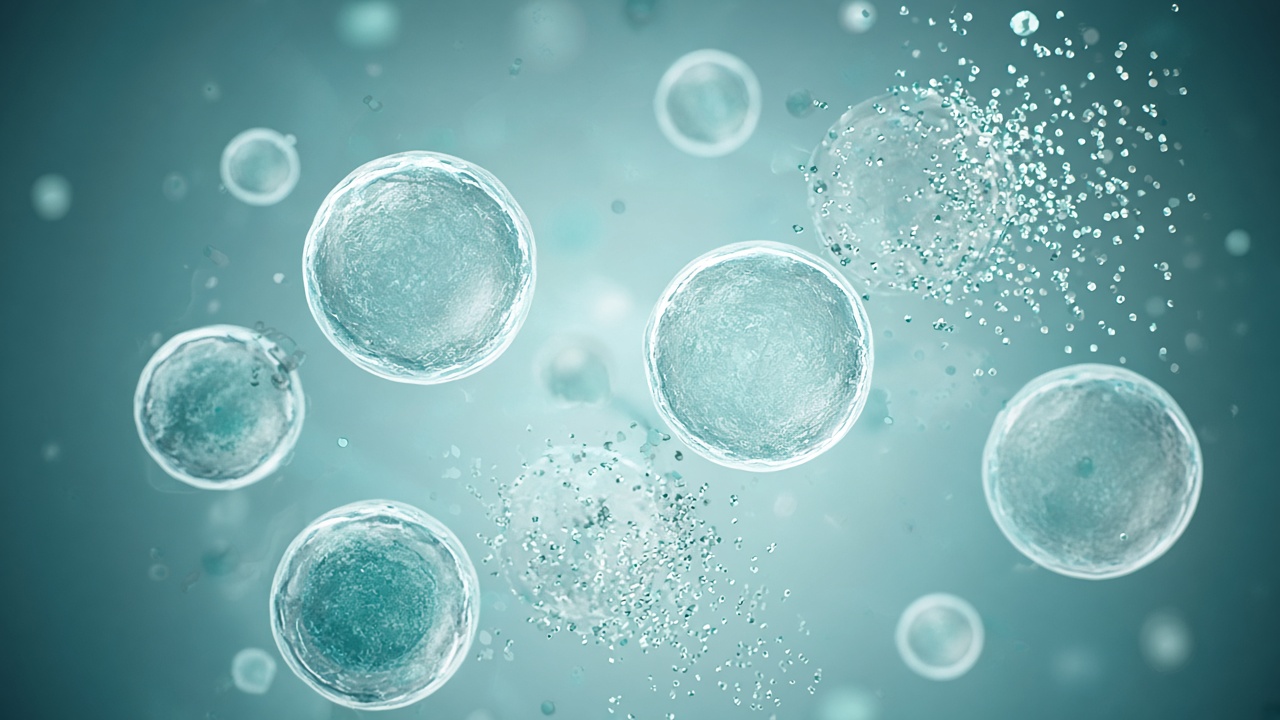
Apoptosis is a programmed, orderly form of cell death. In the literature this is what separates CBL-514 from lipolysis approaches that work by necrosis, where cells rupture and release their contents.
CBL-514 Lipolysis Research: What Has Been Published?
The peer-reviewed record for CBL-514 is still small and comes mostly from sponsor-funded studies. PubMed lists these papers:
- Phase IIa, 2022: Goodman GJ et al., Aesthet Surg J 2022;42(11):NP662 (PubMed 35709509; PMC9384315). It describes the DYRK1B/caspase-3/Bax-Bcl-2 mechanism and the 3T3-L1 adipocyte data (registry NCT04698642).
- Phase II, placebo-controlled, 2025: Gold M et al., Aesthet Surg J 2025 (PubMed 40037659; PMC12080885), registry NCT04897412.
- Phase 2a in Dercum’s disease lipomas, 2026: Herbst KL et al., JAAD Int 2026 (PubMed 41623934; PMC12854054).
- Phase 2b with MRI assessment, 2026: Lorenc ZP et al., Aesthet Surg J 2026 (PubMed 42159040).
- Reviews: a systematic review of injectable lipolytic agents (Carrion K et al., Plast Reconstr Surg 2026, PubMed 41296813) and a review of Dercum’s disease therapies (Idris YA, Janis JE, 2026, PubMed 42488923).
The nonclinical mechanism data behind CBL-514 have not been published as standalone peer-reviewed papers. The cited studies describe them as company reports, which limits how far outside researchers can check them.
CBL-514 Clinical Trial Registry IDs
ClinicalTrials.gov lists the following CBL-514 records, all with Caliway Biopharmaceuticals as lead sponsor (status as listed in October 2026):
| Registry ID | Phase (registered focus) | Status |
|---|---|---|
| NCT04699669 | Phase 1 | Completed |
| NCT04698642 | Phase 2 | Completed |
| NCT04575467 | Phase 2 | Completed |
| NCT04897412 | Phase 2 | Completed |
| NCT05234736 | Phase 2 (pharmacokinetics) | Completed |
| NCT05387733 | Phase 2 (Dercum’s disease lipomas) | Completed |
| NCT05632926 | Phase 2 (EFP/cellulite, stage 1) | Completed |
| NCT05836779 | Phase 2 (EFP/cellulite, stage 2) | Completed |
| NCT05736107 | Phase 2 | Completed |
| NCT06005441 | Phase 2b | Completed |
| NCT06303570 | Phase 2 (Dercum’s disease lipomas) | Completed |
| NCT07140939 | Phase 3 | Recruiting |
| NCT07526974 | Phase 3 (SUPREME-02) | Not yet recruiting |
| NCT07733947 | Phase 3 (long-term follow-up) | Not yet recruiting |
| NCT07608770 | Phase 2 | Recruiting |
| NCT07608757 | Phase 2 | Not yet recruiting |
Why Identity Data Matter for Research Compounds
For any compound, a CAS number, a PubChem record and a published structure are what let independent labs confirm that they are working with the same material. CBL-514 currently has none of these in the public record, so outside researchers can identify it only by its development code and the sponsor’s publications. Modern Aminos describes its own approach to identity and purity documentation on the Quality Assurance Program page. For examples of fully identified compounds, see the Prostamax (Lys-Glu-Asp-Pro) tetrapeptide explainer and the Modern Aminos research blog.
Frequently Asked Questions About CBL-514
What is CBL-514?
CBL-514 is an investigational small-molecule compound developed by Caliway Biopharmaceuticals (New Taipei City, Taiwan). Published papers describe it as an injection lipolysis agent studied for inducing adipocyte apoptosis.
Is CBL-514 a peptide?
No. Peer-reviewed papers describe CBL-514 as a small molecule, not a peptide or an amino acid chain.
What is the proposed mechanism of CBL-514?
Published papers report that CBL-514 inhibits the cell-survival kinase DYRK1B and raises the apoptosis markers caspase-3 and the Bax/Bcl-2 ratio in adipocytes. The authors cite these nonclinical findings as unpublished company reports.
Does CBL-514 have a CAS number or PubChem CID?
No public CAS number, PubChem CID or chemical structure was found for CBL-514 as of October 2026. The peer-reviewed papers identify it only by its development code.
Who develops CBL-514?
Caliway Biopharmaceuticals Co., Ltd. is the named developer in the peer-reviewed papers and the lead sponsor of every CBL-514 study on ClinicalTrials.gov.
Which cell model is cited for CBL-514 apoptosis data?
The 2022 Phase IIa paper describes internal work in mature 3T3-L1 adipocytes, which showed higher caspase-3 activation, Bax/Bcl-2 ratios and Annexin V/propidium iodide labeling than controls.
Does Modern Aminos sell CBL-514?
No. Modern Aminos does not list CBL-514. This article is an educational research overview.
References
- Goodman GJ, Ho WWS, Chang KJ, et al. Efficacy of a Novel Injection Lipolysis to Induce Targeted Adipocyte Apoptosis: A Randomized, Phase IIa Study of CBL-514 Injection on Abdominal Subcutaneous Fat Reduction. Aesthet Surg J. 2022;42(11):NP662. PubMed 35709509
- Gold M, Schlessinger J, Goodman GJ, et al. Efficacy and Safety of CBL-514 Injection in Reducing Abdominal Subcutaneous Fat: A Randomized, Single-Blind, Placebo-Controlled Phase II Study. Aesthet Surg J. 2025. PubMed 40037659
- Herbst KL, Ling YF, Sheu AY, et al. Efficacy and safety of CBL-514 for Dercum disease lipomas: A randomized phase 2a study. JAAD Int. 2026. PubMed 41623934
- Lorenc ZP, Gold M, Schlessinger J, et al. Randomized Phase 2b Trial of CBL-514 Injection for Abdominal Subcutaneous Fat Reduction With Clinician- and Patient-reported Outcomes and MRI Assessment. Aesthet Surg J. 2026. PubMed 42159040
- Carrion K, Salingaros S, Bernal C, et al. A Systematic Review of Injectable Lipolytic Agents for Nonsubmental Fat Reduction. Plast Reconstr Surg. 2026. PubMed 41296813
- Idris YA, Janis JE. Dercum’s Disease: A Practical Review of Existing and Novel Therapies. Plast Reconstr Surg Glob Open. 2026. PubMed 42488923
- ClinicalTrials.gov records for CBL-514, U.S. National Library of Medicine (registry IDs listed above).