
How Does Minoxidil Work?
Minoxidil works through its metabolite. Sulfotransferase enzymes add a sulfate group to minoxidil, and the resulting minoxidil sulfate opens ATP-sensitive potassium (KATP) channels. In human hair follicles, those channels sit in the dermal papilla and sheath, and minoxidil acts only on the SUR2-type form. Caffeine, its partner in 5% Minoxidil + 1% Caffeine, works on a different target: it blocks adenosine receptors.
Chemical Identity of Minoxidil
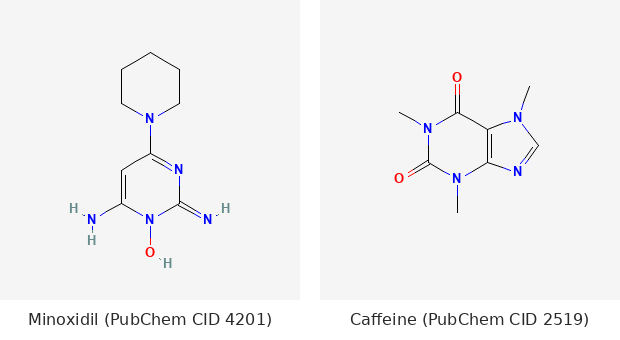
Minoxidil is a piperidinyl pyrimidine N-oxide and caffeine is a trimethylated purine, so neither is a peptide.
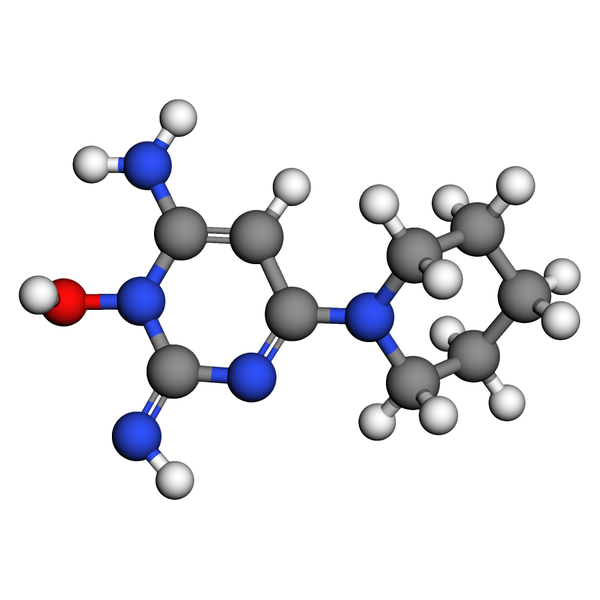
Minoxidil’s formal name is 3-hydroxy-2-imino-6-piperidin-1-ylpyrimidin-4-amine. PubChem lists it as CID 4201, formula C9H15N5O, molecular weight 209.25 g/mol (PubChem CID 4201). Its core is a pyrimidine ring carrying two amino groups, a piperidine ring at one carbon, and an oxygen on a ring nitrogen. That N-oxide oxygen is the handle sulfotransferases use: sulfation there produces minoxidil sulfate.
Caffeine is 1,3,7-trimethylxanthine, formally 1,3,7-trimethylpurine-2,6-dione. PubChem lists it as CID 2519, formula C8H10N4O2, molecular weight 194.19 g/mol (PubChem CID 2519). It is a xanthine, a fused purine ring system with two carbonyl groups, with methyl groups on three of its nitrogens.
Molecular Data
| Property | Value |
|---|---|
| CAS# | 38304-91-5 |
| PubChem ID | CID 4201 |
| Molecular Formula | C9H15N5O |
| Molecular Weight | 209.25 g/mol |
| Exact Mass | 209.1277 Da |
| IUPAC Name | 3-hydroxy-2-imino-6-piperidin-1-ylpyrimidin-4-amine |
| InChIKey | ZIMGGGWCDYVHOY-UHFFFAOYSA-N |
| SMILES | C1CCN(CC1)C2=NC(=N)N(C(=C2)N)O |
| Molecular Class | Small molecule (non-peptide); piperidinopyrimidine N-oxide |
| Stereocenters | 0 defined, 0 undefined |
| Hydrogen bond donors / acceptors | 3 / 3 |
| XLogP3 (computed) | 1.2 |
Values from PubChem CID 4201 (computed by PubChem).
What Are the Key Chemical Identifiers for Minoxidil and Caffeine?
Minoxidil is CAS 38304-91-5 and caffeine is CAS 58-08-2; the table lists the PubChem identifiers for both.
| Item | Minoxidil | Caffeine |
|---|---|---|
| CAS | 38304-91-5 | 58-08-2 |
| PubChem CID | 4201 | 2519 |
| Formula | C9H15N5O | C8H10N4O2 |
| Molecular weight | 209.25 g/mol | 194.19 g/mol |
| Exact mass | 209.1277 Da | 194.0804 Da |
| InChIKey | ZIMGGGWCDYVHOY-UHFFFAOYSA-N | RYYVLZVUVIJVGH-UHFFFAOYSA-N |
| Chemical class | Pyrimidine N-oxide | Methylxanthine (purine) |
| Active form | Minoxidil sulfate | Caffeine itself |
Why Does Minoxidil Need Sulfotransferase Activation?
Because minoxidil sulfate, not minoxidil, is the active compound, and sulfotransferases are the enzymes that make it.
Minoxidil is metabolized by sulfation to the active compound, minoxidil sulfate (Anderson et al., 1998). The reaction belongs to the cytosolic sulfotransferase family, enzymes that move a sulfate group from the donor cofactor PAPS (3′-phosphoadenosine-5′-phosphosulfate) onto an acceptor. For most substrates, sulfation is an inactivation step that speeds excretion. Minoxidil is an exception: here sulfation is the activation step (Dooley, 1999).
Which enzymes do the work? Studies with human platelet, skin and cDNA-expressed preparations showed that at least four cytosolic sulfotransferases can sulfate minoxidil: the thermostable and thermolabile phenol sulfotransferases, dehydroepiandrosterone sulfotransferase and estrogen sulfotransferase (Anderson et al., 1998). The older name “minoxidil sulfotransferase” therefore describes a combined activity rather than a single enzyme.
The genes are known too. The human phenol sulfotransferases include a phenol-preferring and a catecholamine-preferring form, encoded by three closely related genes, STP1, STP2 and STM. All three map to a small region of chromosome 16p and share seven coding exons. At least one of them is responsible for forming minoxidil sulfate in the lower outer root sheath of anagen hair follicles (Dooley, 1999). The follicle, in other words, carries its own machinery for activating minoxidil.
How Does Minoxidil Sulfate Act on Potassium Channels?
It opens ATP-sensitive potassium channels, and in hair follicles it targets the SUR2B-containing form found in the dermal papilla.
KATP channels are built from two parts: a pore-forming Kir6.x subunit and a regulatory sulfonylurea receptor, SUR. In vascular smooth muscle, minoxidil sulfate acts as an opener of sarcolemmal KATP channels (Messenger and Rundegren, 2004). The open question for years was whether the same channels exist in hair follicles.
Shorter and colleagues answered it in human follicles. Using organ culture, RT-PCR and immunohistochemistry, they found two channel types: Kir6.2/SUR1 in the epithelial matrix, and Kir6.1/SUR2B in the dermal papilla and sheath. Minoxidil stimulates only the SUR2-type channels, and in organ culture minoxidil and the channel blocker tolbuta/mide opposed each other’s effects on the anagen growth phase (Shorter et al., 2008).
Not every study agrees on the channel picture. Patch-clamp recordings from cultured human outer root sheath and dermal papilla cells found two dominant channels, large- and small-conductance Ca2+-activated K+ channels with unitary conductances of 246 and 70 pS. Intracellular ATP and glibenclamide did not block them, and minoxidil sulfate and pinacidil did not open them or increase 86Rb efflux (Nakaya et al., 1994). A follow-up in cultured human dermal papilla cells found a large-conductance Ca2+-activated K+ channel of about 179 pS dominated, with no KATP channels observed in the patches tested (Hamaoka et al., 1997).
One difference is the model: Shorter and colleagues examined intact follicle tissue, while the patch-clamp studies recorded from cells grown in monolayer. Hamaoka and colleagues concluded that increased K+ permeability in dermal papilla cells may not, by itself, be enough to explain minoxidil’s effects, which keeps the other pathways below in play.
What Happens Inside Dermal Papilla Cells?
Minoxidil pushes cultured dermal papilla cells toward proliferation and survival, and raises VEGF and β-catenin signaling.
The dermal papilla is the cluster of specialized fibroblasts at the base of the follicle that signals to the growing hair. In cultured human dermal papilla cells, minoxidil increased proliferation, raised ERK phosphorylation by 287% at 0.1 µM and 351% at 1.0 µM, and raised Akt phosphorylation by 168% and 257%. At 1.0 µM it increased Bcl-2 by more than 150% and cut Bax by more than 50%, and isolated follicles in organ culture elongated significantly (Han et al., 2004).
Growth factor output shifts as well. Across 0.2 to 24 µmol/L, minoxidil raised VEGF mRNA in a concentration-dependent way, about six-fold at the top concentration, with matching increases in VEGF protein (Lachgar et al., 1998). Minoxidil also activated a β-catenin reporter, moved β-catenin into the nucleus, increased phosphorylation of GSK3β, PKA and PKB, and induced the β-catenin targets Axin2, Lef-1 and EP2 (Kwack et al., 2011).
Prostaglandins are another route. Prostaglandin endoperoxide synthase-1 (PGHS-1, also called COX-1) is the main isoform in the dermal papilla of human hair follicles. Minoxidil activated purified PGHS-1 with an AC50 of 80 µM, measured by oxygen consumption and PGE2 production, and increased PGE2 output by cultured human dermal papilla fibroblasts (Michelet et al., 1997).
One study ties minoxidil directly to adenosine. Dermal papilla cells expressed SUR2B along with adenosine A1, A2A and A2B receptors. Minoxidil-induced rises in intracellular calcium and VEGF production were blocked by 8-sulfophenyltheophylline, a xanthine adenosine receptor antagonist. The calcium response depended on A1 receptors, while VEGF production was blocked by both A1 and A2 antagonists (Li et al., 2001).
Caffeine: Adenosine Receptors First, Phosphodiesterases Second
Adenosine receptor antagonism is caffeine’s most potent action, and phosphodiesterase inhibition requires far higher concentrations.
Fredholm and colleagues ranked caffeine’s known targets by the concentration each one needs. Caffeine blocks adenosine A2A receptors most potently, then A1. Inhibiting cyclic nucleotide phosphodiesterases, the enzymes that break down cAMP and cGMP, takes about 20 times more caffeine. Blocking GABAA receptors takes about 40 times more, and mobilizing intracellular calcium stores about 100 times more (Fredholm et al., 1999).
That ranking matters for reading follicle data. The caffeine concentrations used in organ culture, 0.0005 to 0.005%, correspond to roughly 26 to 260 µM if read as weight per volume. That range overlaps both the adenosine receptor and the phosphodiesterase windows, and the follicle papers measured outcomes rather than assigning them to one target.
In microdissected human hair follicles held in serum-free organ culture for 120 hours, caffeine enhanced hair shaft elongation, prolonged anagen and stimulated matrix keratinocyte proliferation. It raised IGF-1 protein and countered testosterone-driven TGF-β2, a key catagen signal. Follicles from female donors were more sensitive than those from male donors. In outer root sheath keratinocytes, caffeine increased proliferation, reduced apoptosis and necrosis, increased IGF-1 secretion and reduced TGF-β2 secretion (Fischer et al., 2014). An earlier study found that 0.001% and 0.005% caffeine counteracted growth suppression by testosterone, and that caffeine alone stimulated follicle growth (Fischer et al., 2007).
How Does Minoxidil Differ From Caffeine?
Minoxidil is a potassium channel opener that must be activated, while caffeine is an adenosine receptor antagonist that acts as it is.
| Property | Minoxidil | Caffeine |
|---|---|---|
| Primary target | SUR2-type KATP channels, via minoxidil sulfate | Adenosine A2A and A1 receptors |
| Activation step | Sulfation by cytosolic sulfotransferases | None |
| Main cell type studied | Dermal papilla cells | Matrix and outer root sheath keratinocytes |
| Key readouts | ERK and Akt, Bcl-2/Bax, VEGF, β-catenin | Shaft elongation, IGF-1, TGF-β2 |
| Concentrations in cell culture | 0.1-24 µM (dermal papilla cells) | 0.0005-0.005% |
The two compounds reach the follicle through separate routes, one through the dermal papilla’s potassium channels and one through keratinocyte growth signals. The Li study adds a twist, since minoxidil’s effects in dermal papilla cells ran partly through adenosine receptors, the same receptors caffeine blocks. In the published sources checked, nobody has tested the two compounds together in the same culture, which leaves the interaction an open experimental question.
What Formats and Testing Cover 5% Minoxidil + 1% Caffeine?
It comes in one format, a 30 mL amber bottle with a 1 mL precision dropper.
All applicable tests are performed on our products. Modern Aminos supplies 5% Minoxidil + 1% Caffeine as a 30 mL amber bottle with a 1 mL precision dropper. The minoxidil raw material is covered by a Vanguard Laboratory certificate for bulk powder lot B-WH19KXV3, which reports identity matched to a reference standard by HPLC-UV/VIS. Our note on HPLC testing explains why chromatography matters.
Related Research Tools
References
- Anderson RJ, Kudlacek PE, Clemens DL. Sulfation of minoxidil by multiple human cytosolic sulfotransferases. Chem Biol Interact. 1998;109(1-3):53-67. PMID 9566733
- Dooley TP. Molecular biology of the human cytosolic sulfotransferase gene superfamily implicated in the bioactivation of minoxidil and cholesterol in skin. Exp Dermatol. 1999;8(4):328-329. PMID 10439254
- Messenger AG, Rundegren J. Minoxidil: mechanisms of action on hair growth. Br J Dermatol. 2004;150(2):186-194. PMID 14996087
- Shorter K, Farjo NP, Picksley SM, Randall VA. Human hair follicles contain two forms of ATP-sensitive potassium channels, only one of which is sensitive to minoxidil. FASEB J. 2008;22(6):1725-1736. PMID 18258787
- Nakaya Y, Hamaoka H, Kato S, Arase S. Effect of minoxidil sulfate and pinacidil on single potassium channel current in cultured human outer root sheath cells and dermal papilla cells. J Dermatol Sci. 1994;7 Suppl:S104-S108. PMID 7999667
- Hamaoka H, Minakuchi K, Miyoshi H, Arase S, Chen CH, Nakaya Y. Effect of K+ channel openers on K+ channel in cultured human dermal papilla cells. J Med Invest. 1997;44(1-2):73-77. PMID 9395721
- Han JH, Kwon OS, Chung JH, Cho KH, Eun HC, Kim KH. Effect of minoxidil on proliferation and apoptosis in dermal papilla cells of human hair follicle. J Dermatol Sci. 2004;34(2):91-98. PMID 15033191
- Lachgar S, Charveron M, Gall Y, Bonafe JL. Minoxidil upregulates the expression of vascular endothelial growth factor in human hair dermal papilla cells. Br J Dermatol. 1998;138(3):407-411. PMID 9580790
- Kwack MH, Kang BM, Kim MK, Kim JC, Sung YK. Minoxidil activates β-catenin pathway in human dermal papilla cells: a possible explanation for its anagen prolongation effect. J Dermatol Sci. 2011;62(3):154-159. PMID 21524889
- Michelet JF, Commo S, Billoni N, Mahé YF, Bernard BA. Activation of cytoprotective prostaglandin synthase-1 by minoxidil as a possible explanation for its hair growth-stimulating effect. J Invest Dermatol. 1997;108(2):205-209. PMID 9008235
- Li M, Marubayashi A, Nakaya Y, Fukui K, Arase S. Minoxidil-induced hair growth is mediated by adenosine in cultured dermal papilla cells: possible involvement of sulfonylurea receptor 2B as a target of minoxidil. J Invest Dermatol. 2001;117(6):1594-1600. PMID 11886528
- Fredholm BB, Bättig K, Holmén J, Nehlig A, Zvartau EE. Actions of caffeine in the brain with special reference to factors that contribute to its widespread use. Pharmacol Rev. 1999;51(1):83-133. PMID 10049999
- Fischer TW, Herczeg-Lisztes E, Funk W, Zillikens D, Bíró T, Paus R. Differential effects of caffeine on hair shaft elongation, matrix and outer root sheath keratinocyte proliferation, and transforming growth factor-β2/insulin-like growth factor-1-mediated regulation of the hair cycle in male and female human hair follicles in vitro. Br J Dermatol. 2014;171(5):1031-1043. PMID 24836650
- Fischer TW, Hipler UC, Elsner P. Effect of caffeine and testosterone on the proliferation of human hair follicles in vitro. Int J Dermatol. 2007;46(1):27-35. PMID 17214716
- National Center for Biotechnology Information. PubChem Compound Summaries for CID 4201 (minoxidil) and CID 2519 (caffeine). CID 4201, CID 2519
Frequently Asked Questions
How Does Minoxidil Work?
Minoxidil is a prodrug in the chemical sense: cytosolic sulfotransferases convert it to minoxidil sulfate, the active compound, which opens ATP-sensitive potassium channels. In human hair follicles, the minoxidil-sensitive channel is the SUR2B-containing form found in the dermal papilla and sheath.
What Is Minoxidil Sulfate?
Minoxidil sulfate is the sulfated metabolite of minoxidil and its active compound. At least four human cytosolic sulfotransferases can make it, including the thermostable and thermolabile phenol sulfotransferases.
How Does Caffeine Work?
Caffeine, 1,3,7-trimethylxanthine, competitively blocks adenosine A1 and A2A receptors at micromolar concentrations. It also inhibits cyclic nucleotide phosphodiesterases, but only at concentrations about 20 times higher than those that block adenosine receptors.
Minoxidil vs. Caffeine: What Is the Difference?
They work on different targets. Minoxidil acts through its sulfate on SUR2-type potassium channels, while caffeine blocks adenosine receptors. Minoxidil needs metabolic activation; caffeine does not. In follicle culture, minoxidil data center on dermal papilla cells, while caffeine data center on hair shaft elongation, IGF-1 and TGF-β2.
Are Minoxidil and Caffeine Peptides?
No. Both are small heterocyclic molecules, not chains of amino acids. Minoxidil is a pyrimidine N-oxide with a piperidine ring, C9H15N5O, 209.25 g/mol. Caffeine is a methylated purine, C8H10N4O2, 194.19 g/mol.
How Is Minoxidil Identity Confirmed?
By comparison with a reference standard. The Vanguard Laboratory certificate for minoxidil bulk powder lot B-WH19KXV3 reports identity as a pass by HPLC-UV/VIS, matching the reference standard.