
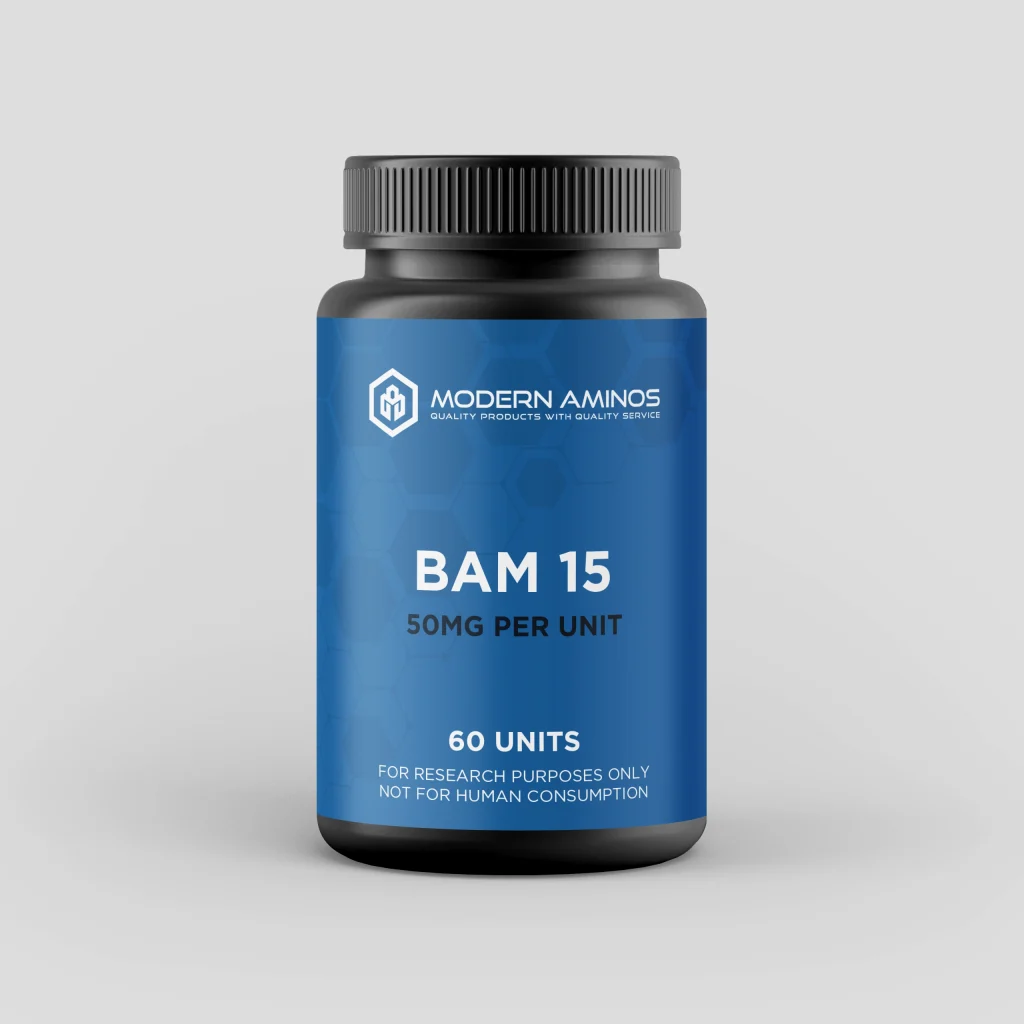
What Is BAM15?
Short answer: BAM15 is a small-molecule mitochondrial protonophore uncoupler, N5,N6-bis(2-fluorophenyl)-[1,2,5]oxadiazolo[3,4-b]pyrazine-5,6-diamine (CAS 210302-17-3). It has the formula C16H10F2N6O and a molecular weight of 340.29 g/mol. Its defining feature, reported when it was discovered, is that it uncouples mitochondria without depolarizing the plasma membrane. To buy BAM15 as a documented reference compound, see the product page.
That is the core idea. Below: what “uncoupling” actually means, how BAM15 was found, how it compared with the classic uncoupler FCCP in cultured cells, and how it is checked.
What is BAM15, chemically speaking?
BAM15 is a flat, fused heterocycle. At its center is an oxadiazolopyrazine: a pyrazine ring (six atoms, two nitrogens) fused to a 1,2,5-oxadiazole ring (five atoms, two nitrogens and one oxygen). Two neighboring carbons on the pyrazine each carry an N–H group bonded to a 2-fluorophenyl ring. Those two N–H groups are the molecule’s only hydrogen-bond donors, and they matter for how it works (PubChem CID 565708).
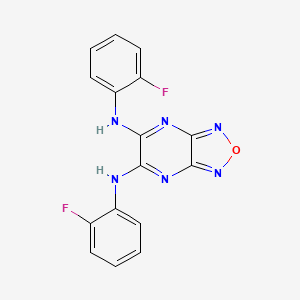
PubChem gives the InChIKey OEGJBRZAJRPPHL-UHFFFAOYSA-N and records no stereocenters. It is not a peptide, not a hormone and not a receptor ligand in the usual sense. It acts on a membrane, not a receptor.
What does “mitochondrial uncoupler” mean?
Mitochondria make ATP by pumping protons across their inner membrane and then letting those protons flow back through ATP synthase, like water through a turbine. Kenwood and colleagues describe chemical uncouplers as lipophilic weak acids that carry protons back into the mitochondrial matrix by a route that bypasses ATP synthase (Kenwood et al., Mol Metab 2014). The result, step by step:
- Proton shuttle. The uncoupler picks up a proton outside the inner membrane, crosses it, and releases the proton inside.
- Lower gradient. The proton motive force across the inner membrane drops.
- Faster respiration. The respiratory chain speeds up to compensate, so oxygen consumption rises.
- Less coupling. Nutrient oxidation is uncoupled from ATP production, and mitochondrial reactive oxygen species production decreases (Kenwood et al., Mol Metab 2014).
That is why uncouplers are standard tools for measuring maximal mitochondrial respiration in the lab.
BAM15 vs. FCCP: why was a new uncoupler needed?
The widely used protonophores FCCP and 2,4-dinitrophenol have off-target activity at other membranes, including plasma membrane depolarization, mitochondrial inhibition and cytotoxicity, which can confound measurements (Kenwood et al., Mol Metab 2014). BAM15 came out of a small-molecule library screen designed to find an uncoupler without that plasma membrane effect. The table summarizes the published in vitro comparison and the PubChem identity data.
| Item | Finding or value | Source |
|---|---|---|
| Plasma membrane potential | Not depolarized by BAM15 | Kenwood 2014 |
| Potency vs. FCCP | Described as equal potency | Kenwood 2014 |
| Maximum respiration in cultured cells | Higher with BAM15 than FCCP | Kenwood 2014 |
| Cytotoxicity in cultured cells | Lower with BAM15 than FCCP | Kenwood 2014 |
| Molecular formula | C16H10F2N6O | PubChem |
| Molecular weight | 340.29 g/mol | PubChem |
| Exact mass | 340.0884 Da | PubChem |
| XLogP3 | 3.7 | PubChem |
| Topological polar surface area | 88.8 Å2 | PubChem |
| H-bond donors / acceptors | 2 / 9 | PubChem |
What this tells us: BAM15 fits the textbook profile of an uncoupler, a lipophilic molecule (XLogP 3.7) with acidic N–H groups. Our interpretation is that the electron-poor oxadiazolopyrazine core makes those N–H protons acidic enough to shuttle across a membrane; the discovery paper reports the behavior but does not frame it in exactly those terms.
Why is BAM15 useful as a respirometry tool?
In a typical mitochondrial stress test, researchers add compounds in sequence to a well of cultured cells while measuring oxygen consumption: an ATP synthase inhibitor first, then an uncoupler to reveal the maximum rate the respiratory chain can reach, then respiratory chain inhibitors to subtract non-mitochondrial oxygen use. The uncoupler step is the one that defines “spare respiratory capacity.” Kenwood and colleagues point out that off-target effects of older uncouplers interfere with exactly this kind of measurement, and they present BAM15 as a tool for studying mitochondrial function without those confounding effects (Kenwood et al., Mol Metab 2014). Because BAM15 produced a higher maximum respiration than FCCP in their cultured-cell experiments, our interpretation is that estimates of maximal capacity obtained with FCCP may, in some cell types, understate the true ceiling. That is a reason to state which uncoupler was used when comparing respirometry data across studies.
What happens downstream in cells?
A 2020 study reported that BAM15 exposure in vitro enhanced mitochondrial respiratory kinetics, improved insulin action and stimulated nutrient uptake through sustained activation of AMPK, the cell’s energy-sensing kinase (Axelrod et al., EMBO Mol Med 2020). In the same work, BAM15 did not induce Caspase 3/7 activity, a marker of apoptosis, at concentrations up to 40 µM in culture. Those are cell-level readouts and explain why BAM15 is used as a tool for studying energy sensing.
Is BAM15 a peptide, a SARM or a hormone?
None of those. BAM15 contains no amino acids, binds no androgen receptor and is not a hormone analog. It is best compared with other metabolic tool compounds. Cardarine (GW-501516), for example, works through a nuclear receptor, while BAM15 works directly on the mitochondrial membrane. For another small molecule often mistaken for a peptide, see is DADA a peptide.
BAM15, BAM 15 or BAM-15?
All three spellings refer to the same compound; the discovery paper writes it as BAM15 (Kenwood et al., Mol Metab 2014). Because the name is short and generic, the CAS number 210302-17-3 and the InChIKey above are the reliable identity checks.
How is BAM15 tested?
All applicable tests are performed on our products, and the certificates are posted publicly. Open the current BAM15 certificate of analysis to review lot results.
How is BAM15 supplied for research?
Modern Aminos lists BAM15 as a laboratory reference material. See the BAM15 product page for the current listing and availability.
Where BAM15 sits among other metabolic research tools
BAM15 pairs naturally with nuclear-receptor tools such as cardarine and with adipocyte-focused compounds such as CBL-514. For small molecules with unusual naming, see what MK-777 is.
Frequently asked questions
What is BAM15?
BAM15 is a small-molecule mitochondrial protonophore uncoupler (CAS 210302-17-3, C16H10F2N6O, 340.29 g/mol) that uncouples mitochondria without depolarizing the plasma membrane in cultured cells. It is supplied for laboratory research use only.
How does BAM15 work?
Like other protonophore uncouplers, it carries protons back across the mitochondrial inner membrane by a route that bypasses ATP synthase, which lowers the proton gradient and raises respiration.
How is BAM15 different from FCCP?
In the discovery paper, BAM15 matched FCCP in potency but did not depolarize the plasma membrane, gave a higher maximum respiration rate and was less cytotoxic in cultured cells.
Is BAM15 a peptide?
No. BAM15 is an oxadiazolopyrazine small molecule with no amino acids or peptide bonds.
How is BAM15 purity verified?
All applicable tests are performed on our products, and the current BAM15 certificate of analysis is posted publicly on the Modern Aminos COA page.
Where can I find BAM15 for sale for research?
Modern Aminos lists BAM15 on its product page as a laboratory reference material, for research use only.
References
- Kenwood BM, Weaver JL, Bajwa A, et al. Identification of a novel mitochondrial uncoupler that does not depolarize the plasma membrane. Mol Metab. 2014;3(2):114-123. doi:10.1016/j.molmet.2013.11.005 (PMID 24634817)
- Axelrod CL, King WT, Davuluri G, et al. BAM15-mediated mitochondrial uncoupling protects against obesity and improves glycemic control. EMBO Mol Med. 2020;12(7):e12088. doi:10.15252/emmm.202012088 (PMID 32519812)
- National Center for Biotechnology Information. PubChem Compound Summary for CID 565708, BAM15. pubchem.ncbi.nlm.nih.gov/compound/565708
BAM15 is a mitochondria-selective uncoupler with a clear structural identity and a well-documented advantage over older uncouplers in cell models. Use the CAS number and InChIKey to confirm identity, and check the current COA.