
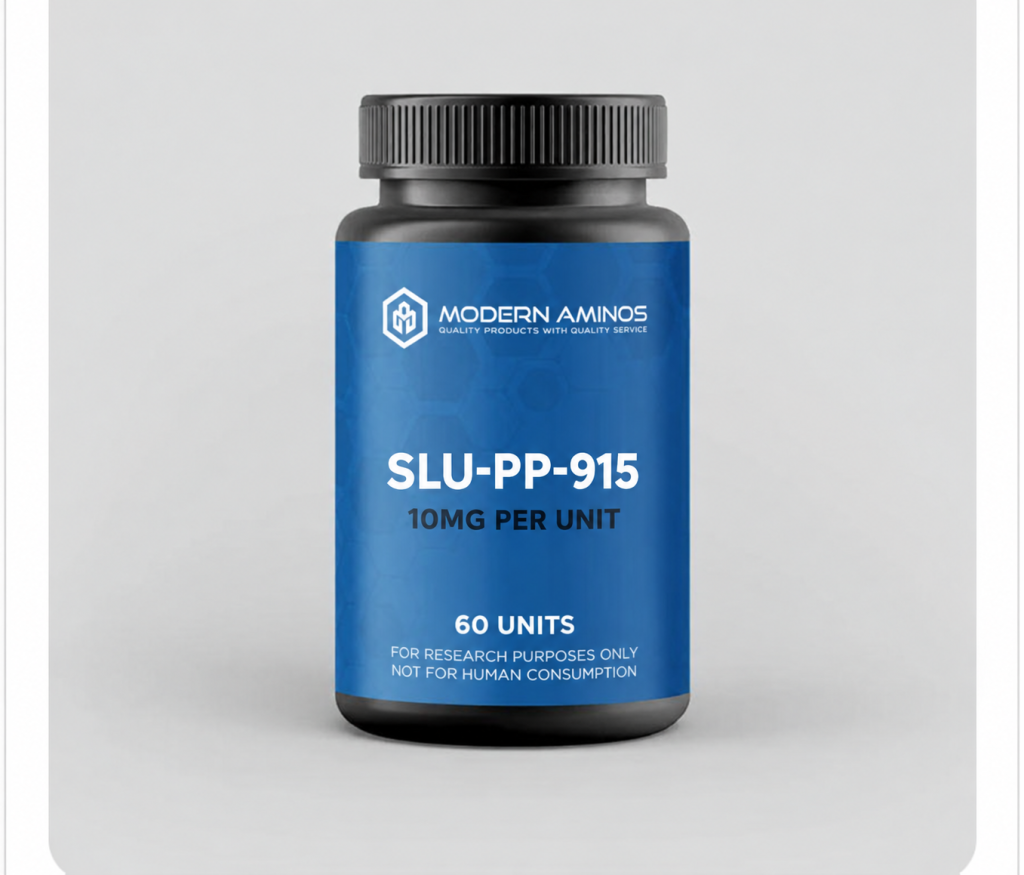
What Is SLU-PP-915?
SLU-PP-915 is a synthetic small molecule, not a peptide, that researchers use as a pan-agonist of the three estrogen-related receptors, ERRα, ERRβ and ERRγ. Chemically it is a thiophene ring carrying a 2-fluorophenyl amide on one side and a phenyl boronic acid on the other. Its published EC50 values sit close together, from 378 to 435 nM, across all three receptors. To view SLU-PP-915 as a documented reference compound, use the product button above.
Chemical Identity of SLU-PP-915
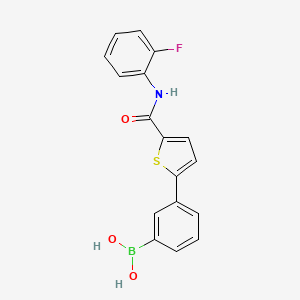
SLU-PP-915 is an aryl boronic acid built on a 2,5-disubstituted thiophene, with the formula C17H13BFNO3S.
Let’s walk through the molecule one piece at a time, the way you might in a chemistry class. In the middle sits a thiophene, a five-membered ring with one sulfur atom. On one side of that ring is a carboxamide, a C(=O)NH group, joined to a benzene ring with a fluorine next door to the nitrogen; that is the “2-fluorophenyl” part of the name. On the other side is a second benzene ring, and at its meta position hangs a boronic acid, a boron atom holding two hydroxyl groups. Boron is unusual in a research compound, and it is the feature that sets SLU-PP-915 apart from the earlier compounds in its family.
Why put boron there? The design team was looking for a group that could donate a hydrogen bond the way a phenol does. Phenyl boronic acids typically have a pKa between 8.0 and 9.0, so near neutral pH they stay protonated and can play that role. The meta placement mattered: both meta-boronic acids in the series were full agonists at ERRγ, while the para version was only a partial agonist at 53% (Hampton et al., 2023).
Molecular Data
| Property | Value |
|---|---|
| CAS# | 2285432-92-8 |
| PubChem ID | CID 142532359 |
| Molecular Formula | C17H13BFNO3S |
| Molecular Weight | 341.20 g/mol |
| Exact Mass | 341.0693 Da |
| IUPAC Name | [3-[5-[(2-fluorophenyl)carbamoyl]thiophen-2-yl]phenyl]boronic acid |
| InChIKey | CKROIKQTGRZRKF-UHFFFAOYSA-N |
| SMILES | B(C1=CC(=CC=C1)C2=CC=C(S2)C(=O)NC3=CC=CC=C3F)(O)O |
| Molecular Class | Small molecule (non-peptide); boronic acid-containing pan-estrogen-related receptor (ERR) agonist |
| Stereocenters | 0 defined, 0 undefined |
| Hydrogen bond donors / acceptors | 3 / 5 |
Values from PubChem CID 142532359 (computed by PubChem).
What Are the Key Chemical Identifiers for SLU-PP-915?
SLU-PP-915 is PubChem CID 142532359, CAS 2285432-92-8, with a molecular weight of 341.2 g/mol and an exact mass of 341.0693 Da.
The table gathers the identity values from PubChem alongside the assay and analytical numbers printed in the two primary papers.
| Item | Detail | Source |
|---|---|---|
| CAS | 2285432-92-8 | PubChem |
| Formula | C17H13BFNO3S | PubChem |
| Molecular weight | 341.2 g/mol | PubChem |
| Exact mass | 341.0693 Da | PubChem |
| InChIKey | CKROIKQTGRZRKF-UHFFFAOYSA-N | PubChem |
| H-bond donors / acceptors; TPSA | 3 / 5; 97.8 Ų | PubChem |
| EC50 ERRα / ERRβ / ERRγ | 0.414 / 0.435 / 0.378 µM | Hampton 2023, Table 4 |
| Efficacy vs. SLU-PP-332 (ERRα / ERRβ / ERRγ) | 90% / 95% / 167% | Hampton 2023, Table 4 |
| Microsomal half-life | >60 min in both preparations tested | Hampton 2023, Table 5 |
| HRMS [M−H]− | m/z 340.0620; product ions 203.0345, 185.0239, 159.0276 | Möller 2026 |
The three EC50 values sit within about 60 nM of each other, which is why SLU-PP-915 is called a “pan” agonist rather than a selective one. The higher-than-100% efficacy at ERRγ simply means it reached a larger maximal signal than the SLU-PP-332 standard in that assay; it is a comparison between two compounds, not a measure of anything beyond the assay itself.
How Does SLU-PP-915 Work?
SLU-PP-915 binds the ligand-binding domain of the estrogen-related receptors and switches on their reporter-gene activity in co-transfection assays.
The estrogen-related receptors are nuclear receptors, proteins that sit on DNA and help decide which genes are read. They are called “orphans” because no natural hormone is known to activate them, which is exactly why a well-characterized synthetic ligand is useful. In the discovery paper, the team showed binding directly with protein NMR: adding SLU-PP-915 at a 1.05:1 ratio shifted the methyl signals of the ERRγ ligand-binding domain in a pattern similar to SLU-PP-332 (Hampton et al., 2023).
Computer docking added a picture of how it might sit in the pocket. In the best-scoring “flipped” pose (Glide score −11.253, the best in the series), one boronic acid hydroxyl hydrogen-bonds to the backbone of Leu-268, and Tyr-326 stacks against both the phenyl boronic acid and the thiophene. A representative set of the analogs, SLU-PP-915 included, showed no activity at the classical estrogen receptors ERα and ERβ. The authors also profiled known ERR target genes such as PGC-1α, LDHA, DDIT4 and PDK4.
How Does SLU-PP-915 Differ From SLU-PP-332?
SLU-PP-332 is an acyl hydrazide that favors ERRα, while SLU-PP-915 is a thiophene amide boronic acid with near-even potency across all three ERRs.
Think of them as cousins designed for the same receptors from different starting points. SLU-PP-332 was the reference agonist in every SLU-PP-915 assay, with EC50 values of 98, 230 and 428 nM at ERRα, ERRβ and ERRγ. SLU-PP-915 trades some ERRα potency for balance, and its boronic acid replaced the phenol found in earlier analogs. The two also behave differently in a mass spectrometer: SLU-PP-332 was followed in positive ionization mode, SLU-PP-915 in negative mode (Möller et al., 2026). For the full side-by-side, read SLU-PP-332 vs. SLU-PP-915: Pan-ERR Agonist Comparison.
What Formats Is SLU-PP-915 Supplied in for Research?
Modern Aminos supplies SLU-PP-915 as 10MG dry-fill capsules, 60 units, in one format only.
All applicable tests are performed on our products. Certificates of analysis can be looked up on our COA Search page, and the current Freedom Diagnostics Testing certificate for SLU-PP-915 is listed there.
Related Research Tools
References
- Hampton CS, Sitaula S, Billon C, Haynes K, Avdagic A, Wanninayake U, et al. Development and pharmacological evaluation of a new chemical series of potent pan-ERR agonists, identification of SLU-PP-915. Eur J Med Chem. 2023;258:115582. PMC10399613 (PMID 37421886)
- Möller T, Krug O, Thevis M. In Vitro Metabolism and Analytical Characterization of SLU-PP-332 and SLU-PP-915: Novel Pan-ERR Agonists With Doping Potential. Rapid Commun Mass Spectrom. 2026;40(8):e70039. PMC12835572 (PMID 41588687)
- National Center for Biotechnology Information. PubChem Compound Summary for CID 142532359, SLU-PP-915. pubchem.ncbi.nlm.nih.gov/compound/142532359
Frequently Asked Questions
What Is SLU-PP-915?
SLU-PP-915 is a synthetic small molecule, [3-[5-[(2-fluorophenyl)carbamoyl]thiophen-2-yl]phenyl]boronic acid (CAS 2285432-92-8, C17H13BFNO3S, 341.2 g/mol), catalogued as a pan-agonist of the estrogen-related receptors ERRα, ERRβ and ERRγ. It was reported in 2023 as compound 10s of a thiophene amide series designed at Saint Louis University.
Is SLU-PP-915 a Peptide?
No. It has no amino acids and no peptide bonds. It is a 24-heavy-atom organic molecule made of a thiophene ring, an amide to a 2-fluorophenyl ring and a phenyl boronic acid, so “research chemical” or “small-molecule ligand” describes it better than “peptide.”
How Does SLU-PP-915 Work?
It is a ligand for the estrogen-related receptors, a family of orphan nuclear receptors that act as transcription factors. In co-transfection reporter assays it gave EC50 values of 414 nM at ERRα, 435 nM at ERRβ and 378 nM at ERRγ, and protein NMR showed it engaging the ERRγ ligand-binding domain much like the reference agonist SLU-PP-332.
SLU-PP-915 vs. SLU-PP-332: What Is the Difference?
SLU-PP-332 is an acyl hydrazide with a naphthalene ring that leans toward ERRα (98 nM, versus 230 nM at ERRβ and 428 nM at ERRγ). SLU-PP-915 is a thiophene amide with a boronic acid whose potency is close to even across all three isoforms. Our full comparison post covers the two side by side.
How Is SLU-PP-915 Identity Documented?
All applicable tests are performed on our products. Certificates of analysis can be looked up on our COA Search page. The current Freedom Diagnostics Testing certificate lists identity as SLU-PP-915 by HPLC with UV detection coupled with mass spectrometry (LC-MS) and a net content of 9.57 mg. The published reference values to check against are the exact mass of 341.0693 Da and the [M−H]− ion at m/z 340.0620.