
What Is DSIP?
DSIP, short for delta sleep-inducing peptide and also known by its nonproprietary name Emideltide, is a small linear peptide made of nine amino acids: Trp-Ala-Gly-Gly-Asp-Ala-Ser-Gly-Glu. Its formula is C35H48N10O15, its molecular weight is 848.8 g/mol, and its CAS number is 62568-57-4. It was isolated and sequenced in 1977, yet no gene, precursor protein or receptor for it has been identified. To buy DSIP as a documented reference peptide, see the product page.
That is the whole answer in a paragraph. DSIP has a famous name and a surprisingly quiet molecular story, so it helps to take it one step at a time: when it was found, what the nine residues look like, and what enzymes do to it.
Key takeaways for researchers
In brief: Here is what is well established about DSIP, and what is not.
- DSIP is a nonapeptide, CAS 62568-57-4, PubChem CID 68816, with free amine and carboxylic acid ends (PubChem).
- Its sequence was first reported in 1977, in the same paper that synthesized it and five of its fragments (Schoenenberger and Monnier, 1977).
- Enzymes attack it from both ends: an aminopeptidase at the N-terminus and peptidyl dipeptidase A at the C-terminus.
- Serine 7 can be phosphorylated, giving P-DSIP, a separate research analog.
- There is still no isolated DSIP gene, precursor or receptor (Kovalzon and Strekalova, 2006).
Research timeline
- 1977 — The peptide is isolated and its sequence, Trp-Ala-Gly-Gly-Asp-Ala-Ser-Gly-Glu, is reported. The authors also synthesize it, along with fragments covering residues 1–8, 2–9, 2–8, 1–4 and 5–9 and two analogs with two residues exchanged (PNAS, PMC430668).
- 1977 — A second report compares the originally isolated nonapeptide with the synthetic one (Experientia, PMID 862769).
- 1987 — Incubation studies in plasma and serum show DSIP breaking down to products that run like free tryptophan on gel filtration, while a phosphorylated analog lasts longer and forms complexes (Peptides, PMID 3628078).
- 1990 — An aminopeptidase of about 80,000 daltons that degrades DSIP is purified from human cerebrospinal fluid; an aminopeptidase inhibitor and a competitive, reversible protease inhibitor and EDTA inhibit it (BBRC, PMID 2322270).
- 1991 — Casein kinase II is shown to phosphorylate DSIP in vitro, with an apparent Km of 20 mM and a Vmax of 90.9 nmol/min/mg protein (Peptides, PMID 1815223).
- 1993 — A 77-residue leucine-zipper peptide, named DIP, is isolated because an anti-DSIP antiserum recognizes it, even though its sequence is unrelated (Eur J Biochem, PMID 8375381).
- 1995 — Peptidyl dipeptidase A is found to trim DSIP two or three residues at a time from the C-terminus, an activity blocked by an angiotensin-converting enzyme (ACE) inhibitor (BBRC, PMID 7763273).
- 1996 — Phosphorylated DSIP is synthesized on solid phase, with an Aloc group protecting the tryptophan indole from oxidation (Int J Pept Protein Res, PMID 8985788).
- 2006 — A review calls DSIP a still unresolved riddle: no gene, protein or receptor has been isolated (J Neurochem, PMID 16539679).
- Today — DSIP is supplied as a laboratory reference peptide; see the DSIP product page and its Certificate of Analysis tab.
Chemical identity
Think of DSIP as a short string of nine beads. The first bead is tryptophan, which carries a two-ring indole side chain and gives the peptide most of its UV absorbance. Then come alanine, glycine and glycine, three of the smallest building blocks there are. Aspartic acid in position 5 and glutamic acid in position 9 each carry an extra carboxylic acid, so the chain holds several negative charges at neutral pH. Serine sits in position 7, and its hydroxyl group is the spot that can be phosphorylated. Every chiral residue is in the L form, and the three glycines have no handedness at all (PubChem CID 68816).
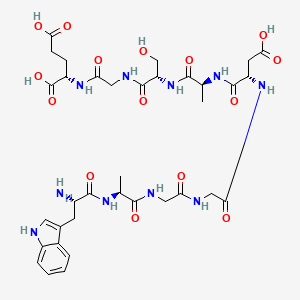
Because the ends are left open, with a free amine on tryptophan and a free acid on glutamic acid, DSIP is a different shape of molecule from ring-closed nonapeptides. Oxytocin, for comparison, has nine residues too, but it is closed into a ring by a disulfide bridge and capped with a C-terminal amide. You can see that contrast in the note on oxytocin, the cyclic nonapeptide.
Molecular data
| Property | Value | Source |
|---|---|---|
| CAS Registry Number | 62568-57-4 | PubChem |
| PubChem CID | 68816 | PubChem |
| Molecular formula | C35H48N10O15 | PubChem |
| Molecular weight | 848.8 g/mol | PubChem |
| Exact (monoisotopic) mass | 848.3301 Da | PubChem |
| IUPAC name | (2S)-2-[[2-[[(2S)-2-[[(2S)-2-[[(2S)-2-[[2-[[2-[[(2S)-2-[[(2S)-2-amino-3-(1H-indol-3-yl)propanoyl]amino]propanoyl]amino]acetyl]amino]acetyl]amino]-3-carboxypropanoyl]amino]propanoyl]amino]-3-hydroxypropanoyl]amino]acetyl]amino]pentanedioic acid | PubChem |
| IUPAC name (residue form) | L-tryptophyl-L-alanyl-glycyl-glycyl-L-alpha-aspartyl-L-alanyl-L-seryl-glycyl-L-glutamic acid | PubChem |
| InChIKey | ZRZROXNBKJAOKB-GFVHOAGBSA-N | PubChem |
| SMILES | C[C@@H](C(=O)NCC(=O)NCC(=O)N[C@@H](CC(=O)O)C(=O)N[C@@H](C)C(=O)N[C@@H](CO)C(=O)NCC(=O)N[C@@H](CCC(=O)O)C(=O)O)NC(=O)[C@H](CC1=CNC2=CC=CC=C21)N | PubChem |
| Molecular class | Linear nonapeptide (neuropeptide); 9 residues joined by 8 peptide bonds, free N-terminal amine and C-terminal carboxylic acid | PubChem |
| Sequence | WAGGDASGE (one-letter); Trp-Ala-Gly-Gly-Asp-Ala-Ser-Gly-Glu (three-letter) | PubChem; Schoenenberger and Monnier, 1977 |
| Form described | Neutral peptide, no counter-ion (PubChem CID 68816) | PubChem |
| Other names | Emideltide (INN), DSIP nonapeptide | PubChem |
| Stereochemistry | 6 defined stereocenters, all L-residues; the three glycines are achiral | PubChem |
| Computed properties | XLogP −7.1; topological polar surface area 407 Å2; 14 hydrogen-bond donors, 16 acceptors; 25 rotatable bonds; 60 heavy atoms; formal charge 0 | PubChem (computed) |
| Known modification | Serine 7 can be phosphorylated (P-DSIP, a separate research analog) | Nakamura and Shiomi, 1991 |
How enzymes process DSIP, step by step
DSIP is a short, open chain, so enzymes can reach both ends easily. Three well-documented steps describe most of its chemistry.
Step one: the N-terminus. An aminopeptidase purified from human cerebrospinal fluid removes residues from the tryptophan end. It is about 80,000 daltons, works best at neutral pH, is blocked by an aminopeptidase inhibitor, a competitive, reversible protease inhibitor and EDTA, and also degrades the enkephalins (Nyberg et al., 1990).
Step two: the C-terminus. Peptidyl dipeptidase A works from the other end, clipping off two or three residues at a time. An angiotensin-converting enzyme (ACE) inhibitor blocks it, and when angiotensin-converting enzyme (ACE) inhibitor and a competitive, reversible protease inhibitor were used together, DSIP was fully protected in that test system (Augustijns et al., 1995).
Step three: serine 7. Casein kinase II can add a phosphate to serine 7, using either ATP or GTP. Heparin slowed the reaction and spermine sped it up (Nakamura and Shiomi, 1991).
Published numbers at a glance
| Item | Detail | Source |
|---|---|---|
| Sequence length | 9 residues (WAGGDASGE) | Schoenenberger and Monnier, 1977 |
| Casein kinase II, apparent Km | 20 mM | Nakamura and Shiomi, 1991 |
| Casein kinase II, Vmax | 90.9 nmol/min/mg protein | Nakamura and Shiomi, 1991 |
| CSF aminopeptidase size | about 80,000 Da | Nyberg et al., 1990 |
What this tells us: the apparent Km of 20 mM is high, so casein kinase II needs a lot of DSIP before it approaches full speed. DSIP works as a substrate in the test tube, but these numbers describe an enzyme assay, not a conclusion about what the peptide does in a living system.
DSIP compared with oxytocin
Both DSIP and oxytocin are nonapeptides, but their shapes differ. Oxytocin folds into a ring closed by a cysteine-to-cysteine disulfide bond and ends in an amide, which makes it compact and resistant to simple end-trimming (PubChem CID 439302). DSIP is an open chain with free ends and no disulfide, which is exactly why the aminopeptidase and peptidyl dipeptidase A studies above could trim it from either side. Comparing the two is a tidy way to see how ring closure changes a peptide’s chemistry.
Research formats and documentation
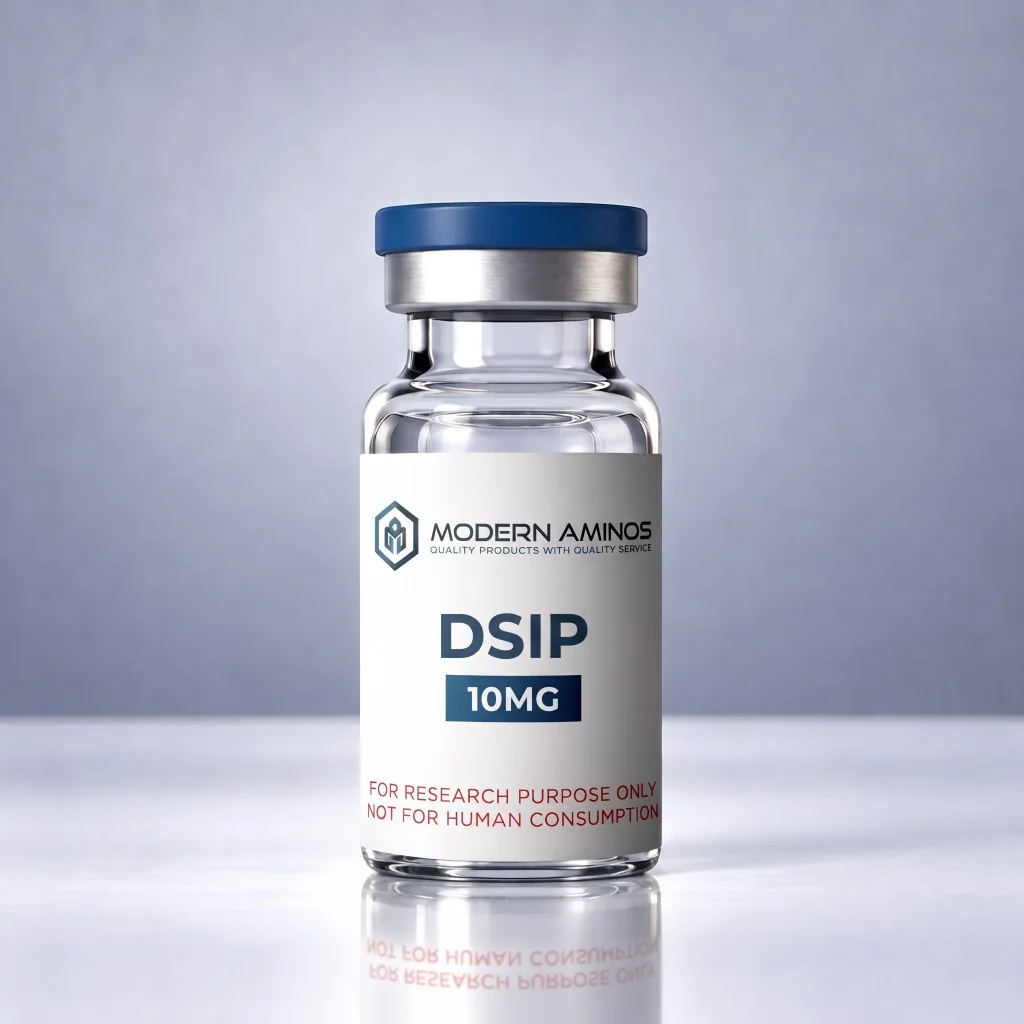
All applicable tests are performed on our products. Modern Aminos lists DSIP as 10 mg of lyophilized powder in a 2R glass vial. The DSIP product page links the current certificate from Freedom Diagnostics Testing, which reports LC-MS identity confirmation and an HPLC-UV chromatogram. For why chromatography and mass spectrometry are the right tools for a nine-residue peptide, see the note on HPLC testing.
Related research tools
For another short regulatory peptide, read what Pinealon (Glu-Asp-Arg) is. The Prostamax (Lys-Glu-Asp-Pro) guide and the KPV tripeptide explainer round out a short-peptide reference set, and the HPLC testing note explains how identity and quantity are confirmed.
Frequently asked questions
What is DSIP?
DSIP, short for delta sleep-inducing peptide and also called Emideltide, is a linear nonapeptide with the sequence Trp-Ala-Gly-Gly-Asp-Ala-Ser-Gly-Glu. Its formula is C35H48N10O15, its molecular weight is 848.8 g/mol and its CAS number is 62568-57-4.
What is the amino acid sequence of DSIP?
The sequence is Trp-Ala-Gly-Gly-Asp-Ala-Ser-Gly-Glu, or WAGGDASGE in one-letter code. Tryptophan sits at the N-terminus with a free amine, and glutamic acid sits at the C-terminus with a free carboxylic acid.
What is DSIP used for in research?
In the laboratory, DSIP serves as a defined reference peptide for chemistry and enzymology. Published work uses it as a substrate for an N-terminal aminopeptidase (Nyberg et al., 1990), for peptidyl dipeptidase A (Augustijns et al., 1995) and for casein kinase II (Nakamura and Shiomi, 1991), and as the parent of the phosphorylated analog P-DSIP. Its name dates to the 1977 isolation work, and no gene, precursor protein or receptor for it has been isolated (Kovalzon and Strekalova, 2006).
DSIP vs. phosphorylated DSIP: what is the difference?
Phosphorylated DSIP, or P-DSIP, carries one phosphate group on serine 7. Casein kinase II can add that phosphate in vitro, and in plasma and serum incubations a phosphorylated analog broke down more slowly than DSIP and formed non-specific complexes.
What is the dosing for DSIP?
Unfortunately, we are not able to provide dosing instructions for individual research applications. This is outlined in the research documentation ‘materials and methods’ section, and should be documented prior to beginning any research with your reference materials.
How do I reconstitute DSIP?
We are unable to provide instructions on how to reconstitute DSIP because each laboratory study may require a different concentration of the compound in their sample. Adjusting the concentration could have significant impact on the outcome of each study, and as such, we cannot provide guidance for reconstituting your reference materials.
References
- Schoenenberger GA, Monnier M. Characterization of a delta-electroencephalogram (-sleep)-inducing peptide. Proc Natl Acad Sci U S A. 1977;74(3):1282-1286. PMC430668
- Monnier M, Dudler L, Gächter R, et al. The delta sleep inducing peptide (DSIP). Comparative properties of the original and synthetic nonapeptide. Experientia. 1977;33(4):548-552. PMID 862769
- Graf MV, Saegesser B, Schoenenberger GA. Degradation and aggregation of delta sleep-inducing peptide (DSIP) and two analogs in plasma and serum. Peptides. 1987;8(4):599-603. PMID 3628078
- Nyberg F, Thörnwall M, Hetta J. Aminopeptidase in human CSF which degrades delta-sleep inducing peptide (DSIP). Biochem Biophys Res Commun. 1990;167(3):1256-1262. PMID 2322270
- Nakamura A, Shiomi H. Phosphorylation of delta sleep-inducing peptide (DSIP) by casein kinase II in vitro. Peptides. 1991;12(6):1375-1377. PMID 1815223
- Sillard R, Schulz-Knappe P, Vogel P, et al. A novel 77-residue peptide from porcine brain contains a leucine-zipper motif and is recognized by an antiserum to delta-sleep-inducing peptide. Eur J Biochem. 1993;216(2):429-436. PMID 8375381
- Augustijns PF, Ng KY, Williams TM, et al. Peptidyl dipeptidase A-catalyzed metabolism of delta sleep-inducing peptide in bovine brain microvessel endothelial cells. Biochem Biophys Res Commun. 1995;210(3):987-994. PMID 7763273
- Vorherr T, Trzeciak A, Bannwarth W. Application of the allyloxycarbonyl protecting group for the indole of Trp in solid-phase peptide synthesis. Int J Pept Protein Res. 1996;48(6):553-558. PMID 8985788
- Kovalzon VM, Strekalova TV. Delta sleep-inducing peptide (DSIP): a still unresolved riddle. J Neurochem. 2006;97(2):303-309. PMID 16539679
- National Center for Biotechnology Information. PubChem Compound Summary for CID 68816, Delta Sleep-Inducing Peptide. pubchem.ncbi.nlm.nih.gov/compound/68816
DSIP is a good reminder that a famous name and a settled molecule are two different things. The sequence has been fixed since 1977, the enzymes that cut it are well mapped, and the phosphorylation site is known, even as the larger biology stays open. Check the CAS number, read the sequence one residue at a time, and the chemistry is easy to follow.