
What Is Oxytocin?
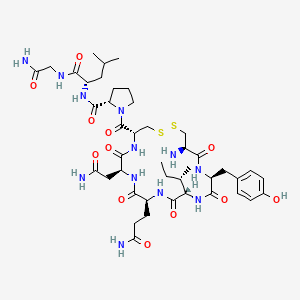
Oxytocin is a small peptide hormone made of nine amino acids, Cys-Tyr-Ile-Gln-Asn-Cys-Pro-Leu-Gly-NH2, folded into a ring by a disulfide bridge between its two cysteines. It carries CAS number 50-56-6, the formula C43H66N12O12S2, and a molecular weight of 1007.2 g/mol. It works by switching on the oxytocin receptor, a G protein-coupled receptor that signals mainly through Gq and phospholipase C-β. Its closest chemical relative is vasopressin, which differs at only two positions.
Chemical Identity of Oxytocin
Let’s look at the molecule itself. Oxytocin starts with cysteine, tyrosine, isoleucine, glutamine, asparagine, and a second cysteine. Those two cysteines reach toward each other and join through their sulfur atoms, and that single disulfide bond closes a twenty-membered ring. Hanging off the ring is a short tail of proline, leucine, and glycine, and the glycine ends as an amide rather than a free acid. PubChem gives the full name as a pentazacycloicosane carboxamide, which is simply a careful chemist’s way of describing that ring and tail. The InChIKey is XNOPRXBHLZRZKH-DSZYJQQASA-N, and the ChEBI entry is CHEBI:7872.
One small piece of history explains a puzzle you may run into. The 1953 paper calls oxytocin an octapeptide, while modern references call it a nonapeptide. Both are describing the same molecule. The older count treated the disulfide-linked cystine as one building block; today we count each cysteine on its own, which gives nine.
Molecular Data
| Property | Value |
|---|---|
| CAS# | 50-56-6 |
| PubChem ID | CID 439302 |
| Molecular Formula | C43H66N12O12S2 |
| Molecular Weight | 1007.20 g/mol |
| Exact Mass | 1006.4365 Da |
| IUPAC Name | (2S)-1-[(4R,7S,10S,13S,16S,19R)-19-amino-7-(2-amino-2-oxoethyl)-10-(3-amino-3-oxopropyl)-13-[(2S)-butan-2-yl]-16-[(4-hydroxyphenyl)methyl]-6,9,12,15,18-pentaoxo-1,2-dithia-5,8,11,14,17-pentazacycloicosane-4-carbonyl]-N-[(2S)-1-[(2-amino-2-oxoethyl)amino]-4-methyl-1-oxopentan-2-yl]pyrrolidine-2-carboxamide |
| InChIKey | XNOPRXBHLZRZKH-DSZYJQQASA-N |
| SMILES | CC[C@H](C)[C@H]1C(=O)N[C@H](C(=O)N[C@H](C(=O)N[C@@H](CSSC[C@@H](C(=O)N[C@H](C(=O)N1)CC2=CC=C(C=C2)O)N)C(=O)N3CCC[C@H]3C(=O)N[C@@H](CC(C)C)C(=O)NCC(=O)N)CC(=O)N)CCC(=O)N |
| Molecular Class | Cyclic nonapeptide with a Cys1-Cys6 disulfide bridge and C-terminal glycinamide |
| Stereocenters | 9 defined, 0 undefined |
| Hydrogen bond donors / acceptors | 12 / 15 |
| XLogP3 (computed) | -2.6 |
Values from PubChem CID 439302 (computed by PubChem).
Research Timeline
- 1953Vincent du Vigneaud’s group reported the synthesis of “an octapeptide amide with the hormonal activity of oxytocin,” one of the first laboratory syntheses of a peptide hormone of its kind (J Am Chem Soc, 1953).
- 2001Gimpl and Fahrenholz described the oxytocin receptor as a typical class I GPCR coupled through Gq to phospholipase C-β, with a high-affinity state that needs both Mg2+ and cholesterol (Physiol Rev, 2001).
- 2012Busnelli and colleagues used a BRET biosensor to show that oxytocin activates Gq and every Gi/o subtype, while several analogues favor single pathways (J Biol Chem, 2012). The same year, Manning and colleagues compiled receptor affinity data for oxytocin and vasopressin research ligands (J Neuroendocrinol, 2012).
- 2020Waltenspühl and colleagues solved the crystal structure of the human oxytocin receptor bound to the antagonist retosiban at 3.2 Å, revealing a cholesterol site and a Mg2+ site (Sci Adv, 2020).
- 2022Meyerowitz and colleagues solved the active-state receptor bound to oxytocin and a miniGq/i protein by cryo-EM at 2.9 Å (Nat Struct Mol Biol, 2022).
How Oxytocin Signals Through Its Receptor
The oxytocin receptor sits in the cell membrane and threads back and forth through it seven times, like most G protein-coupled receptors. When oxytocin settles into the pocket at the top, the receptor changes shape and hands a signal to a Gq protein on the inside. Gq turns on phospholipase C-β, which splits a membrane lipid into two messengers, inositol trisphosphate and diacylglycerol, and inositol trisphosphate opens calcium stores inside the cell (Gimpl and Fahrenholz, 2001).
The 2022 cryo-EM structure let researchers watch the first step up close. Isoleucine 3 of oxytocin tucks into a hydrophobic pocket, the peptide and receptor hold a magnesium ion between them, and transmembrane helix 7 is disrupted. That helix change is the difference between full agonism by oxytocin and the partial agonism seen with some analogues (Meyerowitz et al., 2022). Earlier BRET work had already shown that the receptor is not a one-lane road: oxytocin itself engages Gq and all Gi/o subtypes, while altered analogues choose narrower routes (Busnelli et al., 2012).
Published Numbers at a Glance
| Item | Detail | Source |
|---|---|---|
| CAS | 50-56-6 | PubChem |
| Formula | C43H66N12O12S2 | PubChem |
| Molecular weight | 1007.2 g/mol | PubChem |
| Sequence | Cys-Tyr-Ile-Gln-Asn-Cys-Pro-Leu-Gly-NH2, Cys1-Cys6 disulfide | PubChem |
| Active-state receptor structure | 2.9 Å cryo-EM (OXTR with oxytocin and miniGq/i) | Meyerowitz 2022 |
| Antagonist-bound receptor structure | 3.2 Å crystal (OXTR with retosiban) | Waltenspühl 2020 |
| G11 activation EC50, wild-type OXTR | 3.7 nM (95% CI 2.7-5.3 nM) | Meyerowitz 2022 |
| Vasopressin Ki, human oxytocin receptor | 1.7 nM | Manning 2012, Table 5 |
Oxytocin is a potent, low-nanomolar agonist at its own receptor, and its receptor is well enough mapped that researchers can point to the exact residues and the exact ion involved. The vasopressin number is a gentle reminder that a close cousin binds the same receptor nearly as tightly, so selectivity has to be checked rather than assumed.
Oxytocin Compared with Vasopressin
Put the two sequences side by side and they look like siblings. Oxytocin reads Cys-Tyr-Ile-Gln-Asn-Cys-Pro-Leu-Gly-NH2; arginine vasopressin reads Cys-Tyr-Phe-Gln-Asn-Cys-Pro-Arg-Gly-NH2. PubChem even lists “3-isoleucine-8-leucine vasopressin” as a synonym for oxytocin. In the 2022 structure, Ile3 of oxytocin and Phe3 of vasopressin fill the same kind of hydrophobic pocket in their receptors (Meyerowitz et al., 2022). Because of that family resemblance, vasopressin binds the human oxytocin receptor with a Ki of 1.7 nM and the human V1a receptor with a Ki of 1.1 nM (Manning et al., 2012, Table 5).
Research Formats and Documentation
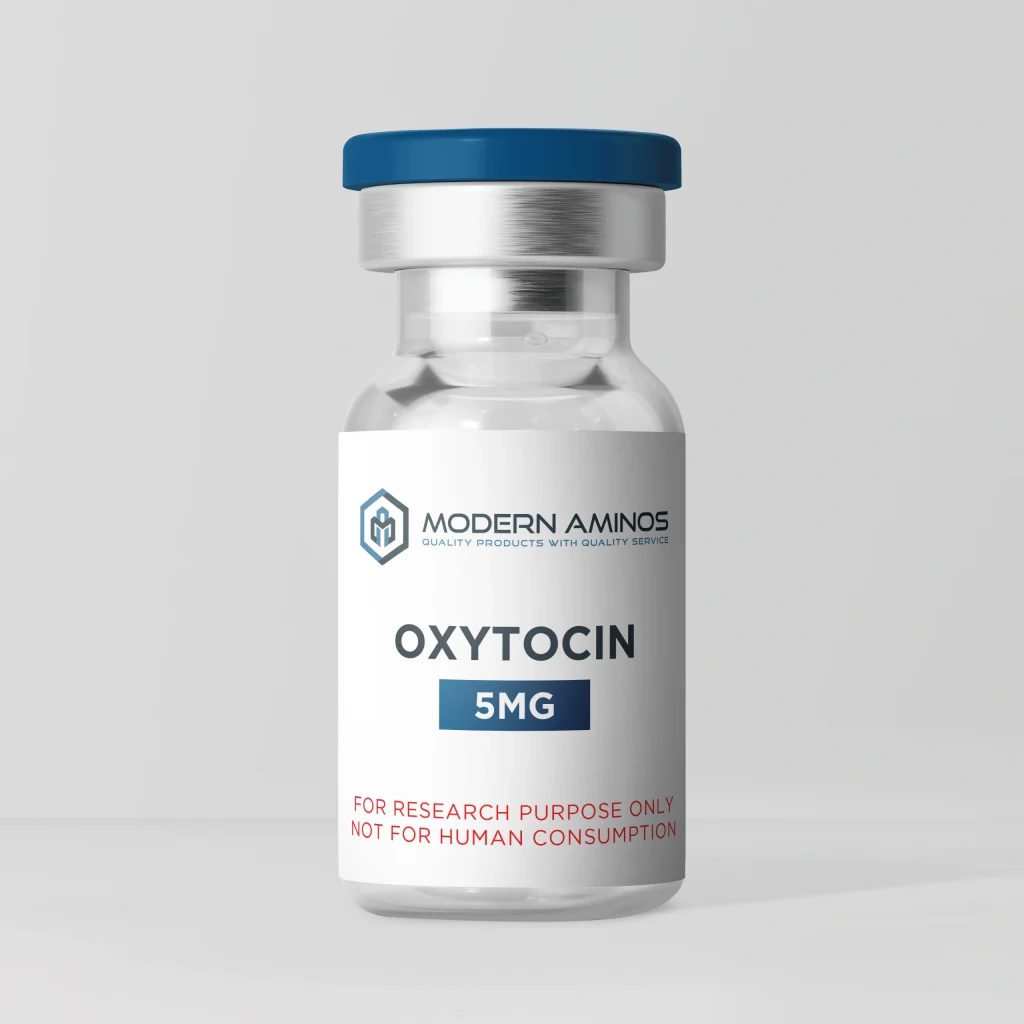
All applicable tests are performed on our products. Modern Aminos supplies Oxytocin as a 5MG lyophilized powder and a 10MG lyophilized powder, each in a 2R glass vial. Each lot certificate confirms identity by LC-MS and reports net content, endotoxin, microbial or sterility, and heavy-metal screens, and the reports are listed on the COA Search page. The button at the top of this article opens the product page.
Related Research Tools
References
- du Vigneaud V, Ressler C, Swan JM, Roberts CW, Katsoyannis PG, Gordon S. The synthesis of an octapeptide amide with the hormonal activity of oxytocin. J Am Chem Soc. 1953;75(19):4879-4880. DOI 10.1021/ja01115a553
- Gimpl G, Fahrenholz F. The oxytocin receptor system: structure, function, and regulation. Physiol Rev. 2001;81(2):629-683. PMID 11274341
- Busnelli M, Saulière A, Manning M, Bouvier M, Galés C, Chini B. Functional selective oxytocin-derived agonists discriminate between individual G protein family subtypes. J Biol Chem. 2012;287(6):3617-3629. PMC3281696
- Manning M, Misicka A, Olma A, et al. Oxytocin and vasopressin agonists and antagonists as research tools and potential therapeutics. J Neuroendocrinol. 2012;24(4):609-628. PMC3490377
- Waltenspühl Y, Schöppe J, Ehrenmann J, Kummer L, Plückthun A. Crystal structure of the human oxytocin receptor. Sci Adv. 2020;6(29):eabb5419. PMC7439316
- Meyerowitz JG, Robertson MJ, Barros-Álvarez X, et al. The oxytocin signaling complex reveals a molecular switch for cation dependence. Nat Struct Mol Biol. 2022;29(3):274-281. PMC12101619
- National Center for Biotechnology Information. PubChem Compound Summary for CID 439302, Oxytocin. pubchem.ncbi.nlm.nih.gov/compound/439302
Frequently Asked Questions
What Is Oxytocin?
Oxytocin is a nine-residue peptide hormone of the neurohypophysial family, with the sequence Cys-Tyr-Ile-Gln-Asn-Cys-Pro-Leu-Gly-NH2 and a disulfide bridge between Cys1 and Cys6. PubChem lists it under CAS 50-56-6 and CID 439302, with the formula C43H66N12O12S2 and a molecular weight of 1007.2 g/mol.
Is Oxytocin a Peptide?
Yes. Oxytocin is built from nine amino acids joined by amide bonds, ends in a glycinamide, and is folded into a ring by one disulfide bond. Older papers sometimes call it an octapeptide because they counted the disulfide-linked cystine as one unit.
How Does Oxytocin Work?
Oxytocin binds the oxytocin receptor, a G protein-coupled receptor that signals mainly through Gq and phospholipase C-β. Structural work shows that oxytocin and the receptor share a magnesium ion between them and that oxytocin disrupts transmembrane helix 7, a change linked to full receptor activation.
Oxytocin vs. Vasopressin: What Is the Difference?
The two peptides share the same ring-and-tail shape and differ at just two positions: oxytocin carries isoleucine at position 3 and leucine at position 8, while arginine vasopressin carries phenylalanine and arginine. Because they look so alike, vasopressin also binds the human oxytocin receptor, with a reported Ki of 1.7 nM.