
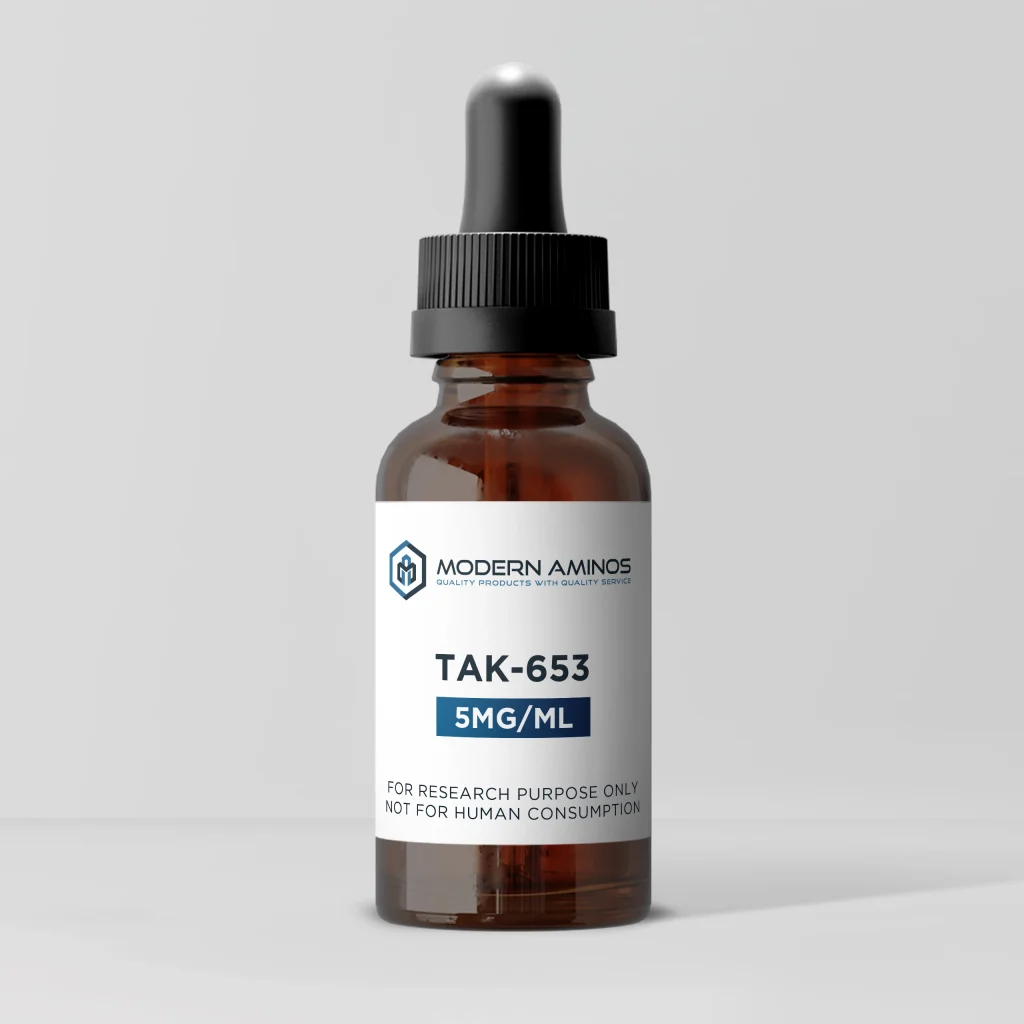
What Is TAK-653?
TAK-653, also known as osavampator or NBI-1065845, is a small molecule, not a peptide. It is an AMPA receptor positive allosteric modulator (PAM): in published binding and cell assays it attaches to the ligand-binding domain of AMPA-type glutamate receptors, mainly when glutamate is already bound. Its formula is C19H23N3O3S, its molecular weight is 373.5 g/mol, and its CAS number is 1358751-06-0. A 1.44 Å crystal structure shows it at the dimer interface of the GluA2 ligand-binding domain (Suzuki et al., 2021).
Chemical Identity of TAK-653
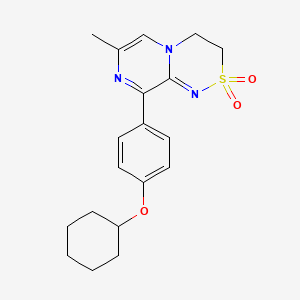
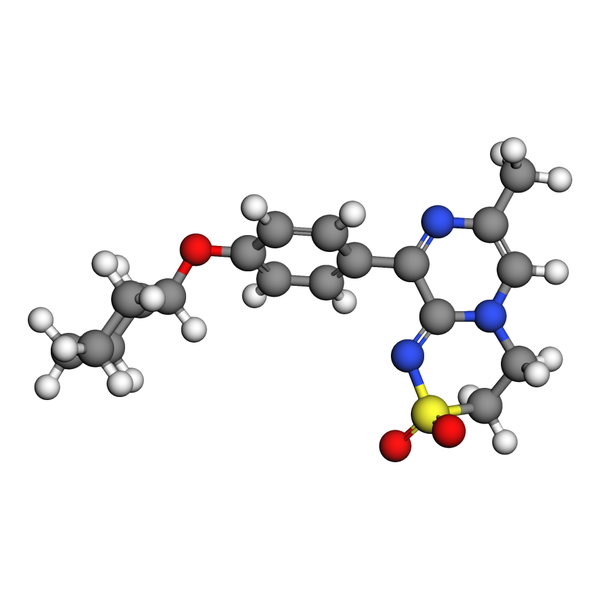
TAK-653 is a fused two-ring heterocycle carrying a cyclohexyl ether, with no stereocenters.
The IUPAC name, 9-(4-cyclohexyloxyphenyl)-7-methyl-3,4-dihydropyrazino[2,1-c][1,2,4]thiadiazine 2,2-dioxide, describes three parts. The core is a pyrazine ring fused to a six-membered ring that holds a sulfonyl group, S(=O)2, next to an imine-type nitrogen, which makes it a cyclic sulfonyl amidine. A methyl group (position 7) and a 4-(cyclohexyloxy)phenyl group (position 9) sit on the pyrazine ring. That last group is a benzene ring carrying a cyclohexyl ether, and it is the bulky, flexible tail of the molecule. PubChem records no stereocenters, with the InChIKey PXJBHEHFVQVDDS-UHFFFAOYSA-N, and lists TAK-653, osavampator and NBI-1065845 as names for the same record (PubChem CID 56655833).
Molecular Data
| Property | Value |
|---|---|
| CAS Registry Number | 1358751-06-0 |
| PubChem CID | 56655833 |
| Molecular formula | C19H23N3O3S |
| Molecular weight | 373.5 g/mol |
| Exact (monoisotopic) mass | 373.1460 Da |
| IUPAC name | 9-(4-cyclohexyloxyphenyl)-7-methyl-3,4-dihydropyrazino[2,1-c][1,2,4]thiadiazine 2,2-dioxide |
| InChIKey | PXJBHEHFVQVDDS-UHFFFAOYSA-N |
| SMILES | CC1=CN2CCS(=O)(=O)N=C2C(=N1)C3=CC=C(C=C3)OC4CCCCC4 |
| Molecular class | Small molecule (not a peptide): fused pyrazine and thiadiazine heterocycle with a cyclohexyl ether; AMPA receptor positive allosteric modulator |
| Form described | Neutral parent molecule (no salt) |
| Other names | Osavampator (INN), NBI-1065845 |
| Stereochemistry | None: 0 defined stereocenters, achiral |
| Computed properties | XLogP 2.7; topological polar surface area 79.7 Å2; 0 hydrogen-bond donors, 5 acceptors; 3 rotatable bonds; 26 heavy atoms; formal charge 0 |
| Experimental structure | Crystal structure with the GluA2 ligand-binding domain and glutamate, 1.44 Å (PDB 7F3O) |
Research Timeline

- 2002: Crystal work on the GluR2 receptor shows that its ligand-binding cores form dimers, and that stabilizing the contact between the two halves of the dimer reduces desensitization (Sun et al., 2002).
- 2005: Co-crystal structures of the modulators aniracetam and CX614 place both at a shared site in the dimer interface, next to the hinge of the ligand-binding “clamshell” (Jin et al., 2005).
- 2018: HBT1, an AMPA receptor potentiator that binds the ligand-binding domain, is described; a labeled version of it is later used as the competitor ligand in the TAK-653 binding assay (Kunugi et al., 2018; Suzuki et al., 2021).
- 2021: TAK-653 is characterized in binding, cell and electrophysiology assays, and its crystal structure with glutamate is released as PDB 7F3O (Suzuki et al., 2021).
- 2026: A review of AMPA receptor PAM chemistry covers TAK-653 among its key chemotypes, along with the dimer-interface site, flip/flop splice variants and TARP auxiliary proteins (Colson et al., 2026).
How TAK-653 Works at the AMPA Receptor Binding Site
TAK-653 binds where two ligand-binding domains meet, and in the published binding assay it bound the isolated domain robustly only when glutamate was present.
AMPA receptors are glutamate-gated ion channels. In each subunit, the ligand-binding domain folds like a clamshell that closes around glutamate, and two clamshells pair into a dimer. Early crystal work showed that stabilizing the interface between the two halves of that dimer reduces desensitization (Sun et al., 2002). Co-crystal structures with aniracetam and CX614 then placed modulators at a shared site on the two-fold axis of that interface, next to the clamshell hinge, where they are proposed to hold the closed, glutamate-bound shape (Jin et al., 2005).
TAK-653 follows that general pattern. In the 1.44 Å structure of the GluA2 ligand-binding domain with glutamate and TAK-653, the compound sits at the intradimer interface (PDB 7F3O). In a scintillation proximity assay it displaced [3H]HBT1, a labeled modulator of the same domain, with an IC50 of 0.26 µM. It did not displace [3H]AMPA; it slightly raised [3H]AMPA binding instead (EC50 1.5 µM, Emax 19.9%), which suggests it does not bind the glutamate site. Binding of [3H]TAK-653 itself rose strongly when glutamate was present (Suzuki et al., 2021).
The cyclohexyl ring is the design feature. The authors describe giving the molecule a bulky terminal group so that it bumps into Ser750 of the GluA2 domain (Ser743 in GluA1) in the channel-closed state, a feature they associate with a lower agonistic effect. Consistent with that idea, a GluA1 S743A mutation, expected to reduce the interference, gave higher maximum responses than wild type at every glutamate concentration tested (Suzuki et al., 2021).
In functional assays the pattern held. In CHO cells expressing human GluA1, TAK-653 raised Ca2+ influx only in the presence of 3 mM glutamate, with an EC50 of 3.3 µM. There was no prominent subunit selectivity across homomeric GluA1-4 receptors with TARP γ-2. At 10 µM against a panel of 97 targets, only 5-lipoxygenase activity was inhibited (IC50 5.9 µM) (Suzuki et al., 2021).
Published Numbers at a Glance
| Item | Detail | Source |
|---|---|---|
| [3H]HBT1 displacement, IC50 | 0.26 µM | Suzuki 2021, Fig. 1C |
| [3H]AMPA binding | No inhibition; slight increase (EC50 1.5 µM, Emax 19.9%) | Suzuki 2021, Fig. 1E |
| Ca2+ influx, human GluA1 CHO cells with 3 mM glutamate, EC50 | 3.3 µM | Suzuki 2021, Fig. 1F |
| Ca2+ influx, cultured neurons with 5 µM AMPA, EC50 | 0.93 µM | Suzuki 2021, Table 1 |
| AMPA receptor currents, cultured neurons with 1 µM AMPA, EC50 | 4.4 µM | Suzuki 2021, Table 1 |
| Off-target panel (10 µM, 97 targets) | 5-lipoxygenase only, IC50 5.9 µM | Suzuki 2021 |
The functional EC50 values fall between roughly 1 and 4 µM, but each belongs to its own assay. The neuron Ca2+ value (0.93 µM) and the neuron current value (4.4 µM) differ by almost fivefold in the same type of culture, partly because the two assays used different AMPA concentrations (5 µM and 1 µM), so numbers from different read-outs should not be swapped.
TAK-653 Compared with TAK-137 and LY451646
In the same cultured-neuron assays, TAK-653 showed the smallest response when no agonist was added.
TAK-137 is 9-(4-phenoxyphenyl)-3,4-dihydropyrido[2,1-c][1,2,4]thiadiazine 2,2-dioxide. The authors designed TAK-653 from it by adding a bulkier terminal group, a cyclohexyl ring in place of the terminal phenyl, on a pyrazino-thiadiazine core. LY451646 is a separate AMPA receptor potentiator used as a comparator. Table 1 of the paper reports all three side by side (Suzuki et al., 2021).
| Compound | Ca2+ potentiation EC50 (µM) | Ca2+ response alone at 30 µM (%) | Current potentiation EC50 (µM) | Current response alone at 30 µM (%) |
|---|---|---|---|---|
| TAK-653 | 0.93 | 4.8 | 4.4 | 1.7 |
| TAK-137 | 0.42 | 7.6 | 1.4 | 6.4 |
| LY451646 | 0.78 | 88 | 1.9 | 39 |
All three potentiate AMPA responses at sub-micromolar to low-micromolar concentrations, but they differ in how much they activate the receptor on their own. The Ca2+ percentages are relative to a 5 µM AMPA plus 10 µM HBT1 response, and the current percentages are relative to a 100 µM AMPA response (Suzuki et al., 2021).
Related Research Tools
References
- Suzuki A, Kunugi A, Tajima Y, Suzuki N, Suzuki M, Toyofuku M, Kuno H, Sogabe S, Kosugi Y, Awasaki Y, Kaku T, Kimura H. Strictly regulated agonist-dependent activation of AMPA-R is the key characteristic of TAK-653 for robust synaptic responses and cognitive improvement. Sci Rep. 2021;11:14532. PMC8282797
- RCSB Protein Data Bank. Entry 7F3O: crystal structure of the GluA2o ligand-binding domain in complex with glutamate and TAK-653. rcsb.org/structure/7F3O
- Sun Y, Olson R, Horning M, Armstrong N, Mayer M, Gouaux E. Mechanism of glutamate receptor desensitization. Nature. 2002;417(6886):245-253. PMID 12015593
- Jin R, Clark S, Weeks AM, Dudman JT, Gouaux E, Partin KM. Mechanism of positive allosteric modulators acting on AMPA receptors. J Neurosci. 2005;25(39):9027-9036. PMC6725607
- Kunugi A, Tajima Y, Kuno H, Sogabe S, Kimura H. HBT1, a novel AMPA receptor potentiator with lower agonistic effect, avoided bell-shaped response in in vitro BDNF production. J Pharmacol Exp Ther. 2018;364(3):377-389. PMID 29298820
- Colson T, Pirotte B, Francotte P. Positive allosteric modulators of AMPA receptors: advances and emerging trends. Expert Opin Ther Pat. 2026 (online ahead of print). PMID 42867279
- National Center for Biotechnology Information. PubChem Compound Summary for CID 56655833, TAK-653. pubchem.ncbi.nlm.nih.gov/compound/56655833
Frequently Asked Questions
What Is TAK-653?
TAK-653, also called osavampator or NBI-1065845, is a small-molecule AMPA receptor positive allosteric modulator. Its formula is C19H23N3O3S, its molecular weight is 373.5 g/mol, and its CAS number is 1358751-06-0 (PubChem CID 56655833).
Is TAK-653 a Peptide?
No. TAK-653 has no amino acids and no peptide bonds. It is a small molecule built on a fused pyrazine and thiadiazine ring system with a cyclohexyl ether on a benzene ring. It is sometimes searched as a peptide only because it is often listed beside peptides.
What Does TAK-653 Do?
In published laboratory assays, TAK-653 acts as a positive allosteric modulator of AMPA-type glutamate receptors. It binds the ligand-binding domain at the dimer interface and increased calcium influx and receptor currents in cultured cells when an AMPA receptor agonist was present. With no added agonist, 30 µM TAK-653 produced only 4.8% (Ca2+) and 1.7% (currents) of the reference responses in cultured neurons (Suzuki et al., 2021). These figures are in vitro assay readouts.
What Receptor Does TAK-653 Act on?
In published binding and cell assays, TAK-653 acts on AMPA-type glutamate receptors. It binds the ligand-binding domain at the dimer interface, not at the glutamate site, and its binding to the isolated domain rose strongly when glutamate was present (Suzuki et al., 2021).
Is TAK-653 the Same as Osavampator?
Yes. Osavampator is the international nonproprietary name for the same molecule, and NBI-1065845 is another code for it. PubChem lists TAK-653, osavampator and NBI-1065845 together under CID 56655833.
What Is the Dosing for TAK-653?
Unfortunately, we are not able to provide dosing instructions for individual research applications. This is outlined in the research documentation ‘materials and methods’ section, and should be documented prior to beginning any research with your reference materials.