
What Is Kisspeptin-10?
Kisspeptin-10 is a short peptide made of ten amino acids, Tyr-Asn-Trp-Asn-Ser-Phe-Gly-Leu-Arg-Phe, with an amide group capping the final phenylalanine. Its formula is C63H83N17O14, its molecular weight is 1302.4 g/mol and its CAS number is 374675-21-5. It is the smallest active member of the kisspeptin family and an agonist of the kisspeptin receptor, KISS1R, a G protein-coupled receptor that signals through Gq/11 and phospholipase C (Kirby et al., 2010). Researchers who want to buy Kisspeptin-10 as a documented reference peptide can find it on the product page.
Chemical Identity of Kisspeptin-10
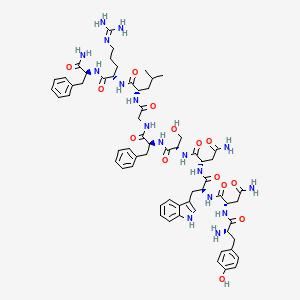
Kisspeptin-10 is filed in PubChem as CID 25240297, the record that CAS 374675-21-5 resolves to. Its ten residues read from the free amine of tyrosine to the amidated phenylalanine, and the tryptophan at position 3 and the two phenylalanines give the chain its large aromatic side chains.
PubChem has no computed 3D conformer for Kisspeptin-10, so no 3D ball-and-stick model is shown. The closest experimental 3D view is the receptor-bound peptide in the cryo-EM entry PDB 8ZJD.
Molecular Data
| Property | Value |
|---|---|
| CAS Registry Number | 374675-21-5 |
| PubChem CID | 25240297 |
| Molecular Formula | C63H83N17O14 |
| Molecular Weight | 1302.4 g/mol |
| Exact Mass | 1301.6305 Da |
| IUPAC Name | (2S)-N-[(2S)-1-[[(2S)-4-amino-1-[[(2S)-1-[[(2S)-1-[[2-[[(2S)-1-[[(2S)-1-[[(2S)-1-amino-1-oxo-3-phenylpropan-2-yl]amino]-5-(diaminomethylideneamino)-1-oxopentan-2-yl]amino]-4-methyl-1-oxopentan-2-yl]amino]-2-oxoethyl]amino]-1-oxo-3-phenylpropan-2-yl]amino]-3-hydroxy-1-oxopropan-2-yl]amino]-1,4-dioxobutan-2-yl]amino]-3-(1H-indol-3-yl)-1-oxopropan-2-yl]-2-[[(2S)-2-amino-3-(4-hydroxyphenyl)propanoyl]amino]butanediamide |
| InChIKey | RITKWYDZSSQNJI-INXYWQKQSA-N |
| SMILES | CC(C)C[C@@H](C(=O)N[C@@H](CCCN=C(N)N)C(=O)N[C@@H](CC1=CC=CC=C1)C(=O)N)NC(=O)CNC(=O)[C@H](CC2=CC=CC=C2)NC(=O)[C@H](CO)NC(=O)[C@H](CC(=O)N)NC(=O)[C@H](CC3=CNC4=CC=CC=C43)NC(=O)[C@H](CC(=O)N)NC(=O)[C@H](CC5=CC=C(C=C5)O)N |
| Molecular Class | Linear C-terminally amidated decapeptide (RF-amide peptide) |
| Sequence | Tyr-Asn-Trp-Asn-Ser-Phe-Gly-Leu-Arg-Phe-NH2 (YNWNSFGLRF-NH2) |
| Stereochemistry | 9 defined stereocenters (all L), 0 undefined |
| Computed XLogP3 | -1.9 |
| Topological Polar Surface Area | 538 Å2 |
| Hydrogen Bond Donors / Acceptors | 18 / 16 |
| Rotatable Bonds | 38 |
| UNII | FS1N52VS3S |
| Experimental Structure | KISS1R bound to Kisspeptin-10, cryo-EM, 3.06 Å (PDB 8ZJD) |
| Other Names | KP-10; metastin 45-54; Kisspeptin-13 (4-13) (human) |
| Form Described | Free peptide amide as listed by PubChem; supplied as a 10 mg lyophilized powder |
Published Numbers at a Glance
Each value below is printed in the cited source.
| Item | Detail | Source |
|---|---|---|
| Kisspeptin-54 length | 54 residues, C-terminally amidated, cleaved from a 145-residue gene product | Kirby 2010 |
| Kisspeptin-10 length | 10 residues; the smallest active fragment | Kirby 2010 |
| Key residues (Kisspeptin-13 numbering) | Phe9, Arg12, Phe13 (Phe6, Arg9, Phe10 in Kisspeptin-10) | Orsini 2007 |
| Helix in SDS micelles (NMR) | Residues 7 to 13 of Kisspeptin-13 | Orsini 2007 |
| Cleaved bond | Gly-Leu (Gly7-Leu8 in Kisspeptin-10), by matrix metalloproteinase | Tomita 2008 |
| KISS1R and Kisspeptin-10 complex | Cryo-EM, 3.06 Å resolution | PDB 8ZJD |
Research Timeline
- 1996The KiSS-1 cDNA is isolated by subtractive hybridization in a search for a gene on human chromosome 6 (Lee et al., 1996).
- 2001A 54-residue, C-terminally amidated peptide named metastin is isolated from human placenta as the ligand of the orphan receptor hOT7T175 (Ohtaki et al., 2001).
- 2001A human receptor named AXOR12 is cloned, and peptides from the KiSS-1 gene, all sharing a C-terminal amidated motif, activate it with high potency (Muir et al., 2001).
- 2001Peptides of 54, 14 and 13 residues with a common RF-amide end are named kisspeptins and shown to act on GPR54 (Kotani et al., 2001).
- 2006Alanine and D-amino acid scans of metastin (45-54) guide shorter analogs that keep high GPR54 agonist activity (Niida et al., 2006).
- 2007NMR shows a helix in the C-terminal half of Kisspeptin-13, and binding assays point to Phe, Arg and Phe on one face of it (Orsini et al., 2007).
- 2008Analogs with non-hydrolyzable Gly-Leu isosteres resist cleavage by MMP-9 while keeping receptor activity (Tomita et al., 2008).
- 2010A pharmacology nomenclature review recommends the name kisspeptin receptor and the gene name KISS1R (Kirby et al., 2010).
- 2024Cryo-EM structures show KISS1R bound to Kisspeptin-10 and to the analog TAK-448 (Shen et al., 2024).
How Does Kisspeptin-10 Activate the Kisspeptin Receptor?
Kisspeptin-10 binds KISS1R from the outside of the cell and switches on its Gq/11 partner. The activated G protein turns on phospholipase C, which splits PIP2 into inositol trisphosphate and diacylglycerol; inositol trisphosphate releases stored Ca2+, and diacylglycerol helps activate protein kinase C (Castaño et al., 2009).
The same receptor has been linked to ERK1/2 and p38 MAP kinase signaling, arachidonic acid release and PI3K/Akt activation in laboratory assays (Kotani et al., 2001), (Castaño et al., 2009). A 2024 study added a second G protein family, reporting that KISS1R can couple to Gi/o as well as Gq/11 (Wu et al., 2024).
Which parts of the peptide matter? Alanine scanning of the 13-residue kisspeptin found that Phe9, Arg12 and Phe13 are crucial, and NMR placed them on one face of a short helix (Orsini et al., 2007). In Kisspeptin-10 those are Phe6, Arg9 and Phe10, all in the C-terminal half. The cryo-EM structures show the peptide reaching the receptor’s extracellular loops, which the authors describe as key contacts for activation (Shen et al., 2024).
Kisspeptin-10 vs Kisspeptin-54: What Is the Difference?
Kisspeptin-10 is the last ten residues of kisspeptin-54, so the two share the receptor-binding end and differ in length.
| Property | Kisspeptin-10 | Kisspeptin-54 |
|---|---|---|
| Length | 10 residues | 54 residues |
| C-terminus | Arg-Phe amide | Arg-Phe amide |
| Relationship | Residues 45 to 54 of kisspeptin-54 | Full-length cleavage product |
| Receptor | KISS1R (GPR54) | KISS1R (GPR54) |
| Cryo-EM complex | PDB 8ZJD (Shen 2024) | Reported by Wu 2024 |
| PubChem record | CID 25240297 | not covered here |
Because the amidated C-terminus is the part that both forms share, many structure-activity studies start from the short decapeptide and change one residue at a time (Niida et al., 2006). One weak point studied this way is the Gly-Leu bond, which matrix metalloproteinases can cut (Tomita et al., 2008).
Why Does Kisspeptin-10 Have So Many Names?
Kisspeptin-10 picked up names from each lab that met it. The Takeda group called the 54-residue peptide metastin, so the decapeptide is also written metastin 45-54 (Ohtaki et al., 2001). Another group named the same family kisspeptins (Kotani et al., 2001), and the receptor was reported as GPR54, AXOR12 and hOT7T175 before the name KISS1R was recommended (Kirby et al., 2010).
PubChem also lists the decapeptide as Kisspeptin-13 (4-13), and separate records exist for salt forms and labeled versions. The safest way to match a sample to its record is by CAS 374675-21-5, CID 25240297 and InChIKey RITKWYDZSSQNJI-INXYWQKQSA-N, rather than by a name alone.
What Format Is Kisspeptin-10 Supplied In?
Modern Aminos lists Kisspeptin-10 as a 10 mg lyophilized powder in a glass vial. Details are on the Kisspeptin-10 product page.
Related Research Tools
- Oxytocin, a cyclic nonapeptide: What Is Oxytocin? Cyclic Nonapeptide
- Hexarelin (Examorelin): What Is Hexarelin?
- CJC-1295 No DAC and Ipamorelin: What Is CJC-1295 No DAC and Ipamorelin?
- Enclomiphene: What Is Enclomiphene?
- Gonadorelin (GnRH), an amidated decapeptide at the GnRH receptor
- TAK-448, a synthetic Kisspeptin-10 analog used in KISS1R structure work
References
- Lee JH, Miele ME, Hicks DJ, et al. KiSS-1, a novel human malignant melanoma metastasis-suppressor gene. J Natl Cancer Inst. 1996;88(23):1731-1737. PMID 8944003
- Ohtaki T, Shintani Y, Honda S, et al. Metastasis suppressor gene KiSS-1 encodes peptide ligand of a G-protein-coupled receptor. Nature. 2001;411(6837):613-617. PMID 11385580
- Muir AI, Chamberlain L, Elshourbagy NA, et al. AXOR12, a novel human G protein-coupled receptor, activated by the peptide KiSS-1. J Biol Chem. 2001;276(31):28969-28975. PMID 11387329
- Kotani M, Detheux M, Vandenbogaerde A, et al. The metastasis suppressor gene KiSS-1 encodes kisspeptins, the natural ligands of the orphan G protein-coupled receptor GPR54. J Biol Chem. 2001;276(37):34631-34636. PMID 11457843
- Niida A, Wang Z, Tomita K, et al. Design and synthesis of downsized metastin (45-54) analogs with maintenance of high GPR54 agonistic activity. Bioorg Med Chem Lett. 2006;16(1):134-137. PMID 16242330
- Orsini MJ, Klein MA, Beavers MP, et al. Metastin (KiSS-1) mimetics identified from peptide structure-activity relationship-derived pharmacophores and directed small molecule database screening. J Med Chem. 2007;50(3):462-471. PMID 17266198
- Tomita K, Oishi S, Ohno H, et al. Development of novel G-protein-coupled receptor 54 agonists with resistance to degradation by matrix metalloproteinase. J Med Chem. 2008;51(23):7645-7649. PMID 19007202
- Castaño JP, Martínez-Fuentes AJ, Gutiérrez-Pascual E, et al. Intracellular signaling pathways activated by kisspeptins through GPR54: do multiple signals underlie function diversity? Peptides. 2009;30(1):10-15. PMID 18775460
- Kirby HR, Maguire JJ, Colledge WH, Davenport AP. International Union of Basic and Clinical Pharmacology. LXXVII. Kisspeptin receptor nomenclature, distribution, and function. Pharmacol Rev. 2010;62(4):565-578. PMC2993257
- Shen S, Wang D, Liu H, et al. Structural basis for hormone recognition and distinctive Gq protein coupling by the kisspeptin receptor. Cell Rep. 2024;43(7):114389. PMID 38935498
- Wu Z, Chen G, Qiu C, et al. Structural basis for the ligand recognition and G protein subtype selectivity of kisspeptin receptor. Sci Adv. 2024;10(33):eadn7771. PMC11328905
- RCSB Protein Data Bank. Entry 8ZJD: cryo-EM structure of kisspeptin receptor bound to KP-10. rcsb.org/structure/8ZJD
- National Center for Biotechnology Information. PubChem Compound Summary for CID 25240297, Kisspeptin-10. pubchem.ncbi.nlm.nih.gov/compound/25240297
- National Center for Biotechnology Information. PubChem Compound Summary for CID 638793, Gonadorelin. pubchem.ncbi.nlm.nih.gov/compound/638793
Frequently Asked Questions
What Is Kisspeptin-10?
Kisspeptin-10 is a ten-residue peptide amide, Tyr-Asn-Trp-Asn-Ser-Phe-Gly-Leu-Arg-Phe-NH2, with CAS number 374675-21-5 and molecular weight 1302.4 g/mol. It is the shortest active kisspeptin and an agonist of the kisspeptin receptor, KISS1R.
What Is the Amino Acid Sequence of Kisspeptin-10?
In three-letter code it is Tyr-Asn-Trp-Asn-Ser-Phe-Gly-Leu-Arg-Phe-NH2; in one-letter code it is YNWNSFGLRF-NH2. The chain ends in an amide rather than a free acid.
Is Kisspeptin-10 the Same as Kisspeptin?
Kisspeptin is a family name. Kisspeptin-54, -14, -13 and -10 all come from the same gene product and share the same C-terminal end, and Kisspeptin-10 is the shortest of them.
What Receptor Does Kisspeptin-10 Act On?
It acts on the kisspeptin receptor, KISS1R, which older papers call GPR54, AXOR12 or hOT7T175. The receptor couples mainly to Gq/11 and phospholipase C (Kirby et al., 2010).
What Is the Difference Between Kisspeptin-10 and Gonadorelin?
Both are amidated decapeptides, but their sequences are unrelated and they act at different receptors. Gonadorelin is the GnRH decapeptide (PubChem CID 638793) and binds the GnRH receptor, while Kisspeptin-10 binds KISS1R.
Why Is Kisspeptin-10 Called Metastin 45-54?
The full 54-residue peptide was first named metastin (Ohtaki et al., 2001). Kisspeptin-10 matches residues 45 to 54 of that chain, so metastin 45-54 describes the same ten residues.
Warning: Cannot modify header information – headers already sent by (output started at phar:///usr/local/bin/wp-cli/vendor/wp-cli/wp-cli/php/class-wp-cli.php:1058) in /srv/htdocs/wp-content/mu-plugins/nocache.php on line 53