
What Is Oxiracetam?
Oxiracetam is 4-hydroxypiracetam, 2-(4-hydroxy-2-oxopyrrolidin-1-yl)acetamide, with CAS number 62613-82-5, the formula C6H10N2O3 and a molecular weight of 158.16 g/mol. It is piracetam with one extra hydroxyl group, which makes it more polar and gives it a stereocenter. In neuronal cell cultures it acts as a positive modulator of AMPA receptor signaling, though its direct binding site has never been mapped.
Chemical Identity of Oxiracetam
Oxiracetam is built on a 2-pyrrolidinone, a five-membered cyclic amide (lactam). An acetamide group, -CH2C(=O)NH2, hangs off the ring nitrogen, exactly as in piracetam. The difference is a hydroxyl group on carbon 4, two atoms away from the lactam carbonyl. PubChem gives the formal name 2-(4-hydroxy-2-oxopyrrolidin-1-yl)acetamide and the InChIKey IHLAQQPQKRMGSS-UHFFFAOYSA-N (PubChem CID 4626).
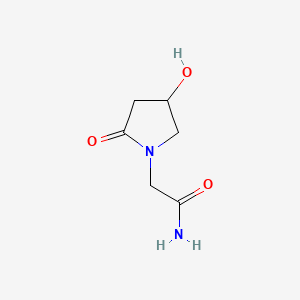
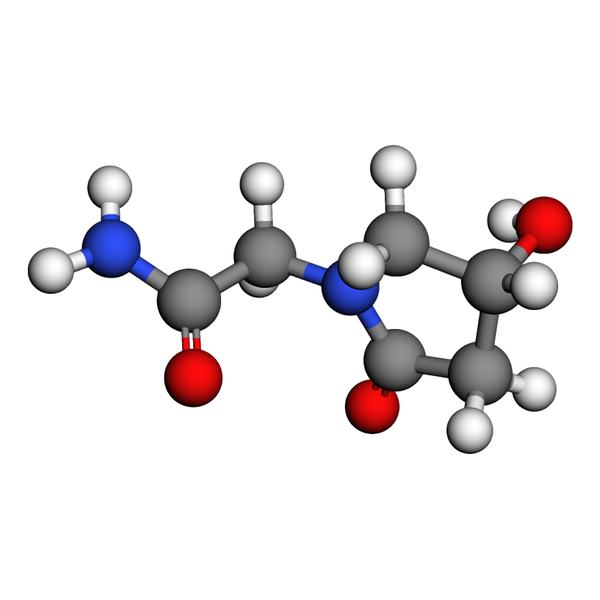
That hydroxyl does three things. It adds a second hydrogen bond donor, alongside the amide NH2. It drops the computed XLogP3 from −1.3 for piracetam to −2.2, making oxiracetam very water-loving. And it turns carbon 4 into a stereocenter.
When Oxiracetam and its 4-acyloxy and 4-alkoxy analogues were first made as cyclic GABA-GABOB analogues, the chemists had to develop a special N-alkylation procedure because 4-hydroxy-2-pyrrolidinones are base-labile (Pellegata et al., 1981). Analytically, the molecule’s polarity and lack of an aromatic ring shape the methods: a validated HPLC method for (S)-oxiracetam and four related substances used an amino (NH2) column, acetonitrile-water 95:5 at pH 2.0 and UV detection at 210 nm (Wang et al., 2020). The enantiomers can be separated on a cellulose-based chiral stationary phase (Camilleri et al., 1991).
Molecular Data
| Property | Value |
|---|---|
| CAS Registry Number | 62613-82-5; 68252-28-8 ((R)-enantiomer); 88929-35-5 ((S)-enantiomer) |
| PubChem CID | 4626 ; 3051965 (4R); 6603951 (4S) |
| Molecular formula | C6H10N2O3 |
| Molecular weight | 158.16 g/mol |
| Exact (monoisotopic) mass | 158.0691 Da |
| IUPAC name | 2-(4-hydroxy-2-oxopyrrolidin-1-yl)acetamide |
| InChIKey | IHLAQQPQKRMGSS-UHFFFAOYSA-N |
| SMILES | C1C(CN(C1=O)CC(=O)N)O |
| Molecular class | Small molecule: racetam, a 2-pyrrolidinone (cyclic amide, gamma-lactam) with an N-acetamide side chain and a 4-hydroxyl group |
| Form described | Neutral free compound (no salt); PubChem CID 4626 |
| Other names | Hydroxypiracetam; 4-hydroxypiracetam; ISF 2522; CT-848; CGP 21690E |
| Stereochemistry | One stereocenter (carbon 4), undefined in CID 4626 and defined in the two enantiomer records |
| Enantiomer InChIKeys | (R) IHLAQQPQKRMGSS-SCSAIBSYSA-N; (S) IHLAQQPQKRMGSS-BYPYZUCNSA-N |
| Enantiomer SMILES | (R) C1[C@H](CN(C1=O)CC(=O)N)O; (S) C1[C@@H](CN(C1=O)CC(=O)N)O |
| Computed properties | XLogP3 −2.2; topological polar surface area 83.6 Å2; 2 hydrogen-bond donors, 3 acceptors; 2 rotatable bonds; 11 heavy atoms; formal charge 0 |
Oxiracetam and AMPA Receptors: The Research Picture
For decades the racetams were studied without a clear target: surveys of the class found no affinity for adrenergic, muscarinic, serotonin, dopamine, adenosine A1, mu-opioid, GABA, benzodiazepine or glutamate receptor binding sites, and no generally accepted mechanism (Gouliaev and Senning, 1994). The strongest lead that emerged was the AMPA receptor, the fast excitatory glutamate receptor.
Step 1: The receptor and its dimer interface. AMPA receptors are glutamate-gated ion channels. Their ligand-binding domains pair up into dimers, and allosteric modulators bind at the interface between the two halves, stabilizing the dimer and reducing desensitization and deactivation (Ahmed and Oswald, 2010).
Step 2: Where racetams sit. Crystal structures of the GluA2 and GluA3 ligand-binding domains show aniracetam in one symmetrical site at the center of the dimer interface, while piracetam occupies several low-occupancy sites along it, one of them a previously unknown site. Both drugs bound GluA2 and GluA3 in a very similar way, suggesting little subunit specificity (Ahmed and Oswald, 2010). Oxiracetam was not part of that study, so its binding pose is still an open question.
Step 3: The readout in cultured neurons. In primary neuronal cultures, micromolar oxiracetam, piracetam and aniracetam enhanced AMPA-stimulated 45Ca2+ influx. They raised AMPA’s efficacy but not its potency, and the effect held in the presence of the L-type calcium channel blocker. Oxiracetam left kainate- and NMDA-stimulated influx unchanged, and all three drugs increased the maximal density of [3H]AMPA binding sites in synaptic membranes (Copani et al., 1992).
Step 4: What this means for assay design. Because oxiracetam changed efficacy rather than potency, the effect shows up as a bigger maximal response to AMPA, not a shifted concentration-response curve. Kainate and NMDA responses make natural specificity controls, and piracetam is the obvious structural control, since it differs from oxiracetam by a single oxygen atom.
Research Timeline
- 1981Synthesis and biochemical activity of new alkyl and acyl derivatives of 4-hydroxy-2-pyrrolidinone, the ring system of Oxiracetam, are reported in a series on cyclic GABA-GABOB analogues (Pellegata et al., 1981).
- 1989In a Fenton-type system generating hydroxyl radicals, Piracetam and Oxiracetam give no protection against protein insolubilization (Pavlík and Pilar, 1989).
- 1991Molecular modelling and the chromatographic behaviour of Oxiracetam and closely related molecules are studied, including separation of the enantiomers on a cellulose-based chiral stationary phase (Camilleri et al., 1991).
- 1992In primary neuronal cultures, oxiracetam enhances AMPA-stimulated 45Ca2+ influx, raising efficacy but not potency, and leaves kainate- and NMDA-stimulated influx unchanged (Copani et al., 1992).
- 1994A review of piracetam and structurally related compounds reports no affinity for the classic neurotransmitter receptor binding sites (Gouliaev and Senning, 1994).
- 1999In cultured astrocytes, two weeks at 10−7 M Oxiracetam raises ATP content and changes cell shape (Gabryel et al., 1999).
- 2010Crystal structures place Piracetam and Aniracetam at the AMPA receptor ligand-binding domain dimer interface; Oxiracetam is not part of the study (Ahmed and Oswald, 2010).
- 2020A validated HPLC method separates (S)-Oxiracetam from four related substances on an amino column (Wang et al., 2020).
Assay Data
| Item | Detail | Source |
|---|---|---|
| AMPA-stimulated 45Ca2+ influx | Enhanced at micromolar concentrations (efficacy, not potency) | Copani 1992 |
| Kainate / NMDA-stimulated influx | No change | Copani 1992 |
| Astrocyte ATP content (10−7 M, 2 weeks) | Increased | Gabryel 1999 |
| Hydroxyl-radical protein protection | No effect (Fenton system) | Pavlík 1989 |
Oxiracetam is a small, very polar molecule whose best-documented in-vitro action is selective, efficacy-type enhancement of AMPA receptor signaling. It is not a radical scavenger: in a Fenton-type system generating hydroxyl radicals, Piracetam and Oxiracetam gave no protection against protein insolubilization (Pavlík and Pilar, 1989). In cultured astrocytes, long exposure at 10−7 M raised ATP content and changed cell shape (Gabryel et al., 1999).
Why Not Piracetam or Aniracetam for the Same Question?
Piracetam (C6H10N2O2, 142.16 g/mol, CAS 7491-74-9) is the parent: the same lactam and acetamide, minus the hydroxyl, and achiral. It is the cleanest control for asking what the 4-hydroxyl adds, and it is the racetam with a solved binding pose at the AMPA receptor dimer interface (Ahmed and Oswald, 2010).
Aniracetam (C12H13NO3, 219.24 g/mol, CAS 72432-10-1) swaps the acetamide for a 4-methoxybenzoyl group on the ring nitrogen. That makes it lipophilic (XLogP3 1.6), adds an aromatic ring and removes every hydrogen bond donor. It is the best-characterized racetam at AMPA receptors: it increased the peak amplitude and slowed the decay of AMPA- or quisqualate-evoked currents (Nicoletti et al., 1992) and sits at the center of the dimer interface in crystal structures (Ahmed and Oswald, 2010). Oxiracetam is the choice when the question is about polarity, stereochemistry or the hydroxyl group itself; aniracetam is the choice when a structurally defined AMPA modulator is needed.
Oxiracetam Format at Modern Aminos
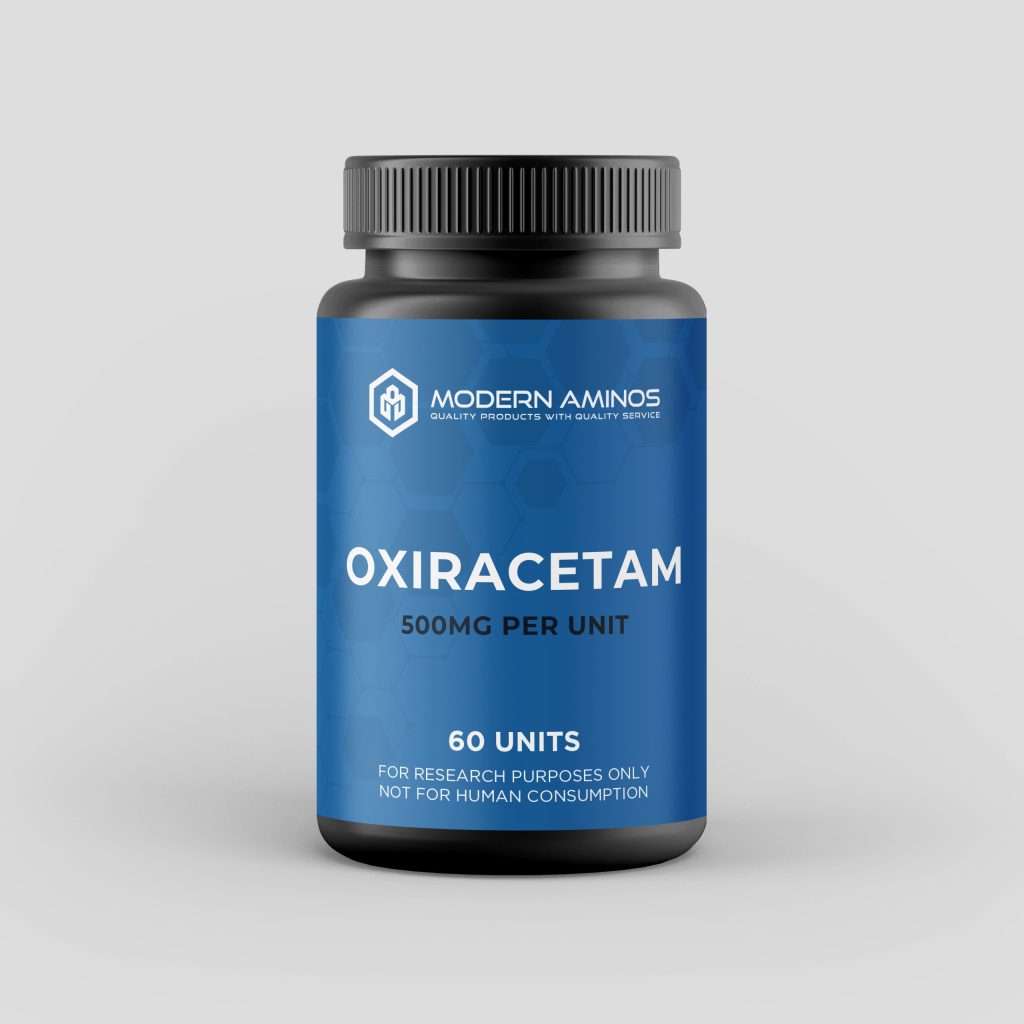
Modern Aminos supplies Oxiracetam as 500 mg capsules, 60 capsules per bottle.
Related Research Tools
References
- Pellegata R, Pinza M, Pifferi G, Gaiti A, Mozzi R, Tirillini B, et al. Cyclic GABA-GABOB analogues. III: Synthesis and biochemical activity of new alkyl and acyl derivatives of 4-hydroxy-2-pyrrolidinone. Farmaco Sci. 1981;36(10):845-855. PMID 7308456
- Copani A, Genazzani AA, Aleppo G, Casabona G, Canonico PL, Scapagnini U, et al. Nootropic drugs positively modulate alpha-amino-3-hydroxy-5-methyl-4-isoxazolepropionic acid-sensitive glutamate receptors in neuronal cultures. J Neurochem. 1992;58(4):1199-1204. PMID 1372342
- Nicoletti F, Casabona G, Genazzani AA, Copani A, Aleppo G, Canonico PL, et al. Excitatory amino acids and neuronal plasticity: modulation of AMPA receptors as a novel substrate for the action of nootropic drugs. Funct Neurol. 1992;7(5):413-422. PMID 1338053
- Gouliaev AH, Senning A. Piracetam and other structurally related nootropics. Brain Res Brain Res Rev. 1994;19(2):180-222. PMID 8061686
- Ahmed AH, Oswald RE. Piracetam defines a new binding site for allosteric modulators of alpha-amino-3-hydroxy-5-methyl-4-isoxazole-propionic acid (AMPA) receptors. J Med Chem. 2010;53(5):2197-2203. PMC2872987
- Gabryel B, Trzeciak HI, Pudełko A, Cieślik P. Influence of piracetam and oxiracetam on the content of high-energy phosphates and morphometry of astrocytes in vitro. Pol J Pharmacol. 1999;51(6):485-495. PMID 10817526
- Pavlík A, Pilar J. Protection of cell proteins against free-radical attack by nootropic drugs: scavenger effect of pyritinol confirmed by electron spin resonance spectroscopy. Neuropharmacology. 1989;28(6):557-561. PMID 2547179
- Camilleri P, Murphy JA, Saunders MR, Thorpe CJ. Molecular modelling studies and the chromatographic behaviour of oxiracetam and some closely related molecules. J Comput Aided Mol Des. 1991;5(4):277-284. PMID 1795177
- Wang C, Dong H, Liu H, Sun Z, Yuan A, Wu J, et al. Using HPLC to analyze (S)-oxiracetam and four related substances in the bulk drug of (S)-oxiracetam. J Pharm Biomed Anal. 2020;180:113072. PMID 31891873
- National Center for Biotechnology Information. PubChem Compound Summaries for CID 4626 (oxiracetam), CIDs 3051965 and 6603951 (enantiomers), CID 4843 (piracetam) and CID 2196 (aniracetam). CID 4626, CID 4843, CID 2196
Frequently Asked Questions
What Is Oxiracetam?
Oxiracetam is 2-(4-hydroxy-2-oxopyrrolidin-1-yl)acetamide, also called 4-hydroxypiracetam, ISF 2522 or CT-848. It has CAS number 62613-82-5, the formula C6H10N2O3 and a molecular weight of 158.16 g/mol. It is piracetam with a hydroxyl group on carbon 4 of the 2-pyrrolidinone ring.
Is Oxiracetam a Racetam?
Yes! Oxiracetam is a small cyclic amide, a 2-pyrrolidinone ring with an acetamide side chain. However, since it contains no amino acid residues joined by peptide bonds, it’s not considered a peptide.
How Does Oxiracetam Work?
Its direct molecular target is not established. In neuronal cell cultures it enhanced AMPA-stimulated calcium influx, raising efficacy but not potency, without changing kainate or NMDA responses (Copani et al., 1992). Racetams show no affinity for the classic neurotransmitter receptor binding sites (Gouliaev and Senning, 1994).
What Is Oxiracetam Used for in Research?
In the published laboratory record, oxiracetam appears as a test compound in cultured-neuron calcium influx assays (Copani et al., 1992) and in astrocyte culture assays of ATP content and cell shape (Gabryel et al., 1999), as a negative result in a Fenton-type radical assay (Pavlík and Pilar, 1989), and as an analyte in HPLC and chiral separation methods (Wang et al., 2020; Camilleri et al., 1991). Each is an assay readout in a defined system.
Oxiracetam vs. Piracetam: What Is the Difference?
Piracetam (C6H10N2O2, 142.16 g/mol, CAS 7491-74-9) has the same lactam and acetamide without the 4-hydroxyl group and is achiral. The hydroxyl lowers the computed XLogP3 from -1.3 to -2.2 and adds a stereocenter. Piracetam has a solved binding pose at the AMPA receptor dimer interface (Ahmed and Oswald, 2010); Oxiracetam’s has not been mapped.
Oxiracetam vs. Aniracetam: What Is the Difference?
Oxiracetam carries an acetamide and a 4-hydroxyl group and is very polar, with an XLogP3 of -2.2. Aniracetam carries a 4-methoxybenzoyl group on the ring nitrogen and is lipophilic, with an XLogP3 of 1.6. Aniracetam binds the center of the AMPA receptor dimer interface in crystal structures.
Is Oxiracetam Chiral?
Yes. Carbon 4 of the ring is a stereocenter. PubChem CID 4626 leaves it undefined, while (R)-oxiracetam is CID 3051965 (CAS 68252-28-8) and (S)-oxiracetam is CID 6603951 (CAS 88929-35-5).
What Is the Dosing for Oxiracetam?
Unfortunately, we are not able to provide dosing instructions for individual research applications. This is outlined in the research documentation ‘materials and methods’ section, and should be documented prior to beginning any research with your reference materials.