
What Is Chonluten? The Glu-Asp-Gly (EDG) Tripeptide Explained

Chonluten is the tripeptide Glu-Asp-Gly, written EDG in one-letter code: L-Glutamic acid, then L-Aspartic acid, then Glycine. PubChem lists it as CID 194641 (CAS 75007-24-8), with the formula C11H17N3O8 and a molecular weight of 319.27 g/mol. In a 2023 docking survey of 26 short peptides, it scored second best at the LAT1 amino acid transporter.
What Is Vilon? The Lys-Glu (KE) Dipeptide Explained
Vilon is the dipeptide Lys-Glu, written KE in one-letter code: one L-Lysine joined to one L-Glutamic acid. PubChem lists it as CID 7010502, with the formula C11H21N3O5 and a molecular weight of 275.30 g/mol. Unlike most short bioregulators, it has measured data at PEPT1, the transporter built for di- and tripeptides.
What Is Cartalax? The Ala-Glu-Asp (AED) Tripeptide Explained

Cartalax is a short synthetic peptide, the tripeptide Ala-Glu-Asp, written AED in one-letter code. PubChem lists it as CID 87815447, with the formula C12H19N3O8 and a molecular weight of 333.29 g/mol, and its published record is computational: docking at a short DNA sequence and at amino acid and peptide transporters.
Cardiogen vs Cartalax (and Chonluten vs Bronchogen): Bioregulator Sequences Compared
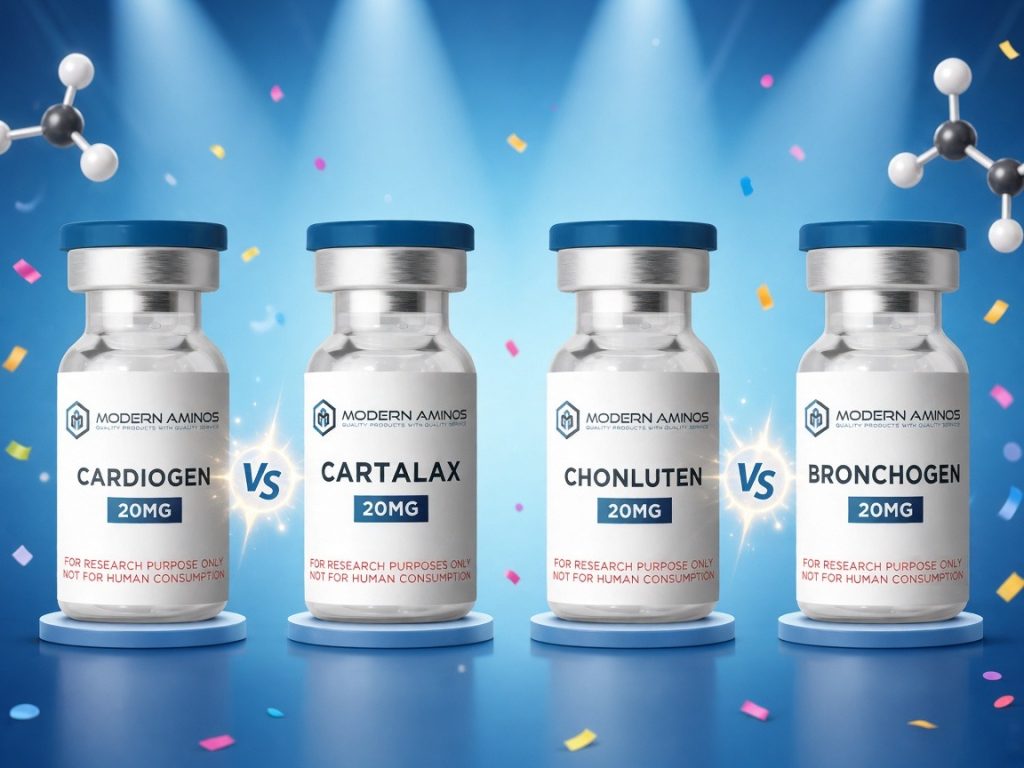
Cardiogen is Ala-Glu-Asp-Arg (AEDR; PubChem CID 11583989). Cartalax is Ala-Glu-Asp (AED; CID 87815447). They share an N-terminal AED motif; Cardiogen adds C-terminal Arg.
What Is Cerluten A-5? Peptide Bioregulator Complex Explained
Cerluten A-5 is a tissue-derived peptide bioregulator complex associated with brain and CNS research materials in the Khavinson programme. It is not a single defined molecule, and it has no verified PubChem CID or CAS number under the name Cerluten.
What Is Bronchogen? The Ala-Glu-Asp-Leu (AEDL) Tetrapeptide Explained

Bronchogen is a short synthetic peptide, the tetrapeptide Ala-Glu-Asp-Leu, written AEDL in one-letter code. Its best-documented chemistry is a modest stabilizing effect on DNA: in calorimetry it raised the DNA melting temperature by 3.1 °C.
What Is Livagen? The Lys-Glu-Asp-Ala (KEDA) Tetrapeptide Explained
Livagen is a short synthetic peptide, the tetrapeptide Lys-Glu-Asp-Ala, written KEDA in one-letter code. It is C18H31N5O9, 461.5 g/mol, with its own PubChem record (CID 87919683).
What Is Cardiogen? The Ala-Glu-Asp-Arg (AEDR) Tetrapeptide Explained

Cardiogen is a short synthetic peptide, the tetrapeptide Ala-Glu-Asp-Arg, written AEDR in one-letter code. It is C18H31N7O9, 489.5 g/mol, with its own PubChem record (CID 11583989).
What Is Prostamax? The Lys-Glu-Asp-Pro (KEDP) Tetrapeptide Explained
Prostamax is a short synthetic peptide, the tetrapeptide Lys-Glu-Asp-Pro, written KEDP in one-letter code. It is C20H33N5O9, 487.5 g/mol, with its own PubChem record (CID 9848296) and CAS number (473578-47-1). It shares its first three residues with Livagen and its first two with Vilon, and the published work on its sequence is about chemistry: how mixed-charge peptides change DNA stability and how well short peptides fit transporter binding sites in computer docking.
What Is Pinealon? The Glu-Asp-Arg (EDR) Tripeptide Explained
Pinealon is the synthetic tripeptide Glu-Asp-Arg, often written EDR, with CAS number 175175-23-2 and a molecular weight of 418.40 g/mol. It is three amino acids, glutamic acid, aspartic acid, and arginine, linked into one small and highly polar peptide. In laboratory studies it binds DNA, partly entering the major groove and touching guanine atoms, and it also binds histone proteins.