

What Is AICAR?
AICAR is acadesine, also called AICA riboside: a small nucleoside, not a peptide, built from an aminoimidazole carboxamide base and a ribose sugar. Its formula is C9H14N4O5, its molecular weight is 258.23 g/mol, and its CAS number is 2627-69-2. Once a phosphate is added to its 5′ carbon it becomes ZMP, which imitates AMP and switches on AMP-activated protein kinase (AMPK) (Corton et al., 1995).
Chemical Identity of AICAR
Think of this table as a map. Nicknames drift from paper to paper, but a CAS number and an InChIKey point to one exact structure.
| Item | Detail | Source |
|---|---|---|
| CAS | 2627-69-2 | PubChem |
| PubChem CID / ChEBI | 17513 / CHEBI:28498 | PubChem; ChEBI |
| Formula | C9H14N4O5 | PubChem |
| Molecular weight | 258.23 g/mol | PubChem |
| InChIKey | RTRQQBHATOEIAF-UUOKFMHZSA-N | PubChem |
| Active form | ZMP (5′-monophosphate), formed by adenosine kinase | Sabina 1985 |
| AMPK stimulation by ZMP | Up to 10-fold; half-maximal at approximately 5 mM (purified hepatic enzyme) | Henin 1995 |
| Fructose-1,6-bisphosphatase, ZMP apparent Ki | 370 µM | Vincent 1991 |
The molecule in the vial and the molecule that touches the kinase are not quite the same thing. AICAR carries the shape; ZMP, its phosphorylated form, does the work, and it needs millimolar levels to fully stimulate AMPK in an enzyme assay.
Molecular Data
| Property | Value |
|---|---|
| CAS# | 2627-69-2 |
| PubChem ID | CID 17513 |
| Molecular Formula | C9H14N4O5 |
| Molecular Weight | 258.23 g/mol |
| Exact Mass | 258.0964 Da |
| IUPAC Name | 5-amino-1-[(2R,3R,4S,5R)-3,4-dihydroxy-5-(hydroxymethyl)oxolan-2-yl]imidazole-4-carboxamide |
| InChIKey | RTRQQBHATOEIAF-UUOKFMHZSA-N |
| SMILES | C1=NC(=C(N1[C@H]2[C@@H]([C@@H]([C@H](O2)CO)O)O)N)C(=O)N |
| Molecular Class | Small molecule (non-peptide); imidazole carboxamide ribonucleoside (AICA riboside), cell-permeable precursor of the AMP mimetic ZMP |
| Stereocenters | 4 defined, 0 undefined |
| Hydrogen bond donors / acceptors | 5 / 7 |
| XLogP3 (computed) | -2.2 |
Values from PubChem CID 17513 (computed by PubChem).
AICAR vs. ZMP: Side-by-Side
| Property | AICAR (acadesine) | ZMP (AICA ribotide) |
|---|---|---|
| CAS | 2627-69-2 | 3031-94-5 |
| PubChem CID / ChEBI | 17513 / CHEBI:28498 | 65110 / CHEBI:18406 |
| Formula / MW | C9H14N4O5 / 258.23 g/mol | C9H15N4O8P / 338.21 g/mol |
| Chemical class | Ribonucleoside (no phosphate) | Ribonucleotide (5′-phosphate) |
| Target | None directly; converted to ZMP | AMPK γ-subunit CBS domains; ATIC |
| Key assay value | not reported for the nucleoside itself | AMPK up to 10-fold, half-maximal near 5 mM (Henin 1995) |
The only chemical difference is one phosphate group, but it changes the CAS number, the PubChem record, the molecular weight by about 80 g/mol, and the molecule’s job. Data for one form should not be quietly copied onto the other.
Reading the Structure
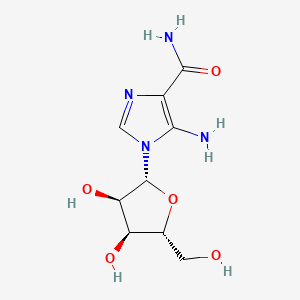
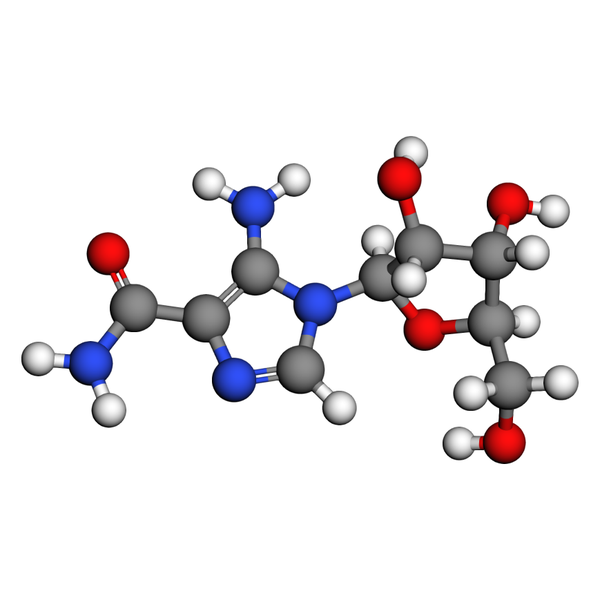
Let’s read the molecule from left to right. On one side is a five-membered imidazole ring carrying an amino group at position 5 and a carboxamide at position 4; chemists call this base AICA. On the other side is β-D-ribose, the same sugar found in RNA, attached to the ring nitrogen. The PubChem IUPAC name, 5-amino-1-[(2R,3R,4S,5R)-3,4-dihydroxy-5-(hydroxymethyl)oxolan-2-yl]imidazole-4-carboxamide, spells out four fixed stereocenters on that sugar, and the InChIKey RTRQQBHATOEIAF-UUOKFMHZSA-N captures that exact three-dimensional shape (PubChem CID 17513; CHEBI:28498).
If that base looks familiar, it should. AICA is an open, unfinished version of the purine ring. In the purine biosynthesis pathway, its ribotide is formylated and then closed into IMP, the parent of AMP and GMP. That family resemblance is exactly why ZMP can pass for AMP at a nucleotide-binding site.
How the Molecule Engages Its Target
First, adenosine kinase adds a phosphate to AICAR’s 5′-hydroxyl. Sabina and colleagues found that the nucleoside is phosphorylated this way rather than broken down by phosphorolysis, so ZMP is its main product (Sabina et al., 1985).
Second, ZMP finds the energy sensor. AMPK’s γ subunit carries pairs of CBS domains that bind adenine nucleotides. In the mammalian regulatory fragment, two of those sites bind either AMP or Mg·ATP, and a third holds an AMP that does not exchange (Xiao et al., 2007). A crystal structure of a human γ1 CBS-domain pair was solved with AMP and, separately, with ZMP, showing the look-alike in the same pocket (Day et al., 2007).
Third, the kinase responds. In the classic 1995 work from the Hardie laboratory, ZMP mimicked both activating effects of AMP: it activated AMPK allosterically and made it a better substrate for the upstream AMPK kinase (Corton et al., 1995). With purified hepatic AMPK, the stimulation reached about 10-fold, with a half-maximal effect near 5 mM (Henin et al., 1995).
There is an honest footnote. Because ZMP looks like a purine nucleotide, other enzymes notice it too. It is the natural substrate of AICAR transformylase, one half of the bifunctional enzyme ATIC, solved at 1.75 Å (Greasley et al., 2001), and it inhibits fructose-1,6-bisphosphatase with an apparent Ki of 370 µM (Vincent et al., 1991). Reviews therefore ask researchers to read AICAR results with care (Guigas et al., 2009; Višnjić et al., 2021).
Naming Traps and Look-Alike Records
This is the part that trips people up. “AICAR” is used for two different molecules. Many papers, including Corton and colleagues, use it for the nucleoside, acadesine. Older enzyme papers use “AICAR” for the ribotide and write “AICA riboside” for the nucleoside (Henin et al., 1995; Vincent et al., 1991). Even the enzyme name “AICAR transformylase” refers to the ribotide.
Databases reflect the same split. A PubChem name search for “AICAR” returns CID 65110, AICA ribotide, while acadesine is CID 17513. Other names you may meet for the nucleoside include AICA ribonucleoside, Z-riboside, GP-1-110 and ARA-100. The safe habit is simple: check the CAS number (2627-69-2 for the nucleoside) or the InChIKey before you trust a data point.
Formats, Testing, and Documentation
All applicable tests are performed on our products. Modern Aminos supplies AICAR as 50 mg of lyophilized powder in a 2R glass vial. For the current lot, Freedom Diagnostics reports chemical analysis by HPLC with UV detection coupled with mass spectrometry, with mass identification as AICAR, and a USP <85> endotoxin test with both replicates passing. Current reports can be found through the COA search, and the product button above opens the AICAR listing.
Related Research Tools
References
- Corton JM, Gillespie JG, Hawley SA, Hardie DG. 5-aminoimidazole-4-carboxamide ribonucleoside. A specific method for activating AMP-activated protein kinase in intact cells? Eur J Biochem. 1995;229(2):558-65. PMID 7744080
- Henin N, Vincent MF, Gruber HE, Van den Berghe G. Inhibition of fatty acid and cholesterol synthesis by stimulation of AMP-activated protein kinase. FASEB J. 1995;9(7):541-6. PMID 7737463
- Sabina RL, Patterson D, Holmes EW. 5-Amino-4-imidazolecarboxamide riboside (Z-riboside) metabolism in eukaryotic cells. J Biol Chem. 1985;260(10):6107-14. PMID 3997815
- Day P, Sharff A, Parra L, et al. Structure of a CBS-domain pair from the regulatory gamma1 subunit of human AMPK in complex with AMP and ZMP. Acta Crystallogr D Biol Crystallogr. 2007;63(Pt 5):587-96. PMID 17452784
- Xiao B, Heath R, Saiu P, et al. Structural basis for AMP binding to mammalian AMP-activated protein kinase. Nature. 2007;449(7161):496-500. PMID 17851531
- Greasley SE, Horton P, Ramcharan J, et al. Crystal structure of a bifunctional transformylase and cyclohydrolase enzyme in purine biosynthesis. Nat Struct Biol. 2001;8(5):402-6. PMID 11323713
- Vincent MF, Marangos PJ, Gruber HE, Van den Berghe G. Inhibition by AICA riboside of gluconeogenesis in isolated rat hepatocytes. Diabetes. 1991;40(10):1259-66. PMID 1657665
- Guigas B, Sakamoto K, Taleux N, et al. Beyond AICA riboside: in search of new specific AMP-activated protein kinase activators. IUBMB Life. 2009;61(1):18-26. PMC2845387
- Višnjić D, Lalić H, Dembitz V, Tomić B, Smoljo T. AICAr, a widely used AMPK activator with important AMPK-independent effects: a systematic review. Cells. 2021;10(5):1095. PMC8147799
- National Center for Biotechnology Information. PubChem Compound Summary for CID 17513, Acadesine. pubchem.ncbi.nlm.nih.gov/compound/17513
- National Center for Biotechnology Information. PubChem Compound Summary for CID 65110, AICA Ribotide. pubchem.ncbi.nlm.nih.gov/compound/65110
- ChEBI. CHEBI:28498, acadesine. ebi.ac.uk/chebi/CHEBI:28498
Frequently Asked Questions
What Is AICAR?
AICAR is acadesine, also called AICA riboside: a nucleoside made of a 5-aminoimidazole-4-carboxamide base joined to ribose. Its formula is C9H14N4O5, its molecular weight is 258.23 g/mol, and its CAS number is 2627-69-2. In the laboratory it is best known as a way to deliver ZMP, an AMP look-alike, to AMP-activated protein kinase.
Is AICAR a Peptide?
No. AICAR has no amino acids and no peptide bonds. It is a nucleoside, a cousin of the building blocks used to make purine nucleotides such as AMP. It is sometimes searched as a peptide only because it is often listed beside peptides.
How Does AICAR Work?
AICAR itself is not the active form. Adenosine kinase adds a phosphate to its 5′-hydroxyl, which turns it into ZMP (Sabina et al., 1985). ZMP then mimics AMP at AMP-activated protein kinase, producing both allosteric activation and easier phosphorylation by the upstream kinase (Corton et al., 1995).
AICAR vs. ZMP: What Is the Difference?
AICAR (acadesine) is the nucleoside, CAS 2627-69-2 and PubChem CID 17513. ZMP (AICA ribotide) is the same molecule with a phosphate on the 5′ carbon, CAS 3031-94-5 and PubChem CID 65110. ZMP is the form that binds AMPK and the purine-pathway enzyme ATIC.
Does AICAR Act Only Through AMPK?
No. ZMP is also the natural substrate of AICAR transformylase in purine biosynthesis (Greasley et al., 2001) and inhibits fructose-1,6-bisphosphatase with an apparent Ki of 370 µM (Vincent et al., 1991). A 2021 systematic analysis of the literature collects many AICAR effects that turned out to be AMPK-independent (Višnjić et al., 2021).