
What Is Tropisetron?
Tropisetron is an indole-3-carboxylic acid ester of tropine, CAS 89565-68-4 as the free base and CAS 105826-92-4 as the hydrochloride (molecular weight 284.35 and 320.8 g/mol). It is a high-affinity antagonist at serotonin 5-HT3 receptors and a selective partial agonist at alpha7 nicotinic acetylcholine receptors. Both targets are pentameric Cys-loop ion channels, which makes tropisetron a useful probe for how one ligand can block one channel and partly open its relative.
Chemical Identity of Tropisetron
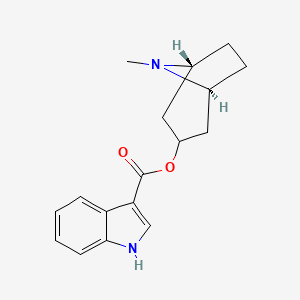
Tropisetron is built from two pieces. One is indole-3-carboxylic acid, a flat aromatic bicycle with an N-H on its five-membered ring. The other is tropine, the endo alcohol of 8-methyl-8-azabicyclo[3.2.1]octane, the same bridged tropane skeleton found in many alkaloids. An ester bond joins the indole carboxyl to the tropine 3-hydroxyl. PubChem gives the formal name [(1R,5S)-8-methyl-8-azabicyclo[3.2.1]octan-3-yl] 1H-indole-3-carboxylate and the InChIKey ZNRGQMMCGHDTEI-FUNVUKJBSA-N (PubChem CID 656665).
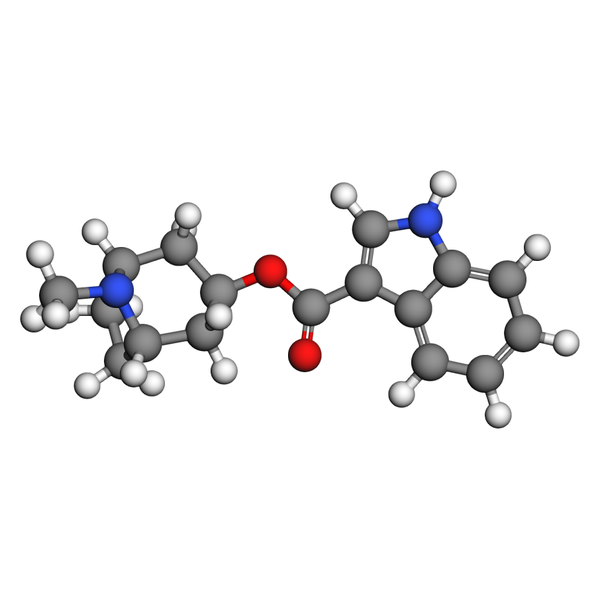
The tropane nitrogen is the chemically busy part. It carries a methyl group and is basic, so it is protonated in water at physiological pH. That positive charge is what the hydrochloride salt captures: tropisetron hydrochloride, CAS 105826-92-4, has the formula C17H21ClN2O2 and a molecular weight of 320.8 g/mol (PubChem CID 656664). The salt and the free base share the same active ion once dissolved; only the counterion differs.
Stereochemistry matters too. The ester sits in the endo (3α) position of the tropane ring, which PubChem records with (1R,5S) ring-fusion descriptors and the synonym 1αH,5αH-tropan-3α-yl indole-3-carboxylate.
Molecular Data
| Property | Value |
|---|---|
| CAS# | 89565-68-4 |
| PubChem ID | CID 656665 |
| Molecular Formula | C17H20N2O2 |
| Molecular Weight | 284.35 g/mol |
| Exact Mass | 284.1525 Da |
| IUPAC Name | [(1R,5S)-8-methyl-8-azabicyclo[3.2.1]octan-3-yl] 1H-indole-3-carboxylate |
| InChIKey | ZNRGQMMCGHDTEI-FUNVUKJBSA-N |
| SMILES | CN1[C@@H]2CC[C@H]1CC(C2)OC(=O)C3=CNC4=CC=CC=C43 |
| Molecular Class | Small molecule (non-peptide); indole-3-carboxylate ester of tropine |
| Stereocenters | 2 defined, 0 undefined |
| Hydrogen bond donors / acceptors | 1 / 3 |
| XLogP3 (computed) | 3.8 |
Values from PubChem CID 656665 (computed by PubChem).
Research Timeline
- 2001Tropisetron, also known by its code ICS 205-930, is identified as a potent and selective alpha7 nicotinic partial agonist; quinuclidine analogues share the profile (Macor et al., 2001).
- 2004In LPS-stimulated primary human monocytes, tropisetron reduces TNF-α and IL-1β release (Fiebich et al., 2004).
- 2005A molecular dissection shows the tropane fragment alone carries alpha7-selective agonist activity (Papke et al., 2005), and a T cell study links tropisetron to the calcineurin pathway (Vega et al., 2005).
- 2009Co-crystal structures with acetylcholine-binding protein reveal how tropisetron sits in a nicotinic-type binding pocket (Hibbs et al., 2009).
- 2012The monocyte effect is traced to blocked p38 MAPK activation at a post-transcriptional step (Stratz et al., 2012).
- 2017Mutagenesis shows tropisetron and granis/etron bind the 5-HT3 site in different orientations, and the 5-HT3 versus alpha7 affinity gap is measured at more than 1000-fold (Ruepp et al., 2017).
- 2024-2025: Cell studies in ARPE-19 retinal pigment epithelial cells and human endothelial cells extend the work to high-glucose stress models (Tang and Liu, 2024; Barzegar-Fallah et al., 2025).
How Tropisetron Acts at 5-HT3 and alpha7 Receptors
5-HT3 receptors are cation-selective Cys-loop receptors. Five subunits, drawn from 5-HT3A to 5-HT3E, surround a water-filled pore, and every functional receptor needs at least one A subunit. Each subunit has a large extracellular domain that forms the ligand-binding site and a transmembrane domain of four helices, M1 to M4 (Lummis, 2012). Tropisetron binds the extracellular site between subunits and holds the channel shut. In radioligand binding on 5-HT3 receptors expressed in HEK 293 cells, it gave a pKi of 9.15, or 0.72 nM (Ruepp et al., 2017).
Alpha7 nicotinic receptors belong to the same Cys-loop family, and here tropisetron behaves differently: it opens the channel, but only partly. Macor and colleagues described it as a potent and selective alpha7 partial agonist, and found that two other 5-HT3 antagonists, onda/nsetron and LY-278,584, lacked high alpha7 affinity (Macor et al., 2001).
Which part of the molecule does the work? Papke and colleagues tested fragments on heterologously expressed human alpha7, alpha4beta2 and alpha3beta4 receptors. The simple compounds tropane and tropinone had alpha7-selective agonist activity comparable to tropisetron’s; tropinone was more efficacious but 100-fold less potent. Even smaller charged amines, such as dimethyl piperidinium, activated alpha7, suggesting the minimal activating pharmacophore is the charged nitrogen. The indole, by contrast, tuned potency, both for alpha7 activation and for blocking alpha3beta4 receptors (Papke et al., 2005).
The partial part has a structural explanation. Acetylcholine-binding protein is a soluble surrogate for the nicotinic ligand-binding domain, and Hibbs and colleagues solved its structures with tropisetron and other alpha7 partial agonists at 1.75 to 2.7 Å resolution. The protonated nitrogen hydrogen-bonds to the backbone carbonyl of Trp147. The indole makes tight contacts with loop F, and that keeps loop C from closing over the pocket the way it does with full agonists (Hibbs et al., 2009).
Published Numbers at a Glance
| Item | Detail | Source |
|---|---|---|
| CAS (free base / HCl) | 89565-68-4 / 105826-92-4 | PubChem |
| Formula (free base / HCl) | C17H20N2O2 / C17H21ClN2O2 | PubChem |
| Molecular weight (free base / HCl) | 284.35 / 320.8 g/mol | PubChem |
| 5-HT3 receptor Ki | 0.72 nM (pKi 9.15) | Ruepp 2017 |
| Alpha7 Ki, [3H]epibatidine competition | 1.58 µM | Ruepp 2017 |
| Alpha7 Ki, earlier report | 6.9 nM | As cited by Ruepp 2017 |
| Monocyte TNF-α / IL-1β release IC50 | 32 / 12 µg/mL | Fiebich 2004 |
Tropisetron is a sub-nanomolar 5-HT3 ligand and a much weaker alpha7 ligand, and the alpha7 number depends on the method. Ruepp and colleagues could not detect saturable [3H]tropisetron binding at alpha7 at all, and noted that their micromolar value sits close to reported alpha7 EC50 values of 0.6 to 1.3 µM and to the 0.5 µM affinity measured at acetylcholine-binding protein (Ruepp et al., 2017). In other words, alpha7 effects appear only at concentrations far above those that saturate 5-HT3 receptors.
Tropisetron Compared with Graniset/ron and On/dansetron
Granise/tron and ondan/setron are the usual 5-HT3 antagonist comparators, and neither shares tropisetron’s alpha7 activity. Gra/nisetron is the more interesting contrast, because its co-crystal with acetylcholine-binding protein shows an almost identical pose to tropisetron’s. Yet in Ruepp’s work, grani/setron did not compete for alpha7 binding at up to 100 µM. At 5-HT3 receptors, 15 of 23 cysteine substitutions affected the two ligands differently, and analogue chemistry agreed: the two adopt different orientations in the 5-HT3 site (Ruepp et al., 2017). Adding a methoxy group at indole position 5, 6 or 7 cut tropisetron’s 5-HT3 affinity 42- to 253-fold, and a benzyl group on the tropane nitrogen cut it about 2000-fold.
Ondans/etron serves as the cleaner negative control for alpha7: Macor and colleagues found it lacked high alpha7 affinity (Macor et al., 2001). Running tropisetron beside ond/ansetron is a simple way to separate 5-HT3-driven effects from alpha7-driven ones in a cell assay.
Some cell effects may sit outside both receptors. In human T cells and Jurkat cells, tropisetron inhibited IL-2 transcription and synthesis and the DNA binding of NFAT and AP-1, with calcineurin identified as one of the main targets, effects the authors considered probably independent of serotonin receptor signaling (Vega et al., 2005). In monocytes, IL-1β and TNF-α mRNA levels were unchanged while p38 MAPK phosphorylation was blocked, placing the cytokine effect after transcription (Stratz et al., 2012). Under high-glucose conditions, tropisetron improved ARPE-19 cell viability and restored SIRT1 (Tang and Liu, 2024) and blocked calcineurin activation and NFATc1 nuclear translocation in human umbilical vein endothelial cells (Barzegar-Fallah et al., 2025).
Research Formats and Documentation
All applicable tests are performed on our products. Modern Aminos supplies Tropisetron HCL in two formats: a 20 mg/mL solution in a 30 mL amber bottle and 10 mg capsules, 60 per bottle. Certificates are listed on the COA Search page as they are published, and our note on HPLC testing explains why chromatography matters for reference compounds.
Related Research Tools
References
- Macor JE, Gurley D, Lanthorn T, Loch J, Mack RA, Mullen G, et al. The 5-HT3 antagonist tropisetron (ICS 205-930) is a potent and selective alpha7 nicotinic receptor partial agonist. Bioorg Med Chem Lett. 2001;11(3):319-321. PMID 11212100
- Papke RL, Schiff HC, Jack BA, Horenstein NA. Molecular dissection of tropisetron, an alpha7 nicotinic acetylcholine receptor-selective partial agonist. Neurosci Lett. 2005;378(3):140-144. PMID 15781147
- Hibbs RE, Sulzenbacher G, Shi J, Talley TT, Conrod S, Kem WR, et al. Structural determinants for interaction of partial agonists with acetylcholine binding protein and neuronal alpha7 nicotinic acetylcholine receptor. EMBO J. 2009;28(19):3040-3051. PMC2760105
- Ruepp MD, Wei H, Leuenberger M, Lochner M, Thompson AJ. The binding orientations of structurally-related ligands can differ; a cautionary note. Neuropharmacology. 2017;119:48-61. PMC5464333
- Lummis SC. 5-HT3 receptors. J Biol Chem. 2012;287(48):40239-40245. PMC3504740
- Fiebich BL, Akundi RS, Lieb K, Candelario-Jalil E, Gmeiner D, Haus U, et al. Antiinflammatory effects of 5-HT3 receptor antagonists in lipopolysaccharide-stimulated primary human monocytes. Scand J Rheumatol Suppl. 2004;119:28-32. PMID 15515409
- Stratz C, Bhatia HS, Akundi RS, Nührenberg T, Trenk D, Muñoz E, et al. The anti-inflammatory effects of the 5-HT3 receptor antagonist tropisetron are mediated by the inhibition of p38 MAPK activation in primary human monocytes. Int Immunopharmacol. 2012;13(4):398-402. PMID 22664143
- Vega L de L, Muñoz E, Calzado MA, Lieb K, Candelario-Jalil E, Gschaidmeir H, et al. The 5-HT3 receptor antagonist tropisetron inhibits T cell activation by targeting the calcineurin pathway. Biochem Pharmacol. 2005;70(3):369-380. PMID 15922994
- Tang M, Liu W. Tropisetron attenuates high glucose-induced oxidative stress and inflammation in ARPE-19 cells in vitro via regulating SIRT1/ROCK1 signaling. Drug Dev Res. 2024;85(7):e70002. PMID 39381984
- Barzegar-Fallah A, Ghaffari-Bohlouli P, Nadjafi S, Razmi A, Dehpour AR, Ghaffarian-Bahraman A, et al. Tropisetron attenuates high-glucose-induced vascular endothelial dysfunction via inhibition of calcineurin/NFAT signalling. Eur J Pharmacol. 2025;994:177389. PMID 39961489
- National Center for Biotechnology Information. PubChem Compound Summaries for CID 656665 (tropisetron) and CID 656664 (tropisetron hydrochloride). CID 656665, CID 656664
Frequently Asked Questions
What Is Tropisetron?
Tropisetron is an indole-3-carboxylic acid ester of tropine, [(1R,5S)-8-methyl-8-azabicyclo[3.2.1]octan-3-yl] 1H-indole-3-carboxylate. The free base is CAS 89565-68-4, C17H20N2O2, 284.35 g/mol, and the hydrochloride is CAS 105826-92-4, C17H21ClN2O2, 320.8 g/mol. It is a 5-HT3 receptor antagonist and an alpha7 nicotinic receptor partial agonist.
Is Tropisetron a Peptide?
No. Tropisetron is a small molecule built from two ring systems, an indole and a bicyclic tropane, joined by an ester bond. It contains no amino acids or amide-linked backbone.
How Does Tropisetron Work?
It binds the orthosteric site of two related Cys-loop receptors. At 5-HT3 receptors it is a competitive antagonist with a Ki of 0.72 nM in cell-based binding. At alpha7 nicotinic receptors it is a partial agonist, opening the channel less fully than acetylcholine.
Tropisetron vs. Ond/ansetro/n: What Is the Difference?
Both block 5-HT3 receptors, but only tropisetron has high affinity for alpha7 nicotinic receptors, where it acts as a partial agonist. Ondans/etron lacked high alpha7 affinity in the study that first described tropisetron’s alpha7 activity.
Is Tropisetron Hydrochloride the Same as Tropisetron?
It is the same active molecule as a salt. Tropisetron hydrochloride adds one equivalent of HCl to the tropane nitrogen, which raises the molecular weight from 284.35 to 320.8 g/mol and changes the CAS number from 89565-68-4 to 105826-92-4.
How Is Tropisetron Identity Confirmed?
Identity is checked against reference identifiers: PubChem CID 656664 and InChIKey XIEGSJAEZIGKSA-KOQCZNHOSA-N for the hydrochloride. Lot reports are listed on the COA Search page as they are published.