Bromantane (Ladasten / N-(4-bromophenyl)adamantan-2-amine / Bromantan) is a synthetic adamantane secondary amine and actoprotector-class reference compound for catecholamine-pathway and structure-activity research. Published molecular pharmacology links Bromantane to transcriptional upregulation of Tyrosine hydroxylase (TH), the rate-limiting enzyme in catecholamine biosynthesis. CAS 87913-26-6.
$49.00
| Quantity | Discounted Price |
|---|---|
| 4 - 6 | $47.04 |
| 7 - 9 | $46.06 |
| 10 + | $45.08 |
| 3 - 5 | $47.04 |
| 5 - 9 | $45.08 |
| 10 + | $43.12 |
| 3 - 5 | $46.55 |
| 5 + | $44.10 |



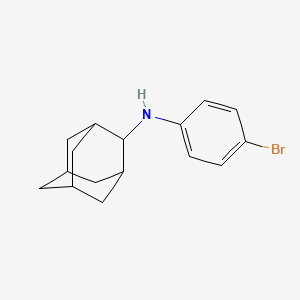
Bromantane (N-(4-bromophenyl)adamantan-2-amine, also called Ladasten, Bromantan, and N-(2-adamantyl)-N-(4-bromophenyl)amine; CAS 87913-26-6) is a synthetic adamantane secondary amine. It is an actoprotector-class research compound built on a rigid tricyclo[3.3.1.13,7]decane (adamantane) core with a para-bromophenyl substituent on the 2-amino nitrogen. Bromantane is not a peptide and not an amino acid, even though some marketplace searches label it a “Bromantane peptide.” Its activity profile in the published molecular pharmacology literature is tied to catecholamine-pathway enzyme expression rather than to a peptide backbone.
Published actoprotector reviews describe Bromantane as acting upstream of monoamine release: by supporting transcriptional upregulation of Tyrosine hydroxylase (TH), the rate-limiting enzyme in catecholamine biosynthesis, and by modulating GABA-transporter expression in GABAergic pathways (Oliynyk & Oh, 2012, PMC3762282). What Bromantane does at the enzyme-and-gene-expression level is therefore chemistry-first: a lipophilic adamantane–bromoaniline scaffold whose reported targets are biosynthetic enzymes and transporter transcripts, not a peptide receptor epitope.
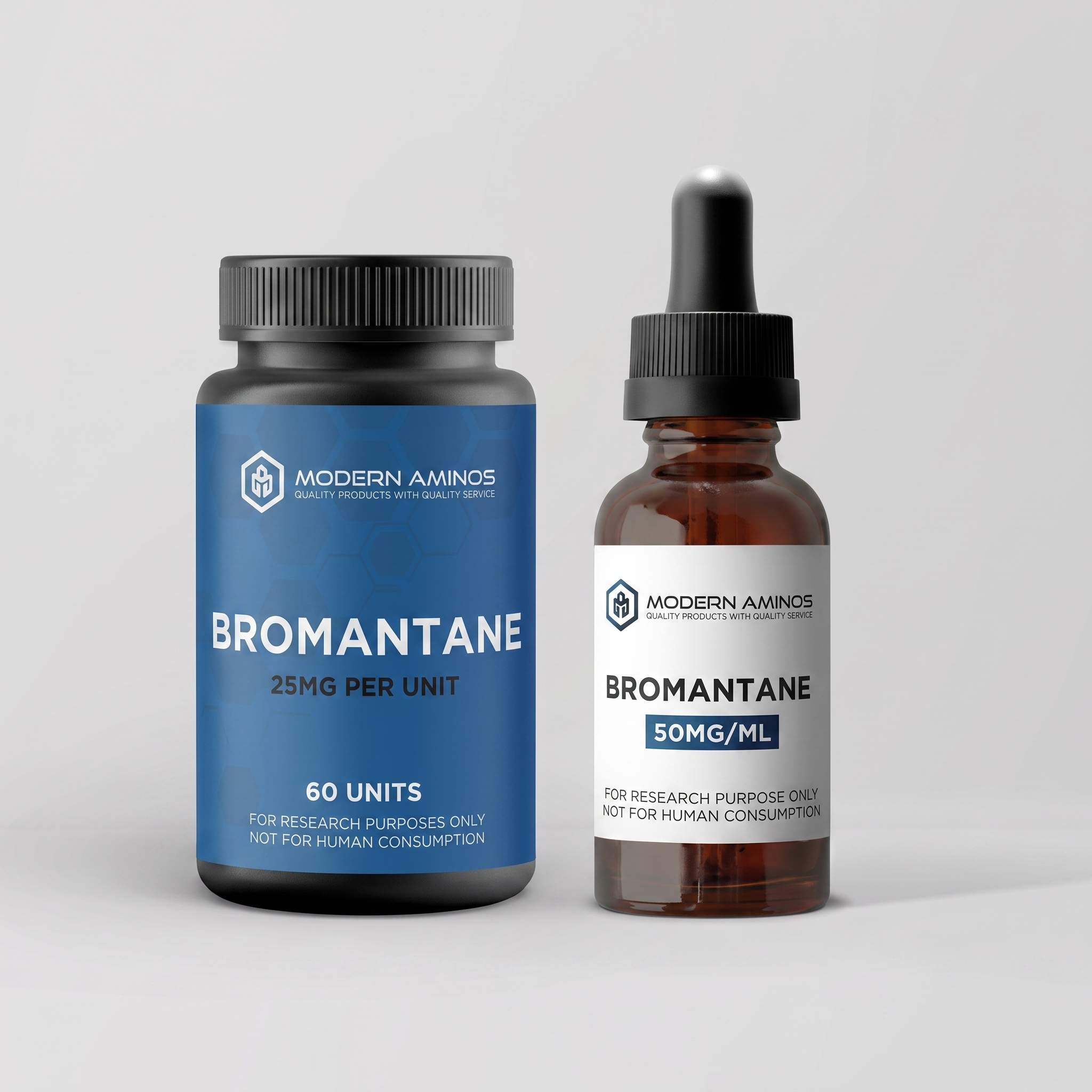
Batch-verified at Modern Aminos, Bromantane is supplied in 2 laboratory formats:
Laboratories building catecholamine-pathway and adamantane structure–activity assay panels often place Bromantane next to other public reference listings such as L-THP, PRL-8-53, TAK-653, and BPAP, as well as Phenylpiracetam Hydrazide, Noopept, and Sunifiram. For a closer look at whether Bromantane is a peptide, see Is Bromantane a Peptide? N-(4-bromophenyl)adamantan-2-amine Explained.
| Compound Name | Bromantane |
|---|---|
| Research Category | Catecholamine-pathway / Tyrosine hydroxylase research compound; synthetic adamantane secondary amine; actoprotector-class reference compound |
| Quantity / Formats Offered | 25 mg Dry-Fill (capsule bottle, 60 units) | 50 mg/mL Liquid (30 mL) |
| Synonyms / Alt Names | Ladasten; Bromantan; bromontan; N-(2-adamantyl)-N-(4-bromophenyl)amine; N-(4-bromophenyl)tricyclo[3.3.1.13,7]decan-2-amine; N-(4-bromophenyl)adamantan-2-amine; UNII N1ILS53XWK |
| CAS Number | 87913-26-6 |
| PubChem CID | 4660557 |
| UNII | N1ILS53XWK |
| Chemical Formula | C16H20BrN |
| Molecular Weight | 306.24 g/mol |
| Exact Mass | 305.07791 Da |
| IUPAC Name | N-(4-bromophenyl)adamantan-2-amine |
| InChIKey | LWJALJDRFBXHKX-UHFFFAOYSA-N |
| SMILES Code | C1C2CC3CC1CC(C2)C3NC4=CC=C(C=C4)Br |
Identity fields are drawn from PubChem CID 4660557; purity and quantity values come from the lot certificates in the Certificate of Analysis tab.
The biochemical targets and pathway logic of Bromantane in laboratory research include:
C1C2CC3CC1CC(C2)C3NC4=CC=C(C=C4)Br, formula C16H20BrN, and InChIKey LWJALJDRFBXHKX-UHFFFAOYSA-N for CID 4660557. The para-bromoaryl amine is the structural handle that distinguishes Bromantane from related adamantane amines such as chlodantane (a chloro analog discussed separately in actoprotector reviews).| Assay Parameter | Bromantane | Related scaffold notes | Source |
|---|---|---|---|
| Core scaffold | Adamantane 2-amine + 4-bromophenyl | Chlodantane is the para-chloro adamantane analog in the same review class | Oliynyk & Oh 2012, Fig. 1B |
| Primary reported pathway | TH transcriptional upregulation (catecholamine biosynthesis) | Distinct from AMPA PAM / ampakine scaffolds used as glutamatergic tools | Oliynyk & Oh 2012 |
| Secondary reported pathway | GABA-transporter expression modulation | Not a benzodiazepine-site ligand description in the cited review | Oliynyk & Oh 2012 |
| Recombinant TH IC50 / receptor Ki | Not reported in PubMed-indexed recombinant assays | — | PubMed index search, 2026-10-15 |
| CAS / PubChem identity | 87913-26-6 / CID 4660557 | Verified InChIKey LWJALJDRFBXHKX-UHFFFAOYSA-N | PubChem CID 4660557 |
Peer-reviewed literature on Bromantane centers on adamantane chemistry, actoprotector class definition, and catecholamine-pathway enzyme expression:
To map catecholamine-pathway and neurochemistry tools, researchers compare Bromantane against other public reference compounds available at Modern Aminos:
| Compound / Reference | Primary Target Class | Core Mechanism of Action | Research Focus & Profile |
|---|---|---|---|
| Bromantane | Adamantane secondary amine / actoprotector class | Reported TH transcriptional upregulation; GABA-transporter expression modulation | Catecholamine-biosynthesis pathway chemistry; CAS 87913-26-6 |
| L-THP (Levo-tetrahydropalmatine) | Protoberberine alkaloid / D1 antagonist tool | Dopamine D1 receptor antagonism in binding and signaling assays | Receptor-level dopaminergic pharmacology; see also What Is L-THP? |
| PRL-8-53 | Substituted aminoethyl benzoate ester | Cholinergic-classified small molecule (patent series); no published receptor Ki | Phenethylamine-benzoate SAR; often mis-searched as a “peptide” |
| TAK-653 | AMPA receptor positive allosteric modulator | AMPA PAM pharmacology | Glutamatergic assay panels |
| BPAP | Enhancer-sensitive catecholaminergic / tryptaminergic tool | Trace-aminergic enhancer chemistry | Catecholamine-release enhancer research (distinct from TH transcription) |
Modern Aminos publishes third-party certificates from Vanguard Laboratory, an A2LA-accredited lab, for Bromantane. The 25 mg capsule lot BX-C-X1W6 lists HPLC-UV/VIS quantity results of 24.92 mg, 25.00 mg, and 25.20 mg per 25 mg unit (Lab ID V260518-14 001, reported 5/29/2026). The 50 mg/mL liquid lot BX-L-W1R4 lists HPLC-UV/VIS identity Pass – Matches Ref. Standard and quantity 55.14 mg/mL (Lab ID V260914-43 003, reported 9/24/2026). If you want to buy N-(4-bromophenyl)adamantan-2-amine as a documented reference material, each certificate is in the Certificate of Analysis tab.
No. Bromantane is a small-molecule adamantane secondary amine (C16H20BrN), not a peptide and not an amino acid. It has no amino-acid residues and no peptide bonds. The misconception query is covered in detail in Is Bromantane a Peptide? N-(4-bromophenyl)adamantan-2-amine Explained.
Bromantane from Modern Aminos is sold as a laboratory research compound with lot-linked third-party certificates, not as a dietary supplement. Product pages and certificates are written for analytical and pathway research use.
Published actoprotector reviews place Bromantane’s primary reported action on catecholamine-pathway enzyme expression — specifically transcriptional upregulation of Tyrosine hydroxylase (TH), the rate-limiting enzyme in catecholamine biosynthesis — with a secondary reported effect on GABA-transporter gene expression. No recombinant TH IC50 or clean receptor Ki panel is indexed in PubMed for Bromantane.
TH converts L-Tyrosine to L-DOPA, the committed step toward dopamine, norepinephrine, and epinephrine. Increasing TH transcript/protein raises the biosynthetic capacity of that pathway. Bromantane is discussed in the actoprotector literature as supporting that transcriptional step rather than as a vesicular monoamine releaser or reuptake-blocker chemotype.
The adamantane cage is a rigid, lipophilic C10 hydrocarbon that strongly influences membrane partitioning. The 4-bromophenyl secondary amine is the heteroaryl handle that defines Bromantane versus related adamantane amines (for example, the chloro analog chlodantane in the same review class). Together they give the C16H20BrN formula recorded under PubChem CID 4660557.
Bromantane is an adamantane amine discussed for TH transcriptional pathway chemistry. L-THP is a protoberberine alkaloid used as a dopamine D1 antagonist tool. They share a broad “dopaminergic research” neighborhood but differ in scaffold, target class, and assay design.
Ladasten and Bromantan are established synonyms for Bromantane in PubChem and in the actoprotector review literature. ADK-709 does not resolve as a PubChem name or PubMed synonym for Bromantane as of October 2026 and is not used as an identifier on this page. The related code ADK-910 in Oliynyk & Oh (2012) refers to chlodantane, a different adamantane analog.
Two Form options: 25 mg dry-fill capsules, 60 units per capsule bottle (SKU C-046), and 50 mg/mL liquid in a 30 mL container (SKU L-025). Choose the format that matches the assay’s solvent and handling needs; both lots have certificates in the Certificate of Analysis tab.
PRL-8-53 is a phenethylamine-benzoate ester (often mis-searched as a peptide). TAK-653 is an AMPA positive allosteric modulator. Bromantane sits in adamantane / TH-pathway chemistry. Labs often run them as orthogonal tools rather than as substitutes. See also the companion Bromantane explainer.
Third-party Vanguard Laboratory certificates (A2LA #6377.01.01) are published in the Certificate of Analysis tab. Capsule lot BX-C-X1W6 reports HPLC-UV/VIS quantity (24.92 / 25.00 / 25.20 mg per 25 mg unit). Liquid lot BX-L-W1R4 reports HPLC-UV/VIS identity Pass – Matches Ref. Standard and quantity 55.14 mg/mL on a 50 mg/mL label claim. Neither certificate prints a purity percentage, HRMS, or heavy-metal panel as of October 2026.
Keep containers sealed, cool, dry, and away from light. Follow the label on each lot. No storage temperature is printed on the current Vanguard certificates, so this page does not invent one.
DISCLAIMER: All compounds and research materials provided by Modern Aminos are strictly for laboratory and research use only. They are not approved for human consumption by the Food and Drug Administration (FDA). No products are approved for oral, sublingual, nor in vivo use. These products should not be used for any form of in vivo experimentation or for any other non-laboratory purpose. Any violation or indication of human or animal use will result in immediate removal from being able to purchase products in the future. By purchasing these products, you acknowledge that they will be used exclusively within a controlled and qualified research environment.
Capsule products are not intended for time-release and are for transport only.
DISCLAIMER: All compounds and research materials provided by Modern Aminos are strictly for laboratory and research use only. They are not approved for human consumption by the Food and Drug Administration (FDA). No products are approved for oral, sublingual, nor in vivo use. These products should not be used for any form of in vivo experimentation or for any other non-laboratory purpose. Any violation or indication of human or animal use will result in immediate removal from being able to purchase products in the future. By purchasing these products, you acknowledge that they will be used exclusively within a controlled and qualified research environment.
