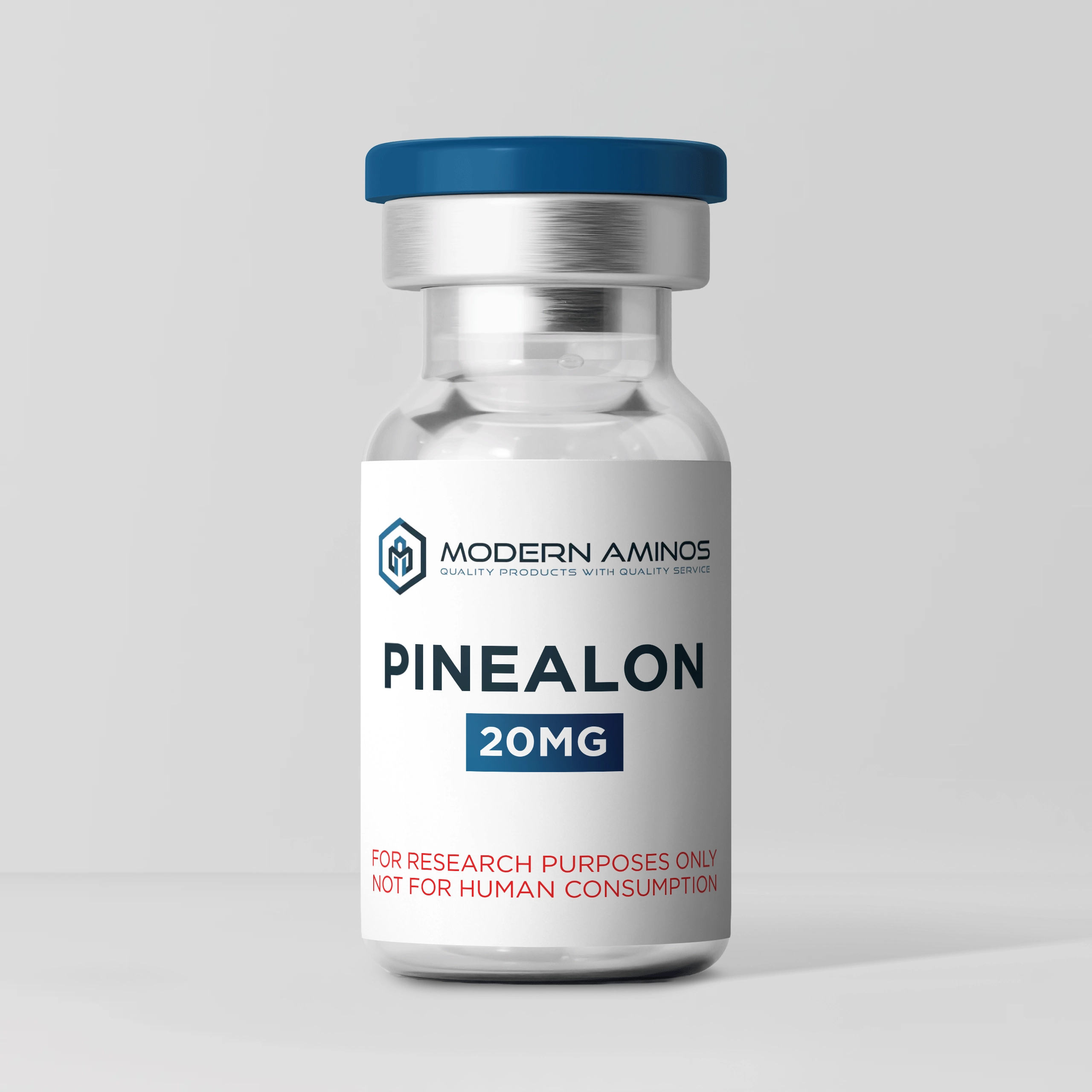
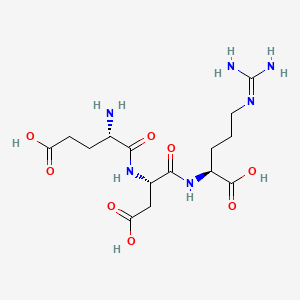
Pinealon 20MG (Glu-Asp-Arg / EDR tripeptide, L-glutamyl-L-aspartyl-L-arginine) is a synthetic tripeptide bioregulator for peptide-DNA and peptide-histone interaction research. In biophysical studies, the EDR sequence partly enters the DNA major groove, contacting guanine N7 and O6, and it binds histone tails in fluorescence-quenching assays. Supplied as 20 mg of lyophilized powder in a sealed vial. CAS 175175-23-2.
$61.00
In stock
| Quantity | Discounted Price |
|---|---|
| 4 - 6 | $58.56 |
| 7 - 9 | $57.34 |
| 10 + | $56.12 |
| 3 - 5 | $59.17 |
| 5 - 9 | $57.34 |
| 10 + | $54.90 |



Pinealon (L-glutamyl-L-aspartyl-L-arginine, also called Glu-Asp-Arg, EDR, EDR tripeptide, H-Glu-Asp-Arg-OH, and the Pinealon bioregulator; CAS 175175-23-2) is a synthetic tripeptide built from three L-amino acids. It belongs to the family of short regulatory peptides, two to four residues long, that are studied for how they bind DNA and histone proteins. Pinealon is a peptide rather than a single amino acid, and Modern Aminos lists it as a research chemical rather than a supplement: a defined sequence with its own PubChem record (CID 10273502). Its activity in the literature comes from the way a small, highly charged peptide recognizes particular DNA sequences and histone surfaces.
Biophysical work using spectral methods, NMR, viscometry, and molecular dynamics showed that the EDR peptide partly penetrates the major groove of DNA and affects guanine N7 and O6 atoms, and that magnesium ions promote the interaction by screening DNA’s phosphate charges (Silanteva et al., 2019, PubMed 30762356). At the molecular level, Pinealon behaves as a sequence-selective DNA and histone ligand.
Batch-verified at Modern Aminos, Pinealon is supplied in 1 laboratory format:
Laboratories building peptide-nucleic acid binding panels often place Pinealon next to other public reference listings such as Bronchogen and Vilon, as well as Epitalon. For a closer look at the sequence and the binding studies, see What Is Pinealon? The Glu-Asp-Arg (EDR) Tripeptide Explained.
| Compound Name | Pinealon 20MG (Glu-Asp-Arg) |
|---|---|
| Research Category | DNA- and histone-binding short peptide; synthetic tripeptide bioregulator; peptide-nucleic acid interaction reference compound |
| Quantity / Formats Offered | 20 mg Lyophilized Powder (single sealed glass vial) |
| Peptide Sequence | H-Glu-Asp-Arg-OH (EDR); all three residues L |
| Synonyms / Alt Names | Glu-Asp-Arg, EDR, E-D-R, EDR tripeptide, H-Glu-Asp-Arg-OH, L-Glu-L-Asp-L-Arg, glutamyl-aspartyl-arginine, L-alpha-glutamyl-L-alpha-aspartyl-L-arginine, Pinealon bioregulator |
| CAS Number | 175175-23-2 |
| PubChem CID | 10273502 |
| ChEBI ID | CHEBI:156374 |
| EPA DSSTox Substance ID | DTXSID601359159 |
| Chemical Formula | C15H26N6O8 |
| Molecular Weight | 418.40 g/mol |
| Exact Mass | 418.1812 Da |
| Stereochemistry | Three defined stereocenters, all L (S configuration) |
| Computed Properties (PubChem) | XLogP3 -6.1; hydrogen-bond donors 8; hydrogen-bond acceptors 10; topological polar surface area 261 Å2; rotatable bonds 14 |
| IUPAC Name | (4S)-4-amino-5-[[(2S)-3-carboxy-1-[[(1S)-1-carboxy-4-(diaminomethylideneamino)butyl]amino]-1-oxopropan-2-yl]amino]-5-oxopentanoic acid |
| InChIKey | QPRZKNOOOBWXSU-CIUDSAMLSA-N |
| SMILES Code | C(C[C@@H](C(=O)O)NC(=O)[C@H](CC(=O)O)NC(=O)[C@H](CCC(=O)O)N)CN=C(N)N |
Identity fields are drawn from PubChem CID 10273502 and ChEBI, with the CAS number cross-checked against the expert-curated EPA DSSTox record; purity and quantity values come from the lot certificate in the Certificate of Analysis tab.
The biochemical targets and binding logic of Pinealon in laboratory research include:
| Assay Parameter | Pinealon (Glu-Asp-Arg) | Epitalon (Ala-Glu-Asp-Gly) / Bronchogen (Ala-Glu-Asp-Leu) | Source |
|---|---|---|---|
| Preferred oligonucleotide motif (Stern-Volmer fluorescence quenching) | CNG-containing; CAG favored | Epitalon: CNG-containing, CAG favored / Bronchogen: CNG-containing, CTG favored | Fedoreyeva 2011, abstract |
| Binding to FITC-labeled histones H1, H2B, H3, H4 | Binds (N-terminal regions) | Both bind (N-terminal regions) | Fedoreyeva 2013, abstract |
| DNA groove contact (NMR, molecular dynamics) | Partial major-groove penetration; guanine N7 and O6 | not reported | Silanteva 2019, abstract |
| Effect of Mg2+ on DNA binding | Promotes binding (phosphate screening) | not reported | Silanteva 2019, abstract |
| Modeled DNA binding sites | d(CCTGCC)2 and d(CCAGC)2 | Epitalon: histones H1/3 and H1/6 (modeling) / Bronchogen: not reported | Khavinson 2020, Figure 3; Khavinson 2020 (AEDG), abstract |
Peer-reviewed literature on Pinealon 20MG and its Glu-Asp-Arg sequence centers on nucleic acid binding, histone binding, and structural modeling:
To map sequence-selective DNA and histone binding, researchers compare Pinealon against other short peptide reference compounds, including several available at Modern Aminos:
| Compound / Reference | Primary Target Class | Core Mechanism of Action | Research Focus & Profile |
|---|---|---|---|
| Pinealon 20MG | Tripeptide (Glu-Asp-Arg), C15H26N6O8, 418.40 g/mol | Partial major-groove DNA contact at guanine N7/O6; CNG- and CAG-preferring oligonucleotide binding; histone N-terminal binding | DNA and histone binding biophysics, Mg2+ dependence, methylation-sensitive recognition |
| Bronchogen | Tetrapeptide (Ala-Glu-Asp-Leu), C18H30N4O9, 446.5 g/mol | CNG-preferring oligonucleotide binding with a CTG preference; histone N-terminal binding | Side-by-side sequence-selectivity comparisons with Pinealon in the same assays |
| Vilon | Dipeptide (Lys-Glu), C11H21N3O5, 275.30 g/mol | Docking places Lys-Glu along the DNA minor groove, with a higher calculated interaction energy than free lysine or glutamic acid | Minimal-length peptide-DNA docking reference (Khavinson et al., 2015) |
| Epitalon | Tetrapeptide (Ala-Glu-Asp-Gly), C14H22N4O9, 390.35 g/mol | CNG- and CAG-preferring oligonucleotide binding; modeled binding to linker histones H1/3 and H1/6 | Histone-modeling comparisons (Khavinson et al., 2020) |
Modern Aminos publishes a third-party certificate from Freedom Diagnostics Testing for Pinealon lot BX-P-M9W2 (reported July 17, 2026). It lists identity confirmed by LC-MS, HPLC-UV purity of 99.82% (vials at 99.80%, 99.83%, and 99.82%), an average net content of 20.09 mg per vial, an endotoxin pass by the Limulus Amebocyte Lysate method under USP <85>, and a PCR microbial screen pass. If you want to buy L-glutamyl-L-aspartyl-L-arginine as a documented reference material, the certificate is in the Certificate of Analysis tab.
Pinealon is a peptide: specifically a tripeptide, three amino acids joined by two peptide bonds in the order L-glutamic acid, L-aspartic acid, L-arginine (Glu-Asp-Arg, or EDR in one-letter code). ChEBI defines it in exactly those terms (CHEBI:156374). Its individual building blocks are amino acids, but the linked chain is a peptide with its own formula, C15H26N6O8, and its own CAS number, 175175-23-2.
Modern Aminos lists Pinealon as a research chemical: a defined synthetic tripeptide with a PubChem record (CID 10273502), a ChEBI entry, and a lot certificate. It is supplied only as a lyophilized powder in a sealed vial, and the published work on it focuses on peptide-DNA and peptide-histone binding chemistry.
The documented molecular partners of Pinealon are nucleic acids and histone proteins. Spectral, NMR, viscometry, and molecular dynamics work shows the EDR peptide partly entering the major groove of double-stranded DNA and affecting guanine N7 and O6 atoms (Silanteva et al., 2019), and fluorescence-quenching studies show it binding histones H1, H2B, H3, and H4 through their N-terminal regions (Fedoreyeva et al., 2013). Its primary documented function is therefore site-specific binding to DNA and histones.
In the 2019 study by Silanteva and colleagues, the EDR peptide partly penetrated the DNA major groove and contacted the guanine base atoms N7 and O6. Magnesium ions strengthened the interaction by screening the negatively charged phosphate groups of DNA, and that effect held in salt solutions as well. Earlier fluorescence work reported that the short peptides tested, Pinealon among them, discriminate between oligonucleotide sequences and recognize their cytosine methylation status (Fedoreyeva et al., 2011).
Glutamic acid and aspartic acid each carry a carboxylic acid side chain, the C-terminus adds a third carboxyl group, and arginine contributes a guanidino side chain, the only strongly basic side chain in the sequence. The free N-terminal amine is the second basic group. PubChem’s computed properties reflect a highly polar molecule: XLogP3 of -6.1, 8 hydrogen-bond donors, 10 hydrogen-bond acceptors, a topological polar surface area of 261 square angstroms, and three defined (L) stereocenters.
Epitalon is a tetrapeptide, Ala-Glu-Asp-Gly (C14H22N4O9, 390.35 g/mol), while Pinealon is the tripeptide Glu-Asp-Arg (C15H26N6O8, 418.40 g/mol). In the same oligonucleotide fluorescence study, both peptides preferred CNG-containing sequences and leaned toward CAG over CTG (Fedoreyeva et al., 2011). Molecular modeling of Epitalon focused on linker histones H1/3 and H1/6, while the Pinealon literature adds NMR and molecular dynamics evidence of major-groove contact.
EDR is simply the one-letter code for Glu-Asp-Arg, and PubChem lists the same compound as H-Glu-Asp-Arg-OH and L-glutamyl-L-aspartyl-L-arginine. A 2020 article by Khavinson and colleagues describes EDR as a tripeptide isolated from the polypeptide preparation Cortexin. The name is often misspelled as pinaleon in searches; every spelling points to the same structure, PubChem CID 10273502.
Modern Aminos offers one format: 20 mg of white lyophilized Pinealon powder in a single sealed glass vial (SKU P-019). The current certificate reports an average measured net content of 20.09 mg across three vials.
Bronchogen (Ala-Glu-Asp-Leu) shared Pinealon’s preference for CNG-containing oligonucleotides but favored CTG, while Pinealon favored CAG (Fedoreyeva et al., 2011). Vilon (Lys-Glu) is a dipeptide whose docking places it along the DNA minor groove (Khavinson et al., 2015), and a systematic docking survey found that most dipeptides cannot bind double-stranded DNA selectively, with selectivity rising sharply as peptides get longer (Kolchina et al., 2019). For a plain-language walk through these comparisons, see What Is Pinealon? The Glu-Asp-Arg (EDR) Tripeptide Explained.
The Freedom Diagnostics Testing certificate for lot BX-P-M9W2 uses HPLC with UV detection coupled with mass spectrometry: LC-MS confirmed the identity as Pinealon and HPLC-UV measured 99.82% purity. The same report lists net content by vial (19.25 mg, 20.93 mg, and 20.09 mg), two endotoxin replicates that passed at an assay sensitivity of 0.05 EU/mL or lower, and no detectable microbial DNA by PCR. Why chromatographic testing matters for reference materials is covered in Modern Aminos’ note on HPLC testing.
Keep the sealed vial cool, dry, and away from direct light, and limit how often it is opened so the lyophilized powder stays free of moisture. Follow the label on each lot, because storage temperatures are not printed on the current certificate.
DISCLAIMER: All compounds and research materials provided by Modern Aminos are strictly for laboratory and research use only. They are not approved for human consumption by the Food and Drug Administration (FDA). No products are approved for oral, sublingual, nor in vivo use. These products should not be used for any form of in vivo experimentation or for any other non-laboratory purpose. Any violation or indication of human or animal use will result in immediate removal from being able to purchase products in the future. By purchasing these products, you acknowledge that they will be used exclusively within a controlled and qualified research environment.
