
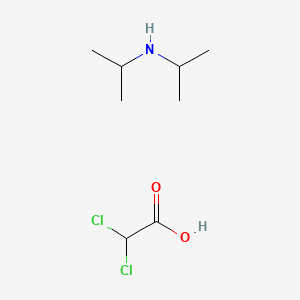
DADA (Diisopropylamine Dichloroacetate / Diisopropylammonium Dichloroacetate) is a 1:1 dichloroacetate salt and pyruvate dehydrogenase kinase (PDK) inhibitor for mitochondrial and oxidative metabolism research. By inhibiting PDK, DADA keeps the pyruvate dehydrogenase (PDH) complex in its active, dephosphorylated state, favoring pyruvate oxidation to acetyl-CoA over lactate formation. CAS 660-27-5.
Price range: $49.00 through $74.00
| Quantity | Discounted Price |
|---|---|
| 4 - 6 | $47.04 |
| 7 - 9 | $46.06 |
| 10 + | $45.08 |



DADA (diisopropylamine dichloroacetate, also called diisopropylammonium dichloroacetate or DIPA-DCA; CAS 660-27-5) is a 1:1 salt of diisopropylamine and dichloroacetic acid. It is a small-molecule inhibitor of pyruvate dehydrogenase kinase (PDK), the mitochondrial enzyme that switches the pyruvate dehydrogenase complex (PDC) off by phosphorylation. DADA is not a peptide and not an amino acid, even though many searches call it a “DADA peptide.” Its activity comes from the dichloroacetate anion, which binds a regulatory pocket on PDK and holds the kinase in an inactive shape.
In recombinant kinase assays, DADA inhibited recombinant PDK4 with an IC50 of 50.9 µM and PDK2 with an IC50 of 636.0 µM, nearly matching sodium dichloroacetate under the same conditions (Yamane et al., 2014, PMC4035290). That is what DADA does at the enzyme level: it keeps PDC in its active, dephosphorylated state, so pyruvate keeps flowing toward acetyl-CoA.
Batch-verified at Modern Aminos, DADA is supplied in three laboratory formats:
Laboratories building mitochondrial and metabolic assay panels often place DADA next to other public reference listings such as ITPP (myo-inositol trispyrophosphate) and GC-1 (Sobetirome), as well as SLU-PP-332, BAM15, AICAR, and MOTS-C. For a closer look at the ERR agonist pair, see SLU-PP-332 vs SLU-PP-915.
| Compound Name | DADA (Diisopropylamine Dichloroacetate) |
|---|---|
| Research Category | Pyruvate dehydrogenase kinase (PDK) inhibitor; dichloroacetate salt; mitochondrial metabolism reference compound |
| Quantity / Formats Offered | 200 mg/mL Solution (20 mL Vial) | 250 mg Dry-Fill Capsules (60 Units) | 300 mg/mL Solution (30 mL Dropper Bottle) |
| Synonyms / Alt Names | Diisopropylammonium dichloroacetate, diisopropylamine 2,2-dichloroacetate, DIPA-DCA, DADA, dichloroacetic acid diisopropylamine salt, IS-401; historically associated with “pangamic acid” (B15) preparations |
| CAS Number | 660-27-5 |
| PubChem CID | 12617 |
| ChEBI ID | CHEBI:31492 |
| UNII / EC Number | BA6QDP0R4E / 211-538-2 |
| Chemical Formula | C8H17Cl2NO2 (C6H15N · C2H2Cl2O2) |
| Molecular Weight | 230.13 g/mol (salt); components: diisopropylamine 101.19 g/mol, dichloroacetic acid 128.94 g/mol |
| Exact Mass | 229.0636 Da |
| Stoichiometry | 1:1 ammonium carboxylate salt (diisopropylammonium cation · dichloroacetate anion) |
| IUPAC Name | 2,2-dichloroacetic acid; N-propan-2-ylpropan-2-amine |
| InChIKey | ILKBHIBYKSHTKQ-UHFFFAOYSA-N |
| SMILES Code | CC(C)NC(C)C.C(C(=O)O)(Cl)Cl (ionic form: CC(C)[NH2+]C(C)C.C(C(=O)[O-])(Cl)Cl) |
Identity fields are drawn from PubChem CID 12617 and ChEBI; purity and quantity values come from the lot certificates in the Certificate of Analysis tab.
The biochemical targets and pathway logic of DADA in laboratory research include:
| Assay Parameter | DADA | Dichloroacetate (DCA) | Source |
|---|---|---|---|
| IC50, PDK4 (recombinant) | 50.9 µM | 57.8 µM | Yamane 2014, Table 3 |
| IC50, PDK2 (recombinant) | 636.0 µM | 676.0 µM | Yamane 2014, Table 3 |
| Apparent Ki, PDK2 to PDK3 | not reported | 0.2 mM (PDK2) to 8 mM (PDK3) | Bowker-Kinley 1998 |
| Binding site | Dichloroacetate anion (same pharmacophore) | Pyruvate site, N-terminal regulatory domain | Knoechel 2006; Kato 2007 |
Peer-reviewed literature on DADA (Diisopropylamine Dichloroacetate) and its active dichloroacetate anion centers on enzyme kinetics, structural biology, and pathway regulation:
To map metabolic pathways, mitochondrial targets, and respiration mechanics, researchers compare DADA against other metabolic reference compounds, including several available at Modern Aminos:
| Compound / Reference | Primary Target Class | Core Mechanism of Action | Research Focus & Profile |
|---|---|---|---|
| DADA (Diisopropylamine Dichloroacetate) | Pyruvate Dehydrogenase Kinase (PDK) Inhibitor Salt | Dichloroacetate anion binds the PDK regulatory domain, keeping the PDH complex dephosphorylated and active | Pyruvate oxidation, lactate/pyruvate ratios, PDK isoform selectivity (PDK4 > PDK2), mitochondrial respiration assays |
| Sodium Dichloroacetate (DCA) | PDK Inhibitor (sodium salt) | Same dichloroacetate pharmacophore as DADA, paired with a sodium counter-ion | Reference standard for PDK kinetics; nearly identical PDK2/PDK4 IC50 values to DADA |
| SLU-PP-332 (comparison guide) | Pan-ERR Nuclear Receptor Agonist | Binds ERRα/β/γ to recruit PGC-1α and upregulate mitochondrial OXPHOS gene networks | Nuclear receptor-driven transcription of mitochondrial biogenesis genes; acts upstream of enzyme regulation |
| BAM15 | Mitochondrial Protonophore Uncoupler | Carries protons across the inner mitochondrial membrane, uncoupling oxidative phosphorylation from ATP synthesis | Uncoupling and oxygen consumption rate (OCR) assays; selective for mitochondrial over plasma membranes |
| AICAR | AMPK Agonist | Converted to ZMP, an AMP mimic that activates AMP-activated protein kinase (AMPK) independent of cellular ATP levels | Energy-sensing kinase signaling, glucose uptake pathways, and mitochondrial biogenesis signaling |
| ITPP | Allosteric Effector of Hemoglobin | Binds the central cavity of hemoglobin and right-shifts the oxygen dissociation curve (raises P50) | Oxygen-delivery chemistry, a supply-side complement to DADA’s enzyme-side PDH regulation |
| GC-1 (Sobetirome) | Thyroid Hormone Receptor β (TRβ) Agonist | Subtype-selective TRβ1 agonist acting on nuclear transcription | Lipid-metabolism gene regulation; transcriptional, not enzymatic, control point |
Modern Aminos publishes third-party certificates from Vanguard Laboratory, an A2LA-accredited lab, for DADA. The raw powder lists chromatographic purity above 99.50% (± 0.18%) by LC-MS/MS, the 250 mg dry-fill capsules list per-unit HPLC quantity values of 248.65, 235.96, and 248.79 mg, the 300 mg/mL solution lists 305 mg/mL by HPLC, and the 20 mL vial lists a USP <71> sterility pass. If you want to buy diisopropylamine dichloroacetate as a documented reference material, each certificate is in the Certificate of Analysis tab.
No. Even though it is often searched as “DADA peptide” or “DADA amino,” DADA has no amide-linked amino acid chain and no amino acid in its structure. It is a small-molecule salt (230.13 g/mol) made of one diisopropylamine cation and one dichloroacetate anion. It is grouped with peptide catalogs only because many research suppliers list both.
Modern Aminos lists DADA as a research chemical: a defined compound with CAS number 660-27-5, PubChem CID 12617, and a characterized PDK-inhibition profile. The “DADA supplement” label comes from old “pangamic acid” products, not from any recognized vitamin or nutrient.
DADA targets pyruvate dehydrogenase kinase (PDK) inside the mitochondrial matrix. By inhibiting PDK, it prevents the inhibitory phosphorylation of the pyruvate dehydrogenase complex, keeping that complex active so it converts glycolytic pyruvate into acetyl-CoA. In recombinant kinase assays, DADA’s IC50 was 50.9 µM for PDK4 and 636.0 µM for PDK2.
PDK phosphorylates the E1α subunit of the pyruvate dehydrogenase complex and turns it off. When PDK is inhibited, the complex stays active, so pyruvate from glycolysis is oxidized to acetyl-CoA and fed into the Krebs cycle and oxidative phosphorylation instead of being reduced to lactate by lactate dehydrogenase (LDH). In assay terms, that means a higher oxygen consumption rate and a lower lactate-to-pyruvate ratio.
Diisopropylamine is the counter-ion. As a secondary amine base, it neutralizes dichloroacetic acid to form a stable, weighable 1:1 diisopropylammonium salt. In side-by-side PDK2 and PDK4 kinase assays, DADA and sodium dichloroacetate gave nearly identical IC50 values, which indicates that the dichloroacetate anion carries the PDK activity while the amine mainly sets the salt’s mass and physical form.
Both deliver the same dichloroacetate anion; only the partner ion differs. DADA pairs it with diisopropylammonium (230.13 g/mol for the salt), and DCA research standards usually pair it with sodium. Because the counter-ions have different masses, equal weights of the two salts do not hold equal moles of dichloroacetate. Molar concentration is the fair basis for comparison.
No. “Pangamic acid” was a mid-20th-century trade label, and DADA was sold in preparations carrying that name, which is why the PubChem synonym list for CAS 660-27-5 still includes B15-era product names. Chemically, DADA is simply diisopropylamine dichloroacetate, and “B15” is not a recognized vitamin.
Modern Aminos supplies DADA in three formats: a 200 mg/mL solution in a 20 mL glass vial, 250 mg dry-fill capsules (60 units per bottle), and a 300 mg/mL solution in a 30 mL amber glass bottle with a 1 mL precision dropper. A loose DADA powder format is not offered. “DADA powder” on a certificate refers to the raw material tested before filling.
They act at three different control points. BAM15 is a mitochondrial protonophore that uncouples oxidative phosphorylation from ATP synthesis. SLU-PP-332 is an estrogen-related receptor (ERR) agonist that upregulates mitochondrial gene transcription. DADA acts directly on an enzyme switch, inhibiting PDK to keep pyruvate flowing through the pyruvate dehydrogenase complex. See our SLU-PP-332 vs SLU-PP-915 comparison for the ERR side of that map.
The raw powder is checked by LC-MS/MS. The certificate shows a multiple-reaction-monitoring trace for the diisopropylamine ion (102.2 → 60.0 Da) and reports chromatographic purity above 99.50% (± 0.18%). Finished formats then get their own tests: HPLC-UV/VIS quantity per capsule and per mL of solution, and USP <71> sterility for the 20 mL vial.
Keep capsule bottles, vials, and dropper bottles tightly sealed in a cool, dry place (15 °C to 25 °C), away from direct light, heat, and moisture. Follow the label on each lot for its specific storage note.
Capsule products are not intended for time-release and are for transport only.
DISCLAIMER: All compounds and research materials provided by Modern Aminos are strictly for laboratory and research use only. They are not approved for human consumption by the Food and Drug Administration (FDA). No products are approved for oral, sublingual, nor in vivo use. These products should not be used for any form of in vivo experimentation or for any other non-laboratory purpose. Any violation or indication of human or animal use will result in immediate removal from being able to purchase products in the future. By purchasing these products, you acknowledge that they will be used exclusively within a controlled and qualified research environment.
